

Sub-Bass Soul & Studio Monitor Precision
PROS: Sub-bass with authority, clean and transparent mids, airy non-fatiguing treble, Excellent imaging and layering, Easy to drive.
CONS: Not the widest soundstage.
Introduction.
Softears has been building a name for itself among audiophiles with its dedication to high-fidelity tuning and innovative in-ear monitor (IEM) designs. Known for models like the RSV and RS10, Softears has often leaned toward a reference-style sound, frequently earning praise from critical listeners. With the Volume S, the brand is taking a different yet familiar direction—aiming to deliver studio-level resolution while enhancing musicality and emotional engagement.
I’ve spent several weeks with the Volume S across multiple sources, genres, and use cases. In this review, we’ll dive deep into its build, fit, sound tuning, technical performance, and how it compares to its peers.

Specs & Tech Highlights.
- Driver configuration: 1DD + 2BA hybrid
- Impedance: 8Ω @ 1kHz
- Sensitivity: 122dB/Vrms
- Frequency Response: 10Hz–40kHz
- Crossover: 3-way
- Connector: 0.78mm 2-pin
- Price: ~$499 USD
Softears describes the Volume S as a “precision monitor with emotional flavour.” It uses a custom dynamic driver for bass and two balanced armatures for mids and highs. The internal crossover network is designed for phase coherence and smooth transitions between drivers. Their goal seems to be bridging the gap between neutral studio tuning and engaging consumer-friendly musicality.

Unboxing & Accessories.
In typical Softears fashion, the unboxing is minimalist yet elegant.
In the box:
- Softears Volume S IEMs
- Silver-plated OFC cable (2-pin, 3.5mm)
- Wide-bore silicone eartips (S/M/L)
- Foam eartips
- Carrying case (semi-hard)
- Cleaning tool
- Documentation
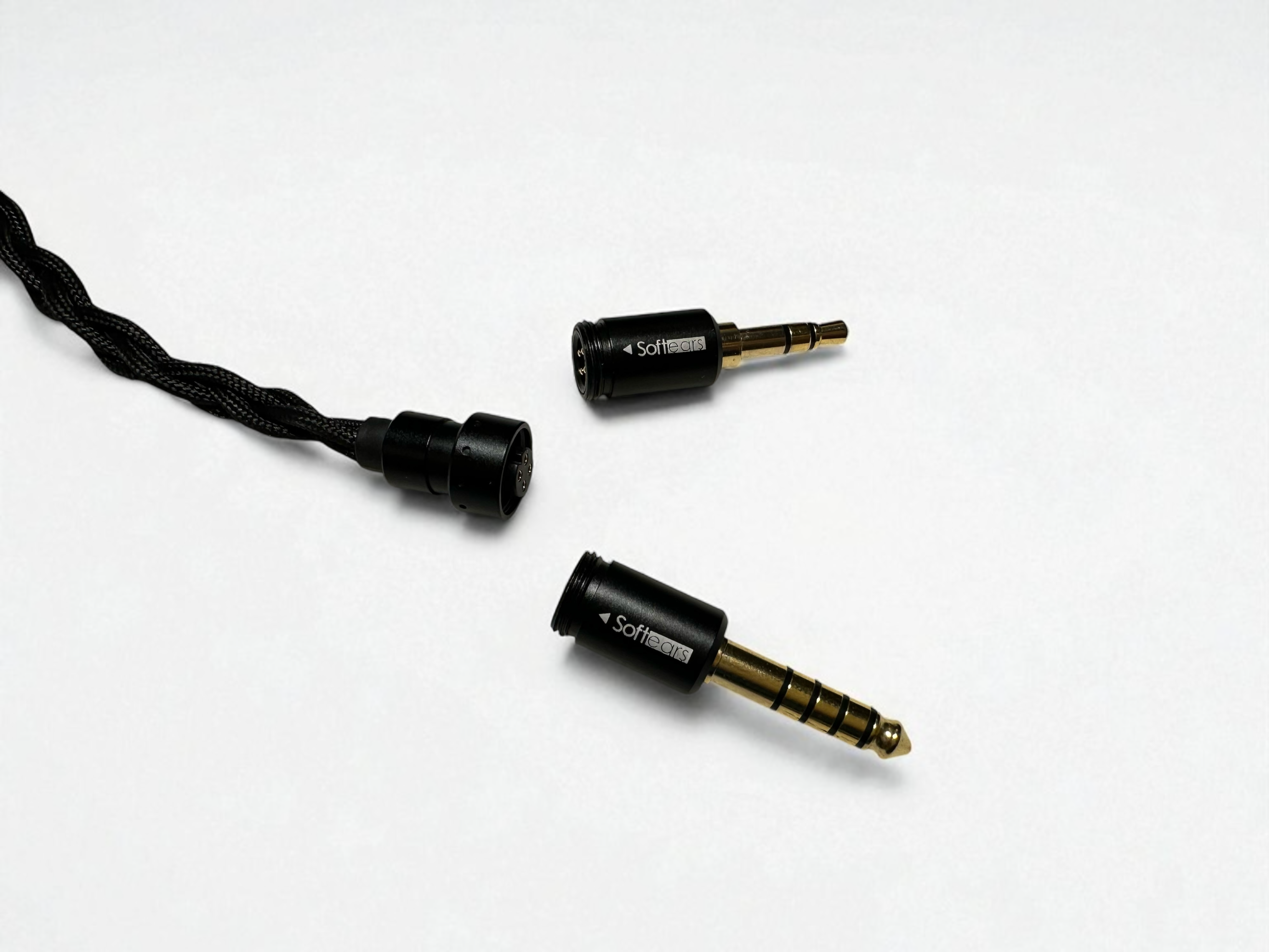
The accessories feel premium. The cable is soft, well-braided, and fairly low in microphonics for a cloth cable, though it’s still there. It has preformed ear hooks and a sturdy metal Y-split with chin slider. I really appreciate Softears offering it as a modular cable with both 3.5mm and 4.4mm jacks for convenience.
Design, Build & Fit.
Visually, the Volume S is striking. It has a matte black shell with a wonderful faceplate design that combine a metal with carbon fibre – fire sparkles design. The shell is medium-sized and ergonomically shaped. I found it very comfortable for long listening sessions. Isolation is quite good—slightly below custom-level sealing but enough for daily commuting or studio work. Build quality is excellent. The shell feels seamless, and the nozzle length ensures a secure seal without causing pressure points. Softears continues to show they know how to combine form and function.

Sound Analysis.
Drivability – The Volume S is very easy to drive. Even low-output dongles can bring out its clarity and resolution, though high-quality sources definitely enhance its dynamic contrast and stage layering.
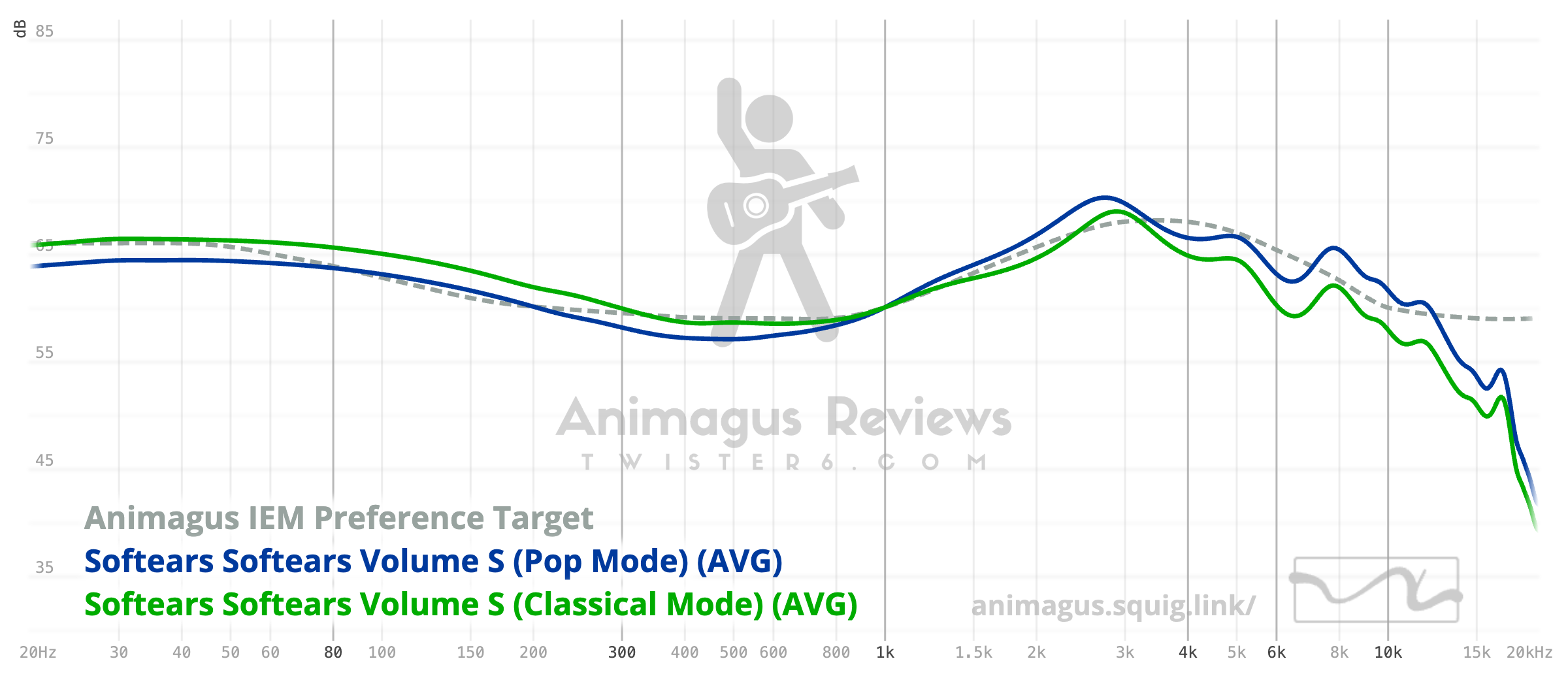
Summary – The Softears Volume S leans towards a sub-bass boosted neutral reference tuning, but it’s not sterile or flat – it adds emotional weight through tasteful sub-bass elevation and smooth upper-treble tuning. It sounds like a studio monitor with tasteful colour. The three-way crossover achieves an exceptionally coherent transition between the dynamic driver and the two balanced armatures. Phase alignment is perceptibly tight, resulting in a seamless presentation from low to high frequencies. It comes with a switch that allows for two different tunings – Classical Mode and Pop Mode. Classical Mode is a slightly warmer, mid-bass oriented tuning that goes for a very easy and musical reference sound signature while the Pop Mode is a slightly leaner and spankier take on reference signature. Both are well done and will please different audiences.

Let’s dig in deeper!
Bass – The Volume S delivers impressively clean and textured low-end. Rather than a mid-bass hump or overbearing warmth, it focuses on sub-bass extension, adding a tactile quality to the low-end without smearing the mids. Sub-bass is present, well-extended, and controlled. You feel it more than you hear it—perfect for adding emotional weight without clouding the soundstage. Mid-bass is linear and tight in Pop Mode and slightly forward and exciting in the Classical Mode. The finesse by which it is executed for the price contributes to the IEM’s clear sense of precision and cleanliness. Bass texture is excellent, something not expected in this price segment. On upright bass or low-frequency synths, you can sense the plucking of strings or granular decay of synth modulations, rather than just a “thud.” The Volume S renders the ominous sub-bass swell with physicality and restraint. There’s zero bloat, allowing the tension in the track to build without sounding muddy. While it won’t satisfy bassheads looking for slam and physical punch, the bass is audiophile-grade: articulate, deep, and fast.
Midrange – The midrange is arguably the Volume S’s most impressive trait. Vocals are perfectly placed and focused—neither recessed nor overly forward. There’s a slightly warm undertone to the lower mids in the Classical Mode, giving body to male vocals and acoustic instruments. But it never dips into muddiness or bloom. Upper mids are tastefully elevated to give clarity and intimacy to vocals and lead instruments, but not so much that they sound shouty. Female vocals come through with excellent resolution and natural tone. Instruments like guitars, strings, and pianos sound natural and textured. There’s a “studio monitor” level of midrange resolution, which makes the Volume S a reliable tool for referencing, mixing and critical listening in this price segment. For a BA-driven midrange, the naturalness is outstanding. There’s only the slightest BA timbre – a microscopic dryness in the note decay – that’s only noticeable in direct A/B comparison with full-DD sets.
Treble – Treble on the Volume S is refined and airy, with excellent upper extension and minimal peaks. There’s no aggressive 5–6kHz glare, no metallic sheen, and no splashiness. Instead, it offers natural decay, realistic cymbal transients, and a sense of “air” that opens up the soundstage. Trumpet overtones and cymbal brushes sound smooth but detailed, without veiling or harshness. The upper registers of the piano come through cleanly without sounding brittle. The treble avoids the pitfalls of analytical tunings—it’s detailed without being punishing. There’s no artificial sense of sparkle; instead, it’s the kind of treble you appreciate over time. Air region is nicely elevated, giving the IEM a sense of openness and resolving power. It doesn’t feel dark or rolled off like some “safe” tunings.
Technical Performance.
The stage is very clean and clear for its price segment, so much that it has now become my cheap EDC. The star here is the depth – foreground, mid-ground, and background elements are clearly layered. You don’t get “holographic” space like in a PMG APX IEM (of course, that’s $6000!!!), but the realism and dimensionality are top-notch for a hybrid in this price range. Imaging & Separation have pinpoint accuracy; instrumental placement is razor-sharp, especially in centre and lateral imaging. Background blackness helps make instruments stand out, especially in orchestral or jazz tracks. Macrodynamics are excellent – the Volume S can deliver impactful crescendos and percussive attacks. Microdynamics is one of its strongest suits – subtle volume gradations and expressive nuances in vocals are handled with finesse.
Comparisons.
Softears Volume.
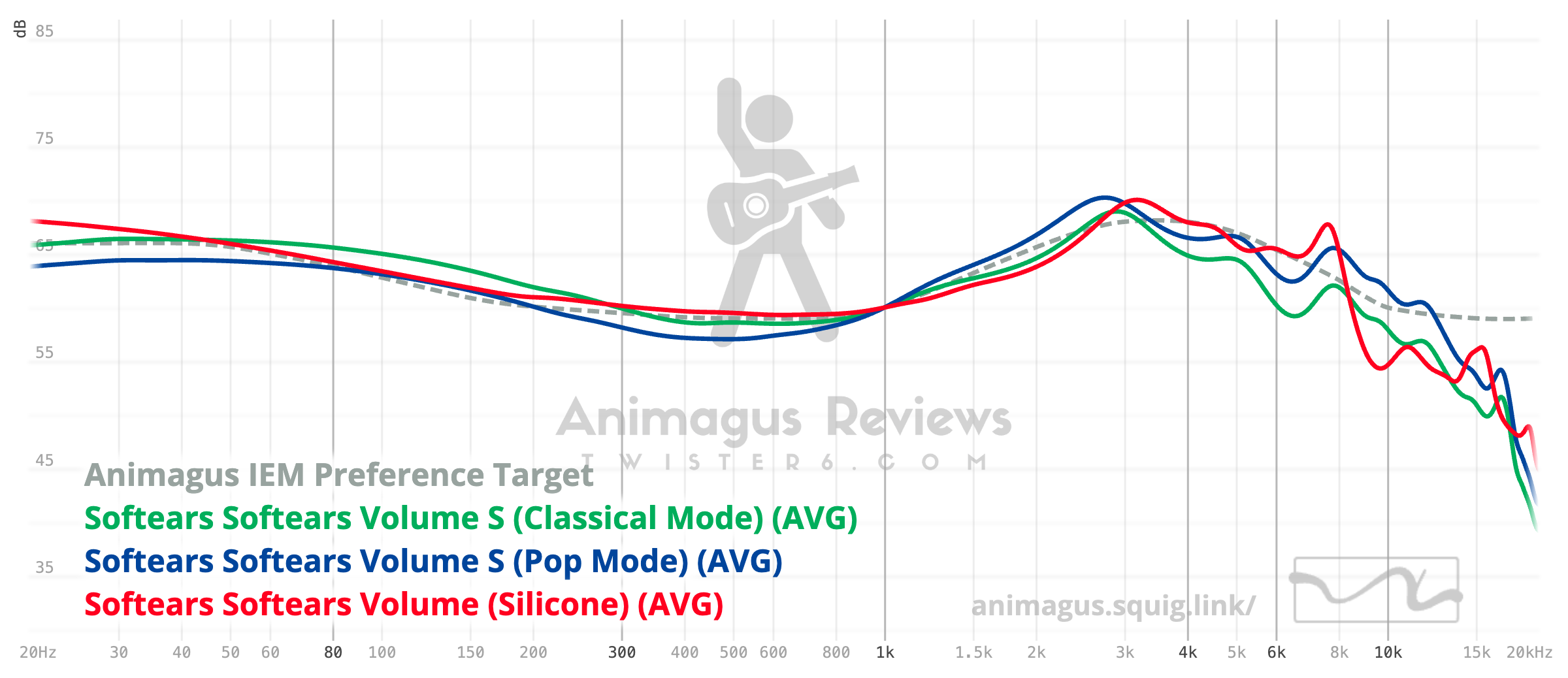
The first-generation Volume was a solid entry in its price class, aiming for a reference-style tonality with a mild V-shape, modest warmth, and smooth treble. It was appreciated for its easygoing character and natural timbre, but it lacked the technical bite and resolution. The Volume S, on the other hand, carries a clear step up in technical refinement and tonal balance. It dials back the warmth of the original and instead introduces a more focused contrasty sub-bass lift, giving it better low-end extension, cleaner bass lines, and improved separation between bass and lower mids. The dynamic driver in the S has superior control and texture – resulting in deeper, more layered bass that doesn’t bleed or smear.
In the midrange, the original Volume tended toward a warmer, slightly thicker presentation, which was forgiving but occasionally veiled or congested in dense arrangements. The Volume S opts for a cleaner, more open midrange with improved transparency and a more realistic presentation of vocals and acoustic instruments. Male vocals in particular benefit from the more linear transition from bass to mids, and female vocals gain presence without sharpness. Treble is one of the most significant differences: where the original Volume could sound a bit safe and overly smooth – almost dull at times – the Volume S introduces greater air, sparkle, and resolution, all while maintaining Softears’ trademark smoothness. It’s more extended up top, with better perceived detail and ambiance, but never veers into sibilance or harshness.
On the technical front, the Volume S clearly outclasses its predecessor. Soundstage depth is deeper, imaging is more precise, and dynamics—both micro and macro—are significantly more engaging. Where the original Volume had a somewhat two-dimensional stage with decent width but limited layering, the Volume S presents a far more three-dimensional soundscape with better instrument separation and blacker background. Even with complex genres like orchestral or progressive metal, the Volume S remains composed, whereas the original can blur under pressure. Build quality and shell ergonomics are also improved in the S model, with a sleeker, more premium design and a more comfortable fit for longer sessions.
In essence, the Volume S is not just a minor revision but a legitimate next-gen upgrade. It maintains the musicality and non-fatiguing nature of the original but raises the bar in clarity, balance, and technical performance. Where the original Volume was a pleasant and easy daily driver, the Volume S is a serious performer that bridges the gap between fun and fidelity. Listeners who enjoyed the tone of the original but wanted more resolution, control, and realism will find the Volume S a deeply satisfying evolution – and one that firmly establishes Softears as a force in the mid-tier IEM category.
Softears Studio 4.
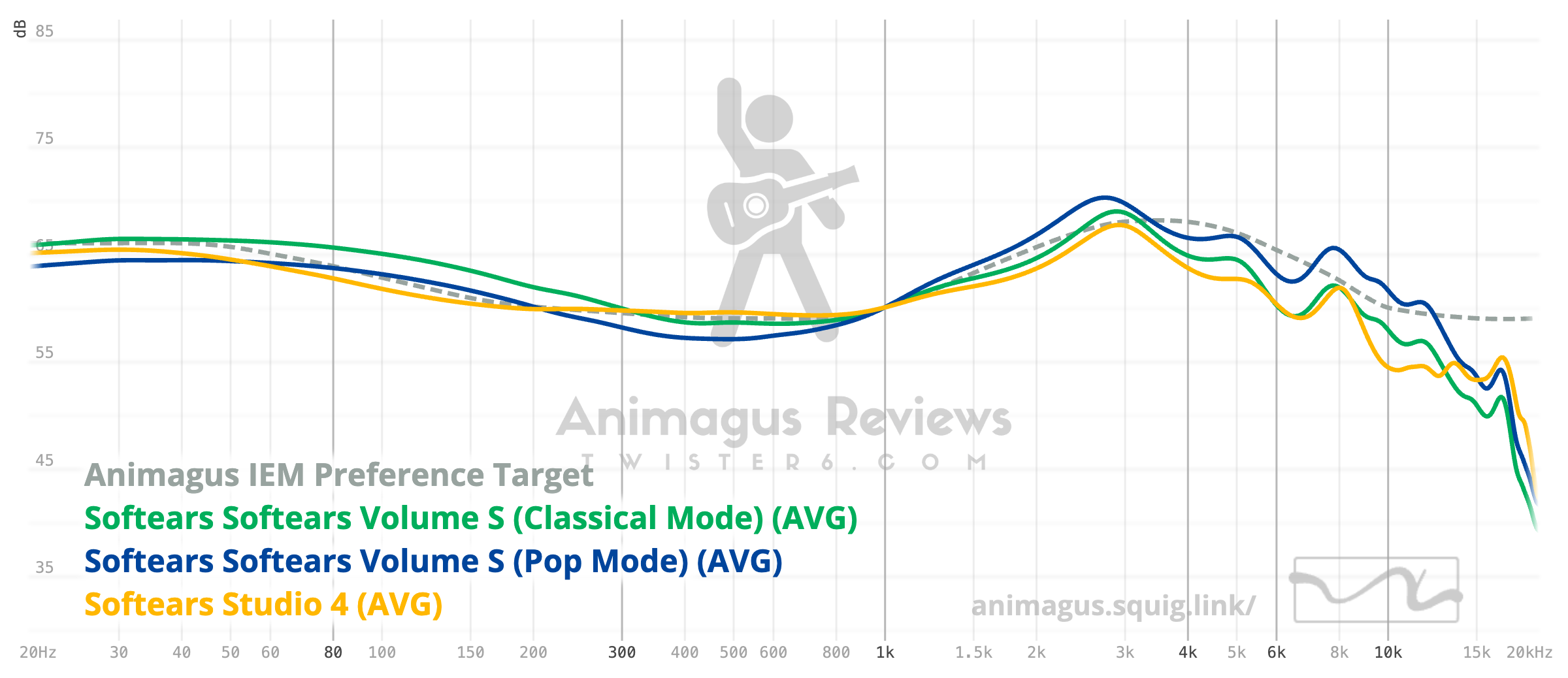
The comparison between Softears Volume S and Softears Studio 4 feels like a conversation between siblings with different personalities. The Studio 4 is tuned for pure reference—completely flat and linear, with a sound signature designed for mixing and studio monitoring. Its all-BA setup results in lightning-fast transients and impeccable tonal accuracy, especially in the midrange. However, this comes at the cost of musicality and dynamic expression. The bass on the Studio 4 is lean and dry, lacking physicality and sub-bass presence, which can make it feel underwhelming for casual music listening. In contrast, the Volume S retains that reference-level clarity while introducing a dynamic driver for bass, which brings more depth, texture, and emotional weight. The mids on both are clean and well-placed, but the Studio 4 can sound slightly cooler and more sterile, while the Volume S adds a subtle warmth that enhances naturalness. Treble on the Studio 4 is accurate but rather restrained, whereas the Volume S offers more air and sparkle without veering into artificial brightness. In terms of technical performance, the Studio 4 might edge out in raw neutrality and tonal honesty, but the Volume S provides better stage depth, microdynamics, and imaging realism. Both share excellent build and comfort, but the Volume S looks and feels more premium, with a shell design that better suits extended listening. Ultimately, the Studio 4 is a great tool for professionals, but the Volume S is the more versatile and emotionally engaging choice—retaining fidelity while enhancing enjoyment.
Tansio Mirai TSMR X.
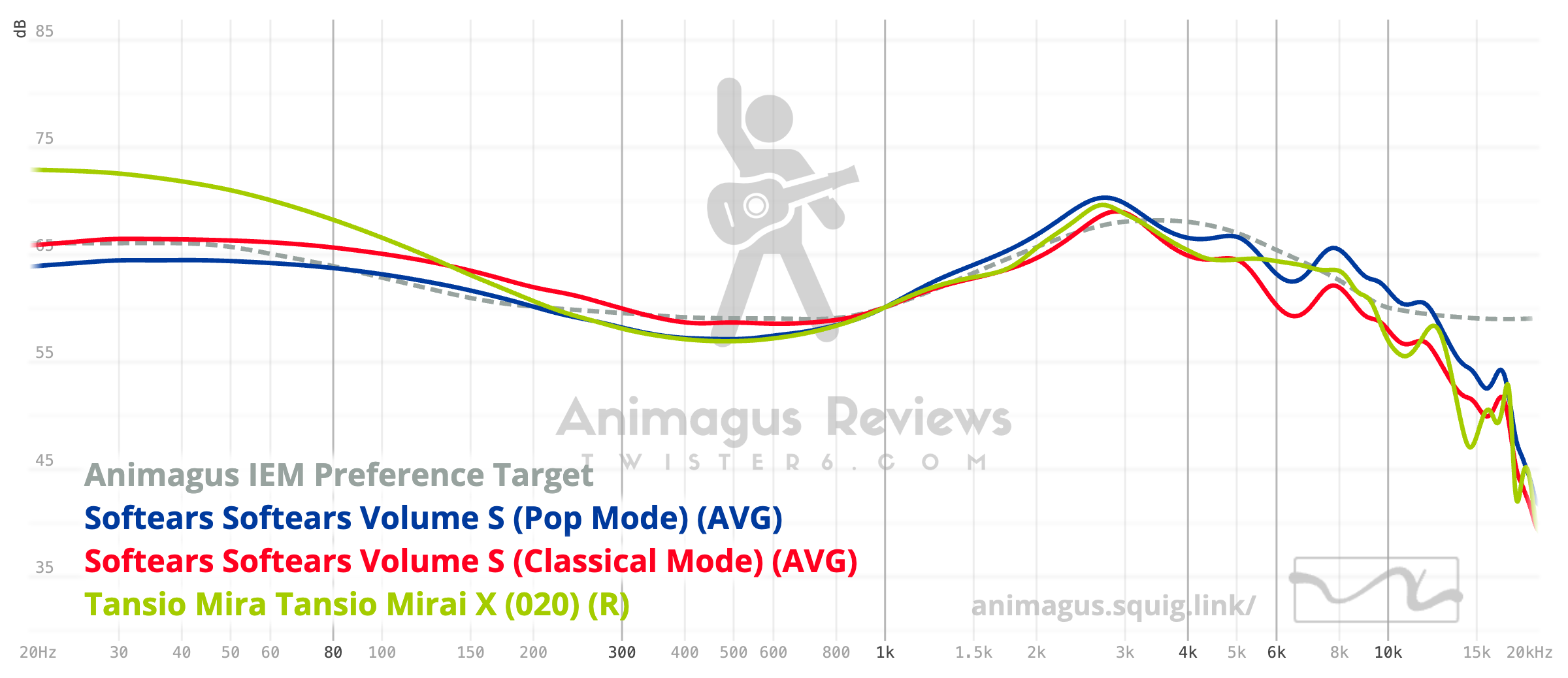
When comparing the Softears Volume S to the Tansio Mirai TSMR X, the differences in tuning philosophy immediately stand out. While the Volume S embraces a studio-monitor-inspired neutral tuning with a tasteful sub-bass lift, the TSMR X leans more toward a customizable V-shaped to U-shaped response, thanks to its 3-way tuning switches. In terms of bass, the TSMR X has more punch and mid-bass thump, giving it a more energetic low end. However, the Volume S delivers a tighter, more controlled bass with deeper sub-bass extension and cleaner separation from the mids. The midrange on the Volume S is more organic and naturally weighted, excelling in vocal and instrument clarity, whereas the TSMR X can occasionally feel recessed or slightly uneven in this region, depending on switch configuration. Treble on the TSMR X is brighter and sometimes fatiguing, while the Volume S maintains a smoother, more refined treble response that remains detailed but never harsh. Technically, the Volume S wins with its superior imaging, midrange layering, and dynamic contrast. Although the TSMR X offers more versatility through tuning, the Volume S’s coherence, timbral accuracy, and long-term comfort make it the more refined choice for serious listening.
BGVP DMA.
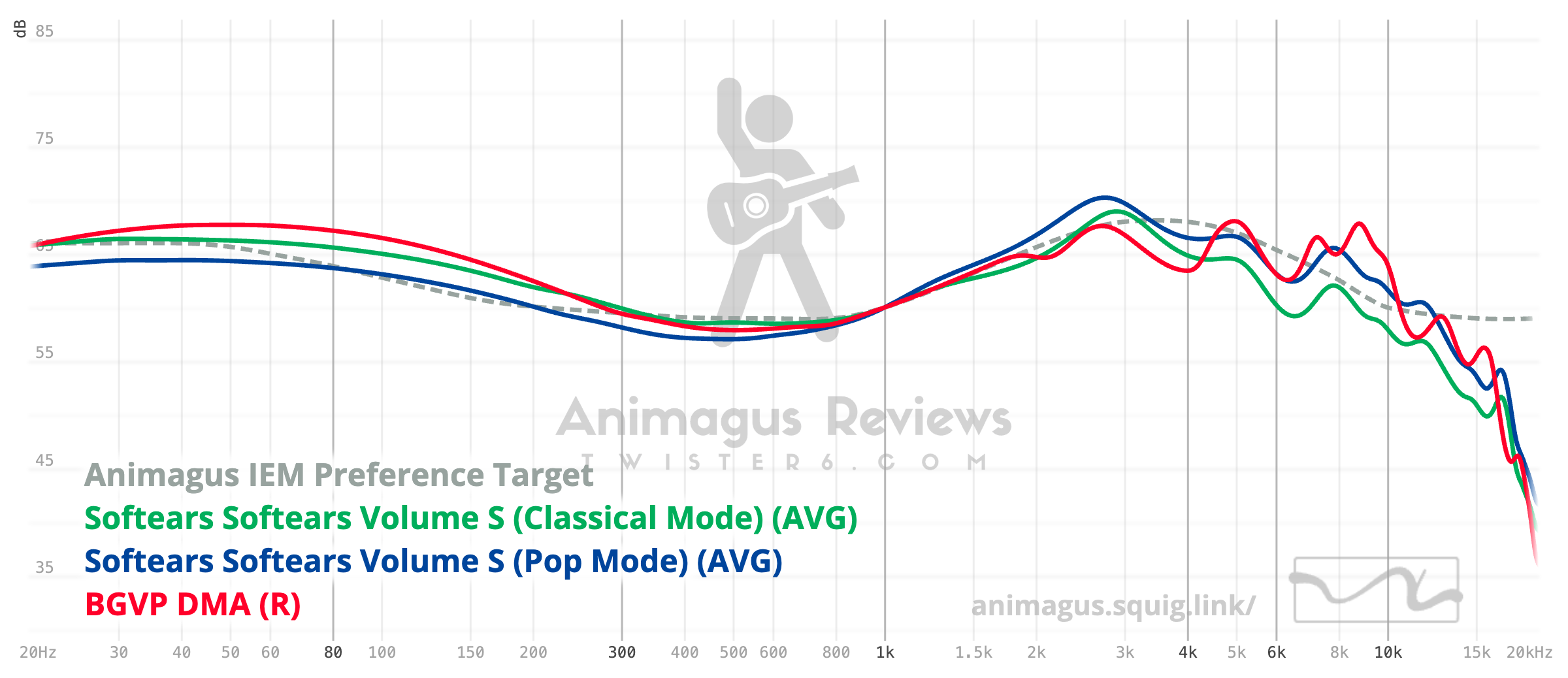
Against the BGVP DMA, the Volume S shows its strength in maturity and tonal refinement. The DMA, being a tribrid with dynamic, BA, and EST drivers, leans towards an attention-grabbing U-shaped tuning with sparkly highs and a wide-open soundstage. It offers greater perceived air and top-end extension due to the ESTs, but that sparkle can sometimes sound forced or artificial. Treble textures may come across as dry or peaky, especially with brighter recordings. The Volume S, in contrast, uses its dual BAs to deliver a smoother, more coherent treble that’s both extended and free of grain. Bass performance between the two also differs significantly: the DMA has more quantity and slam in the mid-bass, but lacks the sub-bass reach and dynamic texture of the Volume S. Mids on the DMA are more recessed and colder in tone, whereas the Volume S keeps vocals front and center with better body and realism. While the DMA impresses with a more expansive soundstage and engaging presence at first listen, the Volume S proves to be more technically refined, with greater control, better instrument separation, and more accurate timbre. Fit and comfort also favor the Volume S, which has a more ergonomic shell, while the DMA’s bulkier design and less optimal nozzle angle may be problematic for smaller ears.
Final Thoughts.
Softears Volume S walks a fine line between monitor-like precision and musicality, and it does so with grace. It delivers on its promise: a clean, coherent sound with emotional engagement and just the right amount of bass flavor. It’s a fantastic option for those who want clarity and resolution without the fatigue that often accompanies ultra-detailed IEMs. Whether you’re a producer needing an honest reference or a casual listener looking for balanced hi-fi, the Volume S is a compelling choice. With a modular cable and two tunings options as a big win, Volume S is one of the best you can buy at its price point, it not the best (as subjective choices come into play)!

 Twister6 Reviews