
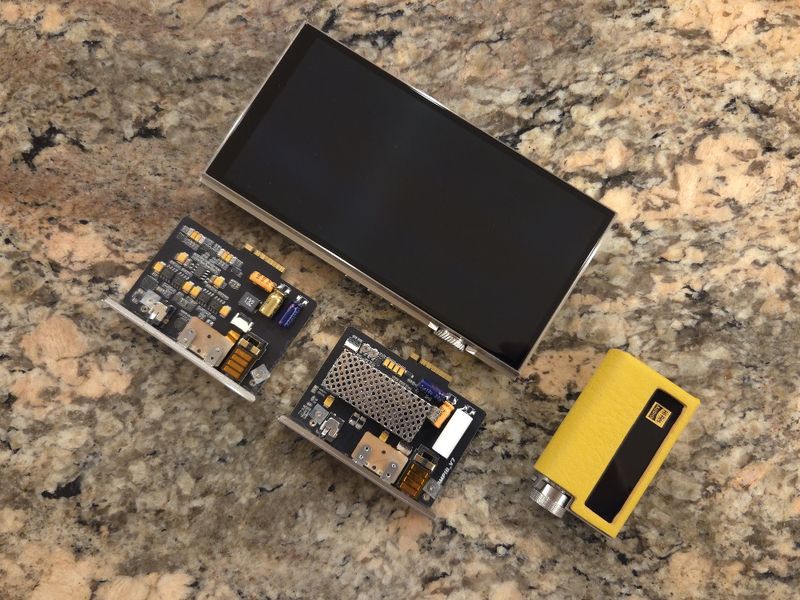
Sound Analysis.
The sound analysis of the DX340 w/AMP16 and Nunchaku was done using various IEMs and headphones listed in the pair-up section of the review, while playing a selection of test tracks such as Agnes Obel’s “The Curse,” Sandro Cavazza’s “So Much Better” (Avicii remix), C-Bool’s “Never Go Away,” Ed Sheeran’s “Shape of You,” Alan Walker’s “Darkside,” Ariana Grande’s “Break Up With Your Girlfriend,” Galantis’s “Hunter,” Iggy Azalea’s “Black Widow,” Indila’s “Boite en Argent,” Dua Lipa’s “Love Again,” Counting Crows’ “Big Yellow Taxi,” David Elias’s “Vision of Her,” and Michael Jackson’s “Dirty Diana.” I had at least 100 hours of burn-in time on both devices before I began my analysis.
I prefer to describe the DAP/source sound by comparing it to other DAPs/sources and pairing it with different IEMs/headphones since the DAP itself doesn’t have a distinct sound. We perceive how it sounds through connected IEMs/headphones or the differences in sound relative to source comparisons using the same pair of IEMs/headphones. This is my subjective opinion, based on how I hear it while analyzing and comparing the sound of the DX340/AMP16 and Nunchaku, and you will gain a better understanding of these sources’ sound in the following sections on Comparison and Pair-ups with specific headphones and IEMs.
The first and most noticeable sound analysis observation was a tonal difference between Class AB (solid-state) and Tube (dual-Raytheon) modes. As I have mentioned before, in my experience with NuTube DAPs, I find those to provide a tonal enhancement between the modes with less drastic sound changes. Even some other DAPs with Raytheon tubes emphasize the tubes more to make them stand out. Here, both modes stand out with impressive sound performance.
The AB mode delivers a clear, detailed, dynamic, faster sound while offering a natural, neutral, and balanced tonality with less coloring in the mids. The bass in AB mode features a faster, snappier mid-bass punch and more transparency in the mids. When switching to tubes, you can hear more warmth in the sound, especially a smooth texture in the mids. The sound becomes more relaxed and laid-back with tubes, characterized by a rounded and slower mid-bass punch and a more organic texture in the mids. Despite these changes, the treble sparkle remained very similar in both modes, which helps to maintain a similar resolution and retrieval of details without too many compromises.
I was also impressed by the rich black background, especially in AB mode. With sensitive IEMs, I found the most optimal performance is to keep the DAC gain high, which maintains the max voltage, and to lower the AMP gain, which cuts down the floor noise. There was no interference in tube mode while streaming with sensitive IEMs. Of course, my testing is based on a selection of a handful of IEMs, and performance could vary from one pair to another. Still, amp-gain adjustment is all you need when navigating between normal and higher sensitivity, lower impedance IEMs.
The soundstage expansion was relatively wide, while the imaging and sound placement varied based on the earphone or headphone pairing, sometimes being more center-focused and at other times more holographic. This remained true in both AB and Tube modes, which I found impressive considering the smoother nature of Tube mode. The AMP16 does not attempt to exaggerate the width of the sound or the sound placement. Instead, I found it to remain close to the original technical performance of each IEM and the headphones I tested it with.
Switching between AB and Tube modes through the menu is very convenient without switching between the modules. This makes it more useful than switching between a NuTube amp module, like AMP14, and another solid-state amp module.
3.5mm vs 4.4mm
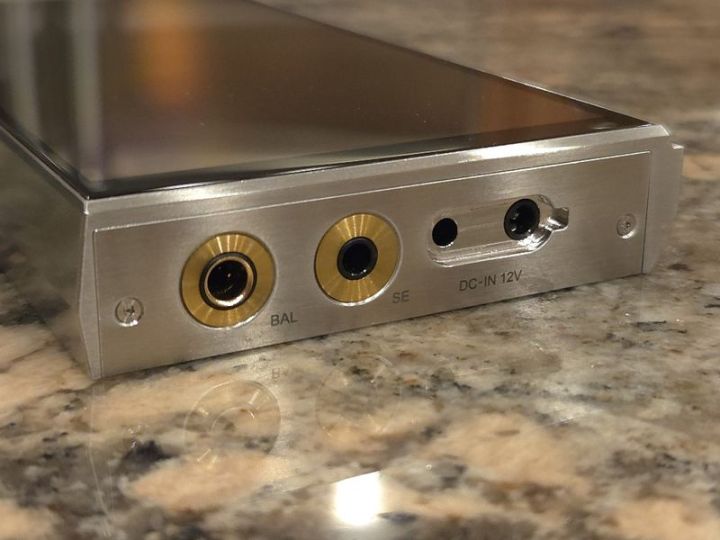
Aside from the SE’s slightly narrower soundstage and less power, I found the tonality identical. BAL 4.4mm output is usually my preferred choice.
DC-in (Super Gain)
The external 12V DC-in, compared to its internal battery, boosts the amp-card output power with the corresponding voltage change from 6.23Vrms (batt) to 8.3Vrms (DC-in).
Right away, I noticed a bigger/wider soundstage expansion, and it was quite noticeable how much wider the sound spreads left to right. While focusing on the tonality, the mids and treble remained the same, but the bass changed. The sub-bass and mid-bass sounds slightly more elevated with a deeper, more textured rumble and stronger, punchier mid-bass. The change in bass makes the sound pace faster and snappier, improving the perception of an even blacker background and vertical dynamics of the sound. The soundstage and bass improvement here were more noticeable.
DX340/AMP16 vs Nunchaku.
An important thing to note is that we are not discussing an apples-to-apples comparison. They both have a similar Solid-State Class AB and dual Raytheon tube implementation. However, even though they share the same amp design and architecture, the sound will not be the same because of the difference in their corresponding DACs. Nunchaku uses CS43198 brighter tonality DACs, while DX340 uses a natural tonality discrete 1-bit DAC. There is also a difference in the output power, where under the same gain, I had to push the Nunchaku volume to 58, while DX340/AMP16 without any external power boost needed about 31 volume clicks. With bigger real estate, AMP16 tube isolation is more robust, having hardly any ringing when inserting earphones/headphones or taping DAP’s chassis, and less hissing with sensitive IEMs. With Nunchaku in tube mode, when inserting IEMs or taping on the dongle, I heard a loud ringing that faded away, and with sensitive IEMs, some waterfall hissing was noticeable even in low gain.
Class AB comparison – The perception of Nunchaku soundstage expansion is a bit wider than DX340/AMP16. Also, Nunchaku mids are slightly less colored, more transparent, revealing, and have more sparkle in treble. In comparison, DX340/AMP16 mids have a fuller body, more textured lower mids, and less sparkle in treble. A smoother tuning of DX340/AMP16 creates the perception of a slightly narrower and more intimate soundstage.
Tube comparison – In both cases, Tubes soften the mid-bass punch with slightly slower attack and longer note decay, add more texture and smoothness to the mids, and give vocals and instruments more organic musical tonality. DX340/AMP16 still has a more intimate soundstage expansion and less sparkle in the treble. Also, similar to their Class AB comparison, AMP16 has more coloring in the mids than Nunchaku.
Both devices produce similar natural organic sound characteristics in the mids, even in solid-state AB mode. As a sidenote, Nunchaku’s dual CS43198 DACs in AB mode sound more natural and smoother than DC07Pro with its quad CS43131 DACs. As I mentioned, the baseline sound usually comes from the DAC and is then colored by the amp, so don’t expect an identical performance between AMP16 and Nunchaku here. Another thing I noticed in DX340/AMP16 was that switching between AB and tubes had a more noticeable effect on the sound change than doing the same with Nunchaku. With Nunchaku, it felt more like a fine-tuning sound difference, while with DX340, it felt like a more noticeable sound sig change.
Page 3 – Comparisons.
Page 4 – Pair-ups, iBasso KLEE, and Conclusion.

 Twister6 Reviews