
A Deal with a Devil?
PROS: balanced W-shaped tuning, clear, revealing tonality, fast, punchy bass, transparent, layered, detailed mids, and crystal-clear non-fatigue energetic treble, big soundstage expansion, beautiful faceplate design, brand-name Eletech cable, and premium packaging.
CONS: sound dependency on source and cable pair-ups, especially when it comes to treble; the teased “temptation” of the upgrade cable.
The product was provided to me free of charge for review purposes in exchange for my honest opinion.
Manufacturer website: Forte Ears. Available for sale from authorized retailers like Musicteck, with a stock cable or in a Tour de Force package bundle with a Temptation cable.
Intro.
Forte Ears Macbeth was a 2024 newcomer, introduced at CanJam NYC ’24 as a “Romeo” prototype, and was ultimately crowned with one of the Watercooler awards of the year (2024) at the CanJam NYC ’25 show early this year. The company was founded by Riccardo Yeh, a former International Sales Director at HIFIMAN, who later assumed the marketing position at Eletech. He then decided to combine his love for Western opera and his passion for music into his own IEM brand, Forte Ears. The Macbeth featured an exclusive “Diablo” customized bass driver (from Sonion). Still, some audio purists who prefer DD bass drivers have been asking Riccardo to consider enhancing the bass in his next Forte Ears release. Their prayers have been answered at the Forte Ears table during the CanJam NYC ’25 with the prototype named “Faust”, teased as the next Forte Ears’ release.
Just as Macbeth and its “Romeo” prototype had a Shakespearean connection, the “Faust” name made sense when Riccardo announced the next Forte Ears release: Mefisto, with a connection inspired by C. Gounod’s Faust and A. Boito’s Mefistofele. The corresponding opera follows the story of Faust, who makes a deal with the devil, Mefistofele, for eternal youth and knowledge. As a side note, I never imagined that reviewing cables (from Eletech and EA) and IEMs (from Forte Ears) could be such an educational experience, allowing me to learn more about Greek mythology, the Renaissance, the Shakespearean period, and Italian operas. Nevertheless, I was pretty impressed with the tuning of “Faust” during CanJam NYC ’25 and looked forward to spending more time with Mefisto. Here is what I found after a month of testing this sophomore release from Forte Ears.
Unboxing and Accessories.
Similar to MB, Mefisto also features an exciting Theatrical unboxing experience. The engaging artwork of the Mefisto exterior sleeve, both front and back, is something you wouldn’t mind showcasing on a bookshelf at home for everybody to see. Under the sleeve cover, the artwork extravaganza continues, leading you to 2 “doors” to explore what’s inside.


Once the cover flaps are open, in the bottom half, you will find a “Grand Imperial Opera House presents” plexiglass insert, like a ticket, which includes individual product numbering. However, mine had D04 – Demo #4, which was made specifically for review purposes. Under the plexiglass is a premium custom leather case stamped with the Mefisto name, measuring 4” x 6” and providing plenty of room to store IEMs, eartips, and possibly a USB DAC dongle or an extra cable. Under the case, there was a small plexiglass insert with Mefisto-themed artwork and new premium Baroque Stage silicone eartips (S/M/L).
The Baroque Stage is the newly updated version of the original Eletech Baroque eartips. These new eartips utilize a different silicone material, which is more grippy. It appears that the L-size of these new Stage eartips falls somewhere between the size of the cap of the original L and XL. I also noticed how the stem of the new eartips is firmer and tighter, fitting more securely around the nozzle. The new Stage eartip caps are also a little less springy.


The top half of the box featured a Mefisto-themed cleaning cloth, covering foam cutouts for the secure storage of the stock Eletech cable and Mefisto IEMs in separate pockets. The unboxing experience here is very satisfying and appropriate for a premium product. Additionally, it’s worth noting that, despite Mefisto being noticeably cheaper than Macbeth, no corners were cut in terms of packaging or accessories.


Cable.
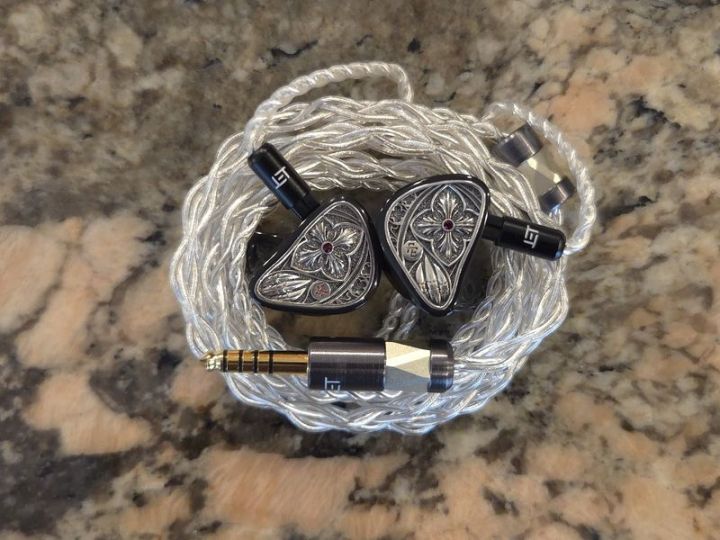
As probably expected, Mefisto also comes with a stock Eletech cable, just like Macbeth. Instead of a premium OCC Copper Litz cable (Macbeth), we have a premium hybrid blend of Silver, Silver-Plated Copper, and Copper wires. According to Forte Ears’ specifications, this cable features a 4-wire design, with each conductor using 25AWG gauge wire. Eletech wires are usually cryogenically treated and use individually enameled strands. It also features a signature FlexiMax insulation with a transparent, soft jacket, allowing the silver finish to remain in clear view.
Additionally, a clear ear hook heat shrink mold is located adjacent to the IEM connectors. The cable is very soft, lightweight, and flexible, and exhibits no microphonics. It also features customized Eletech-branded metal hardware with a matching design of the 4.4mm plug housing and Y-split, as well as compact 2-pin connectors, although there is no chin slider. The cable hardware was the same as that used in Macbeth’s stock copper cable.
Also, similar to Macbeth and its premium bespoke Ambition cable upgrade, Forte Ears offers a special premium design Eletech Temptation cable, a bespoke triple alloy configuration with Gold, Silver, and Copper wires. Forte Ears demoed that cable at the CanJam NYC ’25 show, along with the “Faust” prototype. If I have the opportunity to test this cable with my review sample of Mefisto, I will update my review with impressions on how it compares to the stock cable. The Temptation cable alone costs as much as Mefisto itself, $2.9k. However, for those who opt to purchase it in a bundle with Mefisto, Forte Ears offers a Tour de Force package for $5k that includes both Mefisto and Temptation, as well as a limited-edition “Mefistofele” custom collectible figurine designed by Neufcats, one of Singapore’s well-known independent toy art studios.


Design.
The Mefisto tribrid design utilizes 7 drivers, including a 4-way crossover, which is part of the Forte Circuit Relay (FCR) that uses vintage Japanese inductors. These drivers are partitioned into dual 7.8mm new-gen Liquid Crystal Polymer (LCP) Dynamic Drivers, enclosed in a D.I.S. (diabolic isolation system) comprised of a sealed chamber with an improved isobaric (push-pull) configuration to cover the lows. The mids are covered by 4 Balanced Armature (BAs) drivers. The highs are covered by an in-house developed nano-diaphragm planar magnetic driver (PMD) tweeter. Named as “ARIA”, this PMD driver is not off-the-shelf, and was custom-engineered and explicitly tuned for Mefisto. The internal shell Acoustic Resonance Chamber (ARC) was also custom-designed to enhance and optimize the sonic characteristics of drivers inside. The IEM has an average impedance of 5.6 ohms and a sensitivity of 105 dB, making it easy to drive with a hiss-free performance.


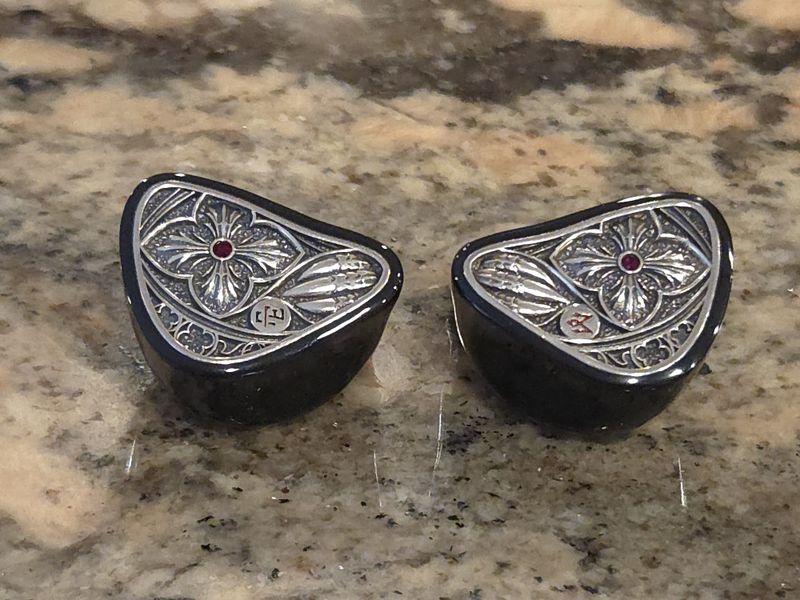
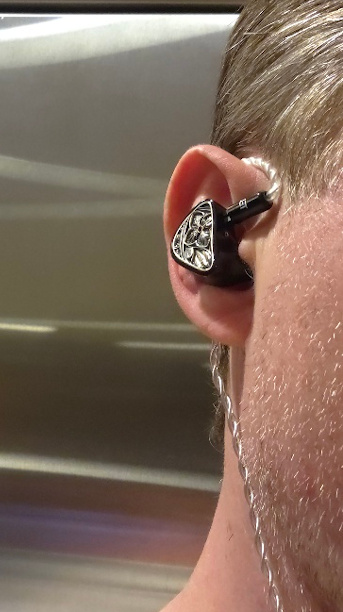
Similar to Macbeth, Mefisto’s 3D-printed black resin shells offer excellent ergonomics, providing a very comfortable fit that I enjoyed during extended listening sessions. The shape of the shells is nearly identical to Macbeth’s as well. I think Mefisto faceplates are rhodium-plated, with a beautifully themed artwork design; however, they are less flashy than a colorful Macbeth. The faceplate design has a subtle difference, with an “M” logo on the left shell and “FE” on the right. The shell features flush-mounted 2-pin connectors, with one metal-plated vent adjacent to the socket. There is no 2nd vent like the one found in Macbeth, and there were no complaints from my wife when I was listening to these in bed. Mefisto offers better passive sound and noise isolation, with no leakage. Nearly identical to Macbeth, the inner part of the shell has a custom-like profile fitting perfectly into my ears. The nozzle, featuring a custom metal mesh cover, is neither too long nor too short, with an average length that provides a comfortable angle, fitting perfectly in my ear canal without any pressure or discomfort.


The fit.
Page 2 – Sound Analysis, Eartips selection, and Cable pair up.
Page 3 – Comparison, Source Pair up, and Conclusion.

 Twister6 Reviews