
Sound Analysis.
I analyzed Mefisto sound performance paired up with L&P P6 Pro while playing a variety of test tracks, such as Agnes Obel’s “The Curse”, Sandro Cavazza’s “So much Better” (Avicii remix), C-Bool’s “Never Go away”, Ed Sheeran “Shape of you”, Alan Walker “Darkside”, Galantis “Hunter”, Iggy Azalea “Black widow”, Indila “Boite en argent”, Dua Lipa “Love Again”, Counting Crows “Big yellow taxi”, Bob Marley “Jamming”, David Elias “Vision of her”, and Michael Jackson “Dirty Diana”. By force of habit and manufacturer’s suggestion, I had Mefisto on burn-in for at least 150 hours before I started to collect my impressions. I was using a stock Eletech cable and Baroque XL eartips.
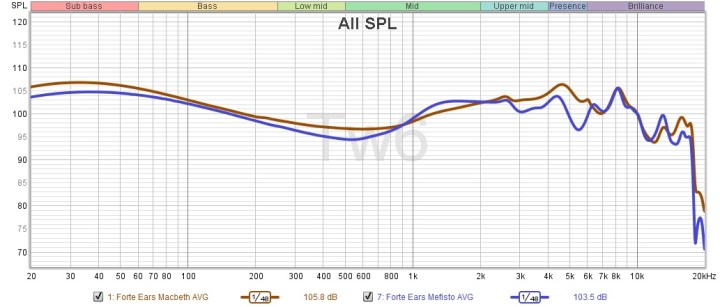
To describe the tuning of Mefisto, I decided to analyze its sound while comparing it to Macbeth (MB).
Starting with a soundstage expansion, they both have a similar rounded soundstage shape, expanding wide, deep-ish, and tall. However, with dual Sonion BCDs, MB imaging feels more holographic, based on how the sound is positioned in space, compared to Mefisto, which has slightly more center-focused imaging. The sound signature of both is balanced, with a clear, detailed sound, but the tonality does vary. MB has a smoother tonality, especially in mids, with its fuller body making it even a bit warmer and slightly laidback relative to Mefisto. On the other hand, Mefisto’s tonality is more revealing, transparent, “cleaner”, and with an extra treble zing. As a result, Mefisto is more energetic, dynamic, and faster, including the improved layering and sound separation.
When it comes to the bass, despite MB having a BA bass driver, it still generates as much weight and rumble, maybe even more sub-bass weight, as Mefisto’s dual DD driver. However, with MB, you hear the bass, while with Mefisto, you can feel it. MB’s Diablo BA bass driver is very powerful, no question about it. However, the BA bass driver of the MB provides low-end power without the dynamic driver bloom. Ironically, MB’s Diablo/BA bass driver shares many characteristics with the DD driver, such as texture and rumble. On the other hand, Mefisto’s dual LCP DD driver exhibits trends similar to those of BA drivers, such as faster speed, better articulation, and more control, which results in snappier note decay. Mefisto bass stands out with a typical DD bloom and air movement that allows you to hear and feel the bass, along with a BA speed to make it fast and articulate. It’s not a basshead-tuned IEM, but the bass offers plenty of authority with a deep rumble.
While MB’s mids are clean and clear, they do have fuller body in the lower mids, pushing them slightly north of neutral, as I mentioned in my MB review. Mefisto’s lower mids are more neutral, creating a cleaner separation between the bass and the mids, which expands the sound dynamics and improves the control of bass notes, especially the note decay. Mefisto’s upper mids are very clean, clear, detailed, layered, and slightly more forward in presentation, being more revealing and transparent when compared to the MB. One interesting observation here is that Mefisto’s pinna gain starts earlier, around 1 kHz, instead of the typical 2 kHz, which brings more clarity to the vocals and instruments.
Mefisto treble is crystal clear and has a well-defined, well-controlled non-fatigue PMD driver zing, which is more accentuated due to a slight dip between the lower and mid-treble. I’m sensitive to and usually complain about mid-treble crunch, but had no issues with Mefisto during extended listening sessions. I want to add that the treble did exhibit some graininess during the first 100 hours of burn-in, but it disappeared afterwards. And I’m not talking about the brain burn-in because I was constantly switching between Mefisto, MB, and other IEMs. What I found interesting in MB is that the treble stood out a bit more due to a smoother tonality of the mids, which created more contrast with mid-treble sparkle, to the point where I preferred listening to MB at a slightly lower volume. In Mefisto, mids are more revealing and forward, which creates the effect of less contrast with its sparkly treble. But Mefisto’s treble itself is more energetic, with more zing and crunch.
As mentioned at the beginning of the sound description, both have a relatively balanced sound tuning. However, due to its punchier bass, more forward mids, and extra treble energy, I find Mefisto to have a sharper W-shaped sound signature in comparison to MB, thanks to Mefisto’s added definition in lows, mids, and highs. Also, similar to MB, to my ears, Mefisto works fine with every music genre. Still, I find it to excel more than MB with electronic music, EDM, Top 40, and Pop, keeping up better with the faster pace of the rhythm and dynamic changes in sound, and picking up more micro-detailed nuances.
Eartips Selection.
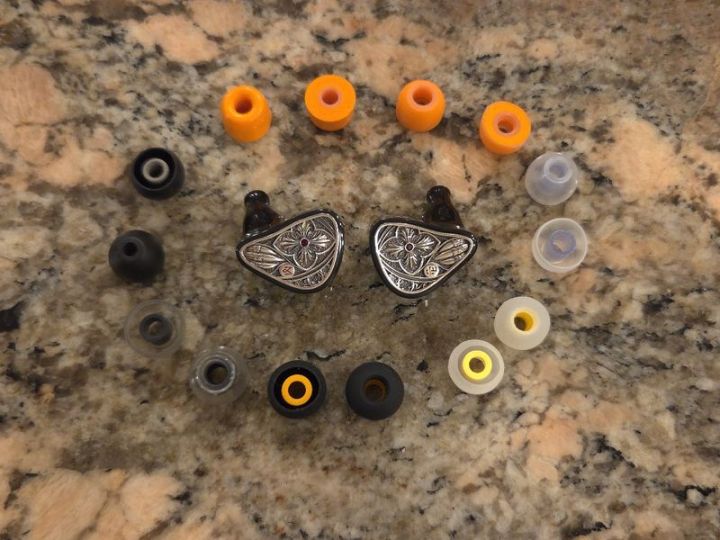
The selection of eartips is crucial for any universal in-ear monitor and will significantly affect the sound, particularly the bass impact, depending on the seal. Due to a large opening in my ear canals, I usually opt for the largest eartips to achieve a better seal. Also, please keep in mind that eartips impressions are subjective and will be based on the anatomy of your ears. My suggestion is to build up your eartips collection and try each one with every new IEM you get to find the pair that yields a perfect sound for your ears.
Eletech Baroque – baseline sound with balanced W-shaped tuning, clear revealing tonality, fast punchy bass, transparent, layered, detailed mids, and crystal-clear non-fatigue treble.
Eletech Baroque Stage (stock) – made the treble a bit brighter, although I need to keep in mind that I’m using an XL-size Baroque versus an L-size Stage. Perhaps, XL makes a slightly better seal.
Azla Crystal – achieved a sound similar to Baroque, but with a bit more body in the lower mids.
Final Type-E – had to set it aside due to the treble being harsh.
SpinFit W1 – here as well, treble was a bit harsher.
Symbio W – similar to above, treble is a bit harsher.
Symbio F – I like how the treble is a bit smoother here, but the soundstage got a bit narrower as well. So, I’m on the fence with these.
Relative to the anatomy of my ears, the original Baroque and Azla Crystal were my favorite eartips with Mefisto.
Cable pair up.
I’m aware that some people are skeptical about the contribution of cable to the audio chain. It’s not my intent to start an argument here. Instead, I would like to share what I hear during my testing. What makes sense to me is that a metal wire is a material with physical properties of resistivity, conductivity, and purity, all of which act as a filter between your source and earphones. Variations in these physical properties can affect the conductivity of an analog signal, resulting in a change in sound that ranges from subtle to more noticeable levels. If discussing cables bothers you, please skip this section. Otherwise, enjoy these short impressions.
Eletech stock Macbeth (copper) cable – I was curious how Macbeth stock copper cable sounds with Mefisto, and found this pair up to be not that great. The soundstage became slightly narrower, and the mids were somewhat thicker, particularly in the lower mids. Especially with mids, vocals lost some of the clarity.
Eletech Aristotle (copper) vs Eletech Euclid (silver with gold) – Euclid is very close to stock cable, just with a touch more body in the mids. At the same time, Aristotle adds a bit more rumble to the sub-bass, making the bass a bit slower, and extra sparkle to the treble.
Eletech Sonnet of Adam – this cable pushes mids a bit more forward and adds more crunch and sparkle to the treble.
Eletech Ode to Laura – here, bass gains more rumble, but remains fast, punchy, articulate; mids gained a little more body, and at the same time, treble gained more crunch and sparkle. The imaging is more holographic.

LL Venom – mids are more revealing, and treble has more crunch and sparkle. The imaging is more holographic.
PWA FT – bass gains a little more weight in sub-bass, mids gain a bit more body, and I hear a bit more sparkle in treble.
HanSound Quentin – The bass gains more weight and rumble in the sub-bass, while the lower mids gain more body. The treble becomes a bit smoother, and it also gains a bit more airiness. This cable is a good option for those who want to tame down Mefisto’s upper frequencies.
HanSound Kunpeng – mids are more revealing, and treble has more crunch and sparkle, very similar to Venom, including more holographic imaging.
I haven’t yet heard the Temptation cable with the final production version of Mefisto, and will update my review as soon as I get a chance to test it. Furthermore, I always encourage my readers to experiment with different cable pairings and maintain realistic expectations about the diminishing returns as you go up in price. The manufacturer invests a significant amount of time and effort in tuning their IEMs using a stock cable. An upgrade cable can offer fine-tuning, rather than a drastic EQ-like change. Then, it will be up to you to decide whether fine-tuning or side-tuning to perfect the sound is worth the additional investment in a cable upgrade.


 Twister6 Reviews