
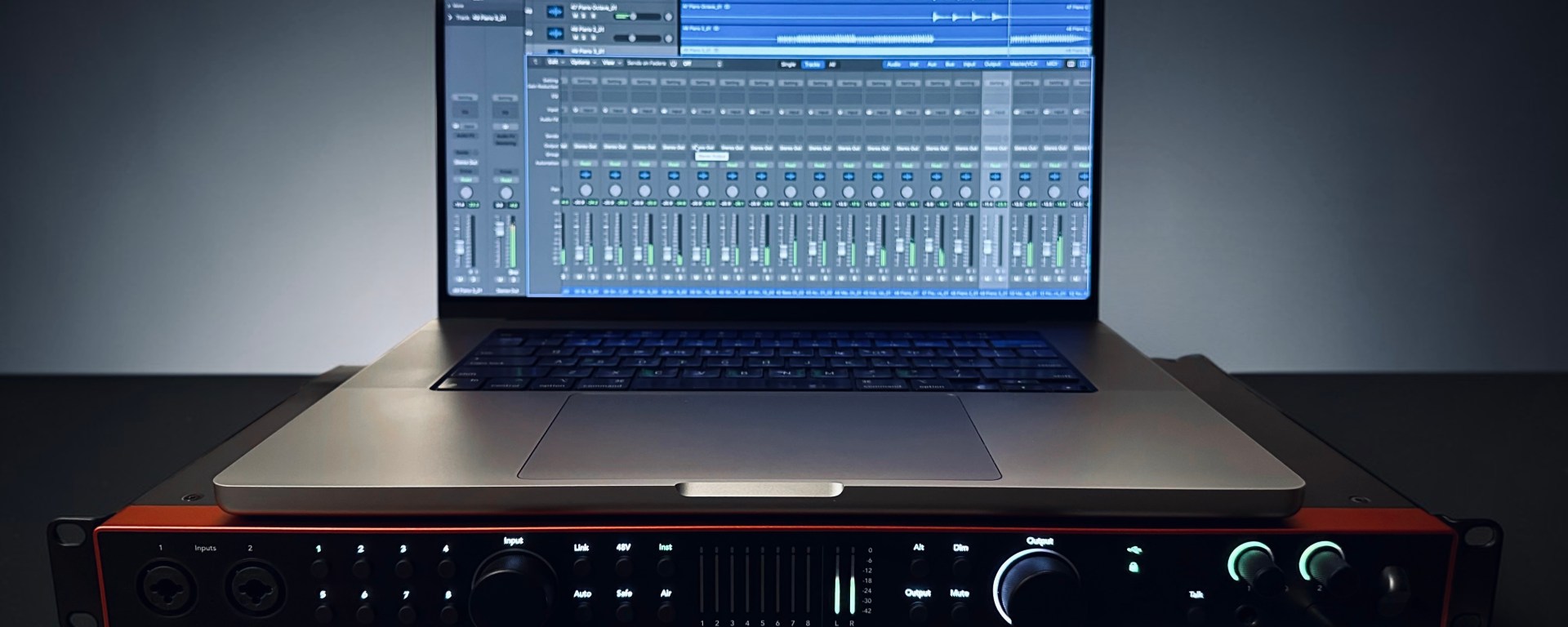
The New Benchmark for Project Studios – A Budget Classic Becomes a Serious Professional Tool!
PROS: Excellent overall value for the I/O density and feature set | Clean, low-noise 4th-gen preamps with 69 dB of gain and improved high-gain stability | Noticeably better converters than previous Scarlett generations; improved stereo imaging and depth | Tight, controlled low-end and articulate midrange that translates well in mixes | Dual Air modes that are genuinely usable and musically tuned | 10 balanced line outputs — excellent for hybrid routing and hardware inserts | Dual ADAT I/O for up to 16 additional channels at 44.1/48 kHz | Digitally controlled gain with full recall and remote adjustment | Clip Safe actively prevents clipped takes in unpredictable sessions | Auto Gain speeds up session setup and guest tracking | Stronger headphone amps than previous generations | Integrated talkback and loopback for streaming and multi-room workflows | Stable drivers with usable low-latency performance | Can function as interface + monitor controller in one unit
CONS: No onboard DSP effects for low-latency reverb or compression | Latency is good but not class-leading | Phantom power grouped rather than per-channel | Headphone outputs adequate but not high-voltage reference-grade | Converters strong for the class, but not mastering-level elite | Air Mode 2 can become overly bright with certain condensers | No redundant USB connectivity or dual-host capability
Introduction.
There’s a difference between being popular and being respected. For years, the Scarlett 18i20 has been the safe recommendation — affordable, capable and widely available. But the 4th Generation is the first time I’ve used an 18i20 and thought: this isn’t just good for the price — it’s genuinely good! This revision is not cosmetic and this is not a light-touch update. The analog front end has been redesigned, the converters are upgraded to RedNet-derived architecture, gain staging is digitally controlled with recall, and workflow protection tools (Auto Gain, Clip Safe) fundamentally change how safely you can track.
This review dissects the 18i20 4th Gen from a studio-engineering perspective — examining topology, signal integrity, latency behaviour, monitoring linearity and real-world usability in hybrid environments.
Links – Official Website | Promusicals (Indian Distributor)
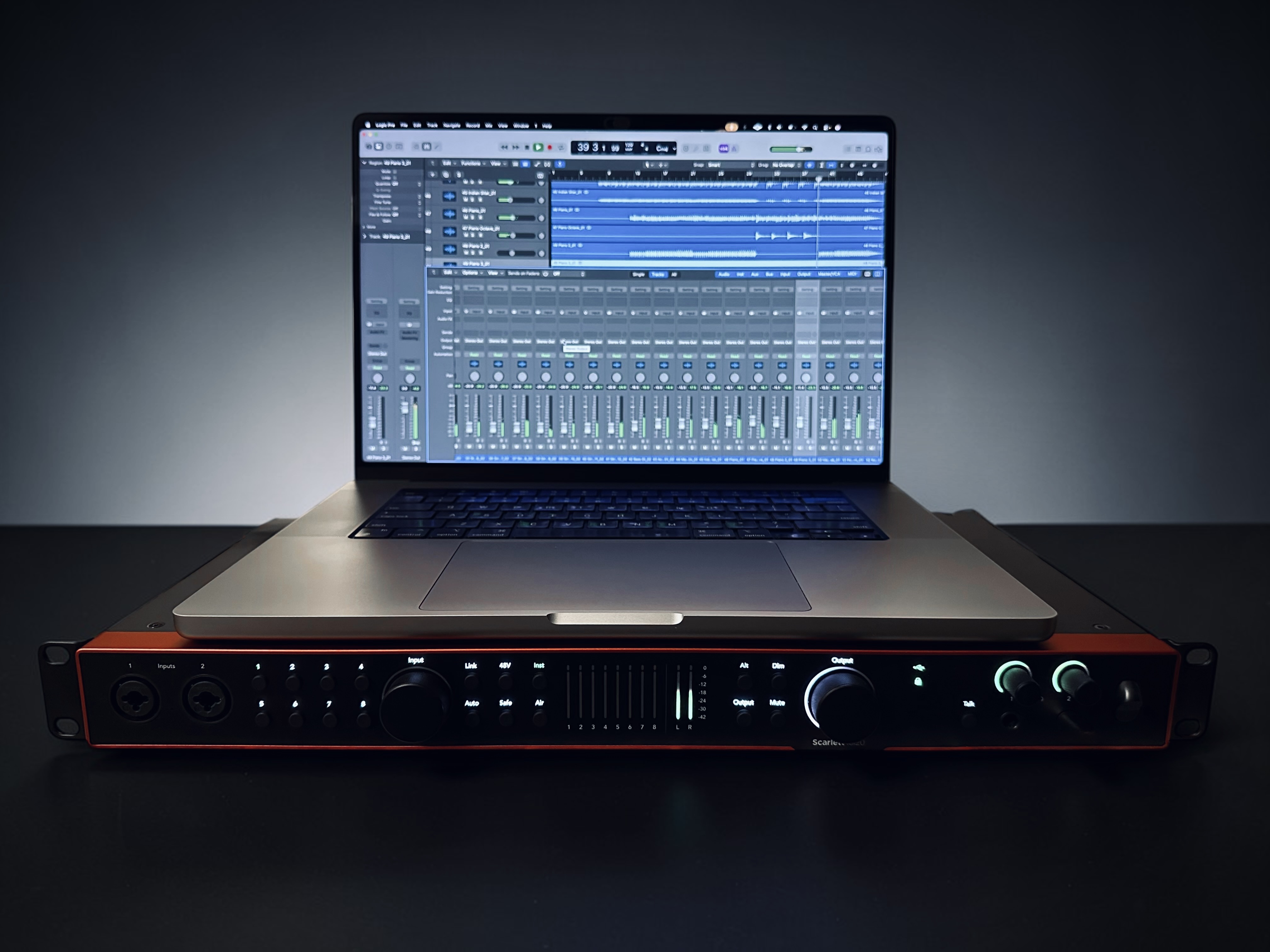
Industrial Design & I/O Architecture
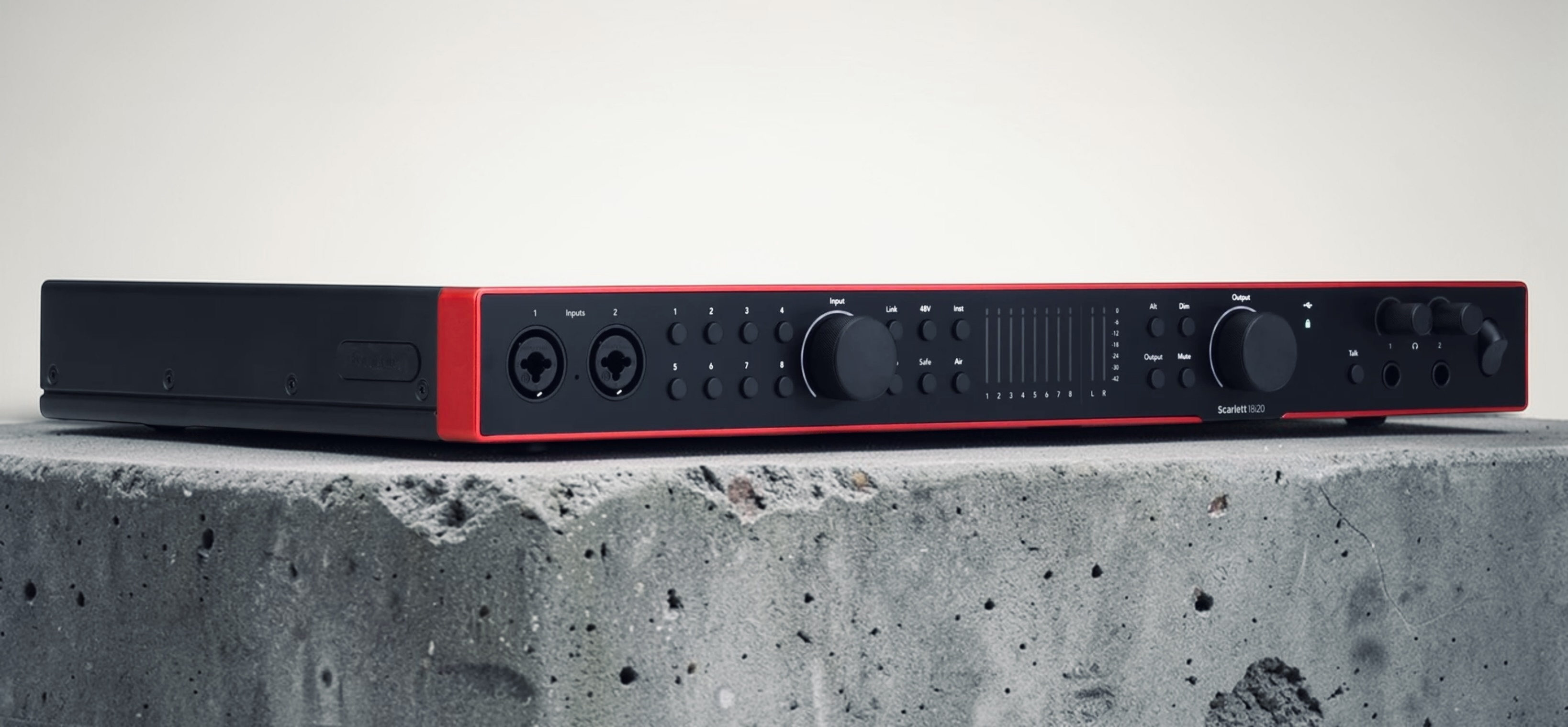
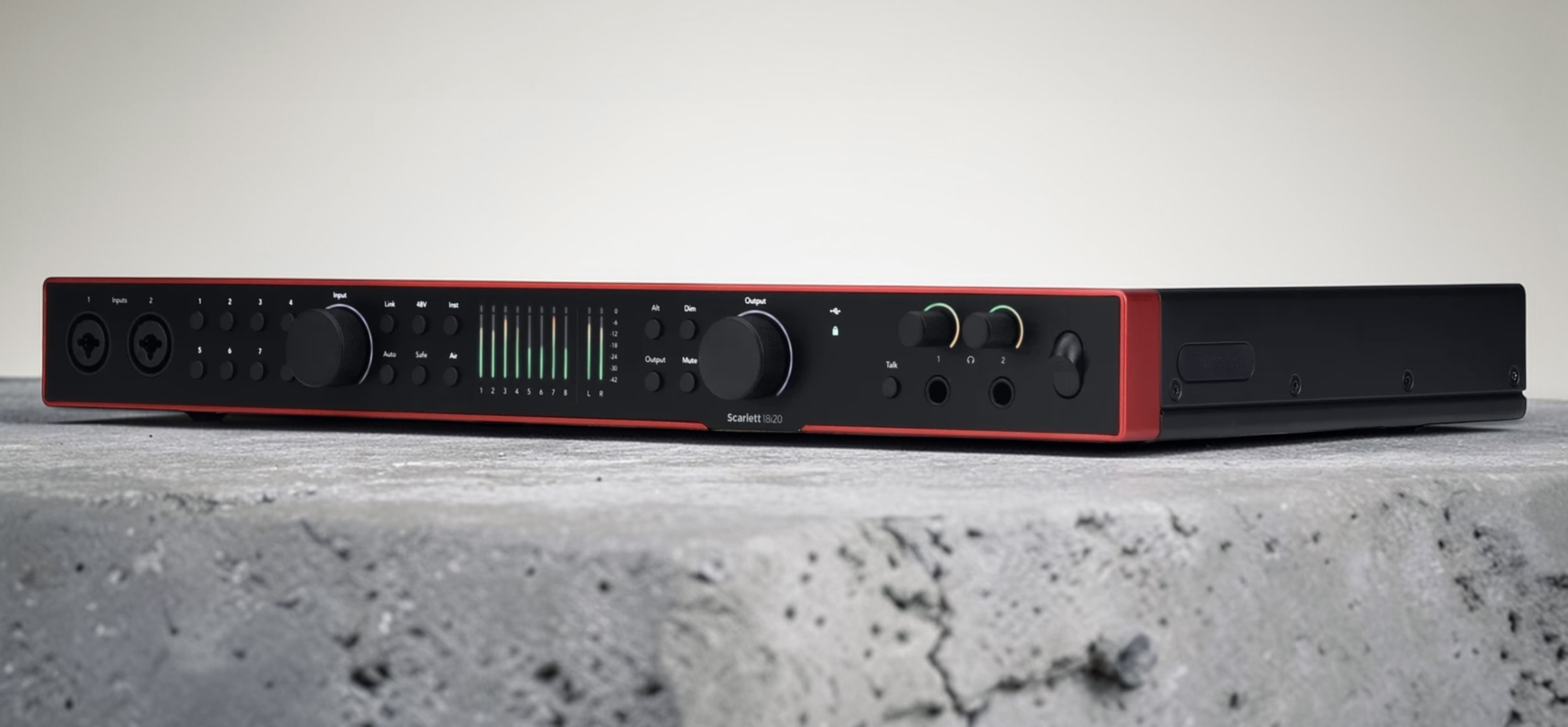
The 18i20 remains a 1U rackmount interface, but internally this generation transitions fully into digitally controlled analog gain stages. All eight mic preamps are controlled via encoder-driven digital potentiometers, enabling precise recall, remote adjustment, and real-time gain modulation (which is how Clip Safe operates).
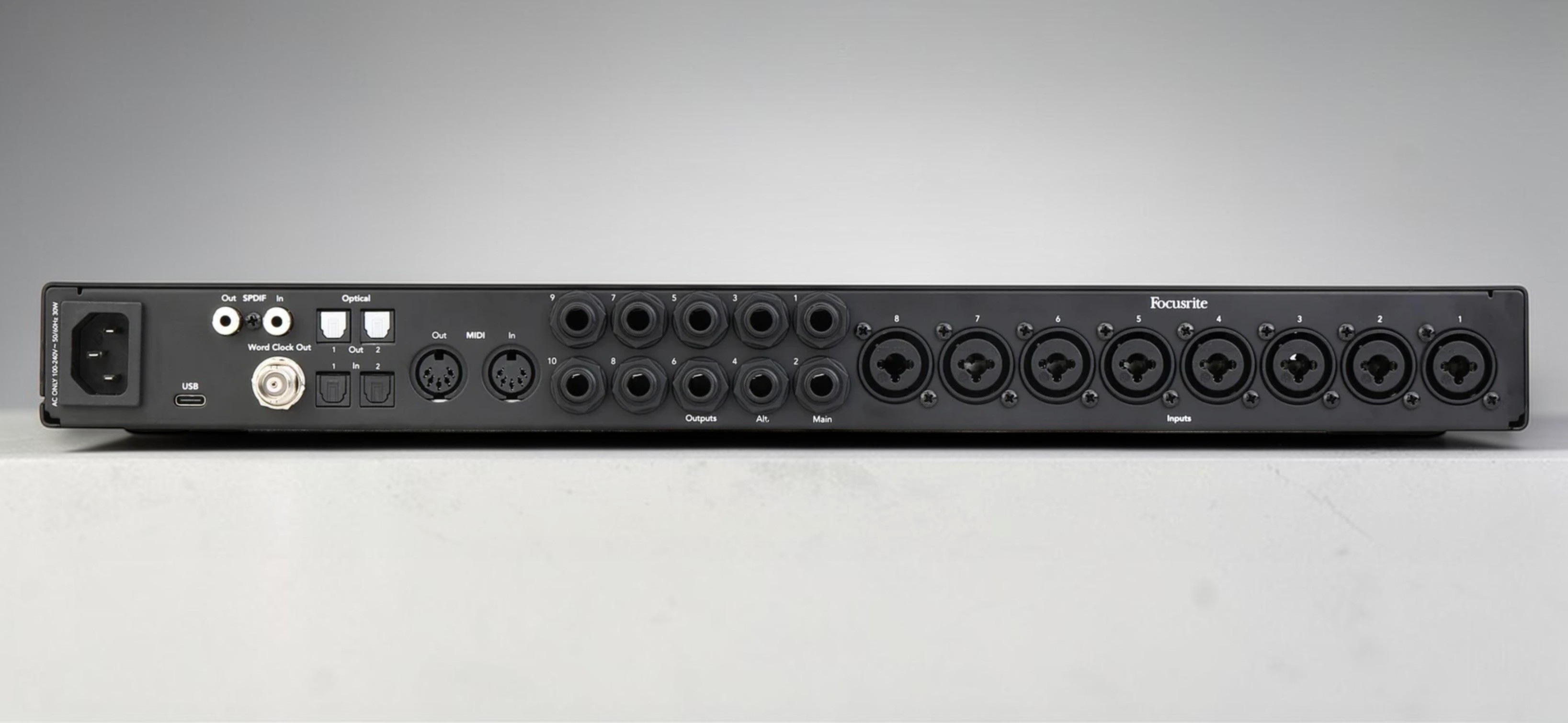
Analog I/O Layout.
Inputs
- 8 × XLR/TRS combo mic/line inputs
- Inputs 1–2: front panel with Hi-Z instrument switching
- Inputs 3–8: rear panel
- Per-channel pad
- Switchable Air (two modes)
- Phantom power grouped in banks
Outputs
- 10 × balanced TRS line outputs
- 2 × independent headphone outputs (front)
- Dedicated monitor out routing (assignable)
Digital
- Dual ADAT input/output (up to 16 channels @ 44.1/48 kHz, 8 channels @ 88.2/96 kHz via SMUX)
- S/PDIF I/O
- MIDI I/O
- Word Clock output
- USB-C (USB 2.0 protocol)
This I/O density is where the 18i20 begins separating itself from desktop-class interfaces. The ten balanced outputs alone allow:
- Dual stereo monitors
- Subwoofer routing
- Hardware insert loops
- External summing integration
- Multi-cue headphone distribution
Ten line outputs on a unit at this price tier immediately expand what’s possible. Dual monitors plus sub. Hardware inserts. External summing, multiple cue sends – this isn’t just connectivity – it’s routing freedom. The 18i20 can realistically function as your monitor controller and analog routing hub without additional hardware.
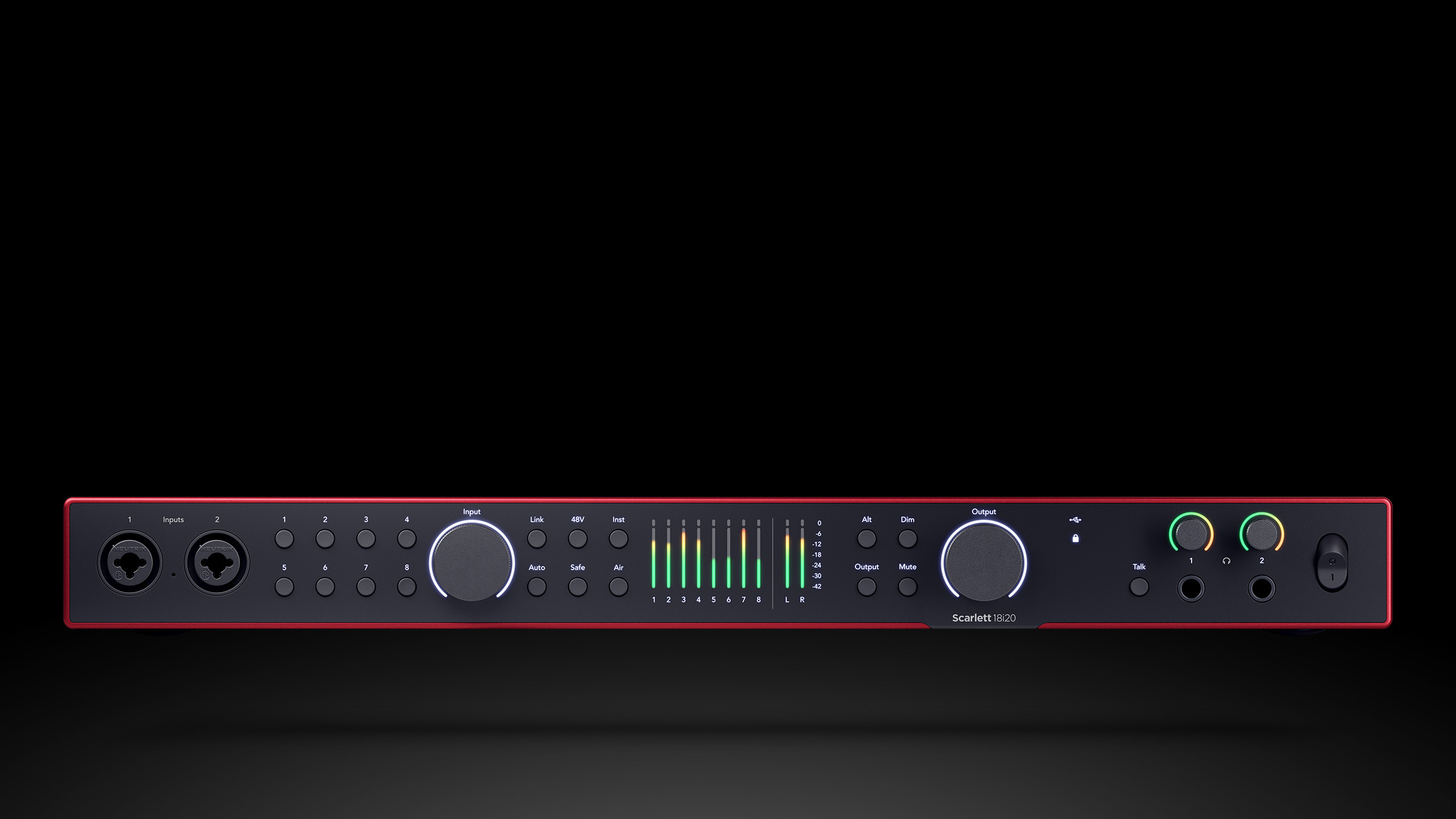
Preamplifier Topology & Performance.
Focusrite quotes:
- 69 dB maximum gain
- EIN ~ -127 dBu (A-weighted)
- THD+N around -100 dB at moderate gain
- 116 dB dynamic range (mic input path)
In measurable terms, this places the Scarlett 4th Gen pres firmly in modern low-noise territory.
Preamps – Focusrite specifies 69 dB of maximum gain, an EIN around -127 dBu (A-weighted), and approximately 116 dB of dynamic range through the mic input path. On paper that’s competitive. In practice, it’s noticeably better than previous Scarlett generations. The most immediate improvement is high-gain behaviour. Earlier Scarlett preamps would develop a slight grain or upper-mid hardness once pushed past 50–55 dB. The 4th Gen remains composed. Noise stays controlled. There’s no brittle glare creeping into the presence region. Dynamic microphones like SM7B-class transducers don’t feel strained or thin.
Tonal Character – The core preamp voicing is neutral but slightly mid-forward. It is not thick. It does not add low-frequency bloom. Instead:
- Low frequencies: Tight, disciplined, controlled decay.
- Midrange: Clean, articulate, slightly forward presentation.
- High frequencies: Extended but not glossy.
Sonically, the preamps are neutral but slightly mid-forward. The low end is tight and disciplined—no bloom, no extra thickness. Kick drums sound controlled rather than inflated. Bass DI tracks are articulate, though they’ll still benefit from tonal shaping downstream. The midrange is articulate and slightly assertive, which actually helps vocal intelligibility in dense mixes. The top end is extended but not glossy. Transient response is clearly improved. Snare hits have sharper leading edges. Acoustic guitar pick attack feels more immediate. There’s a sense of faster slew response compared to older Scarlett designs. This is not a coloured preamp. It won’t give you transformer saturation or tube density. It will give you clarity, headroom, and accuracy. This character benefits mix translation. It does not attempt transformer coloration or harmonic enrichment. If warmth is desired, it must come from microphones, outboard, or plugins.
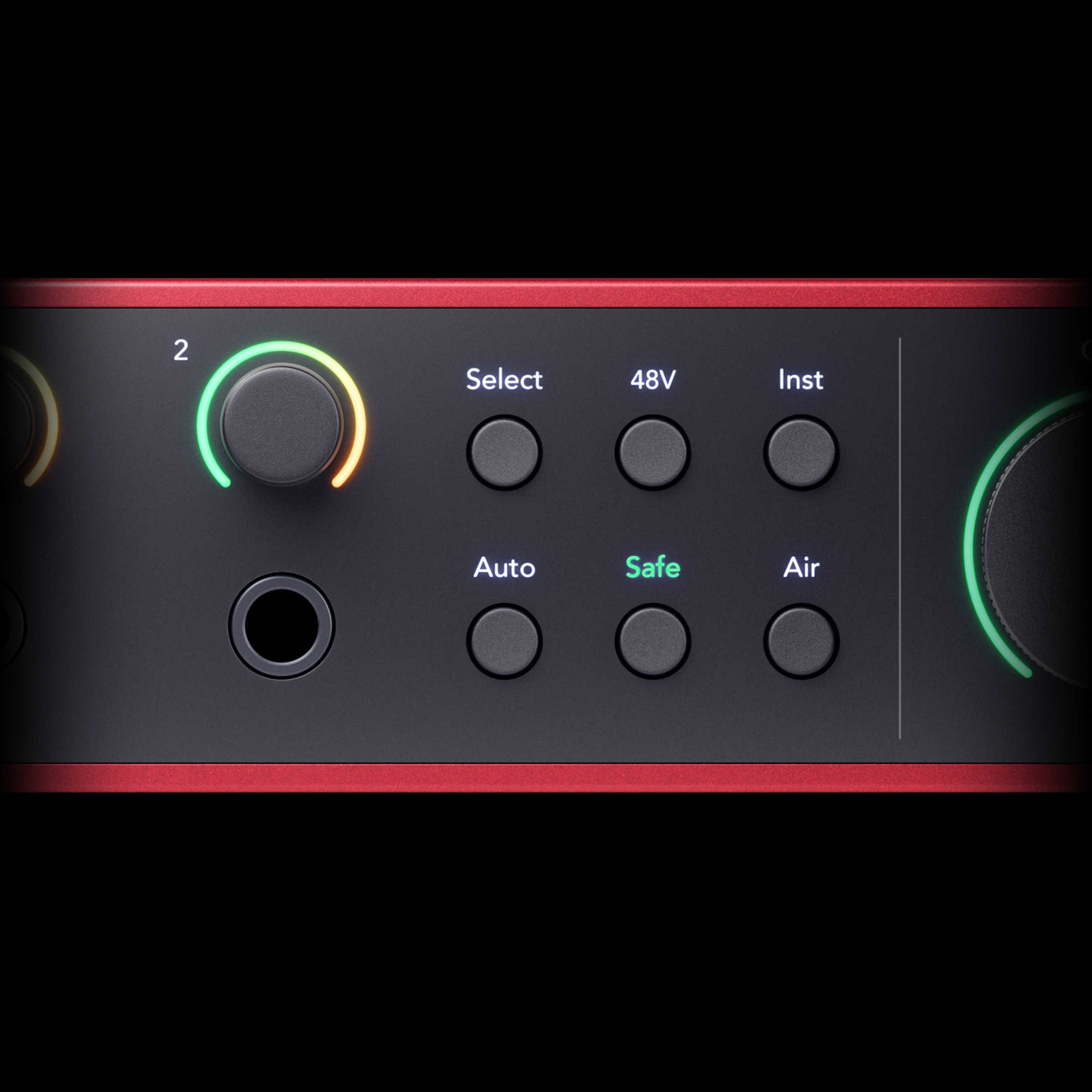
Air Mode – Air mode is not simple EQ. It is circuit emulation & practical impact. It alters impedance characteristics and introduces high-frequency shaping intended to emulate Focusrite’s ISA lineage.
Air 1:
- Presence lift in upper mids
- Subtle high-end clarity increase
- Effective for vocal articulation and acoustic detail
Air 2:
- Broader high-frequency lift
- Slightly more “open” top-end character
- Can exaggerate brightness on already-hot condensers
Air is implemented tastefully. It does not introduce phase anomalies or harsh artificial sheen. It behaves more like analog front-end voicing than digital EQ. Used judiciously, Air reduces downstream EQ dependency.
Conversion Stage – It has RedNet-Derived DAC/ADC. Focusrite specifies up to:
- 122 dB dynamic range (line outputs)
- 116 dB DR (mic inputs)
While these numbers are not flagship-tier (RME ADI-2 class), they are competitive in this segment.
Sound Analysis.
Subjective Monitoring Assessment – Compared to 3rd Gen:
- Improved stereo imaging depth
- Cleaner reverb tail separation
- Reduced high-mid grain
- More defined low-frequency control
The converter section is where the 4th Gen justifies its existence. Focusrite quotes up to 122 dB dynamic range on the outputs, and subjectively the improvement over 3rd Gen is audible. Stereo imaging has more depth. Pan placement feels more precise. Reverb tails separate more clearly from the source. Cymbal decay retains texture rather than smearing into white noise. The upper mids sound smoother and less grainy. Dense mixes feel less congested. Low-frequency reproduction is linear and controlled. Sub information is present without being hyped. Kick drum weight feels accurate rather than exaggerated. The monitoring presentation leans slightly mid-forward, which actually aids mix translation. It is not mastering-tier conversion in the RME ADI-2 sense, but it is absolutely capable of serious mix work in a treated room. It doesn’t flatter. It tells you what’s there.
Instrument Inputs & DI Performance – The front-panel instrument inputs are clean and responsive. Guitar DI capture is fast, with well-defined transients and controlled low-end. It pairs extremely well with amp simulation plugins because it doesn’t pre-color the signal. Bass DI is tight and articulate but not inherently thick. Again, neutrality is the theme.
There’s no compression-like softness on attack. The DI stage feels professional, not compromised.
Headphone Amplification Stage – The headphone outputs are upgraded with increased voltage swing and improved low-volume resolution. They comfortably drive:
- 32–80 Ω studio headphones
- Moderate 150–250 Ω headphones (not at extreme SPL, but adequate)
Noise floor is low. Output remains stable without distortion under load. Detail retrieval is strong enough for cue monitoring and even light editing tasks. This eliminates the need for external headphone amplification in small tracking sessions.
Latency & Driver Performance – USB-C connection operates over USB 2.0 protocol. Latency depends heavily on system configuration, but typical behavior at 48 kHz:
- 32-sample buffer → ~5–6 ms RTL
- 64-sample buffer → stable tracking with plugin chains
- Direct monitoring → effectively zero latency
Connected via USB-C (USB 2.0 protocol), latency performance is solid rather than class-leading. At 48 kHz with 32–64 sample buffers, round-trip latency sits comfortably in the low single-digit millisecond range on a modern system. Real-time vocal tracking through moderate plugin chains is feasible. Guitar amp sims feel responsive. Direct monitoring through Focusrite Control 2 eliminates latency entirely for cue mixes. Driver stability in extended sessions remains reliable. It is not RME-level ultra-low latency, but it does not need to be in this tier.
Auto Gain & Clip Safe – Real-World Engineering Value.
Auto Gain – Auto Gain analyzes incoming signal over a short performance window and sets appropriate preamp gain to avoid clipping while maximising headroom. It’s surprisingly accurate and speeds up session setup, particularly with guest vocalists or drum kits. It is extremely useful for rapid vocal setup, podcast sessions and drum mic baseline gain staging.
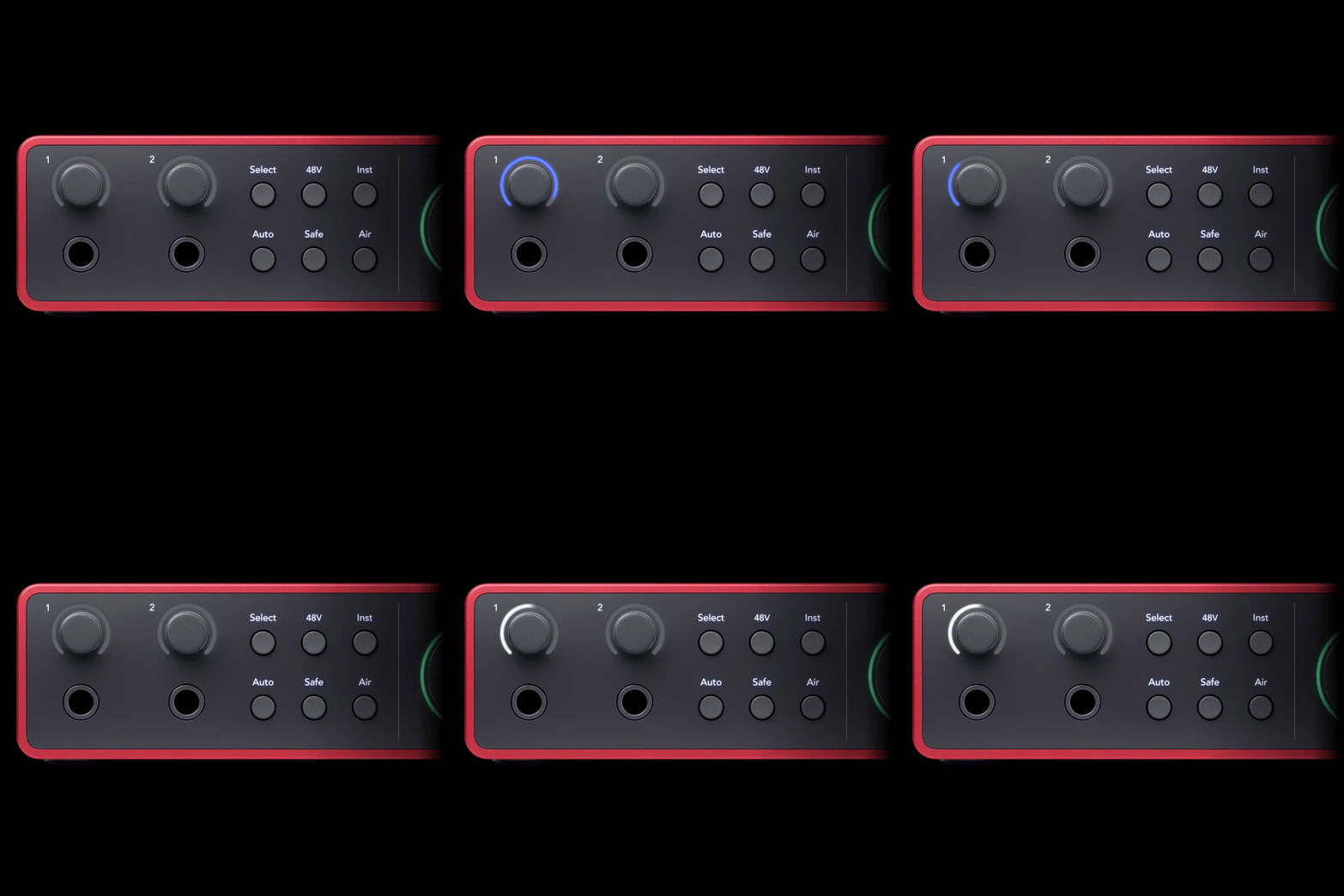
Clip Safe – Clip Safe is more significant. Because the preamps are digitally controlled, the interface can dynamically reduce gain when clipping is imminent. In aggressive rock sessions or unpredictable vocal takes, this can prevent irreversible distortion. It doesn’t audibly pump under moderate adjustments. It simply protects the take. These features reduce risk in real-world tracking environments. That matters more than marketing buzzwords.
Routing, DSP Mixer & Hybrid Workflow.
Focusrite Control 2 provides:
- Multi-bus routing
- Up to six independent cue mixes
- Loopback channels for system audio capture
- Monitor grouping
- Speaker A/B switching
- Remote gain control via mobile device
Focusrite Control 2 provides flexible internal routing, multi-cue mix capability, loopback channels for streaming, monitor grouping, and remote gain control via mobile device. The routing matrix is powerful but not convoluted. With ten line outputs and dual ADAT expansion, the 18i20 integrates cleanly into hybrid setups involving hardware compressors, EQs, and summing boxes. Word Clock out ensures proper synchronization if additional digital gear is involved. This interface scales and doesn’t trap you in a beginner ecosystem.
Use-Case Scenarios.
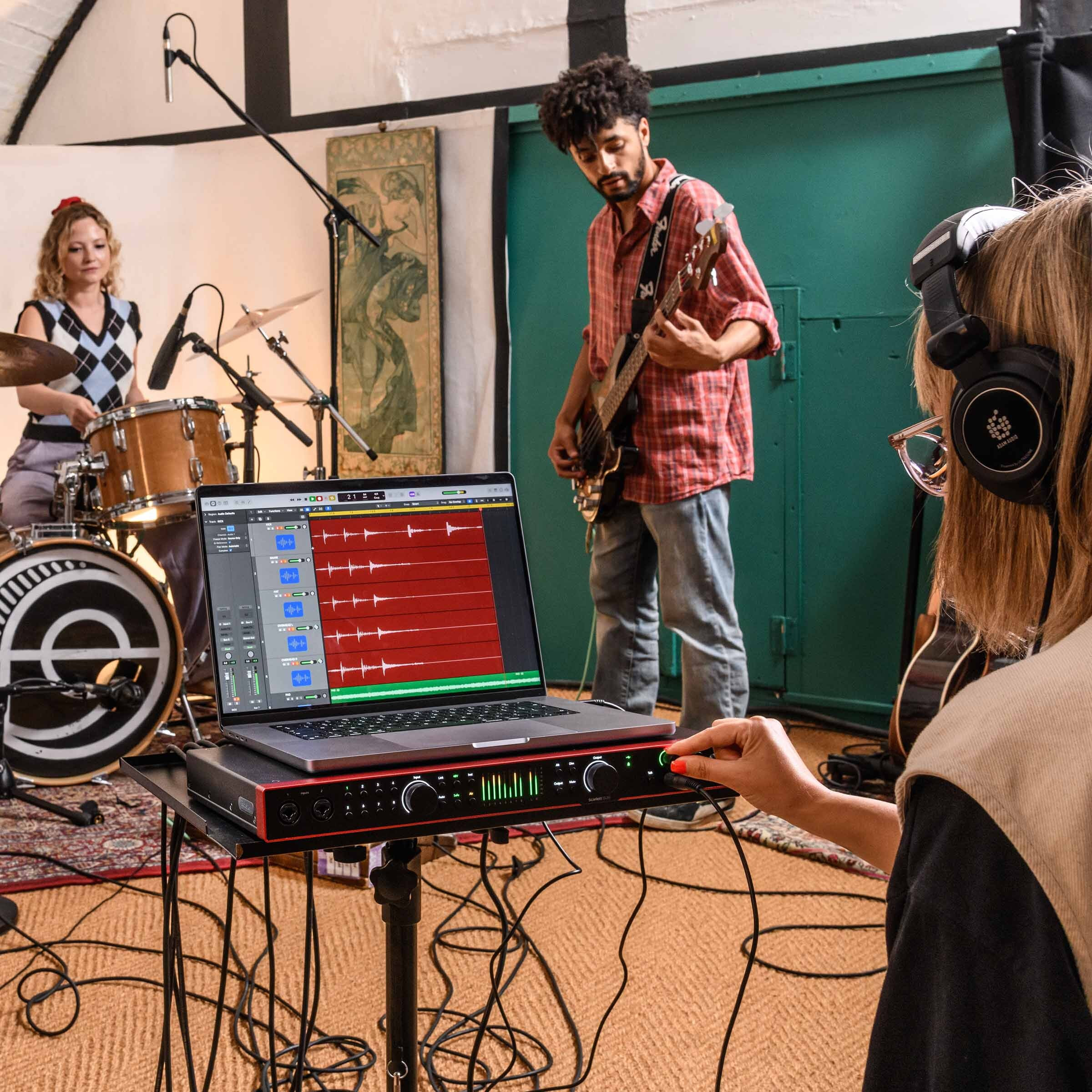
Real-time Small Band Tracking – You can record a small band with 2 guitars, 1 bass, 1 vocals and 1 kick drum, 1 snare and 2 drum overhead mics in real time at ease.
Drum Tracking – 8 onboard pres + 8 via ADAT = full kit capability. Clip Safe mitigates transient spikes.
Hybrid Mixing – 10 line outputs allow:
- Hardware compression loops
- External EQ inserts
- Analog summing feed
Podcast/Streaming – Loopback + Auto Gain simplifies live production.
Instrument Production – Clean DI capture ideal for amp sims and re-amping workflows.
Strengths and Limitations.
Strengths – The Scarlett 18i20 4th Generation’s greatest strength is its balance. It combines low-noise, high-headroom preamps with improved converter performance and genuinely useful workflow innovations, all within a routing architecture that supports serious studio expansion. The preamps are clean and stable even at higher gain settings, transient response is fast and controlled, and the monitoring path offers enough clarity and dimensional accuracy to make confident mix decisions. Ten balanced outputs, dual ADAT I/O, digitally recallable gain, Auto Gain, and Clip Safe collectively make this interface feel mature and studio-ready rather than entry-level. It integrates seamlessly into hybrid setups, handles multi-mic tracking without strain, and remains stable under load. Nothing feels gimmicky; every feature has practical application in real sessions.
Limitations – The limitations are largely philosophical rather than functional. The 18i20 4th Gen is unapologetically neutral — it does not impart warmth, saturation, or analog-style character. Engineers looking for harmonic richness from the front end will need outboard gear or plugins. Latency performance, while solid, is not at the ultra-low benchmark set by higher-tier interfaces. There is no onboard DSP for tracking with built-in effects, phantom power remains grouped, and while the converters are strong for the category, they are not mastering-reference elite. These constraints are consistent with its positioning, but they are worth acknowledging for users seeking coloration, flagship-tier latency, or high-end standalone conversion performance.
Conclusion.
The Scarlett 18i20 4th Generation is the most technically resolved and strategically positioned Scarlett Focusrite has released to date. It doesn’t chase hype, it doesn’t lean on coloration, and it doesn’t try to compete with boutique DSP ecosystems. Instead, it tightens every critical parameter that actually matters in a working studio: lower noise floor, more controlled transient response, improved converter linearity, expanded routing flexibility, digitally recallable gain staging, and meaningful session-protection tools like Clip Safe.
What makes it compelling isn’t one headline feature — it’s the cohesion. The preamps are clean and stable at high gain. The converters are transparent enough for confident mix decisions. The monitoring path is honest and dimensionally improved over previous generations. The headphone amps are no longer an afterthought. The routing matrix supports real hybrid workflows. And the interface behaves predictably under load. Nothing about it feels compromised. Most importantly, the 18i20 4th Gen doesn’t impose itself on your signal chain. It doesn’t thicken, soften, or sweeten. It preserves. That neutrality becomes its strength — your microphones, your room, your outboard, your decisions define the sound. The interface simply delivers it with precision and headroom.
For project studios stepping into serious multi-mic recording, hybrid producers integrating hardware, engineers who need ADAT expansion without sacrificing conversion quality, or creators who want reliability with modern workflow safeguards, this is arguably the most balanced 8-preamp rack interface in its tier. It’s not romantic. It’s not flashy. It’s controlled, capable, and mature — and that’s exactly why it works.

 Twister6 Reviews