

O’Dean tuning of Odin!
PROS: balanced sound sig with a neutral, natural tonality, more musical presentation of the sound with an impressive level of resolution, premium built quality with a durable aluminum shell and a stand-out gold plated faceplate, bespoke design cable, and premium packaging.
CONS: price, larger size shells, and a “signature” driver flex.
The product was provided to me free of charge for review purposes in exchange for my honest opinion.
Manufacturer website: Empire Ears. Available for sale from authorized retailers, such as Musicteck and Bloom.
Intro.
A little over a month ago, when I was approached by the Empire Ears (EE) team and asked if I was interested in reviewing their flagship Odin MKII IEMs, I raised my eyebrows because I was unaware that they were about to be released. If you are familiar with the EE, the new product journey begins well in advance of the release. For me, this often starts at CanJam shows, where you can get a sneak peek at the latest revisions of the upcoming releases and their intermediate sound tuning, as Dean and his team collect crowd-tuning feedback. Without a doubt, Dean is the one who starts with the baseline sound and makes every tuning adjustment decision. However, EE likes to collect input from audiophiles to shape the direction of the tuning.
However, Odin MKII took a different approach, as I don’t recall any crowd-tuning involvement in Odin’s next-gen release. As you can see and hear from Dean himself in this interview, Odin MKII is all about his passion for and emotional connection to the music, as well as bringing the feeling of a live stage performance from his days as a guitarist in the band. I’m probably getting ahead of myself and will elaborate more in my detailed review. But as soon as I put Odin MKII in my ears, with expectations of an OG refinement, I quickly realized it’s going to be something different, more personal, more emotional, following a musical direction of sound evolution, rather than a fine-tuning upgrade.
With that in mind, I approached this review differently, focusing more on the sound evolution from Odin OG to Odin MKII. You will still find all my usual analysis here, but in a slightly different way. So, without further ado, let’s proceed!
Unboxing and Accessories.
The unboxing experience of the Odin MKII is very similar to that of other latest Empire Ears flagships, featuring a large box with the IEMs on display in the middle section and a KVASIR cable stored in a small pocket below it. Then, to the right, you will find the black leather storage case, including a bonus double mesh-pocket IEMs sleeve. To the left, you will find a small storage box containing a set of Final ear tips, a microfiber cloth, and a cleaning tool. As featured in most of our EE releases, these are five pairs (XS/S/M/L/XL) of Final Type-E eartips, organized in an aluminum holder. Additionally, a detailed user manual was included.


I was pleased that Empire Ears switched from their traditional aluminum, puck-shaped, heavy Pandora “box” to a more elegant, round leather case, customized with a Valknut symbol and the “Odin MKII” name stamped on the inside, along with a soft lining. It’s not exactly a unique leather storage case, but it is customized for this release and more practical for storage.
Generally, a larger box with this type of product presentation creates a more premium unboxing experience.


Cable.
The included stock cable, named KVASIR, features four strands of Gold, Silver, and Copper conductors in each. The cable is not bulky, relatively lightweight, and features a jacket with a tightly braided black nylon sheath. To my surprise, considering a nylon jacket, I hardly experienced any microphonics.
The cable hardware is all matte black, with a matching fine-thread laser-cut housing design of a 4.4mm balanced plug and 2-pin 0.78mm connectors. This design enhances the grip of the plug and connectors during handling. The plug features the Empire name and “Odin MKII” along with the Valknut symbol, while the connector housing displays the Empire logo and “L/R” labels. The Y-split also features the Valknut symbol and includes a retractable chin slider.


Design.
While maintaining the same number of drivers, the changes in the type of drivers implemented result in a transformation of the original tribrid 11-driver design with 2DD/5BA/4EST into the MKII quadbrid 11-driver design with 2DD/5BA/2EST/2BCD. The partitioning of these drivers is done through a proprietary 10-way synX Crossover Network, which controls and balances the frequency response of all drivers. And like in previous releases, Anti-Resonance Coating (ARC) was applied to coat the critical internal components with a compound that acts as a dampener to absorb unwanted resonance.
In more detail, you will still find a dual 9mm W9+ “Weapon 9” subwoofers. Then, two precision BA midrange drivers (Sonion EMP75) and three high-frequency BA drivers (Knowles EMP69). Furthermore, dual Sonion Electrostatic drivers (EST) are controlled by the second-generation single transformer, labeled as EIVEC MKII – Empire Intelligent Variable Electrostatic control. It also features dual Sonion Bone Conduction Drivers, part of EE’s Dual Conduction Architecture (DCA), which channels sound simultaneously through both air and bone conduction pathways.

On the outside, MKII shells are significantly different from the original Odin. This is a larger shell design, similar to Novus and Raven. Additionally, it is made of all-metal, like the Novus shell, and features the same CNC-machined aerospace-grade 6061-T6 aluminum alloy material, along with a matte black anodized finish. The faceplate and logos are also made from 6061-T6 aluminum and finished with 24k gold plating. The right side features a 3D-raised EE logo, while the left side has a 3D-raised Valknut symbol consisting of three interlocking triangles.


The 2-pin connector on the shell is recessed, allowing a more secure connection of the cable. Next to it, along the side of the shell, you will find a signature EE 3-pinhole vent port and another separate pinhole vent. But, despite all this venting, you can still expect a “signature” driver flex when inserting these shells in your ears. The nozzle has a small lip for a secure ear tip attachment.
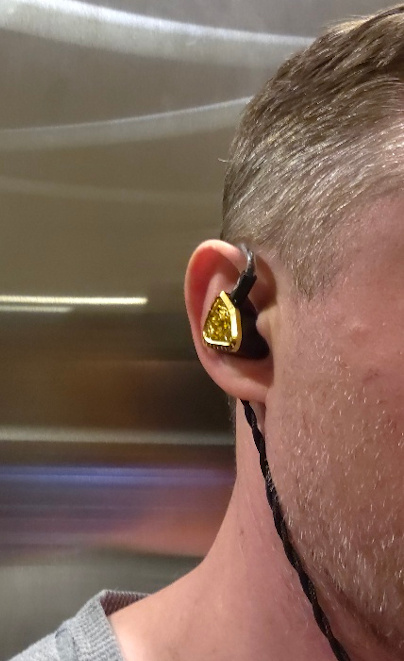
Despite its larger size, the shell remains ergonomically shaped, rounded, and smooth when it comes into contact with the concha area of your ear. But the comfort of the large shell will be subjective, depending on the anatomy, size, and shape of your ears. I have below-average-sized ears, and I was able to tolerate extended listening sessions without a problem. However, please be aware that MKII shells don’t disappear in your ears like the original small compact Odin shell. I can see some people having possible comfort issues if you found Raven or Novus to be too big for you.
Odin vs Odin MKII vs Raven


The fit.
Page 2 – Sound Analysis w/Comparison, and Eartips selection.
Page 3 – Cable pair up, Source pair up, and Conclusion.

 Twister6 Reviews