

Sound Analysis w/Comparison.
I analyzed Odin MKII sound performance paired up with P6 Pro and SP3000M while playing a variety of test tracks, such as Agnes Obel’s “The Curse”, Sandro Cavazza’s “So much Better” (Avicii remix), C-Bool’s “Never Go away”, Ed Sheeran “Shape of you”, Alan Walker “Darkside”, Galantis “Hunter”, Iggy Azalea “Black widow”, Indila “Boite en argent”, Dua Lipa “Love Again”, Counting Crows “Big yellow taxi”, Bob Marley “Jamming”, David Elias “Vision of her”, and Michael Jackson “Dirty Diana”. By force of habit and manufacturer’s suggestion, I had Odin MKII on burn-in for at least 150 hours before I started to collect my impressions. I was using a stock KVASIR cable and switching between Type-E and Baroque XL eartips.
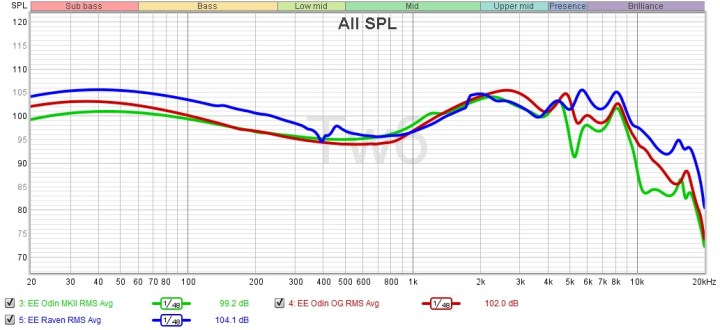
To describe the tuning of the Odin MKII, I decided to analyze its sound evolution by comparing it to that of the Odin OG and Raven. As mentioned earlier, this review will be different, and I will focus more on the transformation of Odin tuning from the original to the MKII.
As you listen to and compare Odin MKII to Odin OG, you can hear that the soundstage width remains similarly wide open, but the perception of the imaging has changed. The OG’s placement of sounds is more 3D holographic, spreading wider and giving the sound more depth, making you feel as if you’re in a larger concert hall with a performer further away from you. MKII maintains a similar spread of the left/right soundstage expansion. Still, the imaging of sound placement is more center-focused, making it more intimate and placing you in a studio environment rather than a large concert hall, bringing you closer to the performer. Overall, the soundstage and imaging of the MKII offer a more intimate experience, enabling a closer connection to the music and the performer on stage. I also noticed that imaging expansion, based on how sounds were placed in space, had a heavy dependency on the eartips being used. Stock Type-E and other ear tips with a narrower bore opening place sounds closer to the center. In contrast, other ear tips, such as Baroque and Crystal, with wider bore openings, allowed for more expansive imaging.
The tuning changes are pretty noticeable and quite surprising. The OG tuning signature was more mid-forward with a leaner neutral tonality. The MKII tuning transforms that into a more balanced signature with a neutral, natural tonality. As you start listening to OG, to me, the upper mids’ clarity and resolution always stood out, followed by a sub-bass rumble with a more neutral, tight mid-bass punch and leaner lower mids. MKII tuning might not “look” drastically different when you have their FRs side-by-side, but it is done in such a way that it sounds like you are listening to an IEM with a different baseline tuning.

Compared to the OG, the sub-bass rumble of the MKII is slightly scaled down, resulting in a more linear and balanced transition without exaggeration. With a reduction in sub-bass, you almost expect the bass to be more neutral. Instead, it still carries plenty of the weight, depth, texture, presence, and articulation, just with less rumble, more controlled depth and shorter note decay, and a more polite, rounded punch.
The mids remain neutral, but their coloring has changed. OG had a sense of leaner lower mids with more revealing, brighter upper mids. MKII lower mids gain more body, giving them more natural coloring, while the upper mids are slightly scaled back, being a bit less forward and smoother in tonality. Mids/vocals don’t lose their resolution; instead, they become less revealing, more laid-back, and more organic.
The intensity of the lower treble also takes a slight step back without significantly affecting the sound’s resolution. The treble extension is slightly reduced, sounding less airy and with less crunch. The clarity is now more natural and neutral, with the treble being more relaxed and better controlled. The reduction in airiness does affect the layering of sounds in the mids relative to the OG, but it never makes them congested or compressed. These changes are expected considering a more natural direction of MKII tuning.
In my opinion, Odin OG was already tuned to perfection, appealing to those who prefer less coloring, more precise detail retrieval, and a more energetic sound presentation. Odin MKII tuning is not an upgrade, but rather a side-grade into a more natural, resolving direction of musical, emotionally charged sound presentation. Based on that, I expected MKII to perform better with vocal, instrumental, classical, and other genres featuring natural rather than synthesized sounds. To my surprise, while going through my usual EDM test tracks, I enjoyed them just as much with MKII as I did with OG. No matter what genre of music I threw at MKII, it just worked, unless you want more bass slam and treble crunch. For that, here comes the Raven!

Comparison of Odin MKII vs Raven
Due to changes in Odin MKII tuning, I thought some would be curious about this comparison as well. Starting with the analysis of the soundstage, Raven has more depth/height than width. With the enhanced bass impact of Raven, the perception of the L/R soundstage spread feels slightly narrower compared to the MKII. Both have a more center-focused imaging based on how sounds are positioned in space. It does give the sound more intimacy, but between these two IEMs, with Raven, it feels like you are a few rows farther from the performer, while MKII brings you a few rows closer to the stage.
When it comes to the tuning, the difference is pretty noticeable. The only thing they have in common is mids, and how naturally and resolving they sound, although Raven has a bit more body in its lower mids, giving them slightly more organic thickness. Treble is varying as well, where Raven has more sparkle and crunch. With Raven’s dominating bass presence, its treble counterbalances it at the opposite end of the spectrum, which takes some edge off its brightness. On the other hand, the MKII treble is not hiding behind the bass or the mids; it is natural, detailed, well-defined, yet smoother and with less airiness. This brings us to the most significant difference in their tuning – the bass.
Raven’s bass is unapologetically big, bold, and bouncy, with scaled-up weight in both the sub-bass rumble and mid-bass punch, rolling into the mids with a longer note decay. The Odin MKII bass is the polar opposite, being scaled down in quantity, less aggressive, more articulate, tighter, and with better control of note decay. In no way would the MKII bass be considered flat or limp; it still cuts through the mix of all the tracks I threw at it. However, the MKII bass never steals your attention or draws more of your focus like the oomph of the Raven’s bass.
In my closing notes of Sound analysis, I would like to mention this. All these EE IEMs use dual 9mm W9+ DD drivers, yet the bass is tuned differently. I no longer have access to EE/A&K Novus, but I clearly remember its bass having a more pronounced mid-bass impact compared to even the Raven. And, despite having similar dual Sonion BCD drivers, Novus had a more holographic soundstage expansion compared to Odin MKII, which also featured the same BCD drivers. My point, stating the obvious, these drivers are just building blocks that can be used to tune each IEM to a desired sound signature. Thus, you can never assume that the same drivers will yield a similar sound tuning.

Eartips Selection.
The selection of eartips is crucial for any universal in-ear monitor and will significantly affect the sound, particularly the bass impact, depending on the seal. Due to a large opening in my ear canals, I usually opt for the largest eartips to achieve a better seal. Also, please keep in mind that eartips impressions are subjective and will be based on the anatomy of your ears. My suggestion is to build up your eartips collection and try each one with every new IEM you get to find the pair that yields a perfect sound for your ears.
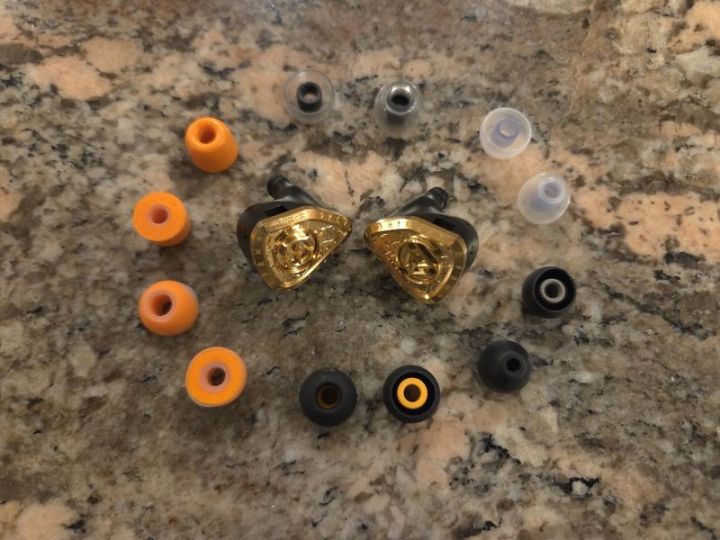
Final Type-E (baseline) – balanced sound signature with a neutral, natural tonality. The bass is deep and articulate, the mids are natural and resolving, and the treble is clear, natural, and relaxed. I hear a relatively wide soundstage that opens up while the imaging is more center-focused.
SpinFit W1 – narrower soundstage with more depth. Tonality is the same.
Azla Crystal – Soundstage expands wider with a bit more holographic imaging. I hear a more pronounced sub-bass rumble and a slightly stronger mid-bass punch, with bass scaling up in comparison to Type-E.
Symbio W – very similar to Type-E sound performance.
Symbio F – narrower soundstage, and a bit more sub-bass rumble.
Eletech Baroque – a slightly wider soundstage with more expanded imaging. I hear a more pronounced sub-bass rumble and a somewhat stronger mid-bass punch, similar to the changes I hear with Crystal, just scaled down slightly.
To my ears, Baroque yields the best pair-up synergy with MKII, providing more weight in bass and helping to expand the soundstage and imaging. Crystal also worked very well. As I mentioned earlier, considering my ear anatomy, I found eartips with a wider bore opening to help with imaging and soundstage expansion. And, a proper seal would be instrumental in bringing in more sub-bass weight and rumble.

 Twister6 Reviews