
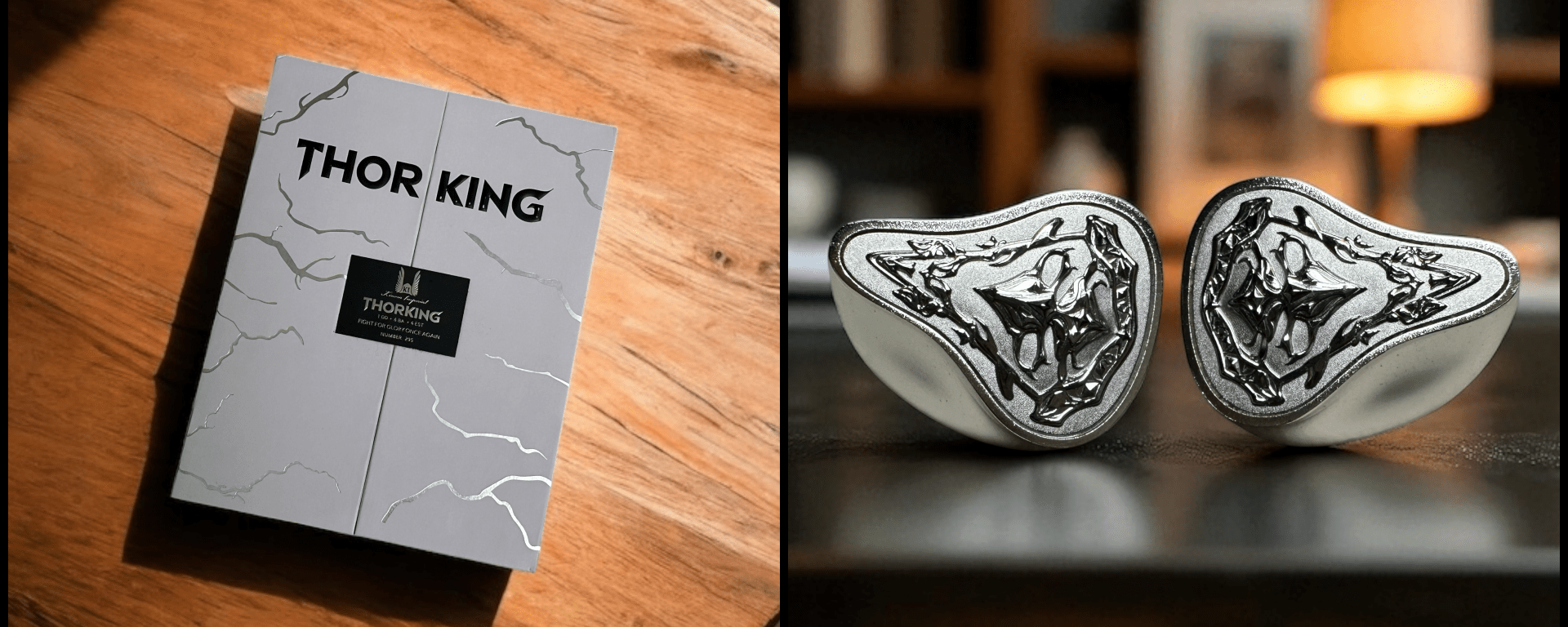
A Valiant Deviation – God of Thunder Ultimate Ears house sound.
PROS: Deep, authoritative bass with excellent sub-bass reach and slam, Sparkling, airy treble that brings brilliance and a sense of openness, Wide and spacious soundstage, giving a grand and immersive presentation, detail retrieval and micro-resolution despite V-shaped tuning, Beautiful full-metal shell design handcrafted with Norse-inspired engraving, Comfortable fit for a large all-metal IEM; ergonomics are well-executed, Premium build quality and solid passive isolation, Thematic unboxing experience with elegant packaging and presentation.
CONS: Recessed ear gain causes mids to lack presence and bite, Timbre is slightly off – particularly for acoustic instruments, Midrange congestion in dense tracks due to V-shaped tuning, Not ideal for reference or studio use – tuning prioritises excitement over accuracy.
The product was provided to me free of charge for review purposes in exchange for my honest opinion.
Manufacturer website: Kinera Official. Available for sale from authorized retailers like Musicteck.
Introduction.
When Kinera unveiled the Thorking under its Imperial line, there was a murmur in the audiophile community – another bold design, another interpretation of high-performance tuning. But unlike the meticulous coherency of the Loki Emerald or the universal appeal of the Verdandi, Thorking marches to the beat of a different drum. Kinera doesn’t merely flirt with uniqueness here – they dive headlong into it, pulling in heavy influence from a very distinct lineage: Ultimate Ears.
In this review, I’ll unpack the sonic philosophy of Thorking and compare it to its peers – Kinera’s own flagships, Ultimate Ears’ IEMs as well as other stalwarts in the segment like the 64 Audio U12t, Elysian Annihilator, Empire Ears Odin, Craft Ears Omnium and Symphonium Europa.
Specifications.
- Driver Configuration: 1 Dynamic Driver + 6 Balanced Armature Drivers + 4 Electrostatic Drivers
- Impedance: 10 ohms
- Sensitivity: 105 dB
- Frequency Response: 5 Hz – 50 kHz
- Connector Type: 4.4mm Balanced
- Cable Connector: 0.78mm 2-pin
- Wearing Style: In-ear
- Cable Length: 1.2 meters
- Shell Material: Brass
- Eartips: Final Type E (SS/S/M/L/LL), Silicone Ear tips Narrow Bore (S/M/L) and Wide Bore (S/M/L)
Unboxing Impressions – A Regal Unveiling.
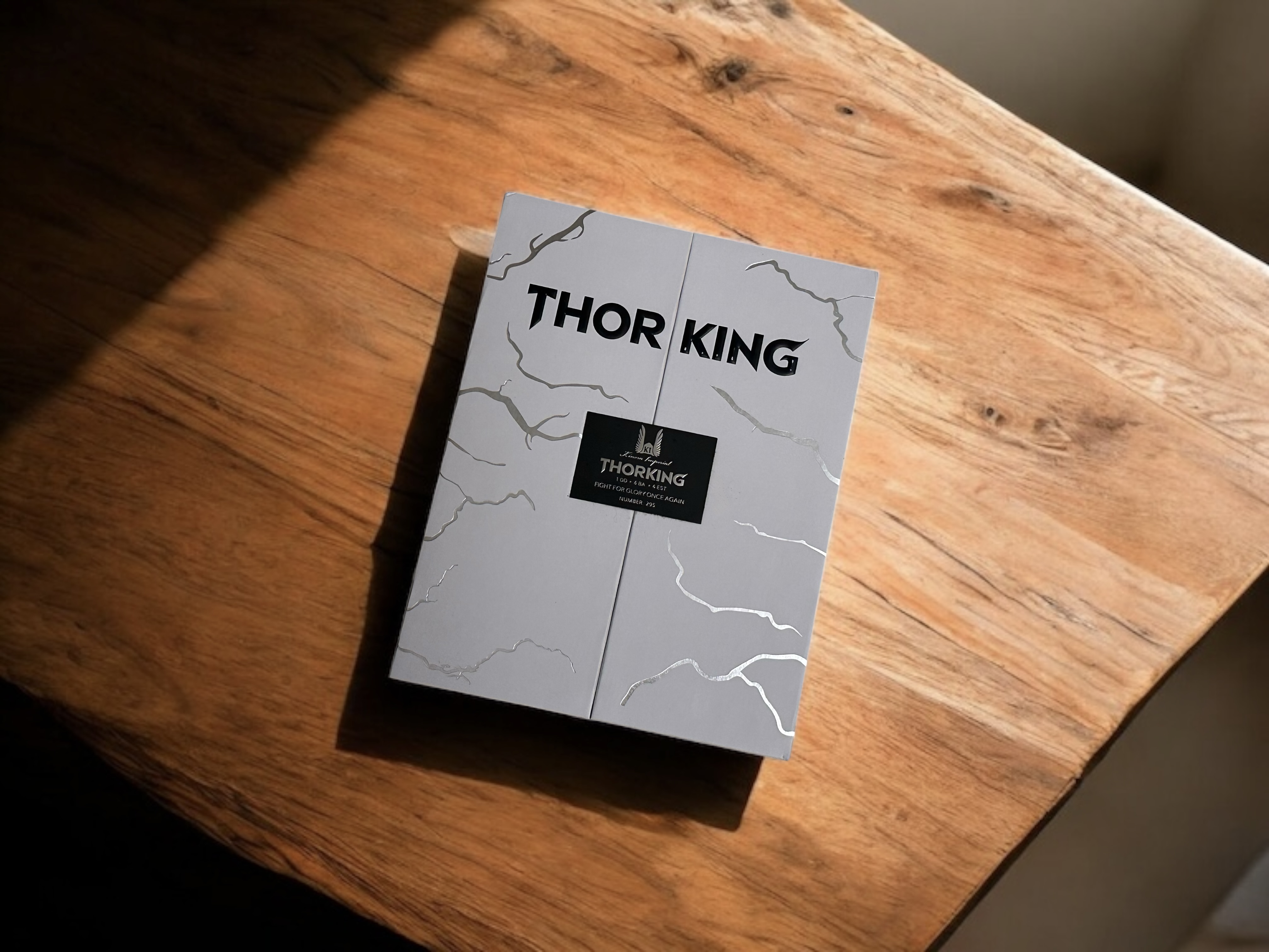
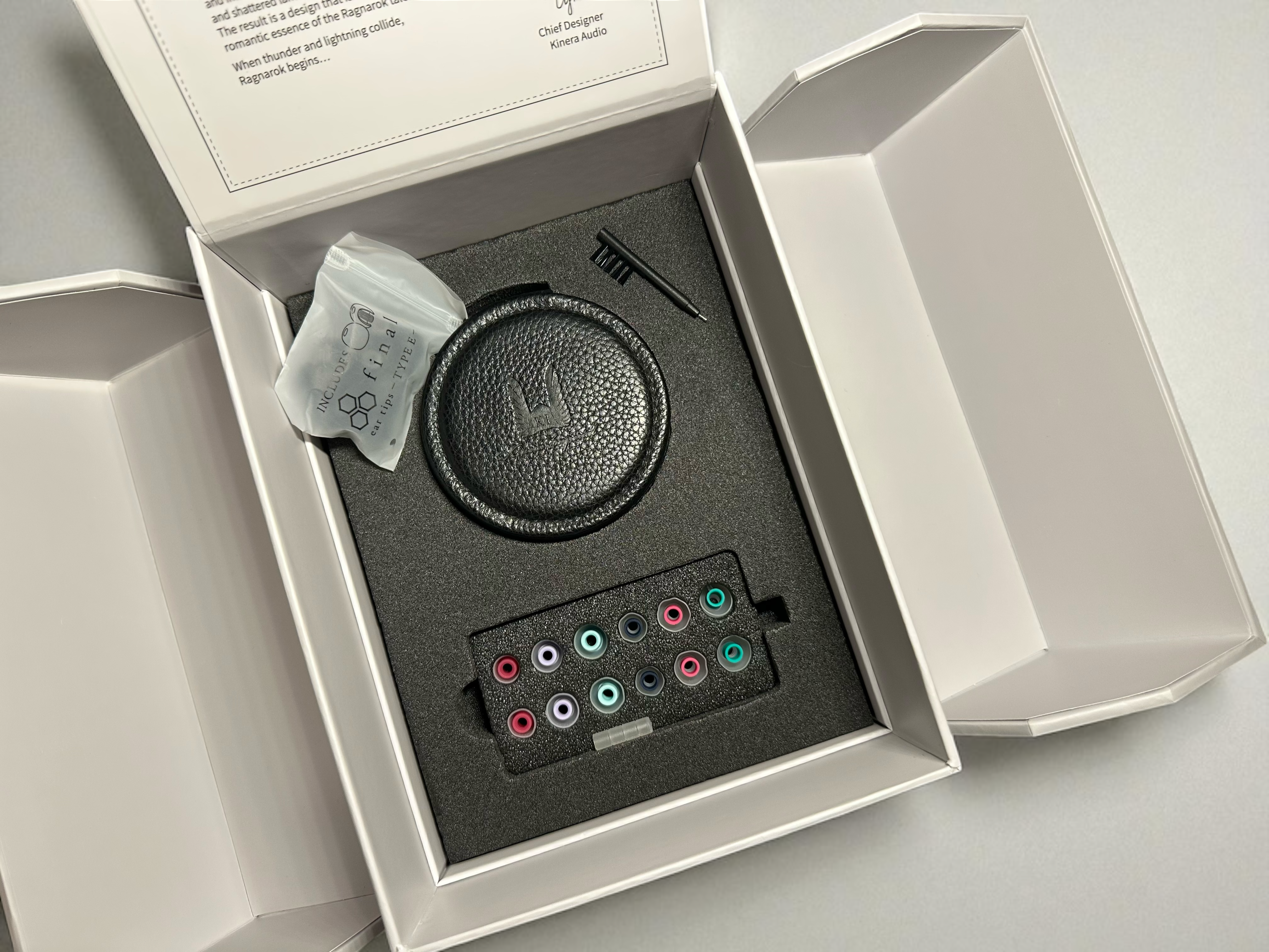
The unboxing of Thorking feels like opening the gates to Asgard. You start with a large, majestic outer box in white and silver, etched with lightning motifs and embossed with “THORKING” in bold lettering. The doors open laterally, revealing a smaller, display-like inner chamber—where the IEMs themselves sit elegantly presented, each nestled in precise foam cutouts. There’s an immediate sense of ceremony. Peeling back the next layer exposes a nicely segmented tray: on the top, the IEMs and cable; below, the accessories and carry case. Kinera deliberately includes a sleek round leather case with a gold-accented zipper, large enough to house the IEMs and stock cable but still compact for daily carry. Inside, you’ll find six pairs of high-quality silicone tips (three narrow-bore, three wider), and a set of Final Audio E-type tips. While functional, the tip assortment feels a touch dated for a flagship—something more premium like foam or hybrid could’ve been a welcome inclusion.
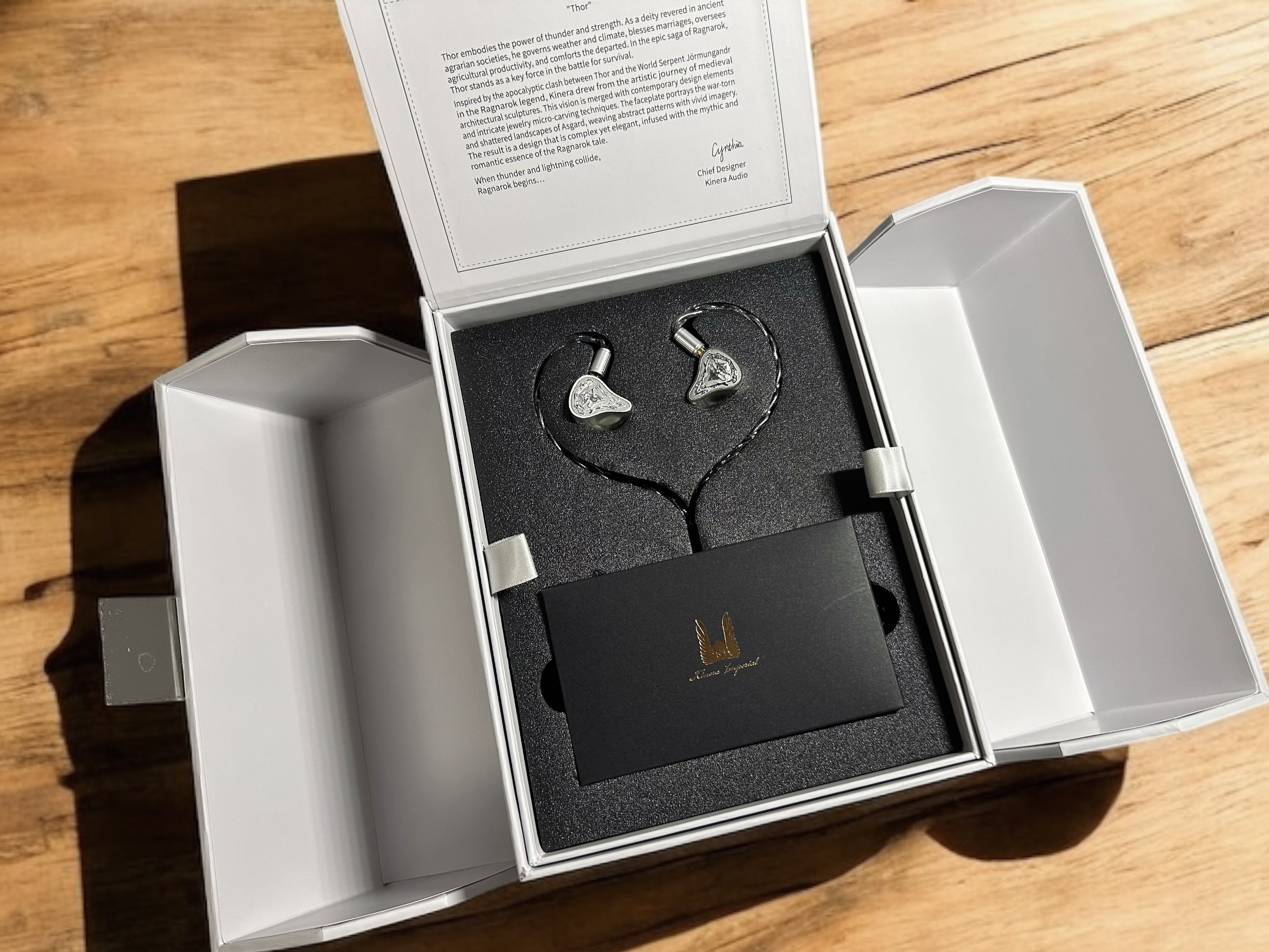
Your first visual take is on the polished metal shells, nestled like treasure. The engraved mythological carvings on the faceplates gleam in contrast to the shiny shell finish, reinforcing the regal aura. The cable and case complete a neat package that speaks of intentional design – no wasted space, each component carefully laid out. There’s a clear commitment to a high-end experience – from the striking outer box to the thoughtful accessories layout. It’s a flag-bearer unboxing that reads like a prelude to an epic sonic journey, even if a more premium tip selection would have brought it fully in line with its flagship ambitions.
Cable: The stock cable is a 7N OCC 26AWG 4-core cable braided in matching black-and-silver cloth. Connector hardware is well-machined and the cable is overall very light for EDC. Very nice cable, no complaints.
Carrying Case: Leather-bound, zipper-secured, and elegantly stamped, the case feels premium. Its mesh pouch helps prevent shell scratching—an appreciated, thoughtful touch.
Overall, the unboxing is cinematic – a bold, thematic entrance that matches the imposing aesthetic and sonic drama of the Thorking itself. This rollout feels earned and fitting for a monitor that wields Thor’s hammer with pride.
Build Quality, Design & Comfort.
Thorking stands apart in Kinera’s lineup as its first all-metal flagship IEM, featuring an artisan-crafted brass shell blended with nickel and copper alloy. This isn’t merely an aesthetic decision – it’s functionally tuned to suppress unwanted internal resonances and manage cavity vibrations with greater authority.
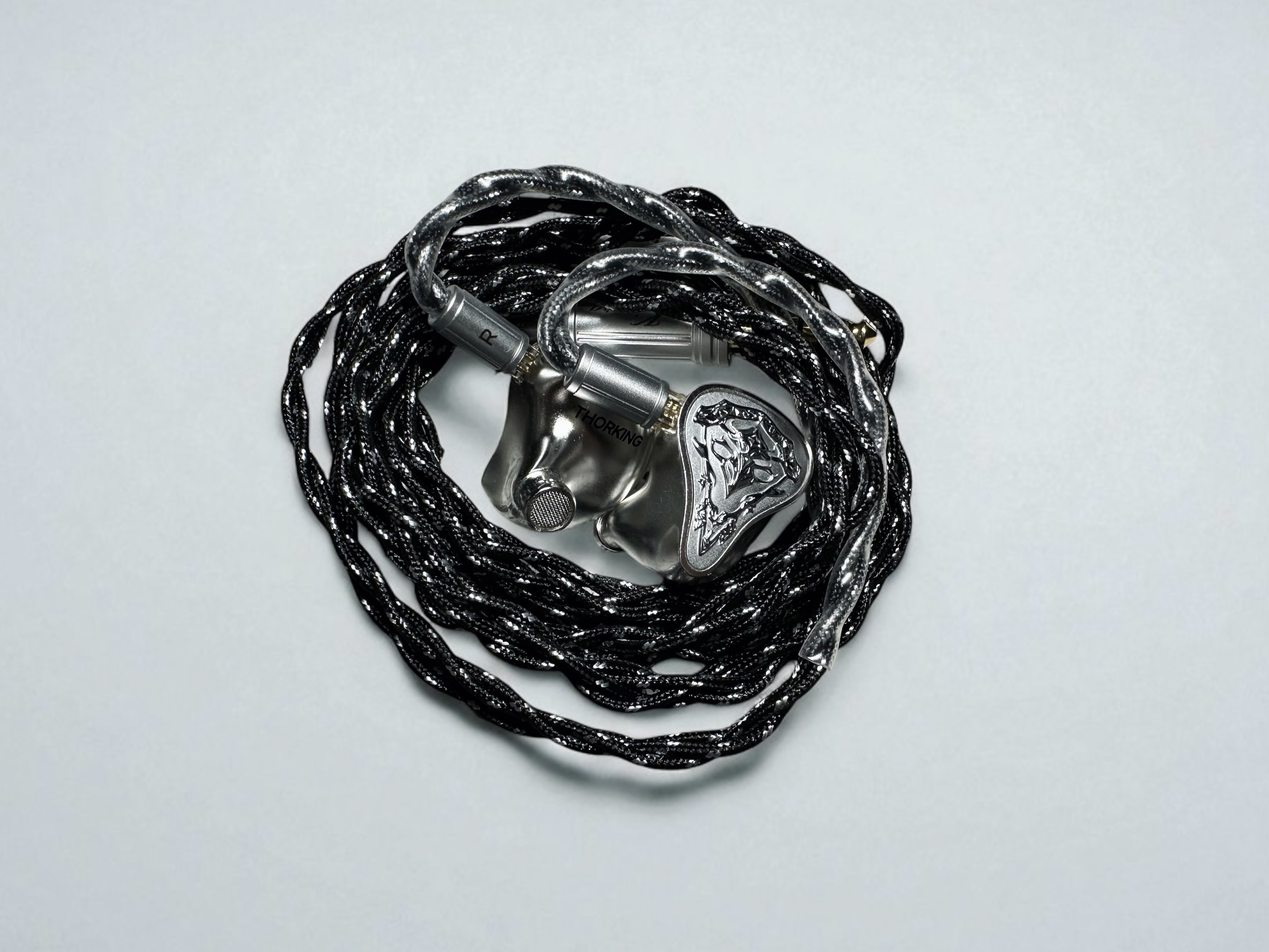
Design & Aesthetics – The faceplates are intricately hand-engraved and sandblasted, shaped using a process of electrodeposition metallurgy on nickel alloy. The end result is a powerful visual identity that depicts the myth of Thor battling the world serpent Jörmungandr – an epic story captured in metal. In hand, the shell feels dense and robust, available in finishes like polished silver or matte brass.
Build Quality – Machined from a single piece of metal, the shell has no v isible seams or sharp junctions. The nozzle is seamlessly integrated into the main body and includes a protective mesh and tip-friendly lip for better grip. The recessed 2-pin connectors are precisely aligned and well secured, allowing for easy cable swapping without stressing the sockets. Dual vents placed under the faceplate allow internal pressure to dissipate efficiently, preventing driver flex and improving wearing comfort over long sessions.
Comfort & Fit – Despite being undeniably weighty and physically large, Thorking is surprisingly comfortable. The shell is ergonomically contoured, with smooth surfaces and curves that avoid pressure points. Once seated, it locks into the concha securely and doesn’t require frequent readjustment. The weight is well-distributed across the outer ear, so there’s no sense of top-heaviness or nozzle drag during listening. However, those with smaller ears may experience slight pressure around the antihelix area during long sessions—not painful, but noticeable.
Isolation – Thorking offers above-average passive isolation thanks to its snug fit and semi-universal shell design. The presence of dual vents does mean it doesn’t isolate like a non-vented IEM or a CIEM, but ambient noise like chatter or air conditioning hum is substantially reduced. Importantly, the venting eliminates driver flex and pressure buildup entirely, allowing for more consistent and comfortable listening. Isolation can be further improved by pairing Thorking with foam or hybrid ear tips.
Sound Analysis – The Price of Drama.
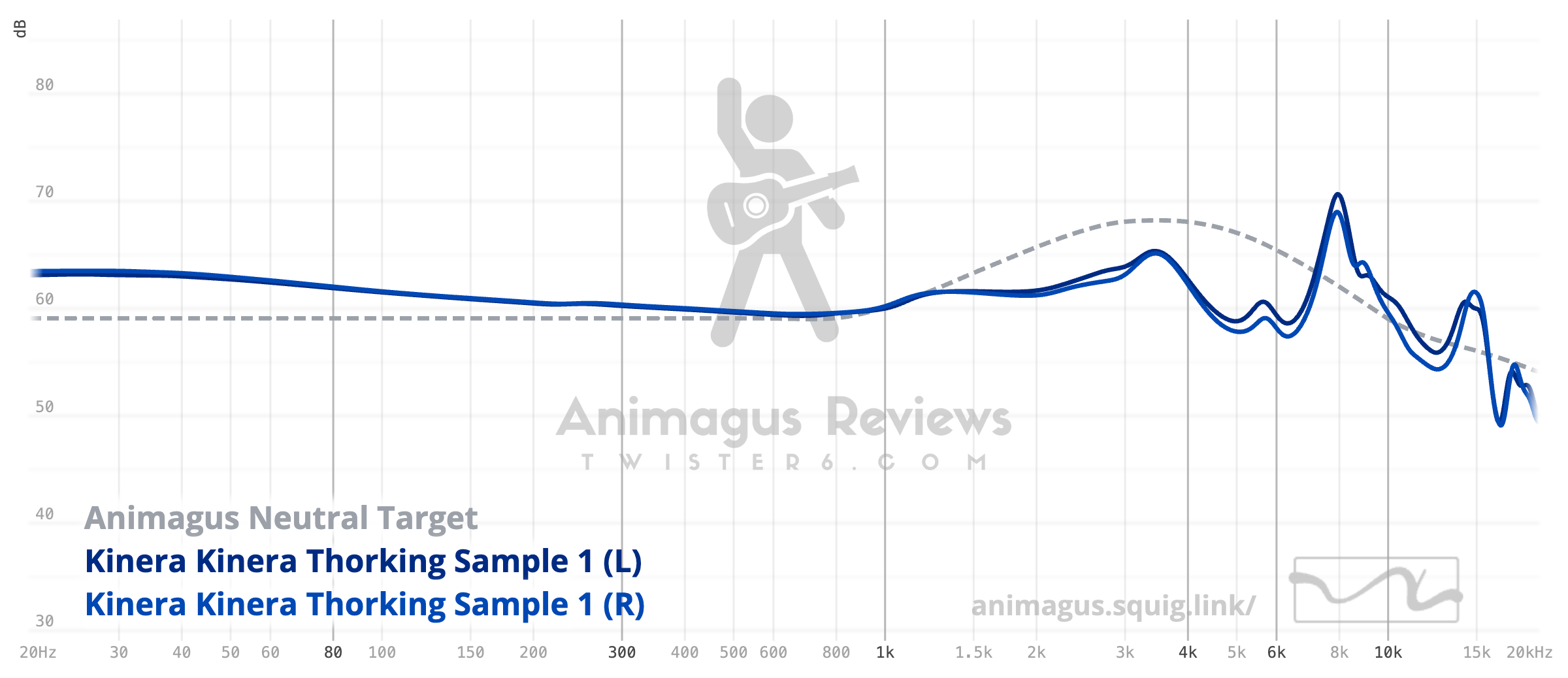
Kinera Thorking is unapologetically dramatic. It embraces a V-shaped tuning that forgoes reference balance in favour of dynamic impact and staging flair. The bass is weighted and immersive, treble is sparkly and expansive, and the midrange – particularly the crucial upper mids/ear gain region is subdued. This results in a presentation that is simultaneously engaging and distant, technically strong yet a little detached from accurate tonality and reference accuracy. It’s a unique approach, reminiscent of pre-2022 Audeze headphones and Ultimate Ears’ UE18+ Pro 2nd Gen style house sound, but exaggerated in fidelity, contrast and coloration. It’s as if Kinera fused Ultimate Ears flat line dry tuning with the cinematic flair of Audeze planars, creating an IEM that’s technically impressive. Thorking is made for slightly loud level listening where reference ear gain can come off as peaky if the signature is not perfectly done – so it sounds great when loud and a little veiled at low volumes.
Let’s dig in deeper…
Bass – Bass is the first thing that captures your attention with Thorking. The sub-bass extends deep, with a satisfying rumble that retains definition. You get that cinematic “floor shake” in low-frequency synths, ambient textures, and film scores. It’s tactile but not boomy – there’s real texture and layering, especially in tracks with multi-tiered low-end compositions. The mid-bass, while elevated, doesn’t smother the midrange thanks to fairly clean and linear bass shelf. Kick drums have body and impact, though they’re slightly rounded in transient edges. Bass guitars and low toms retain their body and warmth without becoming indistinct.
This is a musical bass, not a monitoring one. It feels custom-tailored for genres like:
- Synthwave, ambient, EDM – where the sub-bass texture adds depth
- Hip hop and trap – where 808s slam with authority
- Cinematic orchestration – where cellos and drums bloom with presence
Compared to:
- Kinera Loki Emerald – Loki is tighter, more tonally accurate in bass, with a more honest portrayal. Thorking’s bass is more coloured, with greater elevation and more fun factor.
- 64 Audio U12t – U12t’s bass is cleaner, faster and better separated. Thorking lacks that level of definition but is more immediately visceral.
- Elysian Annihilator – Annihilator has speed and punch but Thorking feels more grounded and resonant in low-end reproduction.
- Symphonium Europa – Europa’s bass is punchy and slamy by comparison and wins in accuracy.
Midrange – The midrange is the polarising aspect of the Thorking. On first listen, it feels spacious and wide but after a while you start to notice the missing pieces – the instruments that lack immediacy, the vocals that sit a bit behind reference accuracy and the tonality that feels slightly distant. The root cause is the recessed ear gain region in the 1.5–6.5 kHz band – which has a cascading effect on everything: guitars, particularly electrics, lose a bit of their crunch and bite, power chords feel smoothed over, vocals – especially female and high-pitched male ones – lack projection/forwardness and sound a bit held back and snare drums and other upper-mid percussive elements do not sound as snappy as they do in reference IEMs.
The thing is that if you listen to Thorking in isolation and at slightly louder volumes, you might not even notice any of these things and even if you do, a lot won’t even care for it since the V-shaped signature and that flat line UE style of tuning is so well done that it makes you feel like you’re listening to music in a room or a band in a hall. So this isn’t a flaw in implementation – it’s an intentional design choice, one that hearkens back to Ultimate Ears’ era and certain Audeze planars (LCD-2/3 pre-Fazor era). It does create a mismatch between the power of the lows/highs and the emotional connection through the mids and timbre takes a hit as a result, especially if you’re a reference head but acoustic instruments like violins, saxophones, and guitars do sound really good, just not forward nor bang on correct in tonality ‘for IEMs’. It instead gives you that flat horizontal shaped band rather than a band that is positioned with depth, with guitarists and vocalist in the front and the bass and drummer at the back. There’s a touch of plasticky dryness in mid-centric material – almost like looking at a beautiful painting through a tinted glass. If you’re someone who loves mid-centric genres (jazz, folk, classic rock, vocal-driven ballads), Thorking may feel emotionally distant. But if your library leans toward instrumental electronica, cinematic scoring, or bass-heavy genres, this might not be as noticeable.
Treble – Treble is where Thorking soars brilliantly and creates magical excitement. It avoids Kinera’s sometimes overzealous brightness (as seen in Odin or Loki) and instead opts for a delicately airy, well-extended, and shimmer-laden treble response. It lifts the soundstage, balances the bass, and provides clarity and micro-detail retrieval without pushing into harshness or grain. Cymbals have a pleasing metallic sizzle with realistic decay, Hi-hats and tambourines sparkle and dance across the upper imaging field and Reverbs in well-mastered tracks linger and decay beautifully into the space. Importantly, this treble gives Thorking its sense of resolution. Even with the recessed mids, the treble helps preserve detail extraction from ambient cues, micro-textures, and spatial reverb trails. That said, it’s not sizzly like the Loki – it’s more polite and deliberate in its energy.
Technical Performance – Soundstage: Thorking’s soundstage is wide – exceptionally wide, in fact for its price segment. Instruments feel spread out from left to right with ample space between them. However, depth is moderate; there’s less layering in the Z-axis. Imaging is competent, but not laser-focused – instrument placement is easy to identify laterally, but front-to-back layering lacks realism. Detail Retrieval: Micro-details like string articulations, room reverbs, and vocal inflections are well-presented, particularly in the treble and bass regions. However, midrange articulation suffers, which affects inner detail clarity. This is a trade-off: in some genres, it’s masked; in others, it becomes apparent. Dynamics: Macro dynamics are excellent – Thorking goes from soft whispers to cinematic crescendos with ease. However, microdynamics are slightly compressed, as a result of the midrange recession.
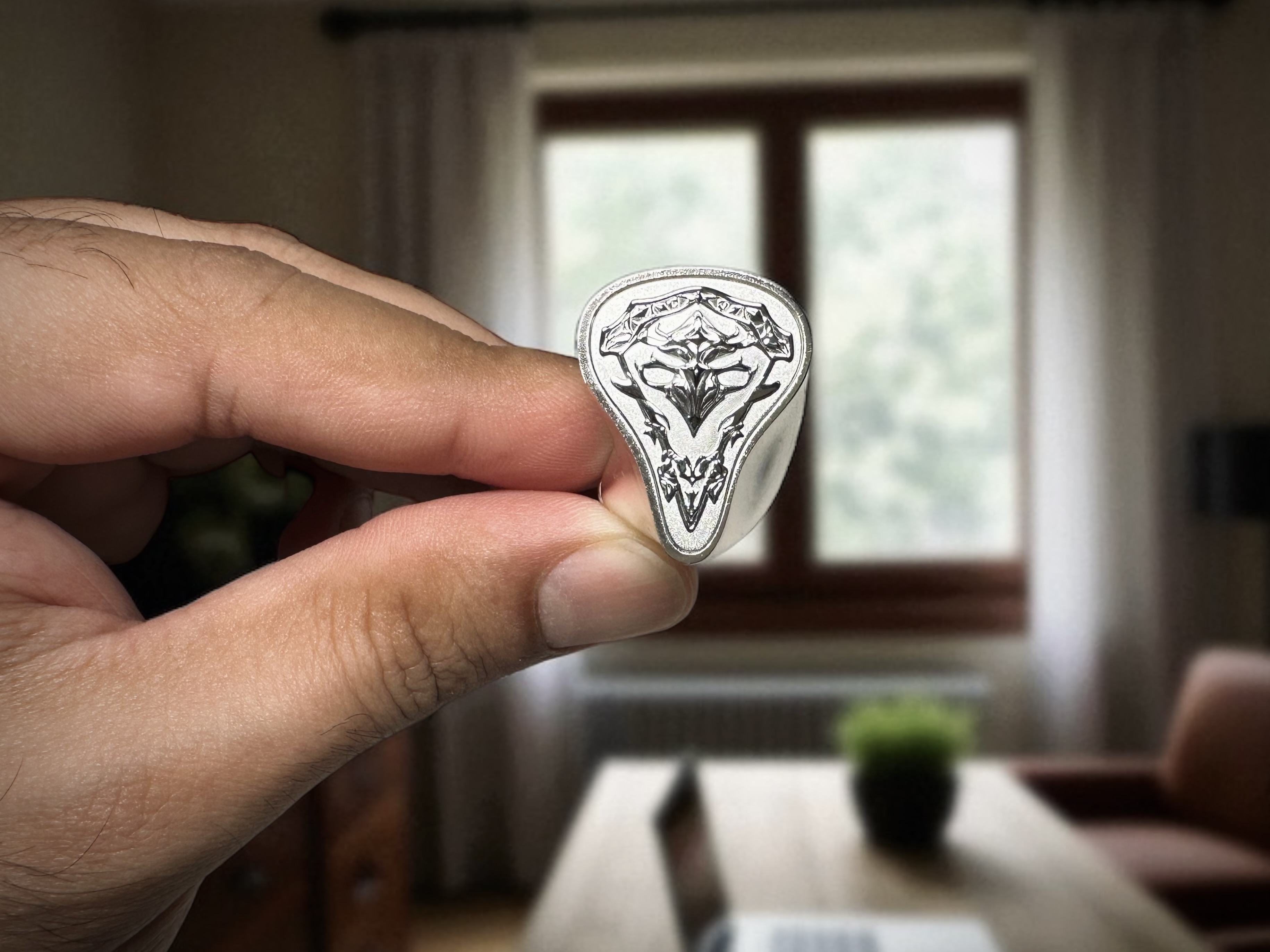
Drivability and Pairing Impressions – Source Synergy with the Thunder God.
The Kinera Thorking, despite its 9Ω impedance and 103dB sensitivity, is not a typical easy-to-drive IEM. On paper it may seem easy to power, but in practice, it craves a clean and robust source to unlock its full potential – particularly when it comes to stage depth, dynamic slam, and treble finesse. Lesser-powered dongles or laptop outputs can certainly get it loud, but they tend to flatten its dimensionality and soften its sparkle. Here’s how it scales across a few select pairings:
Kinera Celest CD-20.
The CD-20 is surprisingly good! It is a very competent dongle DAC/amp and a natural starting point. It offers an impressively quiet noise floor, clean output, and neutral tonality with a slight lean towards clarity. When paired with Thorking, it provides excellent resolution and channel separation, making the details in cymbal work and layered synths stand out. However, you can sense that Thorking is holding back just a bit if you’ve heard it on higher end sources – especially in sub-bass weight and stage depth. While treble shimmer is nicely rendered and the mids retain their V-shaped profile, the soundstage feels very slightly flatter and shallower compared to what the IEM is capable of with the upper echelon of sources. It’s a very respectable pairing and better a lot of dongles I’ve tried at its price.
iBasso DX260mk2.
With the DX260mk2, Thorking sounds like it’s finally playing on its own turf. This pairing brings out everything the IEM is designed to do—massive stage width, strong imaging precision, and a jet-black background that allows every transient to pop with clarity. The DX260mk2 has a rich, resolving character and its class-leading stage depth really complements Thorking’s wide stereo spread, giving the listener a holographic experience.
What stands out most here is how cohesive and layered everything sounds. The bass gains more textural nuance, vocals (even if recessed) come through with improved separation, and treble details sound both shimmery and well-controlled. The recessed ear gain is still present – no source will fully “fix” the tuning – but with the DX260mk2, the resolution and layering make it far more palatable. It’s a synergistic pairing that makes Thorking feel far more flagship-worthy.
iBasso DX180.
The DX180 is no slouch either. Much of the core presentation from the DX260mk2 is retained – clean tonality, balanced frequency response, good dynamics – but you begin to notice subtle differences in depth and refinement. The stage isn’t quite as cavernous, and imaging feels just a tad less pinpoint. Still, the DX180 has enough power to drive Thorking well and brings out most of its dynamic potential.
This pairing also delivers a tight bass response and extended treble clarity, but with a slightly thinner note weight compared to DX260mk2. For most listeners, the difference won’t feel night-and-day unless you A/B the two, but the DX260mk2 still holds the edge in overall staging realism and finesse. That said, DX180 + Thorking is a very satisfying combo and a great value tier for those not seeking flagship-level DAPs.
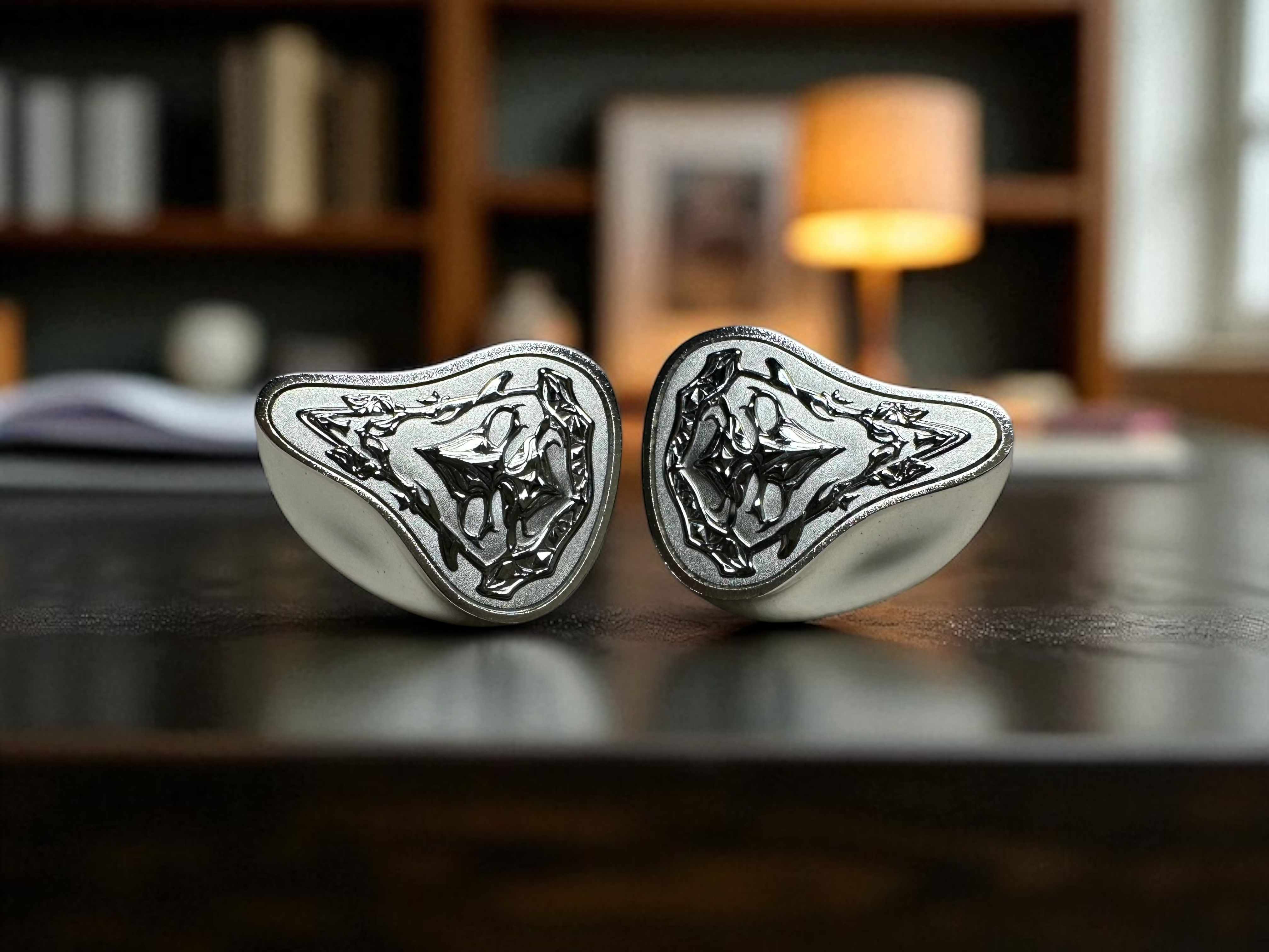
Comparisons with Ultimate Ears IEMs that Thorking takes inspiration from.
Ultimate Ears UE18+ Pro (2nd Gen).
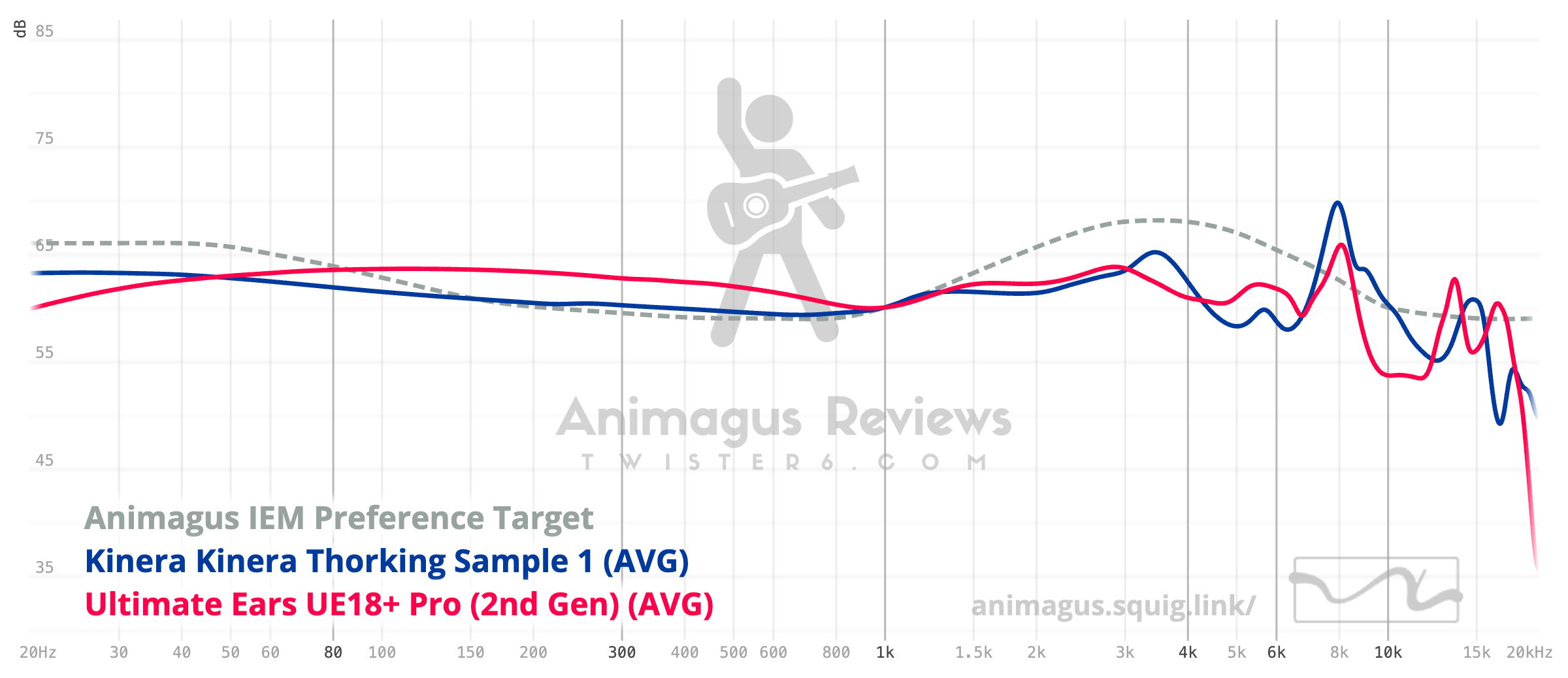
The UE18+ Pro 2nd Gen represents Ultimate Ears’ take on what was marketed as a “musician’s stage monitor” and was far from a truly neutral reference sound. It has a similar V-shaped signature as Thorking, with a slightly relaxed upper midrange and a deep, smooth low end that supports on-stage cues like kick drums and bass guitars. The treble is clean but relatively safe—rolled-off just enough to avoid sibilance, but at the cost of sparkle.
The Kinera Thorking takes UE18+ Pro 2nd Gen’s basic tuning concept and exaggerates it for a more hi-fi and fun-oriented flavour. Its bass has greater extension and slam compared to the UE18+, especially in the sub-bass region, making the Thorking sound more dynamic and cinematic. Meanwhile, its treble has more energy, shimmer, and air, which adds excitement.
In terms of ear gain, both IEMs share a similarly recessed upper midrange, which softens vocals and electric guitars. However, Thorking’s gain is better around 3kHz but dips deeper in 4.5-6.5kHz, making it sound tonally right at first with acoustic instruments (relatively) but more hollow and V-shaped because of the latter. Technically, the Thorking pulls ahead with its wider stage, more holographic imaging, and greater detail retrieval and there is just no competition between the two in today’s world as Ultimate Ears have been falling behind in keeping up with today’s driver driver, technical and technical performance standards.
Ultimate Ears Reference Monitor (UERM).
The UERM holds cult status for its balance between neutral clarity and musicality amongst its fanbase. Among the three UE models, it’s the most “reference-leaning,” with a tighter low end (still mid-bass oriented), more present upper mids, and a subtle but clean treble extension. It still does not adhere to true Diffuse Field or tilted DF tuning – its ear gain is modest – but it renders vocals and instruments with more life than either the UERR or UE18+ in comparison.
Compared to the UERM, the Thorking sounds much more V-shaped and considerably more colored. It outperforms the UERM in bass depth, sparkle, and staging grandeur, but loses out when it comes to midrange articulation, instrument timbre, and tonal balance. The UERM’s more even and precise delivery makes it better for mixing and critical listening, especially in mid-centric recordings.
In technicalities, Thorking again impresses with wider staging, stronger dynamics, and more air, but it doesn’t have the same tonal cohesiveness or naturalness that the UERM manages despite its age. The UERM doesn’t try to be fun – it aims to be honest as far as it could with its imperfect tuning – and it accomplishes that more successfully than Thorking, even if the latter has a stronger “wow” factor on first listen and might be preferrable to the majority. Neither are true Reference IEMs to be honest and if a reference IEM is what you’re looking for, I’d advise to look elsewhere.
Ultimate Ears Reference Remastered (UERR).
The UERR was Ultimate Ears’ answer to professional monitoring – a remaster of their original UERM with a more refined tuning. It maintains a relatively flat bass shelf, a gentle rise in the upper mids, and a smooth but rolled-off treble, resulting in a signature that many describe as “neutral-warm.” However, as with all UE IEMs, the ear gain region remains under-emphasized, leading to a vocal and guitar presentation that lacks energy and clarity compared to IEMs tuned to a true Diffuse Field target.
The Kinera Thorking shares this characteristic but does it better, resulting in a MUCH better take on the house tuning. Compared to the UERR, Thorking’s bass is more physical and fun, and its treble is far more extended and brilliant. While the UERR is smoother and more forgiving, Thorking sounds more lively and expressive.
Technically, the Thorking has the edge in micro-detail extraction, imaging precision, and stage width, whereas the UERR presents music in a warmer manner that is servicing the warm monitoring folks. For accurate studio referencing or vocal-centric listening, I cannot recommend either. But for cinematic immersion and modern genres, the Thorking delivers a more thrilling ride.
Ultimate Ears Comparison Summary.
While the Ultimate Ears UERM, UERR, and UE18+ Pro were often mistakenly marketed as true reference IEMs, they share a common design flaw: recessed ear gain. This puts them in the same camp as the Kinera Thorking, which also abandons the Diffuse Field theory in favor of a flat midrange dip, trading accuracy for a smoother or more fun signature. Thorking takes this approach further by offering greater bass and treble extremes, larger staging, and more detail, but in doing so, it sacrifices tonal fidelity and instrumental timbre.
Ultimately, Thorking feels like a spiritual successor to the UE house sound, but reimagined with modern audiophile flair and technical upgrades. It’s not a tool for mixing or reference-grade balance – but as a statement of musical energy, spaciousness, and engaging coloration, it makes a thunderous impression.
Comparisons with other IEMs.
Kinera Loki Emerald.
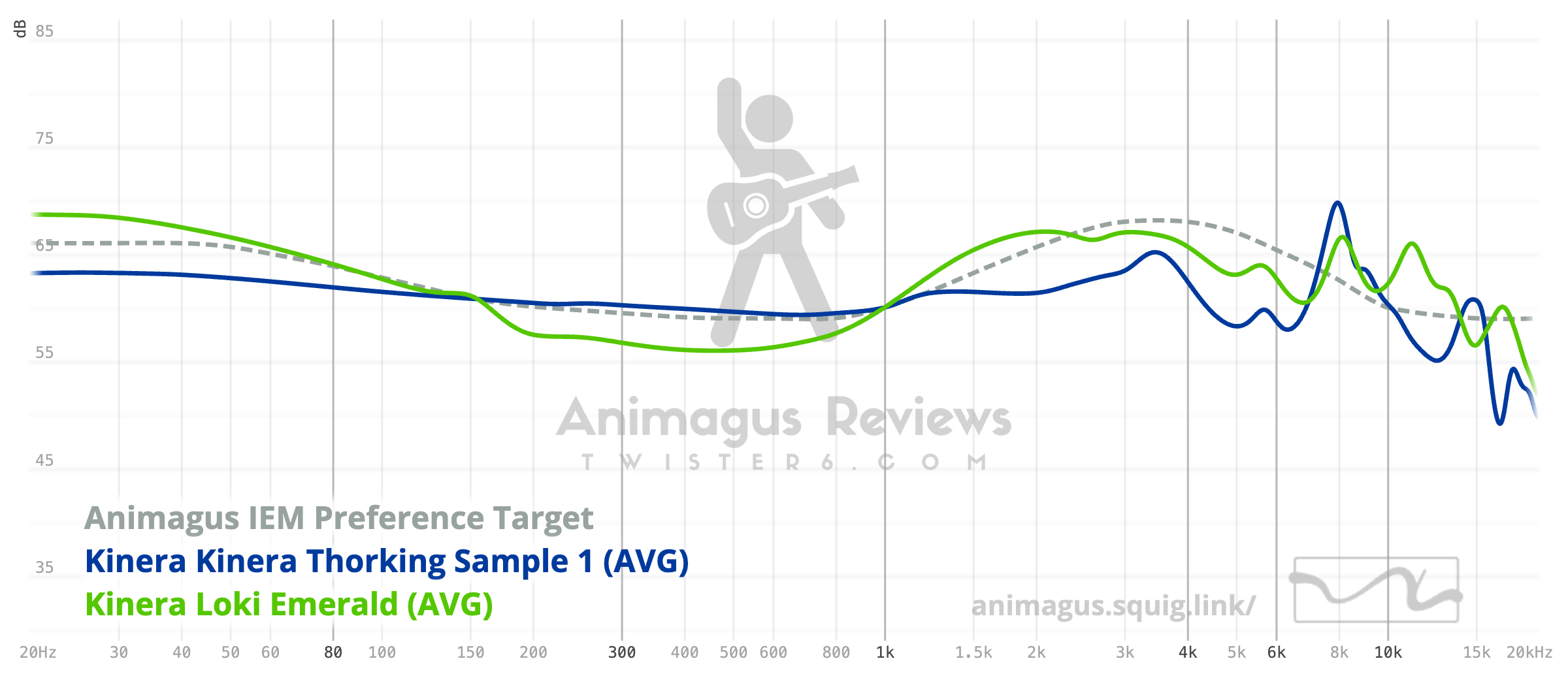
Kinera Loki Emerald and Thorking couldn’t be more different in philosophy, despite sharing the same Imperial bloodline. Where Loki Emerald is a carefully balanced, high-fidelity monitor with a mature sense of tonal contrast, Thorking feels like a deliberately bold deviation, created to impress on impact and scale rather than coherence and realism.
Loki Emerald’s tuning walks a very refined tightrope – it’s mildly W-shaped, with a present midrange that brings instruments and vocals forward, while keeping treble energy vivid yet smooth. It’s a masterclass in how to balance resolution and musicality. The Thorking, in contrast, goes full V-shape. Its recessed ear gain region makes the midrange feel hollowed-out, distancing vocals and muting the natural bite of instruments like electric guitars and horns. That alone gives the two IEMs wildly different personalities: Loki draws you into the heart of the music; Thorking plays from the side of a grand stage, washing you with light and bass.
Technically, Loki also pulls ahead. Its timbre is superior – more lifelike and true-to-source. Acoustic instruments sound believable; Thorking can sometimes feel like it’s applying a filter over the music, adding a synthetic sheen to certain textures. Loki’s soundstage has more depth but Thorking feels wider. Imaging, micro-detail extraction, and layering are also more precise on the Loki.
Still, Thorking isn’t trying to compete on Loki’s terms. It’s going after a visceral, fun-first sound – cinematic, grand, and unapologetically coloured. But in critical listening, Loki emerges as the more complete and satisfying choice for detail-focused ears.
Kinera Verdandi.
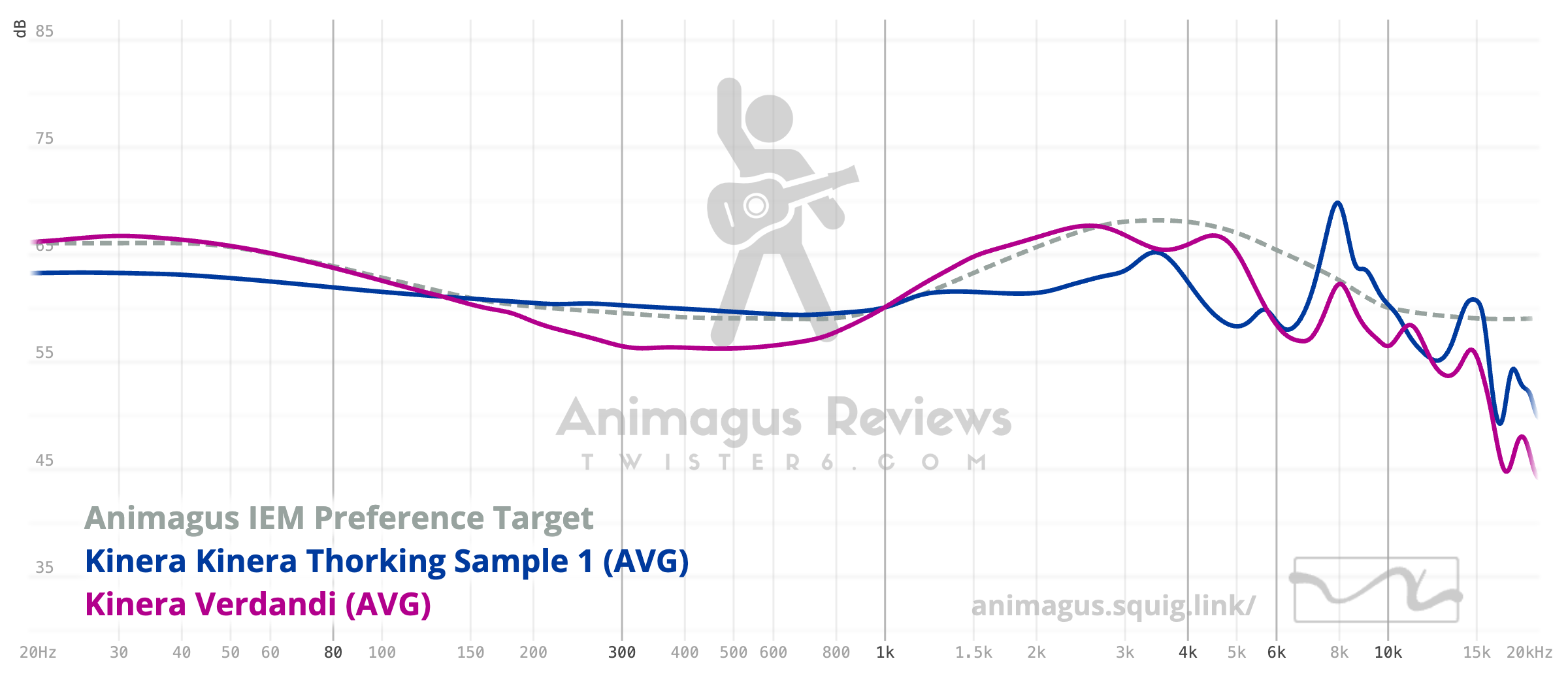
While Loki represents Kinera’s technical peak, Verdandi is their balanced all-rounder – an IEM tuned to appeal to both casual and critical listeners alike. In comparison, Thorking feels more specialised, geared toward listeners who crave a bold, exaggerated sound.
Verdandi’s tuning is more U-shaped, but with far better midrange presence than Thorking. Vocals are forward and instruments like pianos and strings retain their natural attack and decay. Thorking’s midrange, by comparison, feels recessed and softened – muting the bite of lead guitars and placing vocalists a few rows back on the stage. This results in Verdandi having a more realistic timbre, particularly for genres like acoustic, jazz, or singer-songwriter content.
In the bass department, Thorking has the advantage in sub-bass reach and slam. Its low-end presentation is more tactile and atmospheric. Verdandi, while still impactful, feels more restrained and technically disciplined in the lows. For those who enjoy cinematic, EDM, or trap, Thorking’s bass is more emotionally engaging – but Verdandi is more versatile across a wider range of genres. Treble response is brighter and airier on the Thorking, offering more sparkle and space. Verdandi is smoother up top, and while it may feel less exciting in the upper registers, it also avoids fatigue more effectively in longer sessions. Staging on Thorking is wider, while Verdandi has better front-to-back layering. The sense of scale is more immersive on Thorking, but instrument separation and depth are superior on Verdandi. Ultimately, if you’re after coherence, timbral fidelity, and tuning maturity, Verdandi makes a stronger case. Thorking is for when you want your music to sound larger than life.
Empire Ears Odin.
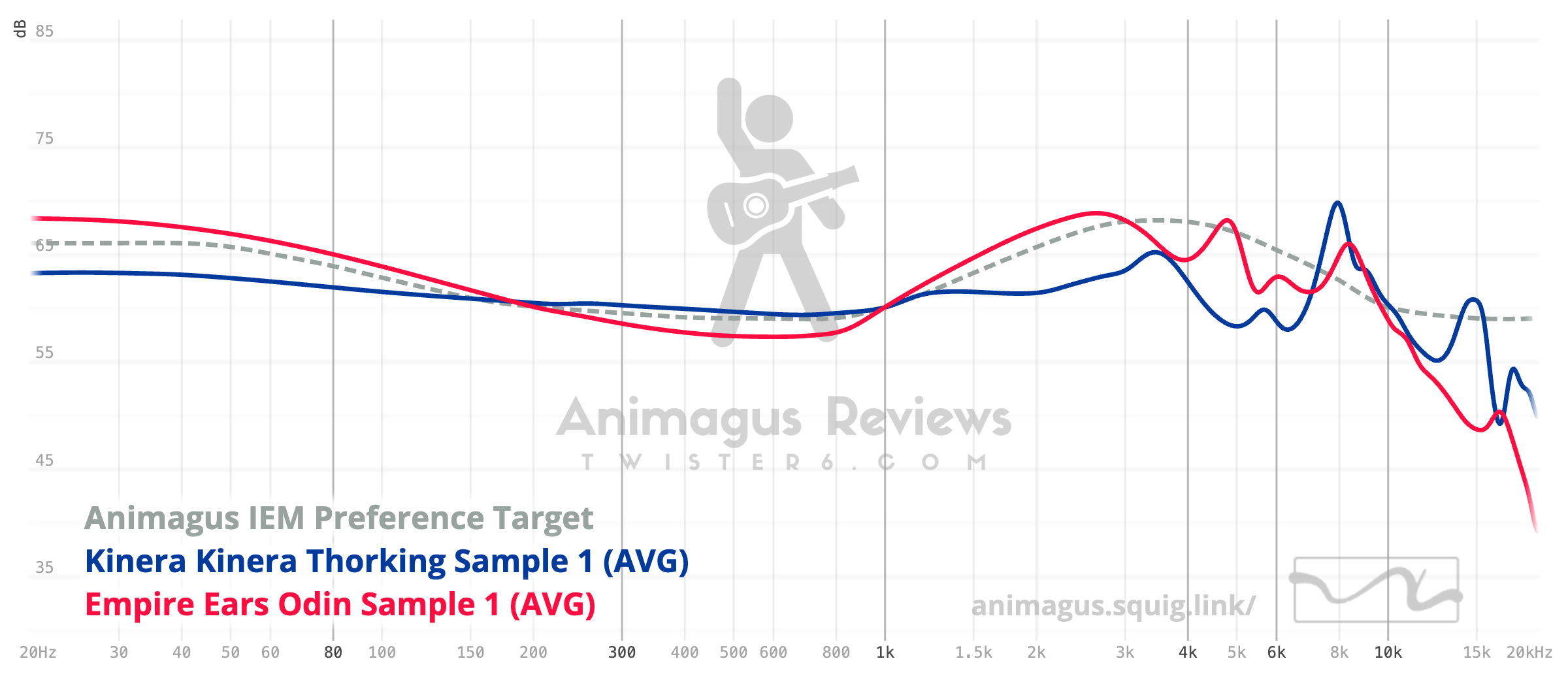
The Empire Ears Odin is a modern classic—revered for its flagship-level tuning, tri-brid architecture, and an engaging balance of musicality and technicality. It follows a neutral-bright signature with elevated sub-bass, forward upper mids, and a treble region that sparkles without crossing into fatigue, provided the source synergy is right. Its most distinctive trait is the “W-shaped” tuning – bass, mids, and treble are all given spotlight at different frequency zones, lending it both energy and balance. The Kinera Thorking, on the other hand, walks a bolder, more V-shaped path. It has a more recessed midrange, especially in the ear gain region, which robs vocals and guitars of presence and attack. Compared to Odin, Thorking comes across as more cinematic and grand, with a heavier bass slam and brighter treble peaks that shimmer vividly. But where Odin feels meticulously tuned with finesse and polish, Thorking leans into raw, visceral impact at the cost of coherence and tonal realism.
In terms of bass, Thorking’s low end has more weight and rumble, particularly in the sub-bass. It’s built for visceral enjoyment. Odin, while also having excellent sub-bass via its dual W9+ dynamic drivers, maintains more discipline – it hits hard when needed but doesn’t dominate. Odin’s bass is better integrated, tighter, and faster, with more nuanced layering. The midrange is the biggest point of divergence. Odin has a relatively forward midrange, especially in the upper mids, allowing vocals and instruments like guitars and violins to shine with texture and authority. In contrast, Thorking’s deep dip in ear gain pushes these elements back, resulting in a more hollow midrange presentation. Electric guitars lack their bite, and vocals—while clean—feel emotionally distant compared to Odin’s vibrant delivery. Treble-wise, both IEMs sparkle, but Odin’s EST treble is more refined and controlled, offering air and microdetail without overwhelming the listener. Thorking’s treble is more emphasized and energetic, creating a highly engaging top-end but at times bordering on fatiguing depending on the track and source. Odin also edges out Thorking in textural treble resolution, making cymbals and strings sound more realistic and layered.
On the technical front, both IEMs perform impressively, but Odin takes the lead in most categories. Its imaging is sharper, layering more defined, and the stage has more depth despite Thorking’s wide lateral spread. Odin also delivers a black background, especially when paired with TOTL sources, helping each note emerge with clarity and contrast. Thorking’s stage is wide and immersive, but less holographic; its imaging, while good, lacks Odin’s pinpoint precision and spatial separation.
Where Odin presents a mature, refined, and emotionally engaging tuning, Thorking trades that for sheer fun and bombast, especially suited to modern genres like electronic, EDM, and cinematic soundtracks. Thorking can feel overwhelming in its contrasts, while Odin feels more measured and organic. In many ways, Thorking is the brash, theatrical cousin to Odin’s stoic precision and poise. While both excel at technical performance, their tuning philosophies diverge—Odin aims for balance and resolution with musicality, while Thorking embraces a dynamic and exaggerated curve for maximum impact. Listeners looking for a more accurate, emotionally connected experience will likely prefer Odin. But for those craving a larger-than-life presentation with thunderous lows and glittering highs, Thorking delivers its namesake’s hammer blow with authority.
64 Audio U12t
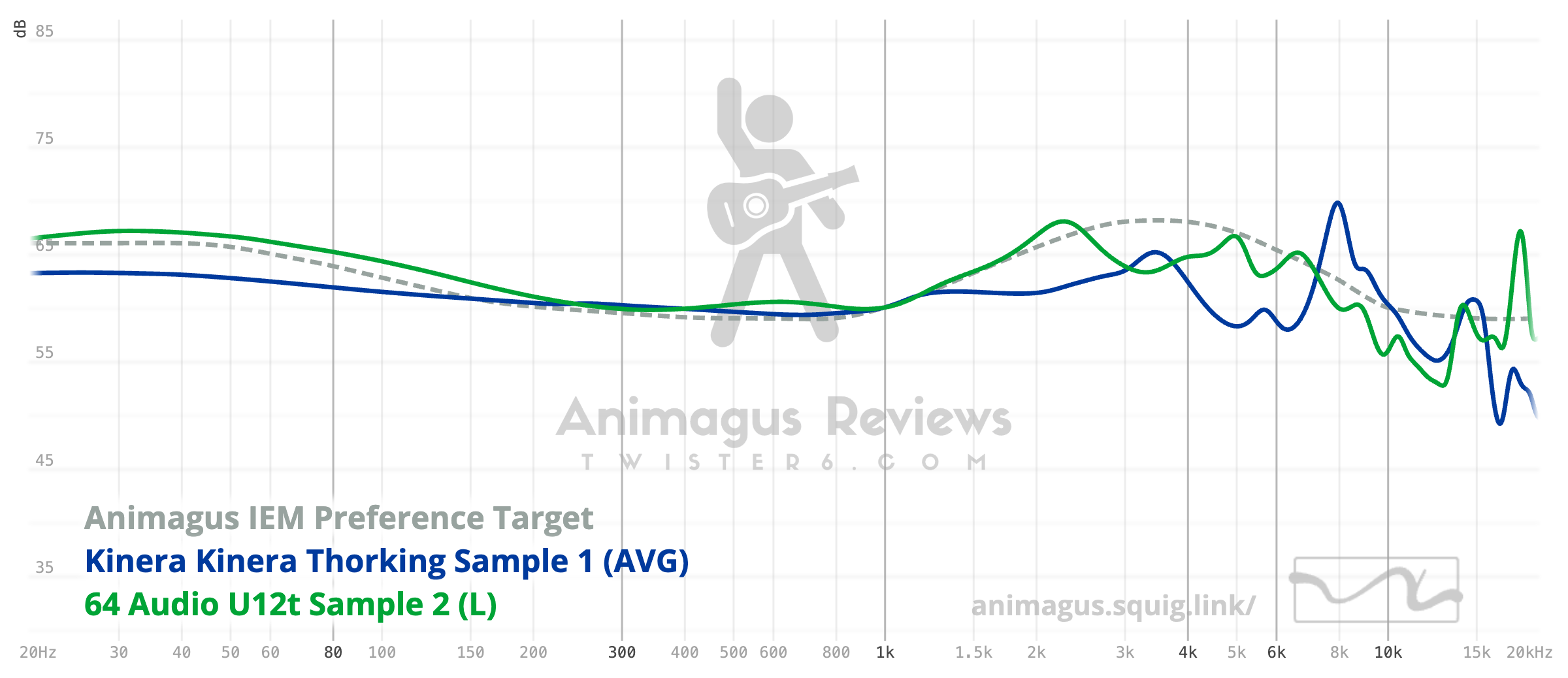
The 64 Audio U12t is a standard bearer in the world of reference tuning with musicality, and putting it next to Thorking reveals just how far apart they are in their intent. U12t is about tonal accuracy, texture, and a dynamically nuanced presentation. Thorking is about scale, impact, and color.
U12t’s bass is among the most refined in any IEM. It doesn’t hit as hard as Thorking in terms of sub-bass quantity, but it is cleaner, faster, and better defined. It layers effortlessly – every thump of a kick drum, every pulse of a bass guitar has a clarity that Thorking’s heavier-handed tuning can’t match. That said, Thorking’s bass is more cinematic—more of a physical experience than an analytical one. Where the comparison tilts strongly in U12t’s favor is in the midrange. U12t has a masterfully tuned ear gain region that gives vocals and instruments a natural forwardness without shoutiness. By contrast, Thorking’s recessed upper mids feel like a conscious sacrifice, causing guitars to lose crunch and vocals to sit unnaturally far behind the instrumentation. U12t delivers emotion through articulation; Thorking delivers drama through staging and contrast. Treble is also handled differently. U12t’s treble is crisp, detailed, and safe—almost understated but extraordinarily clean. Thorking’s treble has more sparkle and a brighter upper edge, giving it a more hi-fi sheen. On the surface, it may seem more exciting, but U12t reveals more microdetails once you acclimate.
In terms of technicalities, U12t is simply in a different league: imaging, layering, staging depth, dynamic range – it wins across the board. Thorking’s wide stage may briefly impress, but U12t’s holographic placement and detail resolution are more complete.
Elysian Annihilator.
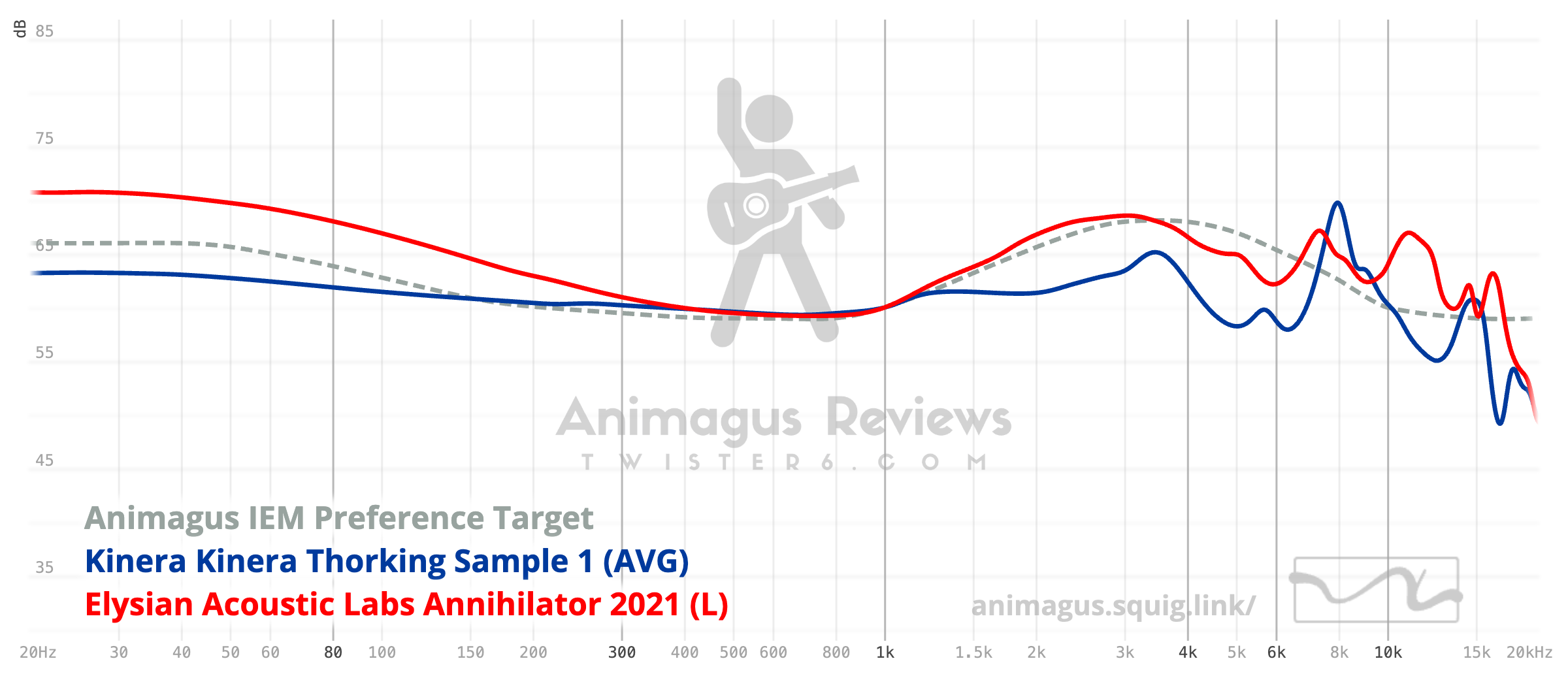
Comparing Thorking to the Annihilator is a study in treble execution and energy handling. The Annihilator is known for its stunning treble extension, surgical transients, and lightning-fast dynamics. It delivers music with fierce clarity and top-end brilliance, making it one of the most exciting IEMs to hear – if your ears can handle it.
Thorking takes a more aesthetic, cinematic approach. Its treble is sparkly and shimmering, but with a smoother rise and a gentler edge. It doesn’t match Annihilator’s air or speed, but it’s also far less fatiguing. If you find Annihilator too aggressive in long sessions, Thorking’s top-end may actually be more listenable. The midrange differences are stark. Annihilator’s mids are present and articulate – even if slightly dry at times, they retain their shape and frontality. Thorking, on the other hand, pulls mids back significantly, making guitars, vocals, and strings sound more ambient and less immediate. Annihilator may fatigue with treble, but it engages emotionally through its forward midrange – something Thorking struggles with due to its tuning dip. Bass is the one area where Thorking clearly edges ahead. While Annihilator has punch and speed, it lacks sub-bass weight and physicality. Thorking’s bass is deeper and more resonant—more enjoyable for low-end heavy tracks.
Technically, Annihilator is sharper and more precise in imaging and detail retrieval, while Thorking is broader, more relaxed, and tuned for grandeur rather than surgical accuracy.
Craft Ears Omnium.
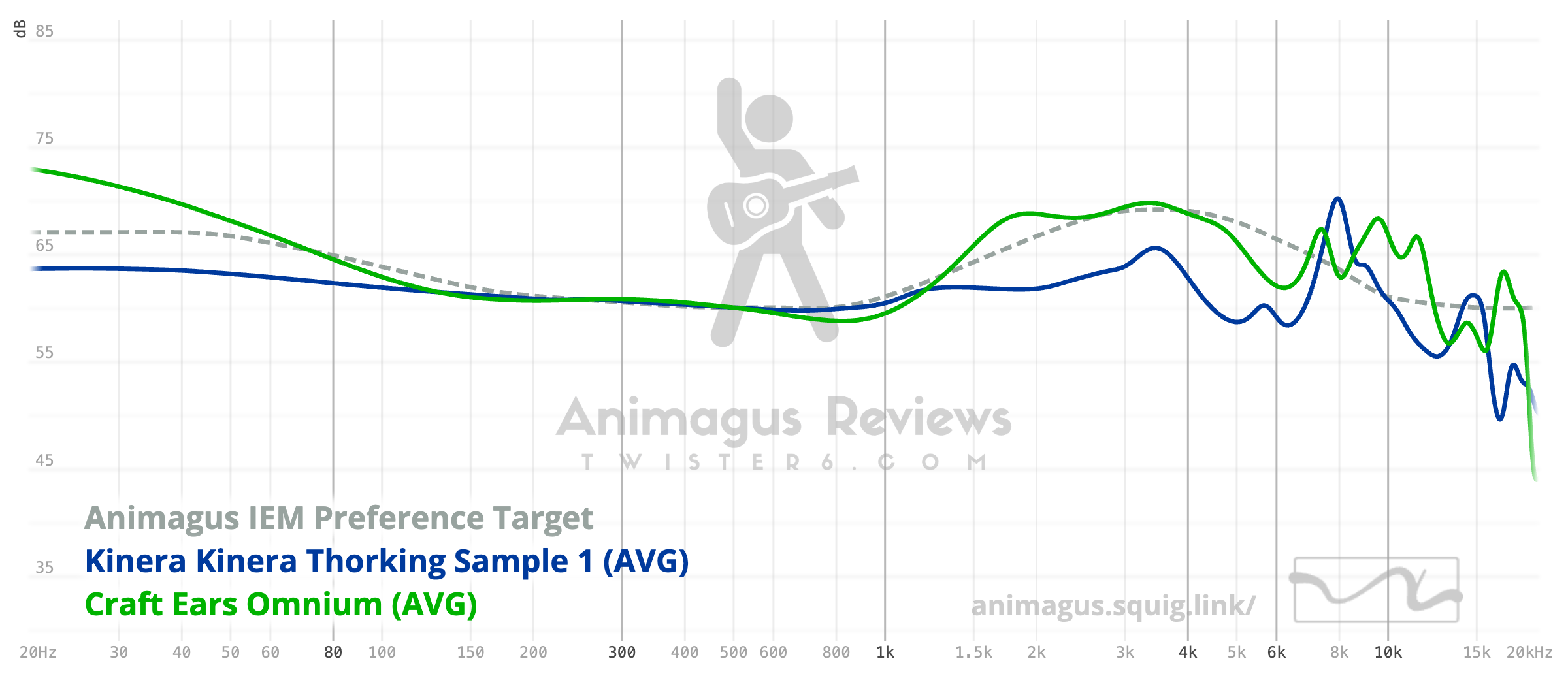
Craft Ears Omnium is a more neutral-reference monitor, offering beautifully natural timbre and a balanced presentation that handles everything from vocals to orchestral arrangements with confidence. Thorking is bolder, darker, and more V-shaped – almost the sonic opposite.
Midrange and timbre is where Omnium runs laps around Thorking. Instruments on the Omnium sound alive – woodwinds, strings, brass all possess the right tone, weight, and air. Thorking by comparison sounds processed in this region; not unnatural per se, but dulled, like a photo with low contrast. Vocals on Omnium are centered and clear; on Thorking, they take a step back. In the bass department, Thorking dominates in sheer presence. Its sub-bass rumble is satisfying and immersive, whereas Omnium’s low-end is more studio-grade: fast, clean, and dry. Thorking’s approach is more consumer-friendly and euphoric, Omnium’s more accurate and refined. Treble on Omnium is soft but detailed, while Thorking offers more sparkle and perceived air. For genres needing openness and space, Thorking may sound more exciting. But Omnium is more consistent across track types, and safer over long sessions.
In staging, Thorking feels wider, while Omnium offers better depth and positional realism. Omnium is better for dissecting complex recordings; Thorking is better for enjoying cinematic sweeps.
Symphonium Europa.
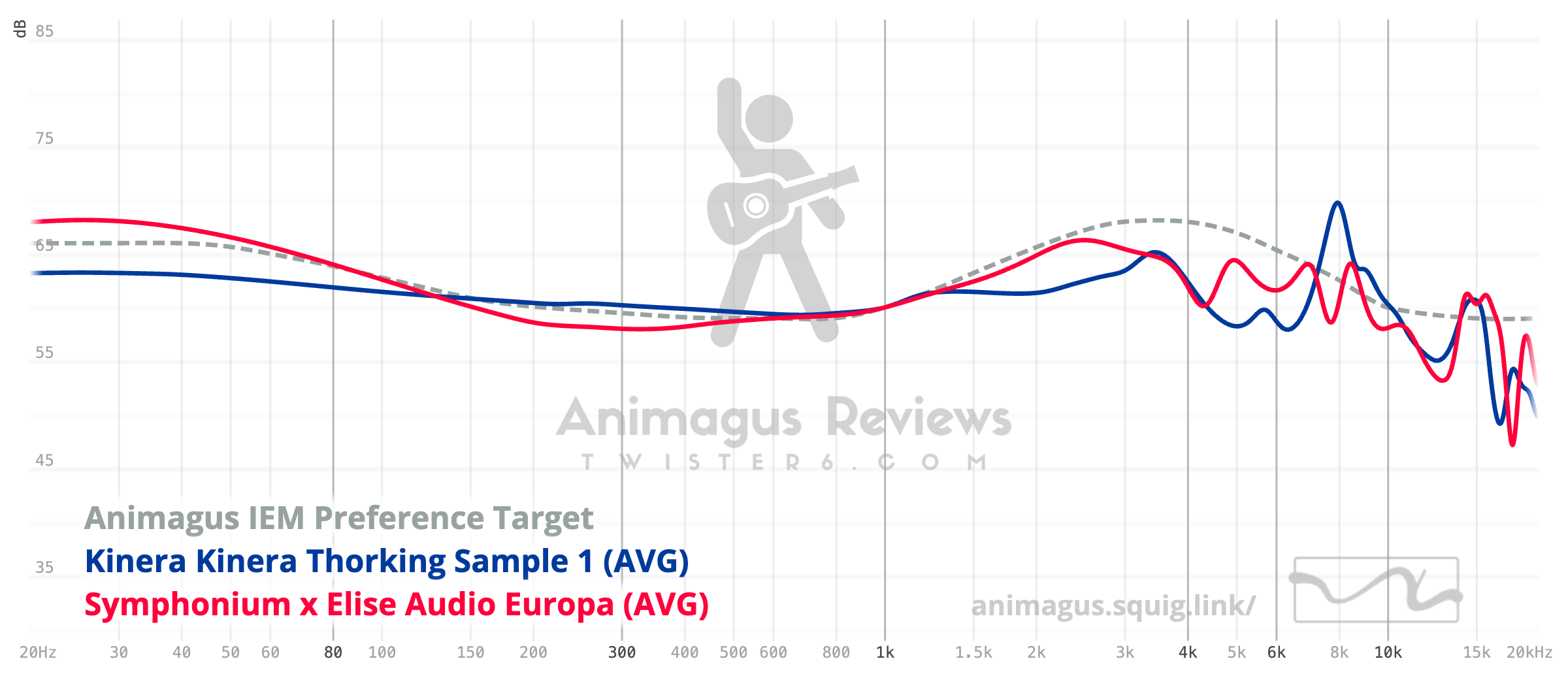
Symphonium Europa is one of the most natural, mid-forward IEMs in its class. It emphasizes vocal clarity and instrument realism, offering a sound that feels honest and emotionally involving. Thorking is the antithesis of that – it prioritizes scale, sparkle, and low-end weight over midrange presence and tonal fidelity. Midrange is the biggest point of divergence. Europa’s vocals are front and center – clear, full-bodied, and emotionally immediate. Guitars and piano have presence and bite. Thorking’s recessed upper mids, on the other hand, take the edge off these instruments and vocals, creating distance and a sense of detachment. If you listen to a lot of vocal jazz, indie rock, or acoustic music, Europa is clearly superior. In terms of bass, Thorking is more fun and impactful. It digs deeper and slams harder, especially in sub-heavy tracks. Europa is tighter and cleaner but can feel a little dry in comparison, particularly in modern electronic music or hip-hop. Treble is another area of contrast – Thorking is brighter, airier, more hi-fi tuned, while Europa is smoother and more integrated. Thorking gives more shine to strings and cymbals, but Europa sounds more cohesive across the frequency spectrum. Soundstage is wider on Thorking, while Europa offers better depth and intimacy. For vocal intimacy and realism, Europa wins. For scale and energy, Thorking takes the edge.
Conclusion.
The Kinera Imperial Thorking is a curious case. It doesn’t try to be a crowd-pleaser like Loki Emerald or an all-rounder like Verdandi. It is a bold and unconventional flagship IEM that blends mythological design with a striking V-shaped tuning. Its sonic signature takes cues from Ultimate Ears’ lineage as well as the early Audeze house sound but pushes the contrast further – emphasising deep, fun bass and shimmering treble, while carving out a noticeably recessed ear gain region. This tuning gives it a spacious, wide soundstage and excellent detail retrieval, but comes at the cost of timbral accuracy and midrange presence. Vocals and electric guitars, in particular, lose some bite and intimacy, making Thorking a technically impressive but tonally polarising listen. From a design perspective, Thorking is among Kinera’s most premium creations yet. The full-metal shell sculpted, engraved, and polished by hand exudes craftsmanship and mythic grandeur. Comfort is surprisingly good and isolation is solid for a vented hybrid. The unboxing experience is lavish and so is the accessory selection. For those seeking a uniquely tuned, visually stunning flagship that doesn’t follow the beaten path, Thorking stands as a memorable and thunderous offering in Kinera’s growing pantheon – it’s fun, detailed, and visually striking, but with tuning choices that might alienate purists.

 Twister6 Reviews