

A Modern Take on a Flawed Legacy.
PROS: Extremely comfortable and compact shells with excellent isolation, Very smooth fatigue-free sound signature suited for long sessions, fairly good 3D printed build and practical cable design, non-fatiguing.
CONS: Very warm, downward-sloping tonality is not neutral or truly “studio reference”, Ear gain is muted, Treble is rolled-off and lacks air and sparkle – can feel dull and veiled compared to modern neutral IEMs. Naming (“studio”) is misleading for what the tuning actually delivers.
Official Links – Softears Studio 2 ($169)
Introduction.
Softears has been one of the most consistently interesting manufacturers in the high-end IEM scene. Their releases tend to carry a clear philosophy—whether it’s the tuning accuracy of RSV, the single-DD purity of Twilight, or the reference flagship technical fireworks of RS10. When they announced the Studio 2, the name alone carried strong expectations, just like it did with Studio 4. To many audiophiles, studio implies neutrality, flat response, and reference-level monitoring. Something closer to Etymotic Reference series than consumer “fun” tunings.
When I saw the name Studio 2, my expectation was straightforward: a neutral, reference-style monitor aimed at engineers and critical listeners, perhaps something to rival the Etymotic ER4SR/XR. But then came the realisation—the Studio 2 isn’t Softears’ interpretation of neutrality. Instead of delivering an ER4 competitor, it is an evolution of the Shure SE house sound, a sound signature that has been both loved and criticized in equal measure over the past two decades – a sound signature that defined stage monitoring for over a decade, but also one that has been heavily criticized for being overly warm, mid-bloated, and treble-shy.
With so much criticism and trolling of the Shure house sound, one begs the question – Should Softears have gone down this road at all?
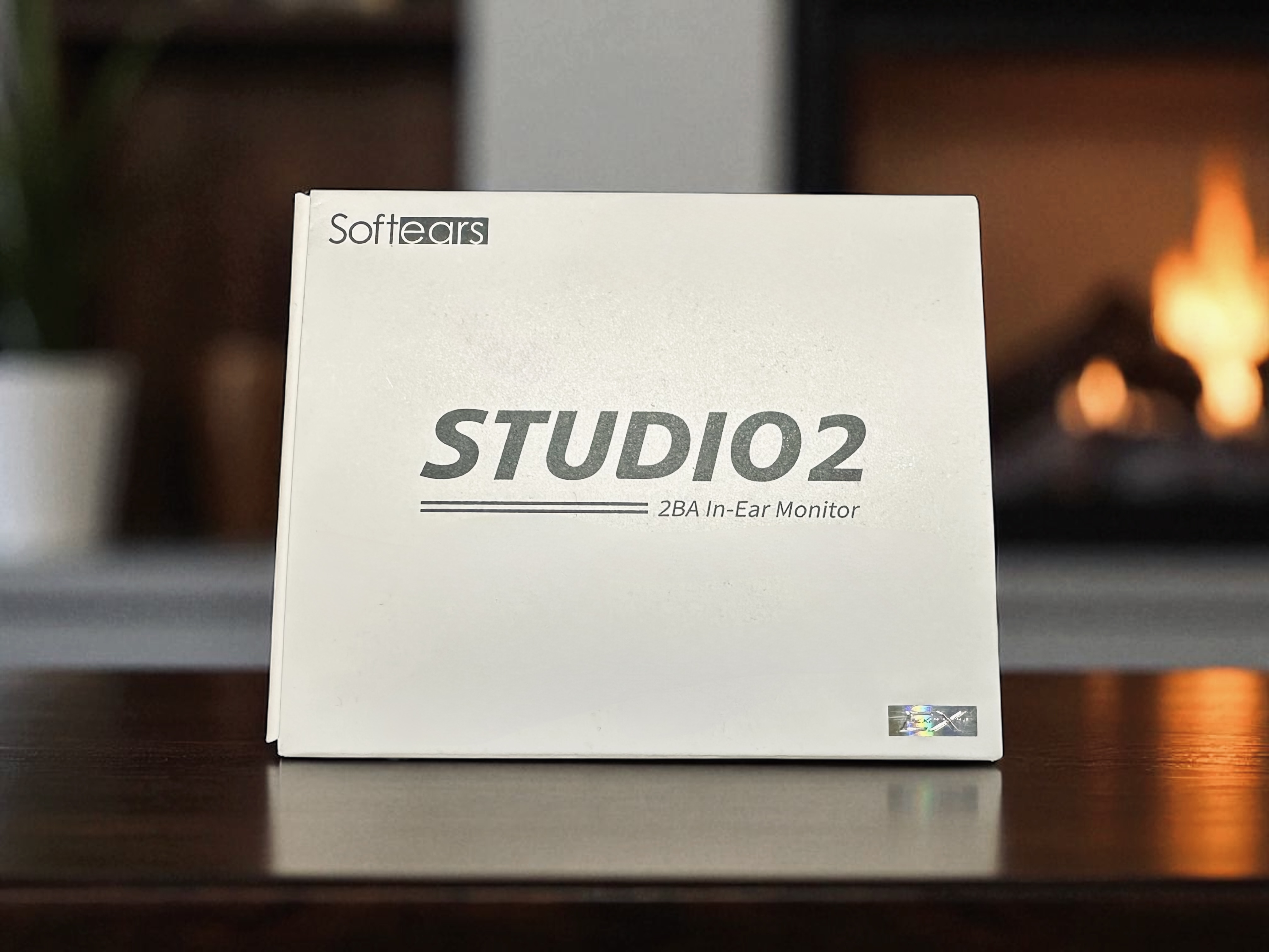
Technical Specs.
- Impedance: 86Ω@1kHz.
- Sensitivity: 127dB/Vrms.
- THD+N: ≤1%@1kHz.
- Frequency Response Range: 5Hz~40kHz.
- Drivers: 2BA
- Tech: Upgraded 2+1 Acoustic Tube Structure, SoftPiral Technology, Hidden Sub-Bass Tube.
- Medical-Grade Resin Material Ear Shells.
- Eartips Slip-Resistant Nozzle Locking Lip.
- Pure Copper Stock Cable.
- Two-Pin 0.78mm Connectors.
- Universal 3.5mm Termination.
- Shockproof and Waterproof Storage Case.
Build, Fit, and Comfort.
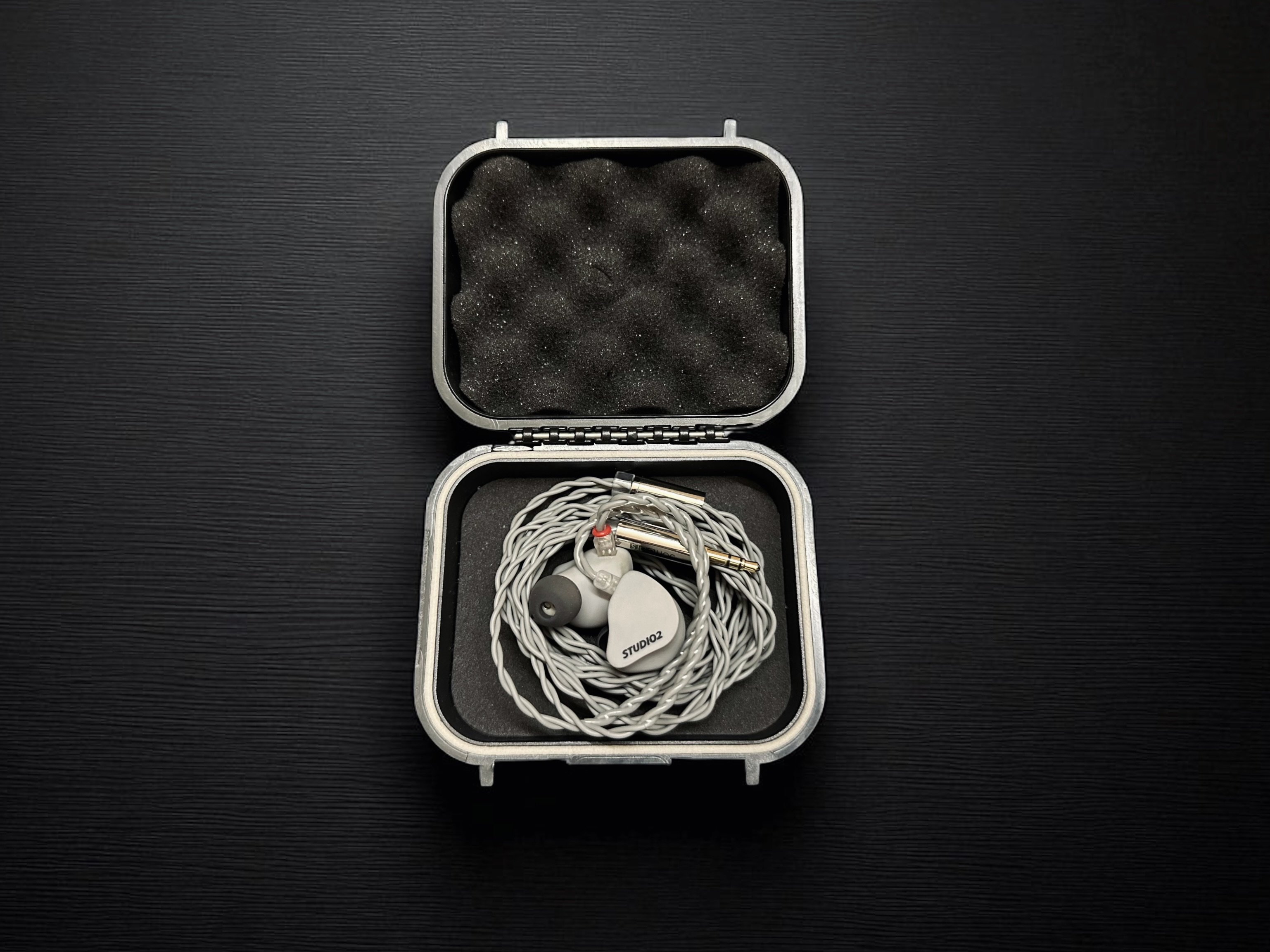
Softears continues to impress with fit and finish. The shells are simple, compact, rounded, and supremely comfortable – clearly inspired by classic stage monitors, but with a more modern aesthetic. The 3D printed resin work is flawless, the nozzles are short but secure, and isolation is excellent, making them one of the easiest Softears models to wear for extended sessions.
The included cable is supple, lightweight, and practical for on-stage or daily use. Nothing flashy here, just professional functionality. As with all Softears models, you get the sense of a manufacturer that values usability which can be seen in the excellently designed shockproof carry case.

Sound Analysis.
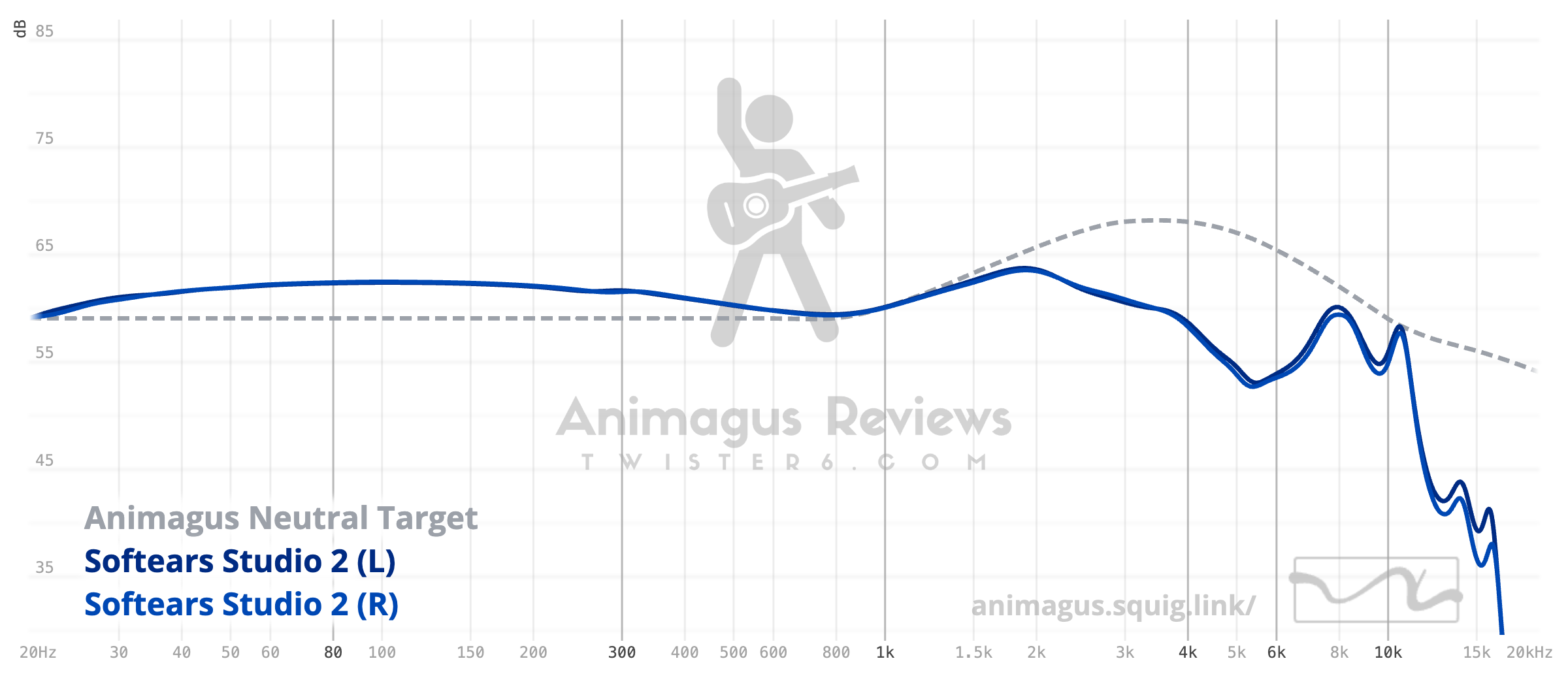
The Studio 2 follows the Shure blueprint: warm, downward-sloping, treble-softened, and lower-mid centric. Where Shure SE models were all over the place, with majority leaning into bloom, congestion, and rolled-off highs, Softears tried to smooth these flaws out but still, the fundamental issue remains – the tonality is not neutral, not reference, and certainly not “studio.” If you loved the Shure sound but wished for a modern equivalent, the Studio 2 delivers a fair sidegrade, one which is also cheaper. But if you’re coming in with expectations of flat neutrality or true reference-grade transparency, you’ll likely be disappointed.
Bass – The low end is thick and weighty, with a mid-bass emphasis that lends body to instruments but also clouds separation. Compared to Shure’s SE215, the Studio 2 has tighter control and avoids the outright mud, but it remains on the warm and bloomy side. Sub-bass reach is moderate, not class-leading, and the overall presentation prioritizes warmth over precision.
Mids – The lower-mids try to be the highlight while the ear gain takes a deep dive. Lower-mids are full and smooth – male vocals sound chesty, female vocals lush, and instruments like guitars and pianos carry a natural warmth. But the tuning tries to avoid all shout and harshness by going to the extreme end and dipping the extremely important region of 2-8kHz of ear gain – which is highly responsible for reference accuracy and natural timbre. While the mids are pleasing and devoid of any harshness, they are very far from reference-accuracy. They are too full, coloured, warm and enhanced. They flatter voices but do so by sacrificing transparency. For critical work, this would mask details. For casual listening, it’s a fatigue-free listen at all times, being way too safe.
Treble – Here lies the biggest drawback. The Studio 2 is subdued and rolled off in the treble, just like its Shure predecessors. Cymbals lose shimmer, air is lacking, and detail retrieval takes a step back compared to other Softears models. The upside is fatigue-free listening and long session comfort, but the downside is dullness and an overall lack of sparkle. This is where the Studio 2 most betrays the promise of its “Studio” naming. There is a gentleness to the top end that ensures zero fatigue, but the cost is a serious lack of resolution. Detail retrieval suffers, subtle room reverb cues are harder to hear, hi-hats blend into the mix, and the overall sound feels constrained rather than expansive.
This kind of treble tuning is intentional in Softears’ opinion – safe for long on-stage monitoring, forgiving of poor recordings – but it’s a strange choice for an IEM marketed as studio. True studio monitors must reveal flaws, not smooth them over.
Technical Performance.
Softears’ driver implementation elevates the Studio 2 well above its Shure predecessors.
- Resolution: Better than the Shure SE200-300 series, but still moderate compared to true reference IEMs like Softears RSV, Moondrop S8 or even the warmer reference Studio 4.
- Imaging: Precise left/right placement, but depth layering feels flattened due to the rolled-off treble.
- Soundstage: Narrow to medium width, with good centre focus but limited openness. The warm tonality keeps everything intimate.
- Dynamics: Softears avoids compression, but the restrained treble makes dynamics feel smoothed over. Crescendos don’t hit with explosive impact.

Comparisons.
Comparisons with Shure IEMs.
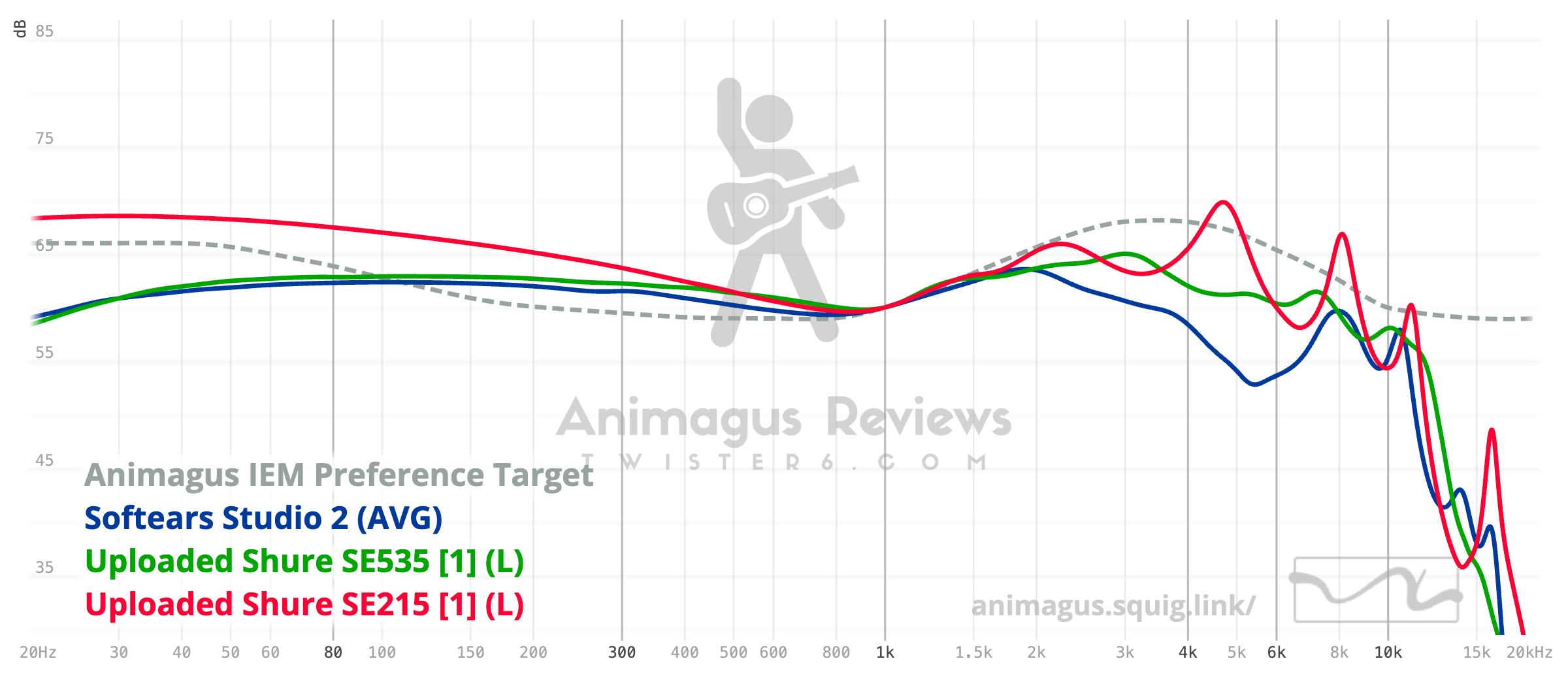
Shure SE215 – Softears Studio 2 can be described as a warmer take on the Shure SE215’s sound. The SE215 carries a heavy sub and mid-bass hump that bleeds into the lower mids, giving it a boomy, muddy character with congested vocals and uneven, splashy treble. Studio 2 trims back the excess bass, offering a tighter and cleaner low-end with mids that are clearer and more natural, especially for vocals. Its treble is smoother and far less fatiguing than the SE215’s, though also darker and rolled off, lacking air and sparkle. In practice, the SE215 sounds thick, shouty, and grainy, while the Studio 2 feels smoothened over tending dark but one that is slightly more technically competent in imaging, staging and separation but still stuck with a downward-sloping, muted tuning philosophy that keeps it from being truly neutral or “studio reference.”
Shure SE535 – The SE535 was Shure’s reference for many years — lush mids, rolled-off treble, and a warm stage-monitor voicing. The Studio 2 feels like a direct homage. Compared head-to-head, Shure SE535 is cleaner, less congested, with tighter bass and more articulate layering. Vocals sound clearer, instruments better separated. But the tonal DNA is unmistakably similar: warm, mid-focused, treble-shy. If you liked the SE535 but wished for a cheaper alternative, Studio 2 is exactly that. If you disliked SE535’s tonality, Studio 2 won’t change your mind.
Comparison with Etymotic target and IEMs.
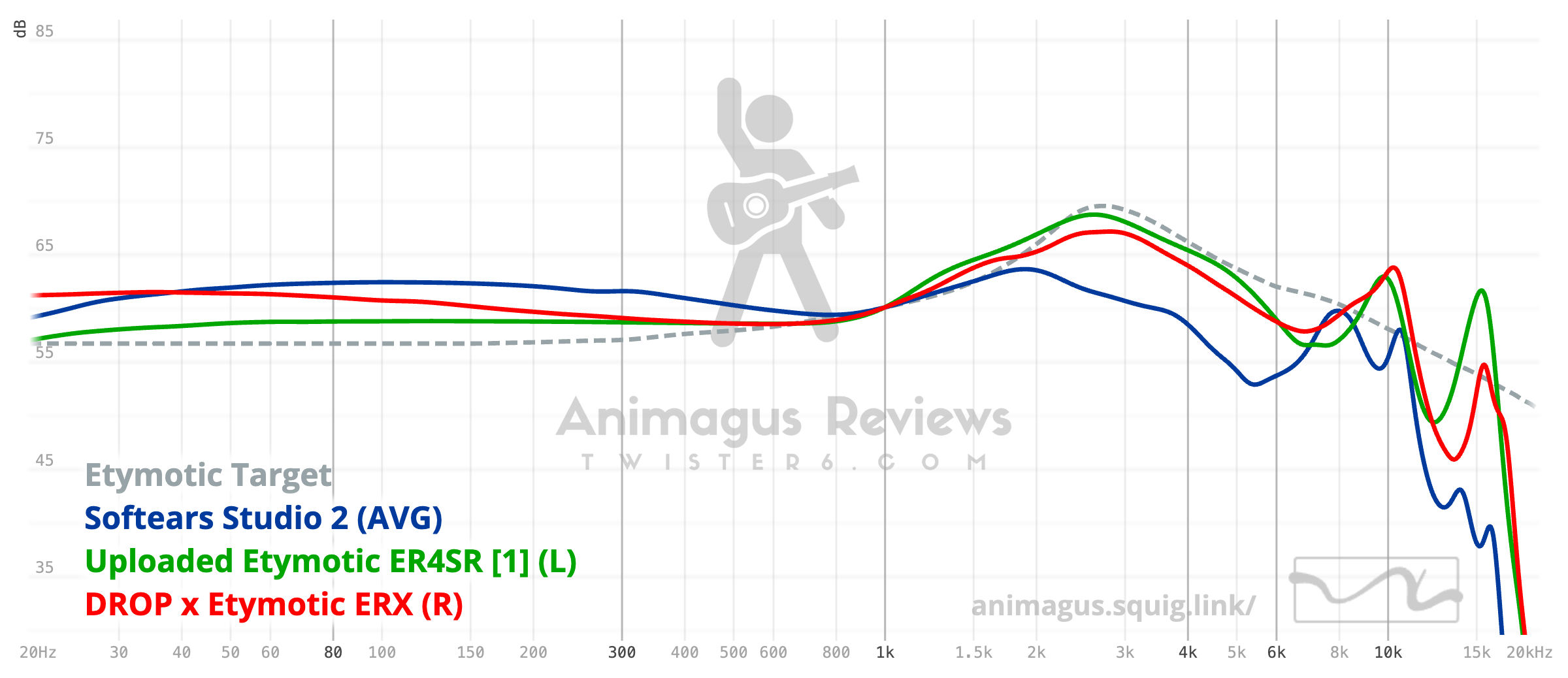
Etymotic ER4SR – The ER4SR is the gold standard of reference neutrality. Compared to Studio 2, the differences are night and day. ER4SR is flat, lean, and revealing, with precise bass, forward clarity in the mids, and treble that extends naturally without excess. Studio 2 by comparison is warm, mid-bloomy, and rolled-off, with much less detail retrieval. If you want accuracy, ER4SR is the clear choice. If you want comfort and warmth at the expense of precision, Studio 2 might still hold appeal — but they live on opposite ends of the tuning spectrum.
Drop x Etymotic ERX – The Softears Studio 2 and Drop x Etymotic ERX represent two very different philosophies of tuning, and that contrast is immediately obvious when comparing them. The ERX, true to its Etymotic lineage, follows a slight fun version of strict diffuse-field-inspired tuning with bass that extends linearly into the sub-bass with a slight sub and mid-bass lift, resulting in an ultra-clean, slightly punchier low-end presentation than Etymotic DF target. By contrast, the Studio 2 has a more noticeable sub-bass and mid-bass presence, giving it more warmth and weight, though at the expense of ultimate tightness. In the mids, ERX delivers razor-sharp accuracy with a forward, almost clinical vocal and instrument presence, whereas Studio 2 smooths things out with a much warmer midrange that favours extreme warmth for ease of listening over strict neutrality. Treble is where their philosophies diverge most: the ERX has a more neutral, more extended upper-treble that enhances air, detail, and spatial openness, while Studio 2 rolls treble off more steeply, keeping cymbals soft and inoffensive but also dulling air and sparkle. Technically, ERX excels in resolution, note definition, and imaging precision, making it more true-to-source, while Studio 2 trades off absolute detail for a much smoother presentation that feels way too forgiving in daily use. In short, the ERX is the surgical scalpel – precise, revealing, and uncompromising—while the Studio 2 is a very heavy brush on detail, offering a very smoothened over sound for a very easy fatigue free listen.
Softears Studio 4.
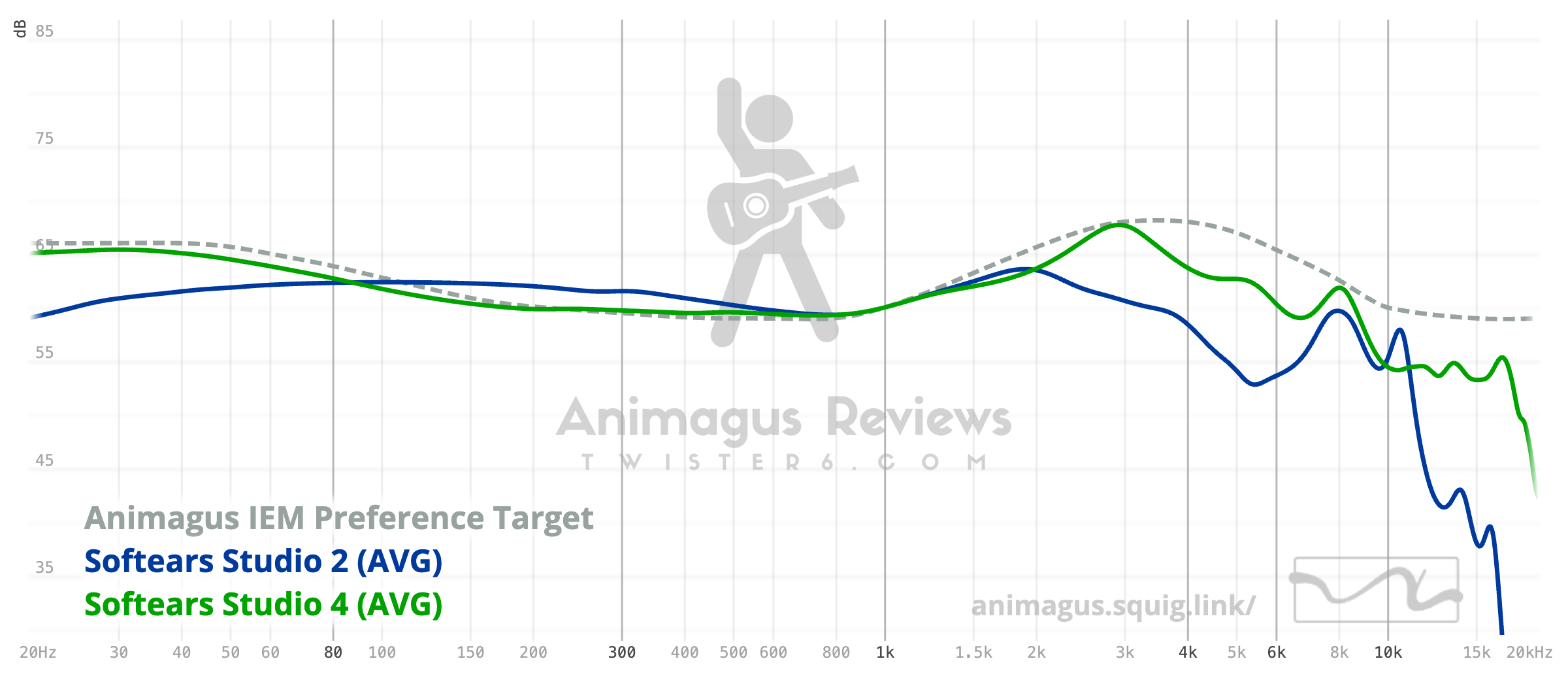
Now here’s where things get interesting. The Studio 4 is far more reference-oriented, with a flatter, more neutral tonality that feels genuinely suitable for professional monitoring. Compared to Studio 2, the Studio 4 is brighter, more transparent, and closer to the studio promise. Bass is tighter and less bloomy, mids less colored, treble more extended. Where Studio 2 flatters voices and smooths details, Studio 4 exposes them. If you want accuracy and neutrality, Studio 4 is the real studio tool; Studio 2 is the nostalgia piece.
Softears RSV.
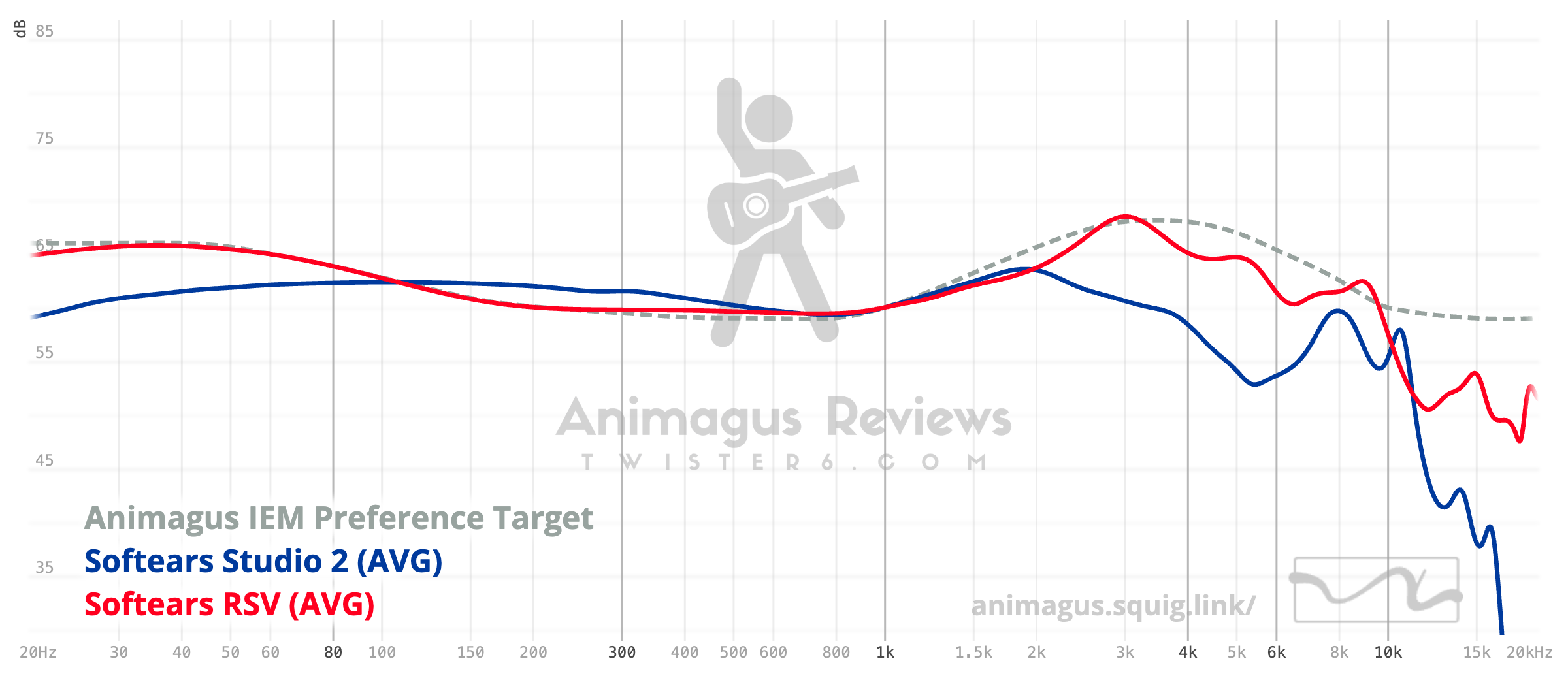
The RSV remains one of Softears’ most balanced tunings: slightly warm, smooth, but with good treble extension and a natural, reference-leaning midrange. Compared to Studio 2, RSV is less bass-bloomy, more resolving, and better extended up top. RSV’s treble avoids fatigue without dulling, giving it more air and detail. The Studio 2 sounds softer and less revealing in direct comparison. For mixing or reference work, RSV is much closer to neutral. For vocal lovers who want that lush mid warmth, Studio 2 may still appeal — but RSV is the more versatile choice.
Softears Volume S.
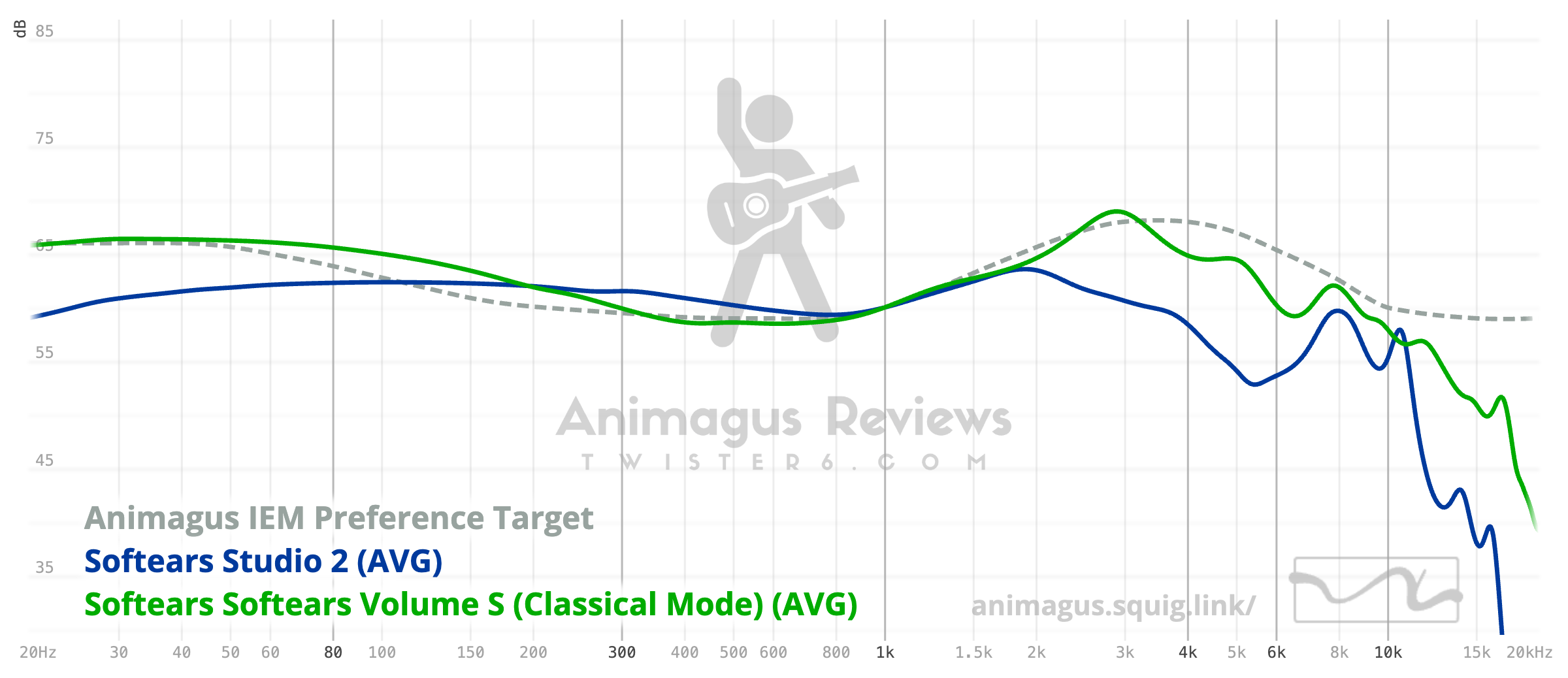
The Volume S is tuned as an energetic, consumer-friendly all-rounder. Compared to Studio 2, Volume S is brighter, punchier, and more exciting. Bass has more sub-bass kick and less mid-bass bloom, treble more sparkle and air. Volume S can get fatiguing over long sessions, while Studio 2 never does — but Studio 2 also feels veiled and restrained in comparison. If you want engagement and dynamics, Volume S wins. If you want relaxed listening, Studio 2 is safer, though less technically impressive.
BGVP DMA.
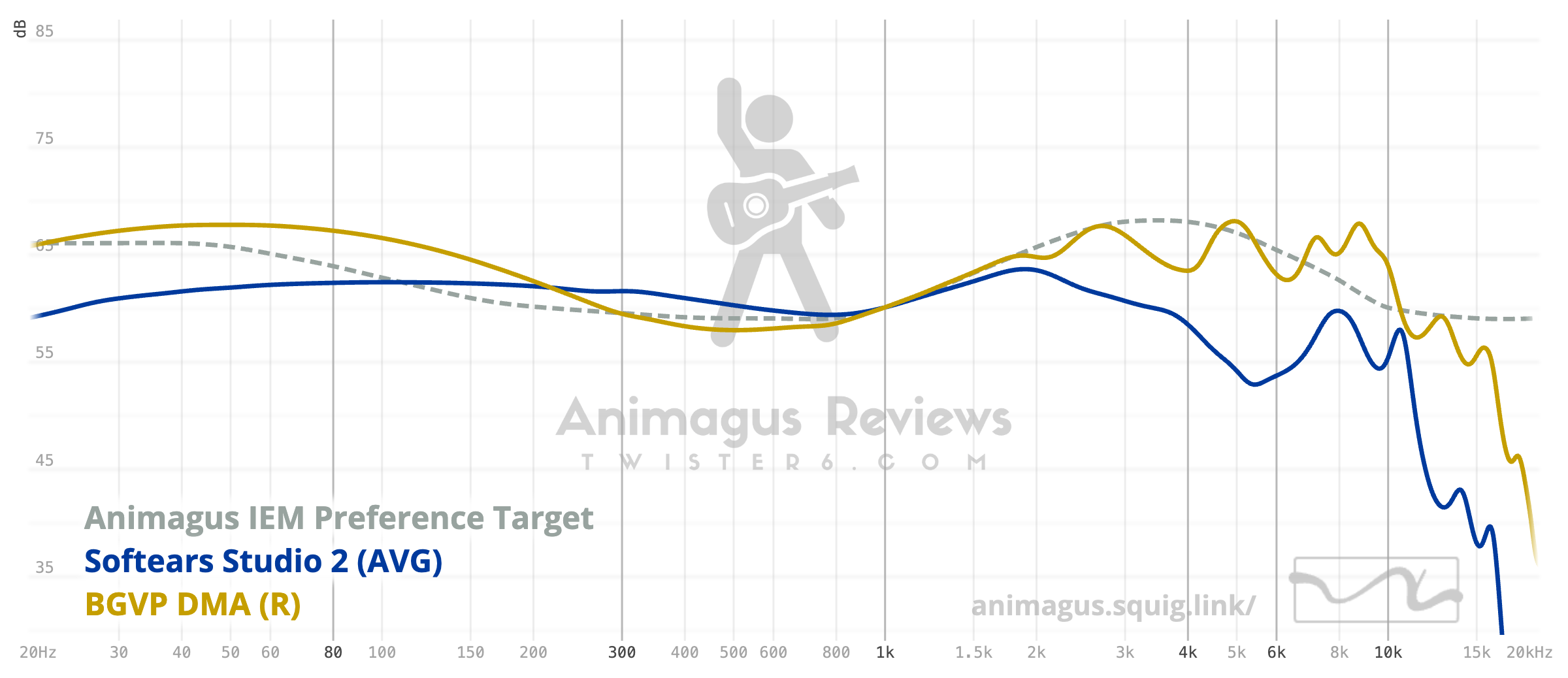
The DMA is a tribrid with a more technical, energetic tuning. It brings more resolution, staging width, and treble presence compared to Studio 2. Bass on the DMA is more extended and cleaner, mids less colored, and treble more revealing. In direct comparison, Studio 2 feels intimate, warm, and soft-edged, while DMA sounds spacious, detailed, and modern. However, DMA can sometimes come off as sharper or less forgiving, whereas Studio 2 prioritizes long-term comfort. These two target very different audiences: DMA for detail chasers, Studio 2 for those who want warmth and fatigue-free listening.
Conclusion.
The Softears Studio 2 is a paradoxical release. On one hand, it’s a modern execution of the Shure SE-style tuning – fuller mids, smooth treble, fatigue-free presentation and on the other, it inherits the very flaws that made Shure’s tuning divisive: excessive warmth, mid-bass bloom, and a treble that feels prematurely rolled off. Calling it Studio is misleading, because this is not what a neutral or reference monitor should sound like. Engineers seeking accuracy won’t find it here. What they will find, however, is a refined, modernised take on a once-popular signature, and for listeners who still cherish the Shure house sound – the Studio 2 being an accessible, cheap option available today.
For the rest of us, especially those looking for true neutrality, the Studio 2 feels like Softears poured their technical skill into the wrong philosophy. It maybe good at what it was designed to do and the niche they were wanting to target – but it’s not what its name promises.

 Twister6 Reviews