
Pair up.
Here is how the SP4k pairs with various IEMs and headphones. All were connected to the 4.4mm BAL output. HDM refers to high driving mode.
Headphones
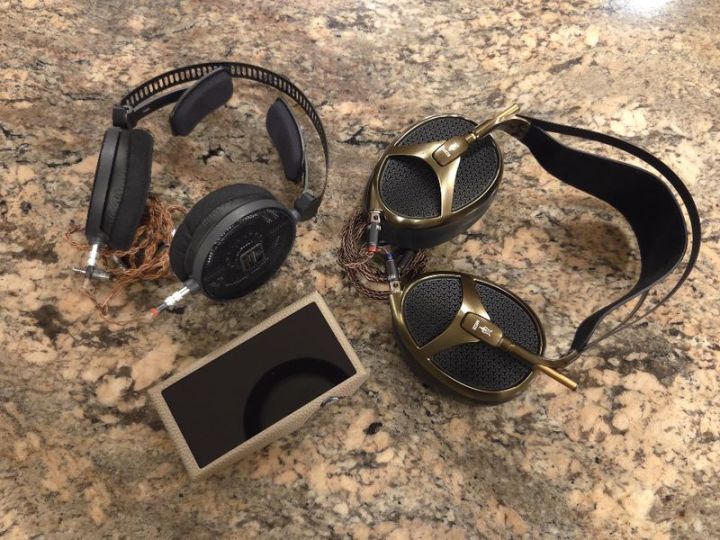
Audio-Technica ATH-R70x – These 470-ohm open-back low-sensitivity headphones are not easy to drive, but I had no issues with the SP4k at 96/150 volume, with plenty of headroom. I preferred the HDM boost in driving R70x with SP4k, and to my big surprise, found the effect of this high driving mode on R70x to be similar to the DAR effect on IEMs. Switching to HDM expanded the soundstage, making it broader and more holographic; the layering of the sounds improved, and there was a noticeable improvement in the retrieval of the details. I could ever hear the background being blacker in HDM mode. The sound signature remained balanced, with a natural, smoother tonality. The bass performance places greater emphasis on the texture sub-bass rumble, accompanied by a slightly softer mid-bass punch, resulting in a somewhat more laid-back sound presentation. Mids are neutral, natural, and resolving, with an improved retrieval of details once you switch to HDM. Treble remained smooth, not rolled off, still well-defined and detailed. The sound of R70x could transform depending on the source pair-up, and here it sounded great if you prefer a more natural, detailed tonality with a big, expanded soundstage and pitch-black background.
MEZE Audio Empyrean – I also preferred HDM here, which gave the Empyrean headphones a bigger and more holographic soundstage expansion, improved imaging, and an improvement in layering and separation of the sounds. The soundstage width benefits from HDM, as Empyrean typically has an average width with many sources. Still, here it stretched out more from left to right, creating a more spherically shaped soundstage with nearly holographic imaging. The sound signature leans towards being balanced, but the tonality was more organic, still detailed, but smoother up top. The bass has a deeper sub-bass rumble with soft, rounded mid-bass with reasonable control of the note decay without spilling into the mids. The mids have more body, which gives them the organic, textured tonality. HDM was important here because with it off, the mids sounded a bit congested, while they cleared up as soon as I switched to high driving mode. Treble was moderately crisp and airy, nicely extended, well-controlled, but a bit more on the smoother side. While Empyrean sounded more laidback and organic with SP4k, HDM helped to make the sound more expansive, more holographic, and more resolving.
IEMs
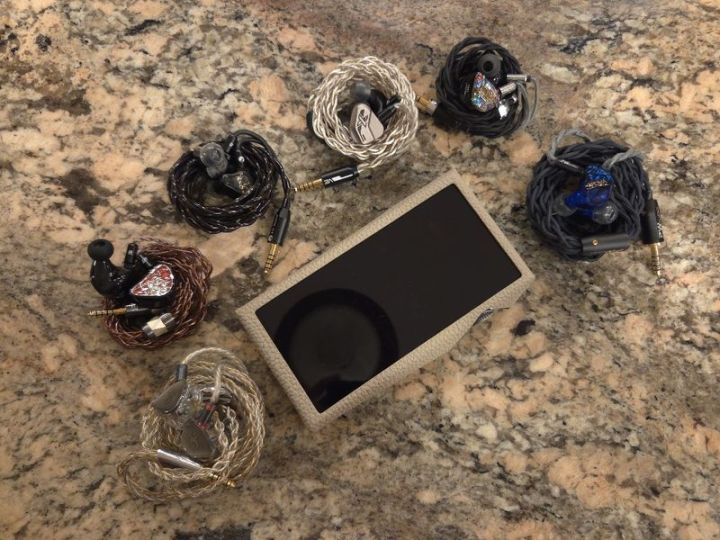
Aroma Jewel w/FT – In this pair-up, and once DAR is enabled, the soundstage has a round proportionally expanded shape with holographic imaging. The sound signature is well-balanced, with a smooth, natural resolving tonality, deep, punchy bass, clear, detailed, layered mids, and naturally resolving, sparkly treble. The tuning is more neutral and natural. I like how this pair-up brings a bit more emphasis on mids, bringing more details in vocals.
FirAudio RN6 – I hear a big holographic soundstage expansion and imaging. The sound signature of RN6 with SP4k is more L-shaped, bringing out more weight in the RN6 kinetic driver with a powerful thumping bass slam. The bass is powerful here, the mids are smoother and a bit thicker, while the treble is also smoother in its presentation. If you prefer to shift RN6 sound in a more balanced direction or bring mids/vocals more forward, SP4k is not the best source for this. But if you want more emphasis on bass, SP4k scales up RN6 basshead performance to the next level.
Vision Ears VE10 – As one of my more sensitive IEMs, I want to mention that it was hiss-free. The soundstage expansion is focused with more depth than width, but the imaging remained holographic, typical of VE10 with other sources. The sound signature is balanced with a fuller body and natural, detailed tonality. The sub-bass rumble here has a little more weight next to a rounded mid-bass punch, mids sound natural, organic, and still quite detailed, and the treble is also clear and detailed. Despite the fuller body organic tuning, the sound of VE10 with SP4k remained quite resolving.
EE Odin – I can report right away, pitch black background with zero hissing. The soundstage here is big; however, I noticed a bit more depth/height in comparison to the width, while the imaging remained holographic. The bass goes deep with a lovely textured sub-bass rumble, and a bit softer attack of the mid-bass punch. The mids are leaner, with a more neutral lower mids and a bit more revealing and forward upper mids, still nicely layered and micro-detailed. Treble is crisp, clear, detailed, more revealing, and yet still well controlled and without any sign of splashiness. I recall being on the fence about the SP3k pair-up with Odin, as it produced a brighter sound presentation, whereas here it wasn’t an issue.
Elysian Acoustic Annihilator 23 – I noticed an expanded soundstage, spherically spaced and spreading evenly in all three directions. The imaging was also approaching a holographic level. The Anni sounds mildly U-shaped with SP4k, having greater emphasis on sub-bass and upper mids/treble. The bass impact here is very impressive, with sub-bass rumble scaling up relative to mid-bass; the mid-bass is not as strong but still has a nice, tight, and well-controlled punch. Mids sound more neutral, natural, and smooth, and their presentation is noticeably pulled back. The treble was crystal-clear, extended, airy, with a non-fatiguing crunch. Even though Anni is harder to drive IEMs, switching to HDM didn’t yield as significant an improvement in comparison to just raising the volume.
Forte Ears Macbeth – I hear a big, expanded soundstage with holographic imaging. The sound signature is balanced, with a natural tonality in the mids and a slightly more revealing and crisper treble, all without being harsh. The bass performance here is very powerful, making you forget that you are listening to a BA driver because it sounds like a DD driver’s performance. The sub-bass rumble is textured and elevated, the mid-bass impact is scaled up, tight, fast, and punchy. The mids have a natural coloring, smooth, and quite resolving. Treble is crisp, airy, extended, and a bit more energetic, though remaining non-fatigued and well-controlled.
Wired and wireless connections.
In addition to being a portable DAP, you can enhance the SP4k’s functionality by using it as a transport to drive an external DAC/amp, add an external amp, or convert the DAP into a wired/wireless USB DAC. Furthermore, you are not limited to wired headphones and can take advantage of a wireless Bluetooth connection.
Wireless/Bluetooth
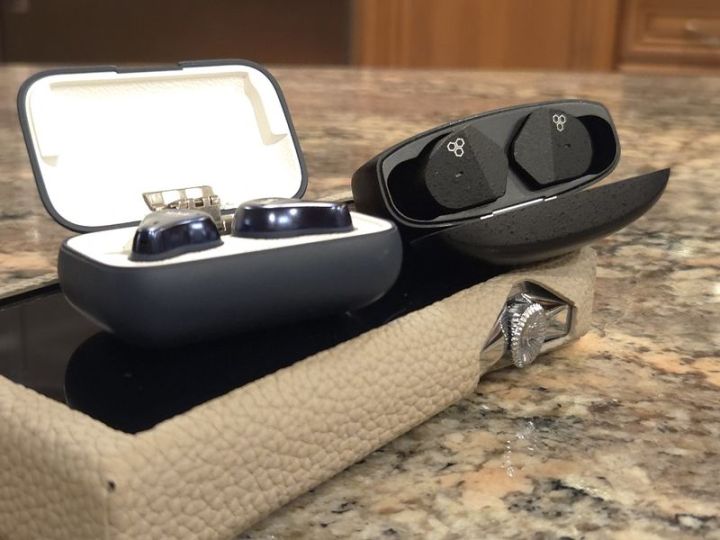
I tested the SP4k BT Tx with the Final ZE3000 TWS (aptX) and confirmed that it operates within 55ft in open space, provides a solid connection, and enables complete remote control. The same TWS worked 45ft away from SP3k. Additionally, I tested the Hiby WH2 TWS (LDAC), which works up to 40ft in open space, while it only worked within 25ft with SP3k. Not sure if anybody will be using TWS earphones that far away from the DAP, but it looks like some improvements were made, on par with SP3kM vs SP3k.
SP4k also features Bluetooth Sink Mode (BT Receiver) when the BT DAC is enabled, allowing you to set SP4k as a wireless DAC/amp. I tested this feature with my Galaxy S25 phone, streaming Amazon HD from my smartphone while using SP4k as a wireless DAC with LDAC protocol. It worked flawlessly 55ft away from my phone, displaying the name of the song I was streaming and letting me control the playback from SP4k.
USB Audio Out
I tested and verified this feature with a few USB DAC dongles, such as NiPO A100 and L&P W4, and found it to work without a problem. Once connected, nothing needs to be selected, and the volume is fixed at a maximum of 150; thus, it is helpful to use it with external dongles that have a volume control. The sound quality was no different when connected to my Galaxy S25 smartphone.
Optical Out
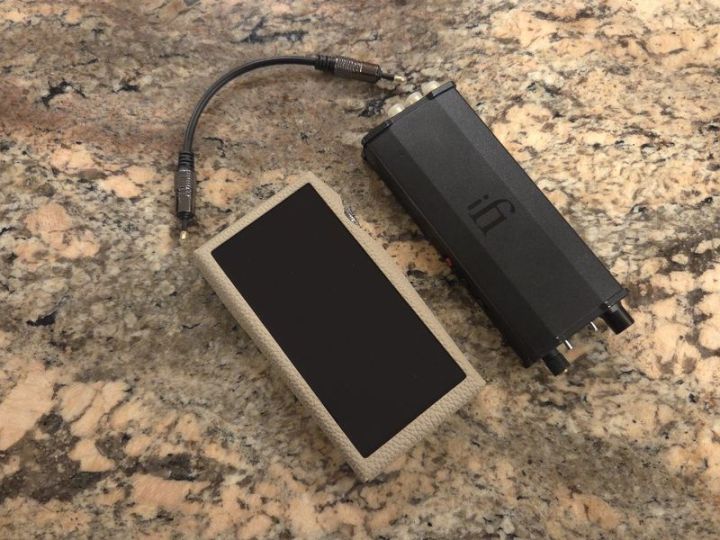
I used iFi micro iDSD BL for this testing. Nothing needs to be enabled; just connect the optical cable to the 3.5mm port and start playing. Optical output was detected automatically, the SP4k volume was set to maximum 150, and I controlled the output from the micro iDSD. Other than that, no surprises using SP4k as a transport to drive the external DAC/amp through optical SPDIF interface, where I’m hearing a typical micro iDSD tonality.
USB DAC
I tested the USB DAC functionality of SP4k with my aging T480S Win10 laptop. Under the USB mode of the DAP, you need to switch from Media device (MTP) to DAC input, which activates USB DAC mode and brings up a menu where you can enable/disable DAR, Charge battery mode, and select a DAC filter. If you are connected to your smartphone to use SP4k as a wired USB DAC, there is no reason to drain the smartphone battery by charging the SP4k, which uses the internal battery. Otherwise, keep charging the DAP when connected to the laptop. My laptop recognized SP4k as an AKAudio USB device without a problem, and I was able to control the volume from both my laptop and SP4k.
One thing to note, once you unplug the USB cable, USB mode on SP4k goes back to MTP.
Line Out
Line Out of SP4k was tested using the Cayin C9ii amp in Classic Tube mode.
I was looking forward to this SP4k vs SP3k test, as a few people had mentioned that the LO of SP4k could be a game-changer. I usually try to stay neutral in my reviews without “omg… the best I’ve heard”, but I have to say that SP4k LO output impressed me a lot. I can’t say this is the best LO “ever” because it is subjective, and I haven’t heard everything, especially other high-end expensive desktop DACs. But I can report it as being the cleanest, the most 3D expanded, tight, layered, dynamic, blackest background LO I heard from any DAP or portable DAC I have tested to date. The idea of LO is to provide a clean output from the DAC, before the source’s internal amp stage. In theory, SP3k and SP4k use the same DACs chipset, but even with C9ii in Classic Tube mode, while connected to SP4k, the sound was very precise, dynamic, layered, and holographic. SP3k LO with C9ii didn’t have the same black background, soundstage was expanded but not on the same level, and the sound was less resolving in comparison. With either DAPs as a source, you will get a typical C9ii NuTube coloring. Still, it sounded like two different DAPs with SP4k being a lot tighter, having a blacker background, more holographic soundstage expansion, and less “fuzziness” in tonality.
I also added SP3kT and SP3kM into the LO comparison and found similar differences. SP3kM LO had a slightly larger soundstage than SP3k and SP3kT, but it was still not on the same resolving level as SP4k.
Furthermore, I compared SP4k LO vs DX340 LO (amp15, dac/amp gain high for max output voltage). I found similar differences with SP4k LO, which has a tighter sound, blacker background, more precise layering, and better sound separation.
Also, I compared SP4k LO vs DX320Max LO, and it was a similar story with SP4k LO being tighter, punchier, and with a blacker background.

Conclusion.
You can say that with SP4k, A&K broke the cycle of new SP-series releases being aligned with new AKM DAC announcements, resulting in more focus on fine-tuning and technical improvements rather than having more drastic sound changes. You have to be realistic, because at this flagship level, you can’t reinvent the wheel. But A&K managed to come up with a very focused, impressive finetuning where I hear notes in SP4k to have more weight and more solid body, while remaining very detailed and natural. The technical performance has improved with the sound being fuller, tighter, having a blacker background, and more holographic imaging under the new Advanced DAR implementation. And, while the general sound tuning is not that drastically different from SP3k, and considering we are not talking about the “T” version with a dual tonality, SP4k almost sounds like a crossover between the technicality of a Delta-Sigma DAC and the musicality of a discrete DAC. A more noticeable improvement was in the performance of its Line Out, which was very clean and precise.
SP4k is a big boy with some hefty weight, so expect it to be a transportable device, making it an attractive option for use as a standalone or with your portable AMPs, even on the go. I’m sure, due to its robust ROON implementation, that many will also consider using SP4k as a desktop source, driving their stationary amp stack up. The device is slick, solid, and built like a tank, making it suitable for either use. In addition, you get a bigger, high-res 6” display, High Driving Mode for your more demanding headphones, and, finally, the ability to install any of your favorite streaming apps, thanks to full access to the Google Play Store. Die-hard SP-series fans will also find it comforting that the SP4k interface still looks similar to their previous device, so you don’t have to re-learn anything. Also, while SP4000T and SP4000M are on my wishful thinking list, I hope A&K will continue to partition their SP-series into the main no-compromises DAP version, dual-tonality “T” version, and pocket-friendly portable “M” version.
To wrap it up, I have been covering A&K DAPs for many years, and some of my readers assume that as soon as the new SP-series model is announced, I will have the review available soon, to help them in deciding if they should upgrade their current DAP. This time, I received my SP4k review sample around the same time it became available for sale. To my surprise, I got a handful of messages from the new SP4k owners, curious to hear about my opinion while they were already enjoying their new toy. As I usually say, don’t let a reviewer’s opinion change your mind if you are already enjoying what you have. But I also realized that some still would like a reassurance, and I hope that my informative, neutral style review can help you with that. And please remember, there is no such thing as the best, but rather what is the best for you, per your feature and design requirements, pair-up synergy with IEMs, headphones, and music you are listening to, and within your budget. Enjoy what you already have, but also, don’t spend too much time deciding what you want to get, which you could be enjoying now, before something else is announced.

 Twister6 Reviews
Hey! Would you say that AK’s top‑of‑the‑line SP#K series offers the most detailed sound with IEMs available now and in the near future?
LikeLike
SP models are part of their flagship series, so they are putting all the best tech and their top tuning into that model. Relative to their other DAPs, I think it does offers the most natural and detailed sound.
LikeLike
Thanks for the great review.
Regardirg the Macbeth. Did you hear major changes with/without using the HDM.
many thanks!
LikeLike
If I understand correctly, HDM in SP4k enables extra set of opamps in parallel config. That will increase the current drive of the amp output. Usually, higher current will have a greater effect on demanding headphones, including planar magnetic ones. With IEMs, not so much, though it will depend. Personally, I didn’t hear major changes with Macbeth IEMs here. But, there is a noticeable change with and without DAR.
LikeLike
Your review was exceptionally thorough and detailed. I have a question that has been on my mind, and I would greatly appreciate your expert opinion.
I’m very curious whether you could provide a comparison between this DAP and the N8II purely in terms of sound quality.
Tnx
LikeLike
SP4k background is darker and LO is superior (so far, the best LO output I heard from any dap I tested). In terms of tonality, N8ii uses a “brighter” tonality ROHM DAC so when you add NuTube texture to it, surprisingly it brings it closer to SP4k sound. N8ii is discontinued, for a while now, but in general it is a more revealing, micro-detailed, sparkly up-top source, while SP4k is smoother and more “analog” in a natural kind of way.
LikeLike
Hello,
I’m not specifically looking for a DAP, so is there any laptop setup (transportable or not) you have heard that you can recommend that sounds similar as the SP4000 and is equal/better in sound quality? (I mainly use IEMs although I do have headphones).
I saw some options but I don’t know if they are on the same level of sound quality as SP4000 (e.g., Chord Hugo 2, iBasso D16 Taipan, Questyle Sigma Pro/Sigma, etc.)
Thanks!
LikeLike
SP4000 is one of the top portable sources available at the moment. There are many dongles and usb dacs out there, and if you can get a used D16 at a good price, considering some are upgrading to D17 now, go for it.
LikeLike
Thanks. I forgot to mention that if SP4000 edges out D16 or D17, I do not mind getting SP4000 even for laptop use. Do you prefer the sound of SP4000 or D16 more?
LikeLike