
At the same Allegro pace with a more Cheerful Liveliness.
PROs: a balanced sound sig with a natural, detailed tonality, quadbrid (2DD/8BA/2BCD/PMD) design with a coherent tuning of all 13 drivers, powerful 2xDD driver performance, a vast soundstage expansion reaching the holographic level, beautiful all-metal shell design, custom hardware PS Copper+ cable, and a premium selection of many included accessories.
CONs: price, the fit (subjective), universal only.
The product was provided to me free of charge for review purposes in exchange for my honest opinion.
Manufacturer website: PlusSound.
Intro.
Back in 2022, right before the New Year, PlusSound Audio made a big splash when they decided to wrap up its 10th anniversary with an announcement of the original Allegro IEMs. While it became a new norm to see cable manufacturers collaborating with popular IEM brands, here it was a bold move for a cable manufacturer to release its own IEM under their own brand name. And it wasn’t just an entry-level monitor, but rather a very mature release, which you would expect from a seasoned designer. Most likely, PS is working with an experienced, maybe even a well-known IEM manufacturer, but still, it takes a lot of confidence to release a flagship-level product under your own name instead of a typical “x” collab.
I was pleasantly surprised by the original Allegro release, which I had a chance to review early in 2023, and even more surprised when, a year later, PS introduced two follow-ups, Volta and Sonora, with an updated design, more customizations, and nicely done different tuning flavors. As I always say, at the end of the day, tuning is what matters the most. And still, you also have to convince audiophiles that a well-known and established cable manufacturer can go head-to-head with other notable and established IEM manufacturers they are competing against instead of collaborating with.
The original Allegro IEM was a limited release, maybe probing the water, while Volta and Sonora felt more polished. So, it made sense that PS would take the Allegro OG, apply design changes from Volta and Sonora, and take it to the next level with the Allegro II release I’m going to be covering today. Of course, it is hard to predict what the next level is going to be, but on paper, it looked like a significant inside-out upgrade I was looking forward to testing. Along with Allegro II, I also received their new Hybrid XL cable, which I’m planning to cover in this review as a bonus. So, let’s proceed with what I found in the last month while enjoying this latest flagship quadbrid Allegro II IEM release from PlusSound.
For clarification, in my review, I will refer to the original Allegro as OG and the new Allegro II as A2.
Unboxing and Accessories.
A2 features a very similar unboxing experience to Volta and Sonora, varying only in color theme. The packaging itself is very compact, 6.5”x4.75”x2.5”, and filled to the top with many useful and well-thought-out accessories, no fillers here. At this point, PS should probably consider making the packaging box a little bigger to fit everything in. Starting with the exterior sleeve, the front showcases the design of the faceplate in its corresponding colors and has a round cutout aligned with the PS logo on the top cover of the box. Cleverly, the back of the sleeve showcases the design of the shell in its corresponding colors. With the top cover removed, you will find a traditional PlusSound plexiglass insert with their proud message of “Designed and Hand Assembled in Los Angeles, California, USA”. While some people don’t care about unboxing and skip this section, manufacturers put so much thought and heart into designing the packaging, which I look forward to and enjoy acknowledging.


Inside, you will find a ton of accessories following a black/brown color scheme. There is a leather storage case in black, a brown leather storage drawstring pouch, a brown leather double-pocket drawstring IEM bag, and a brown leather cable organizer. The rest are a cleaning tool, a cleaning cloth, a black metal warranty card (covering 2 years), a Thank You card with Christian Oliver (PS founder) welcome to the family message, and link to the digital start guide, heavy duty black metal eartips organizer card, and 3 sets of eartips which you will find packed tightly under the earphone/cable brown leather stand inside the storage case. There are PlusSound Silicone eartips (S/M/L), PlusSound hybrid eartips (S/M/L), and Comply Foam eartips (S/M/L).


The leather storage case is custom, in black. It’s a rectangular case with a heavy-duty gold-plated metal zipper and exterior dimensions of approximately 6” x 4” x 2” and internal storage space of about 5.5” x 3.75″ x 1.75″. The exterior material is genuine high-quality leather with a stamped PS logo on the top cover. Inside, the case is lined with a soft felt material to keep everything protected and scratch-free. Under the cover, you have a large polyester pocket, a bit tight, though with enough room to store microSD cards, a cleaning cloth, and a cleaning tool.
Inside the case, fitting perfectly, there is a standalone, removable brown leather earphone and cable stand, which PS sells as a separate premium accessory, included free here. The stand features two semi-enclosed corner pockets for IEMs (or CIEMs) with cutouts for nozzles. The pockets have plenty of room even for large custom shells, and allow for the cable to remain attached while letting it extend down the middle to wrap around the organizer spool below it. There is more than enough room for a thicker cable and a large 4.4mm plug and Y-split, keeping it away from the shells. The back of the stand has a kickstand to display your IEMs/cables in the upright position.


The cable.
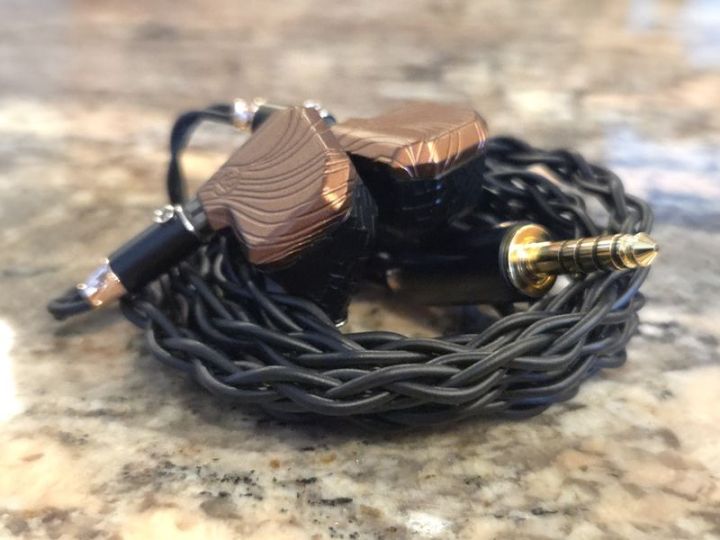
The included cable with A2 is a premium Copper+. I have reviewed it before and will summarize it here again. As the name of the cable suggests, we are dealing with a pure copper wire, but it is not the same as their typical Type 6 litz variant. Those usually feature bundles of twisted wire strands with fiber material at the core of each bundle and another main core dampener in the middle of the cable to absorb vibrations. With Copper+, in addition to multiple twisted litz bundles, there is also a secondary twisted litz wire bundle used as the core with a more durable dampener to support outer wires. One thing remains: each copper strand has an enamel coating to prevent oxidation and crosstalk.
And to keep the overall wire size close to other PS cables, they implemented a new unique shielding using a silver layer between the insulation and wires. This new shielding is two-sided and, in addition to protecting the wires from outside interference to eliminate EMI, could also serve as a ground. And the secondary copper wire at the core could be either grounded or conduct a signal separate from the litz bundles around it. In a way, this is like a coax structure with two wires in one, allowing more design flexibility.
Furthermore, PS implemented a new matte black outer insulation with minimal microphonics and a comfortable fit. But as a result of the updated design, the wire is approximately 15% larger in size in comparison to a standard Type 6 litz. The wire is slightly stiffer than other traditional Type 6 litz cables that PS offers. Unlike the regular Copper+, this particular cable is customized with an exclusive two-tone Y-splitter and copper accent connectors and plug to match the copper scheme of the A2 design.


Bonus: Hybrid XL cable.
As mentioned in the intro, I also received a “bonus” accessory along with A2, their new Hybrid XL cable. I already covered their Copper XL and SPC XL cables, and was curious to check out this new Hybrid design. PlusSound mentioned that the Hybrid XL is their thickest configuration cable ever, featuring a robust 16AWG thickness and a 7x Quad-Layer Coaxial Litz structure, utilizing both copper and silver wires.
According to PlusSound, each of the seven internal groups features four precision-layered strand sets, allowing for a denser, more efficient transmission path that scales effortlessly from sensitive IEMs to power-hungry full-size headphones. Every strand is individually enamel-coated to eliminate electrical interference, mitigate the skin effect, and resist oxidation over time. Furthermore, it uses their proprietary insulation.
A very impressive thing I found about the cable was that, despite its thickness, it was still very soft and comfortable, with no memory effect or microphonics. From a sound perspective, it also had a very unique sound signature with its own secret sauce, which you can read more about in the cable pair-up section of the A2 review. I enjoyed this cable very much and will continue using it in my other IEM reviews as part of the pair-up testing.


Design.
A2 stepped it up to a quad-hybrid design with 2DD/8BA/2BCD/PMD drivers. It uses 13 drivers per side, 2xDD 10mm drivers in an isobaric config (covering sub-lows and lows), 2xBCD (Bone Conduction) drivers, 8xBA drivers (covering mid-lows, mids, and mid-highs), and a single 6mm PMD (planar magnetic) driver (covering super-highs). The drivers are partitioned across an 8-way crossover network and arranged inside the 3D-printed acoustic chamber.


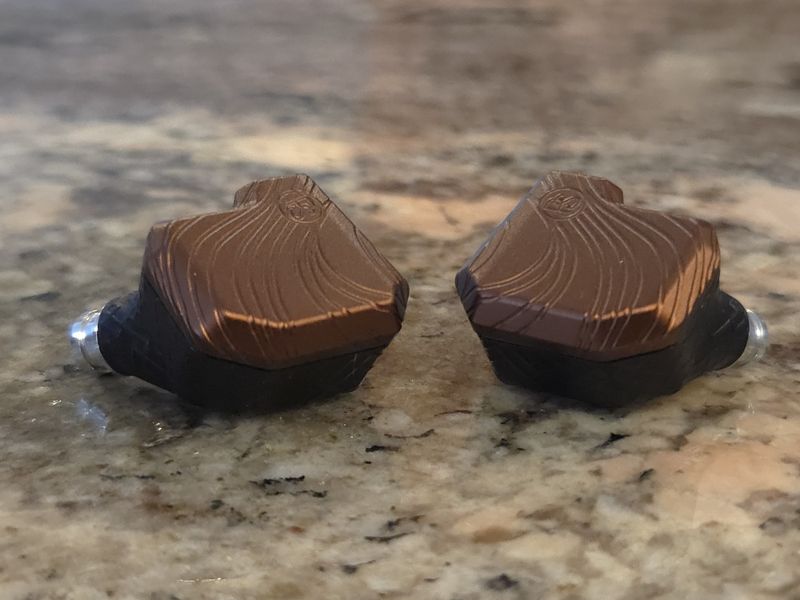
The exterior design is beautifully crafted and features a polished, anodized, and cryogenically treated aluminum faceplate and body, and a shorter/wider nozzle with a lip to secure eartips and 3-bores at the tip. A2 has a copper finish faceplate with a cool line pattern and a black modern pattern body. Similar to Allegro, Volta, and Sonora, there was one long slit-vent on the back, possibly for DD drivers, still having decent sound isolation and no driver flex. Also, the 2pin socket is partially recessed, but not deep enough to hide the 2pin cable connector. According to PS, the 2pin connector is their in-house designed cryogenically treated 0.78mm rhodium-plated tellurium copper with PEEK insulation. The internal wiring is also custom, using proprietary Copper XS and Silver XS, in-house designed cryogenically treated UP-OCC litz wires with proprietary PC insulation.
Allegro vs Allegro II


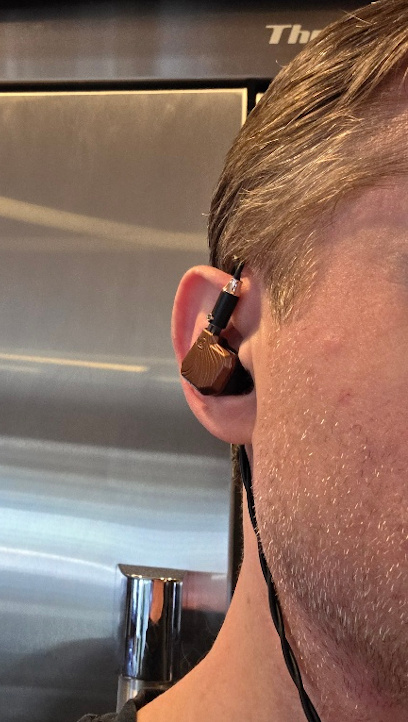
Inside out, it’s a mature design, very similar to Volta and Sonora, which brings me to the topic of how it fits. Sound tuning is up to personal preference, while the fit is up to your ear anatomy. With Allegro OG, the combination of a bulbous shape of the shell body and a short nozzle could be a problem for some ears, and it took me a little while to find the right set of eartips to extend the shell a little bit further out to fit more comfortably in the concha area of my ear. Volta and Sonora featured an updated shell body with a less bulbous and more ergonomic design that feels more comfortable. However, I still found the upper corner of the shell, opposite the nozzle, to dig a bit into the concha area of my ear, something which could be resolved with different eartips. Due to a similarity of the A2 design, I experienced the same here. I know you can’t please everybody. Still, similar to Volta/Sonora, the A2 shell design is an improvement over the Allegro, even to my picky ears.
Allegro II vs Volta vs Sonora


The fit.
Page 2 – Sound Analysis, Eartips selection, and Cable pair up.
Page 3 – Comparison and Conclusion.

 Twister6 Reviews