
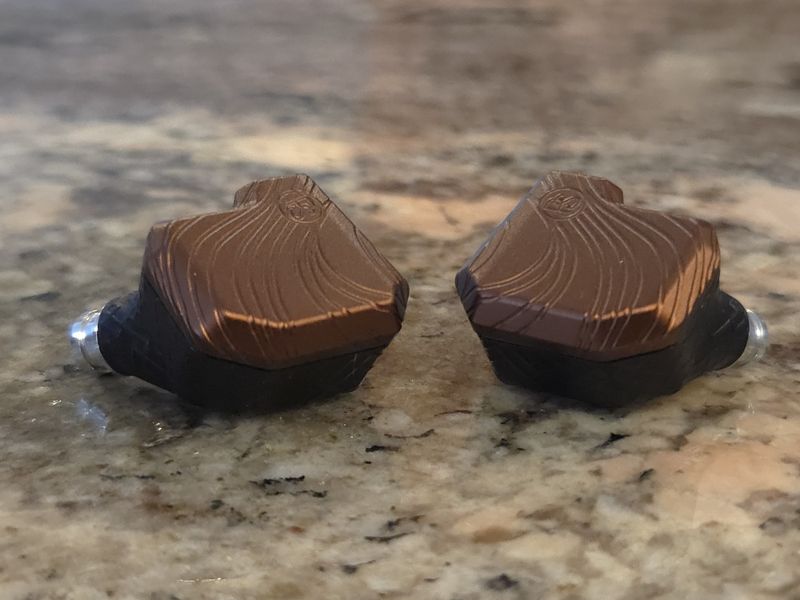
Sound Analysis.
I analyzed A2 sound performance paired up with SP4000 while playing a variety of test tracks, such as Agnes Obel’s “The Curse”, Sandro Cavazza’s “So much Better” (Avicii remix), C-Bool’s “Never Go away”, Ed Sheeran “Shape of you”, Alan Walker “Darkside”, Galantis “Hunter”, Iggy Azalea “Black widow”, Indila “Boite en argent”, Dua Lipa “Love Again”, Counting Crows “Big yellow taxi”, Bob Marley “Jamming”, David Elias “Vision of her”, Michael Jackson “Dirty Diana”, and SaberZ “Without your love”. A2 was on burn-in for 150 hours before I started to collect my impressions. I was using a stock Copper+ cable and stock silicone eartips.

A2 has a well-balanced sound signature with a detailed tonality and natural presentation of the sound. While it features a balanced W-shaped sound signature, unlike the original Allegro, the tuning here is more natural and coherent, as all 13 drivers blend in unison to create a harmonious sound. This harmony extends from the deep, impactful lows to the more natural, detailed mids, and up to the clear, detailed, non-fatiguing highs. The OG Allegro always struck me as having a more vivid presentation of the sound with an extra zing due to its crisp treble. Here, the sound is also very detailed, layered, and resolving. Still, the retuning of upper mids created a more coherent transition into treble with a more natural presentation of high frequencies.

To describe A2 sound tuning in more detail, let me bring it up in a comparison to Allegro OG.
The sound changes from OG to A2 are very noticeable, with a very impressive scaling up in both sound tuning and technical performance. As I usually start with the soundstage expansion, OG had a rounded soundstage, which felt like the sound was placed in front of you rather than being around you. With A2, the soundstage expansion is vast, expanding in every direction, and putting you right in the middle of the sound, with a holographic level of imaging where it feels like you are surrounded by the sound, wrapping around you. This is very typical of Bone Conduction drivers, which usually contribute to the expansion of the imaging and how sounds are placed in space, making me suspect that maybe dual Sonion BCD was used in this design.
The bass of A2 is deep and punchy, and the sub-bass rumble is scaled up, going deeper, more elevated, adding more texture and bloom to the sound, while mid-bass punch is tight and well controlled, especially in the decay of notes, which don’t bleed into the lower mids. Despite 2xDD bass drivers in an isobaric config, the attack of bass notes in A2 is relatively fast too, something you would expect from BA. But this is unmistakably a DD bass performance you can both hear and feel. The sub-bass being scaled up is easy to notice when switching between these two IEMs (OG and A2). You don’t hear bass being as boomy or overpowering; instead, you hear the bass going deeper, with more rumble and hitting harder with a faster punch.
I would say both, OG and A2, have a neutral, natural lower mids, giving more body to the sound. However, due to the more pronounced sub-bass rumble in A2, its lower mids sound fuller, altering their perception to be slightly north of neutral. Next, there is a change in the upper mid tuning of A2, playing an essential role in how you perceive upper frequencies. With OG, the upper mids pinna gain had a roll off which created a noticeable contrast with a peak in mid-treble, making the sound presentation more vivid, with upper frequencies being more revealing. A2 upper frequencies are still quite resolving, but with a proper pinna gain of the linear 2k-4kHz region, they sound more natural and a lot better balanced with mid-treble.
The treble is still crisp, airy, and well-defined, but it no longer stands out in contrast with the mids and instead blends in more naturally. OG mid-treble energy was a bit too revealing for my taste, so I had to spend more time tip-rolling to tame it down. Here, I enjoyed the sound with stock silicone eartips and found the treble to be non-fatiguing, naturally resolving, yet still quite crisp, airy, and extended.

From a technical perspective, the separation and layering of instruments and vocals is very precise, with plenty of air between the layers of the sound to prevent any congestion, while everything still sounds natural and resolving. The sound is very dynamic, expanded, and the retrieval of details reaches a micro-detail level without sounding too analytical. I didn’t even need to use any other ear tips and, as already mentioned, was happy with the stock silicone tips that came with it.
From a genre perspective, everything I threw at these IEMs just worked, regardless of whether it was hard-hitting EDM tracks, soulful vocal tracks, or the natural timbre of instruments in acoustic tracks.

Source pair-up.
From a source pair-up perspective, I also didn’t notice a huge variation. Also, with 15ohm impedance and 116dB sensitivity, A2 was easy to drive. With OG, some of the brighter-tuned sources might not have the best synergy, and smoother sources could kill the resolution. With A2, using DX320MaxTi or DX340 w/amp15 had the effect of slightly more revealing mids and airier treble, but the sound wasn’t too bright. The P6 Pro pair-up was smoother, yet still very layered, dynamic, and quite resolving. When going between SP3000M and SP4000, 3kM gave mids a bit more body and took a notch off the treble sparkle, while SP4000 brought more attention to the mids, making them more resolving and helping with treble airiness. Using N6iii with R202, in R-2R DAC mode, you hear more texture in the mids and natural detailed treble resolution, while 1Bit DAC mode gives you more transparency with improved retrieval of details, and both DAC modes make the bass shine with deep punchy impact.

Eartips Selection.
The selection of eartips is crucial for any universal in-ear monitor and will significantly affect the sound, particularly the bass impact, depending on the seal. Due to a large opening in my ear canals, I usually opt for the largest eartips to achieve a better seal. Also, please keep in mind that eartips impressions are subjective and will be based on the anatomy of your ears. My suggestion is to build up your eartips collection and try each one with every new IEM you get to find the pair that yields a perfect sound for your ears.
w/stock silicon – A2 has a balanced sound tuning with a natural, detailed tonality and a big holographic soundstage expansion.
w/stock Comply – they don’t fit the nozzle and keep coming off, similar to what I have found with Volta/Sonora.
w/stock Hybrid – these silicone eartips have a sticky/grippy silicone and a foam insert under the cap. I found them to sound similar to regular stock silicon, except for having a little more crunch in mid-treble.
w/Symbio W – here, the sound tuning is very similar to stock Hybrid eartips, with the same amount of extra crunch in treble.
w/Symbio F – here, I hear the sub-bass and mid-bass being slightly reduced, scaled down, while mids and treble sound a bit smoother.
w/Eletech Baroque – the sound was similar to stock silicone eartips, just with a bit more smoothness in mids.
w/Final Type-E – here, the soundstage was reduced, making the sound more center-focused, and the mid-treble peak was a bit harsh to my ears.
w/SpinFit W1 – here, I hear bass being a bit scaled down and treble having more crunch.
w/Azla Crystal – nearly the same sound as stock silicone eartips, just a touch more revealing in upper mids and with more crunch in treble.
To my ears, I’ll probably stick with stock silicone eartips.

Cable pair up.
I’m aware that some people are skeptical about the contribution of cable to the audio chain. It’s not my intent to start an argument here. Instead, I would like to share what I hear during my testing. What makes sense to me is that a metal wire is a material with physical properties of resistivity, conductivity, and purity, all of which act as a filter between your source and earphones. Variations in these physical properties can affect the conductivity of an analog signal, resulting in a change in sound that ranges from subtle to more noticeable levels. If discussing cables bothers you, please skip this section. Otherwise, enjoy these short impressions.
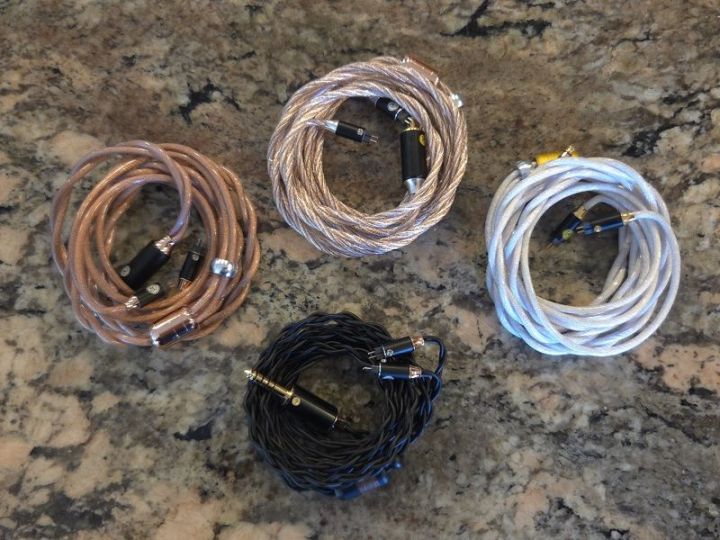
w/PS Copper XL – the soundstage expansion remained the same, big, open, holographic. The same with sub-bass rumble, being deep and textured. I noticed mid-bass hitting a little harder, and treble being just a touch smoother. Copper XL cable does offer a small level of refinement over the Copper+, just enough for me to consider using XL with A2 instead of Copper+, which I’m still thinking about. Plus, the color of the cable looks cool with a faceplate of A2.
w/PS SPC XL – this SPC cable from PS performs more like a pure silver cable than SPC. It gave A2 a deeper and more velvety sub-bass extension, and a bit smoother upper mids and mid-treble. The tuning here reminded me of a smoother tonality of Volta but with a higher level of resolution, layering, and detail retrieval. The only thing here, due to a softer/warmer tonality, is that the soundstage is a bit narrower in comparison to a stock cable. But I enjoyed this cable pair-up a lot, too, and would consider using it with A2 in the future as well.
w/PS Hybrid XL – this is a new PS cable, and boy, did it give a nice bass boost to A2! A2 is not a basshead-level IEM, but relative to its stock Copper+ cable or other PS cables I tried with it, the Hybrid XL enhanced both the sub-bass and mid-bass, which can put a smile even on the face of a basshead audiophile. At the same time, it also improved the clarity and resolution of the upper mids and gave mid-treble a bit more crunch. But these improvements in upper mids and mid-treble balance out nicely with a bass boost. Literally, it felt like a bass-boost switch was applied to A2. You can call Hybrid XL a basshead-guilty-pleasure cable in a pair-up with A2.

 Twister6 Reviews