
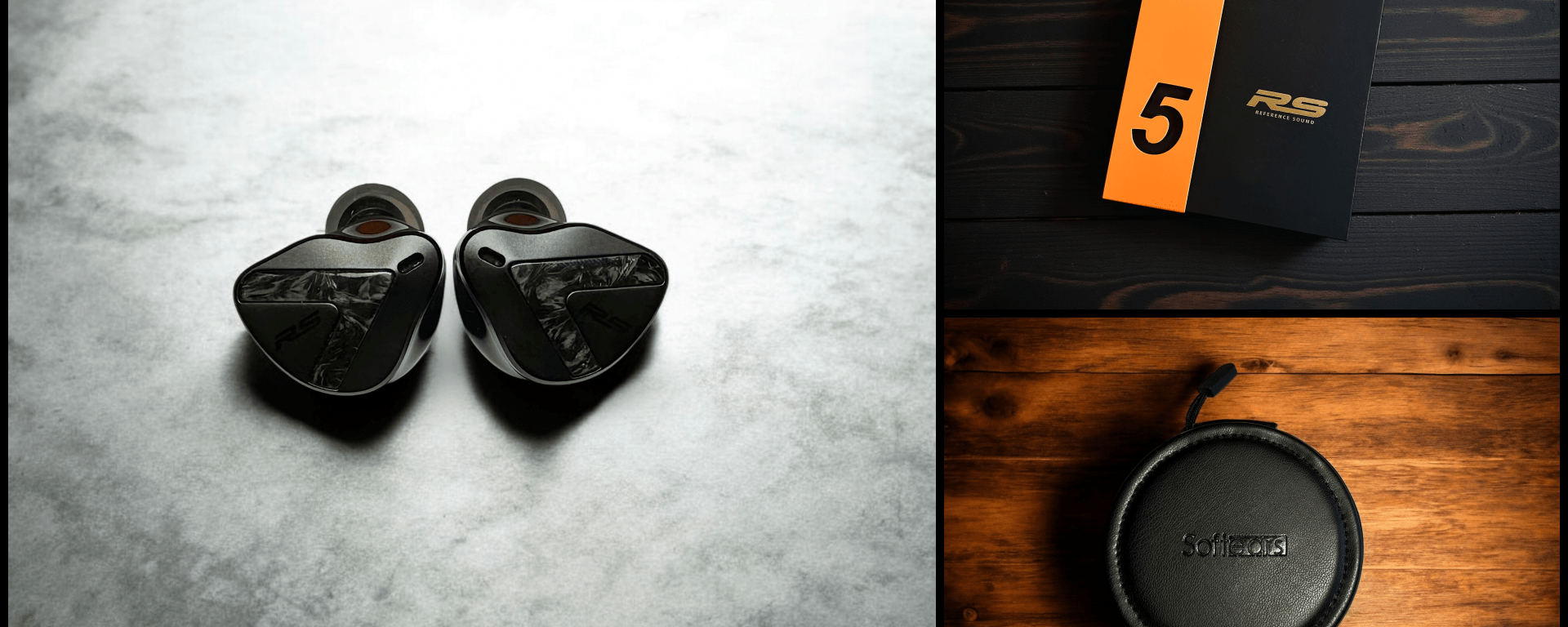
Is this still reference?
PROS: Natural, coherent warm-neutral tuning with excellent midrange tonality, Noticeably clearer and cleaner than the original RSV without becoming brighter, Smooth, refined treble with better extension and air, Improved resolution and layering while maintaining a relaxed presentation, wonderful sub-bass rumble with control and better texture, Strong vocal performance with accurate timbre, Good imaging accuracy and deeper staging than Mk1, Very comfortable shell with high isolation, Easy to drive and consistent across sources.
CONS: Not the most technical set in its price class for raw detail retrieval, Treble remains polite which may feel too safe for listeners wanting sparkle, Staging is improved but not expansive compared to some hybrids, Laid-back dynamics may lack excitement for aggressive genres.
Introduction.
The original Softears RSV earned its following by being one of the most tonally natural and easygoing mid-tier all-BA monitors around. It wasn’t chasing fireworks or hyper-resolution; it was tuned for coherence, musicality, and fatigue-free listening. With the RSV Mk2, Softears claims to retain the same intent while improving technical abilities. Let’s check if they succeeded.
Links – Softears Official ($699)
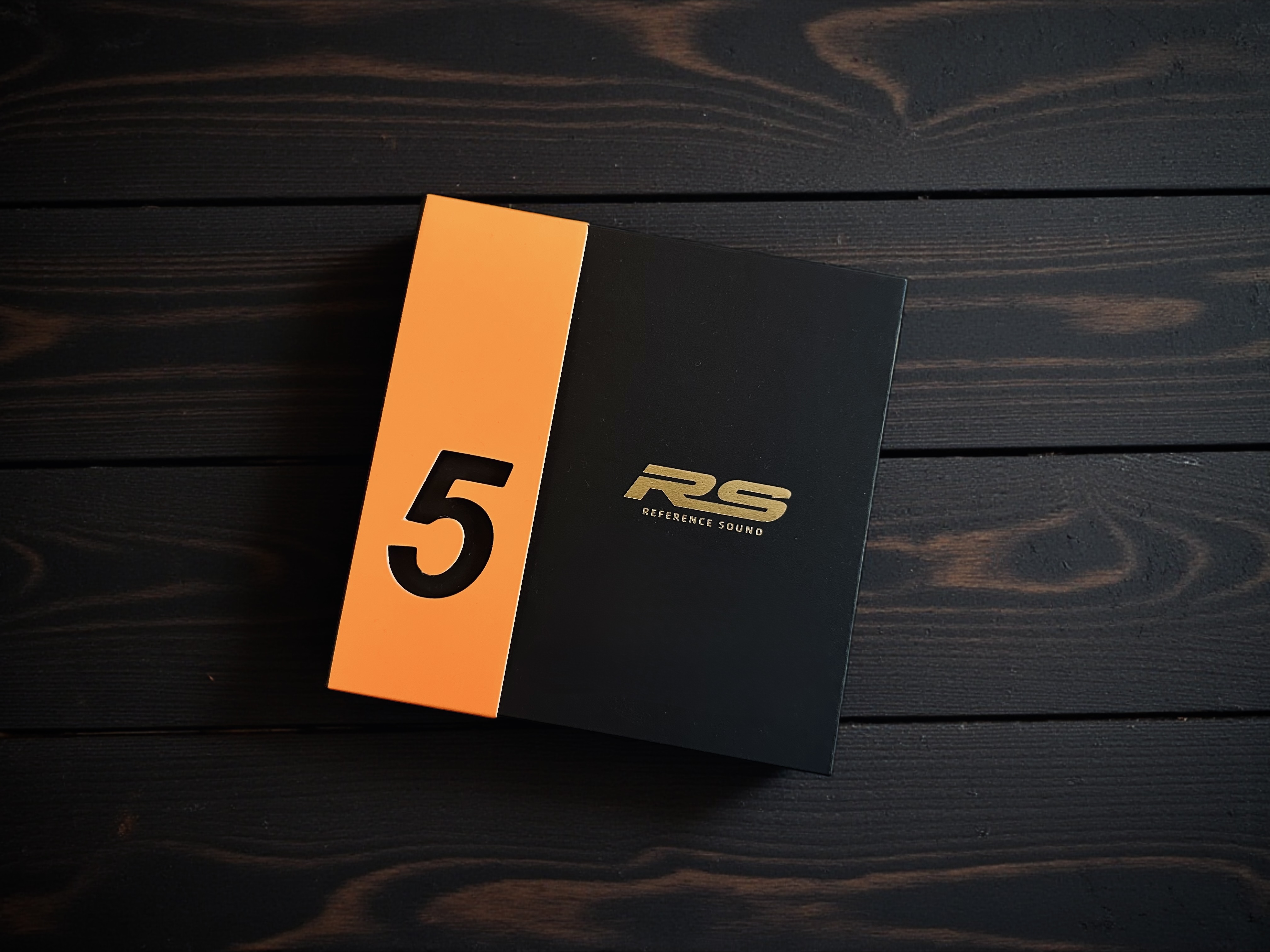
Technical Performance.
- 5BA 4-Way Crossover In-Ear Monitors
- Four-Tube, Five-Driver, Four-Way Crossover
- Dual Bass Tubes
- Passive Pressure Relief Design
- LRC Tuning Network
- Sensitivity: 122 dB/Vrms @ 1 kHz
- Impedance: 7 Ω @ 1 kHz (±15%)
- THD: < 1% @ 1 kHz
- Connector Type: 2-pin (0.78 mm)
- Effective Frequency Response: 20 Hz – 20 kHz (IEC60318-4)
- Frequency Response Range: 15 Hz – 40 kHz (1/4-inch free-field microphone, -3 dB)
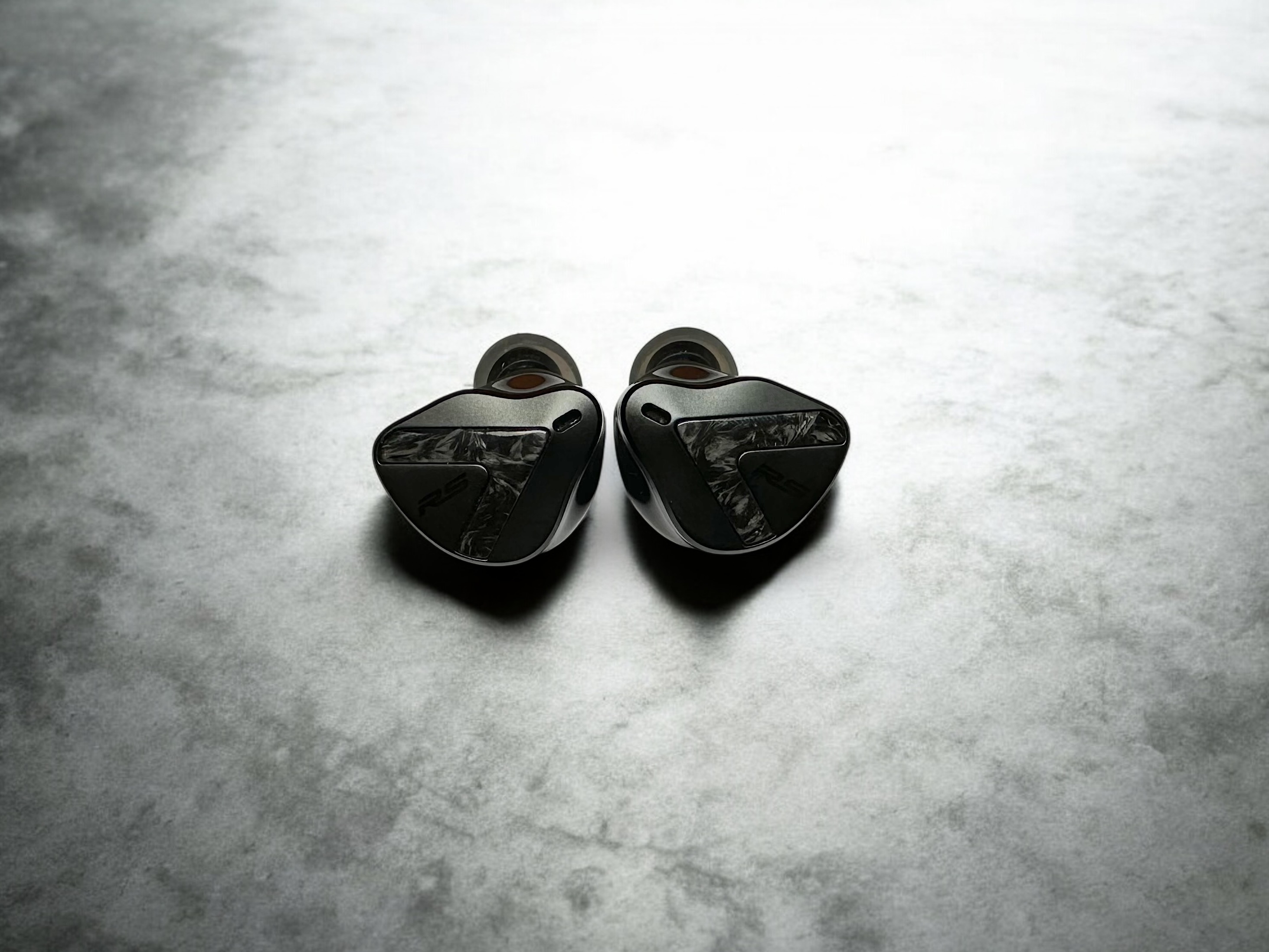
- Shell: Medical-Grade Resin + CNC Aluminum Alloy + Forged Carbon Fiber
- Stock Cable: 6N Oxygen-Free Copper, 4.4 mm Balanced Plug + 2-pin (0.78 mm)
- Connectors: 4.4 mm to 3.5 mm Adapter Cable
Technology inside.
The Softears RSV-MKII takes the core reference-grade architecture of the original RSV and elevates it with precision tuning and component refinement rather than a complete redesign. Retaining the 5 balanced armature drivers per side in a four-way crossover with four independent acoustic tubes, Softears has optimized the impedance across low, mid, and high frequency bands to improve energy distribution and overall tonal balance. The result is deeper, more impactful bass driven by dual Knowles CI22955 BA drivers with a long-stroke diaphragm, a midrange with improved clarity and imaging courtesy of a refined ED driver, and a smoother treble response that maintains detail while reducing harshness. The upgraded crossover architecture incorporates a proprietary LRC tuning network with precision components to reduce metallic character and enhance coherence across the entire spectrum, delivering a fuller, more musical presentation than before.
Build quality and ergonomics reflect Softears’ commitment to premium execution, with precision CNC-machined shells, high-strength materials, and an anti-slip lip design that supports extended listening comfort. The RSV-MKII also features passive pressure relief and air-damping systems that improve comfort and acoustic stability over long sessions. Technical specifications underscore its performance pedigree with high sensitivity (~122 dB/Vrms), low impedance (~7 Ω), and a wide effective frequency response, making it easy to drive from a range of sources while preserving dynamics and resolution. Connectivity is handled via a 2-pin 0.78 mm interface with a premium 6N7 cryo-treated OFC cable terminating in balanced and unbalanced plugs, and the package includes multiple ear tip options for fit and seal optimisation.
Different Eartips in the package.
The Softears RSV‑MKII package includes two distinct sets of silicone ear tips – UC (“Ultra Clear”) tips and Type-B standard tips – each shaping the RSV-MKII’s presentation in subtly different ways. The UC tips are softer and designed for improved sealing and comfort, which typically yields solid low-end weight with clear treble presence, making them a good match for listeners who want a slightly richer bass foundation without sacrificing airiness. The Type-B tips are the reference set used in Softears’ R&D tuning process, offering a more balanced, neutral signature with controlled mids and treble that suits the monitor’s inherent four-way crossover voicing. Choosing between them lets you tailor the RSV-MKII’s tonal tilt based on your listening preferences and fit, with fit and seal directly contributing to both perceived dynamics and imaging.
In practical listening, the RSV-MKII with well-sealed tips delivers a weighty yet controlled low end, mids that maintain natural tonality without harsh coloration, and treble that stays smooth and fatigue-free even over extended sessions. Reviews and user impressions consistently note that the bass texture is punchy and engaging without overwhelming the midrange, while vocals and instrument timbre remain clear and articulate across genres, from electronic and pop to more dynamic mixes. The ability of the ear tips to influence seal and frequency balance means a snug fit can further enhance the RSV-MKII’s spatial performance and perceived soundstage depth, reinforcing why us audiophiles experiment with sets before settling on their preferred pairing.
I also received the Softears UT Titanium Alloy Liquid Silicone Eartips which are an upgrade-oriented tip option designed around a titanium alloy core embedded within a liquid silicone body, combining durability with acoustic control for wider compatibility (4.6 mm–7 mm nozzle) and extended wear comfort. Their design features thickened tube walls and a dual-ring locking structure, which improves nozzle stability and reduces slippage during listening, while the rigid inner core helps to maintain shape and reduce deformation under pressure — a common weakness with all-silicone tips. They are washable and reusable, helping keep hygiene and performance consistent over time. From a sound perspective, these titanium-reinforced tips often deliver a noticeable tightening of the bass and a slightly more controlled low-end response compared with stock silicone tips, attributed to the inner alloy tube facilitating faster acoustic transients. Reviews and user feedback indicate they can promote clearer treble and improved perceived dynamic response, with reduced harshness in the highs relative to basic silicone designs, making them especially useful on IEMs where bloom or congestion in the lower midrange is an issue. Overall, the UT Titanium tips are best appreciated on monitors that benefit from a bit more articulation and faster bass response, while still preserving the core character of the source.
The Mk2 keeps the compact resin shell that made the RSV easy for long sessions. The internal layout has changed slightly but the outer contour remains familiar, secure, and low-profile. The fit is stable, isolation is strong for a ventless BA design, and the nozzle angle works well with most standard silicone tips. The cable is now softer with fewer microphonics, which helps the overall comfort experience. Nothing here feels flashy or boutique; the focus is consistency and ergonomics.
Sound Analysis.
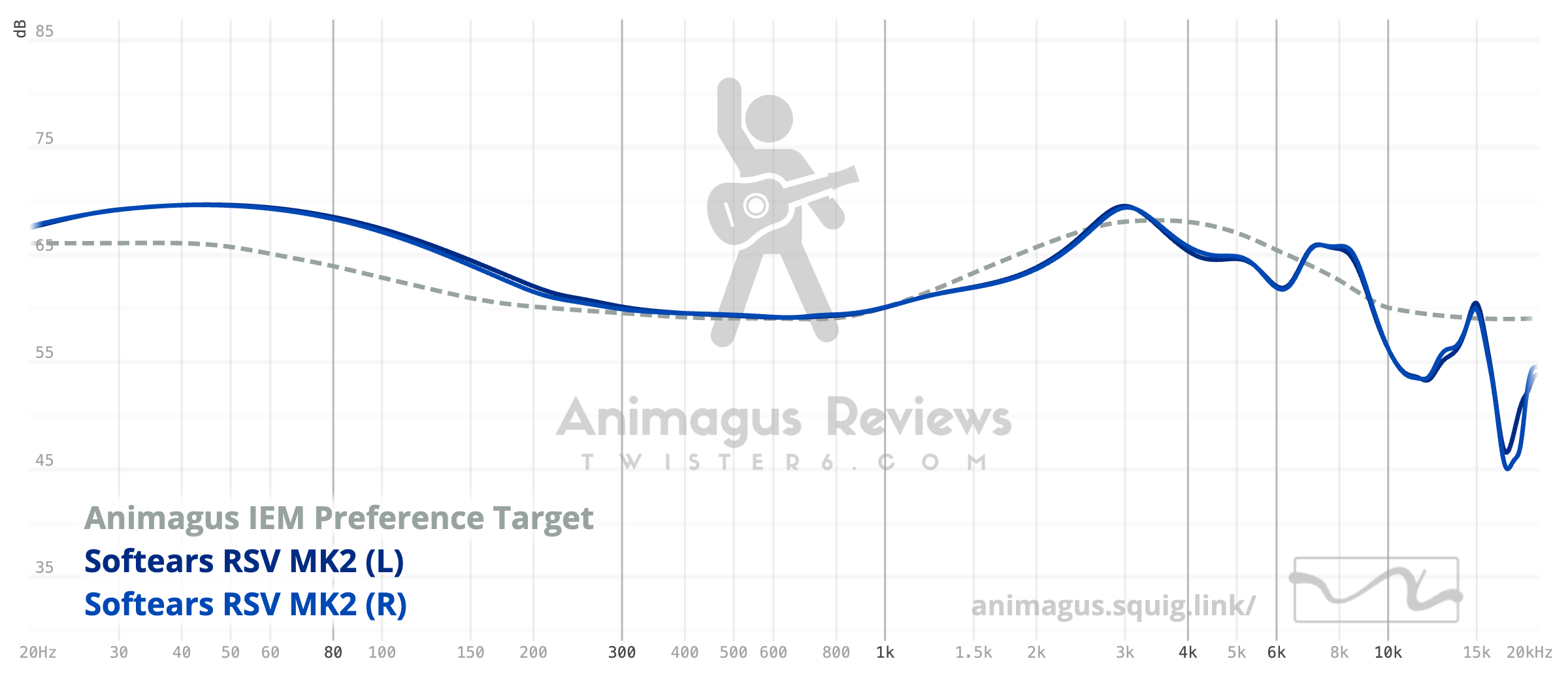
The RSV Mk2 sticks to a warm-neutral tonality with a very natural centre-mass and a soft, unforced treble rise. What changes compared to the Mk1 is the extra bass impact but for the better, overall cleanliness of the presentation. The Mk2 immediately comes across clearer and more articulate, with spaces between instruments better defined and a quieter background anchoring the whole signature. The tuning remains relaxed, but the Mk2 removes the slight haze that made the original RSV sound more mellow than it needed to be. Despite the improvements, it never crosses into analytical territory. Its character is still built around warmth, natural timbre and smoothness.
Let’s dig in deeper….
Bass – Bass performance follows the same philosophy. The Mk2 does not aim to behave like a dynamic driver, but the improvements in texture and control are obvious. Midbass is slightly tighter, more disciplined, and less prone to mild bloom during heavy layering. Subbass extension is significantly better due to the stronger sub-bass lift – giving low-end ambience a bit more foundation, though it still won’t deliver the kind of atmospheric rumble or pressure you get from hybrid or DD-based sets. What the Mk2 does extremely well is maintain consistency: attack speed is quick, decay is neat, and the bass integrates seamlessly into the mids without any distracting lift or coloration. It’s not a basshead signature, but it is boosted while being clean, articulate and tonally honest.
Midrange – The midrange remains the defining strength of the RSV line. The Mk2’s mids are exceptionally coherent with accurate instrument tone and a vocal presentation that feels intimate without being forward. Compared to the Mk1, there is more clarity around vocal edges, slightly higher resolution in microtextures, and better separation during complex passages. Male vocals retain body, female vocals gain a bit of finesse from the cleaner upper mids, and instruments like piano, acoustic guitar, and strings come across with a very believable timbre. One thing Softears handled well is upper mid control. The Mk2 never slips into shout or glare; instead, it maintains a gentle elevation that preserves presence without highlighting sibilant regions or adding artificial brightness. It feels natural in a way that’s honestly rare in all-BA sets.
Treble – Treble is where the Mk2 introduces the most meaningful refinement. The treble is smoother and better extended while also sounding more resolved than the first RSV. Cymbals have more realistic shimmer, upper harmonics breathe better, and fine details such as snare overtones or string friction show up more readily. Importantly, Softears avoided turning the Mk2 into a brighter or sharper IEM. Treble remains polite, fatigue-free, and stable, but with noticeably more information being transmitted. This improves the sense of air and spatial expansion without breaking the warm-neutral balance of the overall tuning.
Technical Performance – Resolution, separation, and microdetail all improve in a way that feels organic rather than forced. The Mk2 presents detail by clarity rather than contrast boosting. Low-level nuances become easier to decipher because the background is cleaner and the layering is more organized. This isn’t a technicality-first IEM in the way some multi-BA sets attempt to be; instead, the Mk2 balances resolution with tonality, letting the listener pick up details naturally as part of the musical flow.
Soundstage grows modestly but noticeably. The Mk2 has more depth than the original RSV and places instruments with better front-back distinction. Width also improves slightly, but the real upgrade is spatial layering. Instruments occupy their own pockets in the stage more confidently, and imaging becomes more precise during fast or busy arrangements. The staging remains grounded and realistic, not exaggerated, but the added depth and stability give the Mk2 a more mature spatial presence than its predecessor.
Dynamic expression also benefits from the cleaner tuning. The Mk2 handles microdynamics with greater sensitivity, giving soft notes more texture and loud passages more punch. Transients are still BA-fast but have a slightly more natural edge, avoiding the plasticky “snap” some BA sets fall into. The Mk2 isn’t built for huge dynamic swings or explosive impact, but what it does offer is smooth refinement with stronger responsiveness than the Mk1.
Comparisons.
Softears RSV Original.
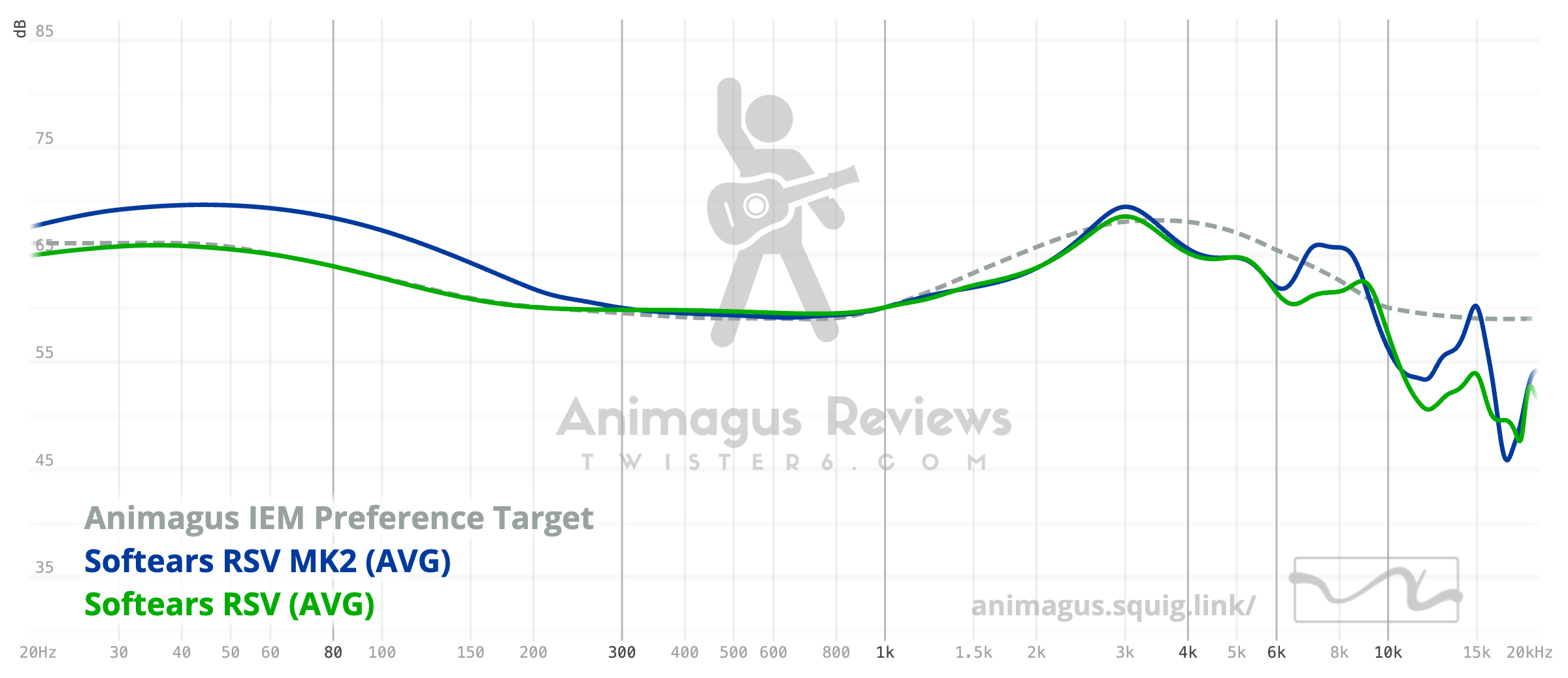
The RSV Mk2 is 75% a refinement over the original RSV and a serious miss for the rest. Both share the same warm-neutral foundation and midrange-centric philosophy, but the Mk2 sounds cleaner, more articulate, and better organised. Where the MK2 faults is mostly it going for a warm tuning with a stronger sub-bass rumble rather than improving on the original to go more reference – that primarily is why it’s not really reference. The original RSV had a slightly softened presentation with a mild haze that favoured musicality over precision, whereas the Mk2 tightens bass control, improves separation, and restores treble air without altering the balance. Vocals on the Mk2 retain the same natural weight and positioning but gain clearer edges and improved micro-detail. In direct comparison, the original RSV sounds thicker and less resolved, while the Mk2 comes across as more transparent, spatially confident, and technically composed. Unless one specifically prefers the softer, more forgiving character of the original, the Mk2 is an upgrade – just not the ideal one.
BGVP Solomon.
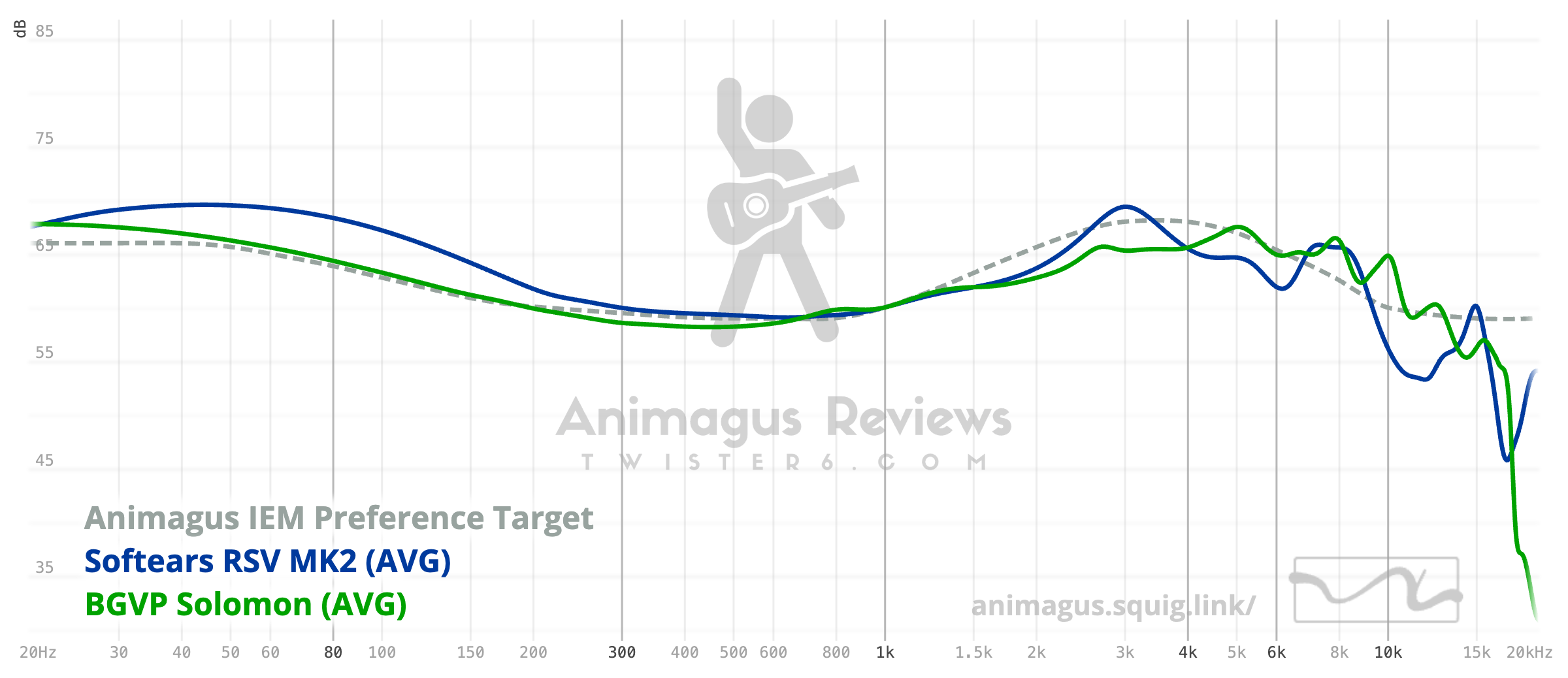
The Solomon and RSV Mk2 approach sound reproduction from opposite directions. The Solomon emphasizes scale, physicality, and low-end authority, delivering a more visceral and energetic presentation with stronger subbass presence and a larger, more dramatic stage. The RSV Mk2, in contrast, prioritizes tonal accuracy, midrange realism, and coherence. Bass on the Mk2 is tighter and more controlled but lacks the sheer impact and rumble of the Solomon, while treble is smoother and less overtly detailed. The Solomon feels more cinematic and engaging for listeners who want weight and excitement, whereas the RSV Mk2 feels more natural, balanced, and fatigue-free over long sessions. This is less a question of technical superiority and more one of tuning philosophy and listening priorities.
Custom Art Hybrid 3 Pro.
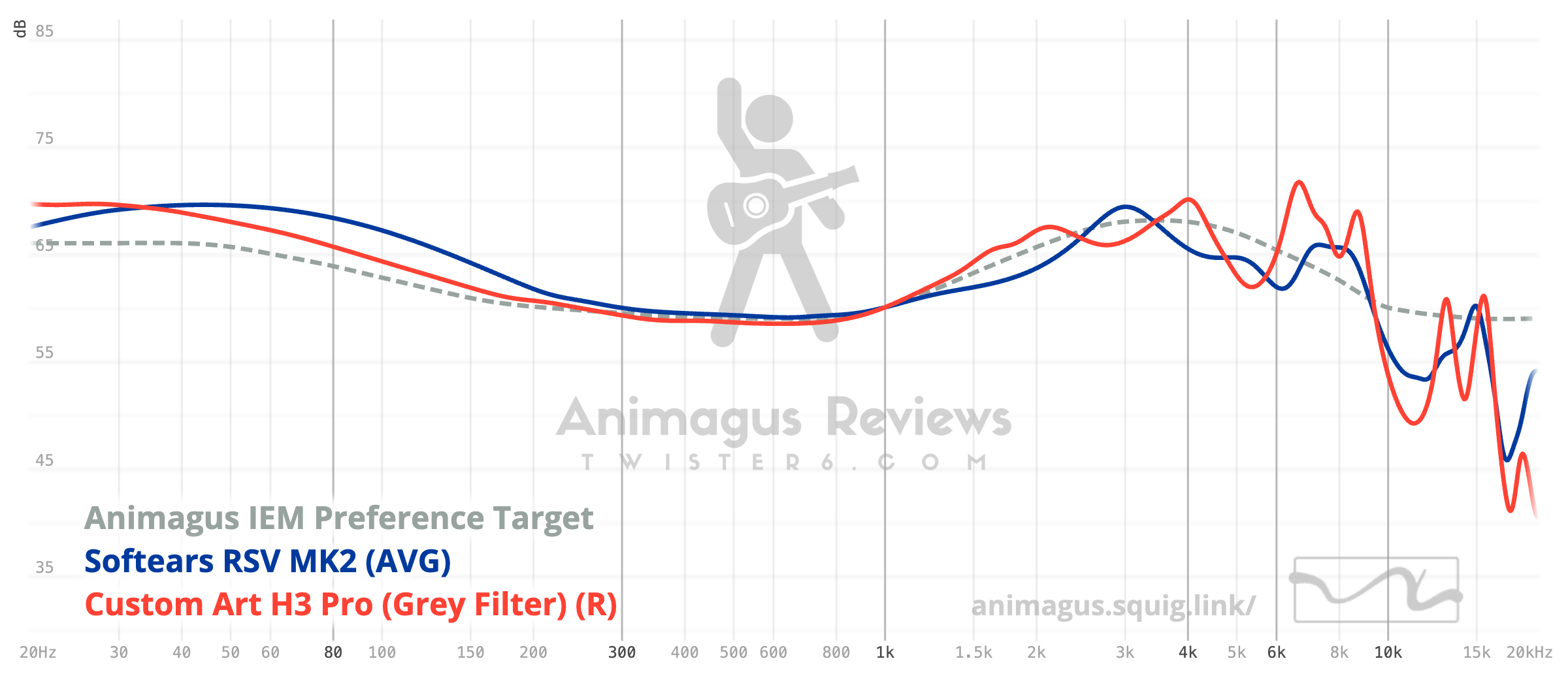
The Hybrid 3 Pro brings a more physical and dynamic presentation compared to the RSV Mk2, with deeper subbass reach and a stronger sense of punch. Its hybrid architecture gives bass notes more air movement and slam, making it more immediately engaging for modern genres. The RSV Mk2 counters with superior midrange cohesion and more consistent timbre across the frequency range. Vocals sound more organic and stable on the Mk2, while the Hybrid 3 Pro can sound more exciting but slightly less even-handed in tonal balance. Treble on the Hybrid 3 Pro is more forward and energetic, whereas the Mk2 opts for refinement and control. Listeners seeking physical engagement and bass impact may gravitate toward the Custom Art, while those prioritizing tonal realism and long-term comfort will likely prefer the Softears.
BGVP DM9.
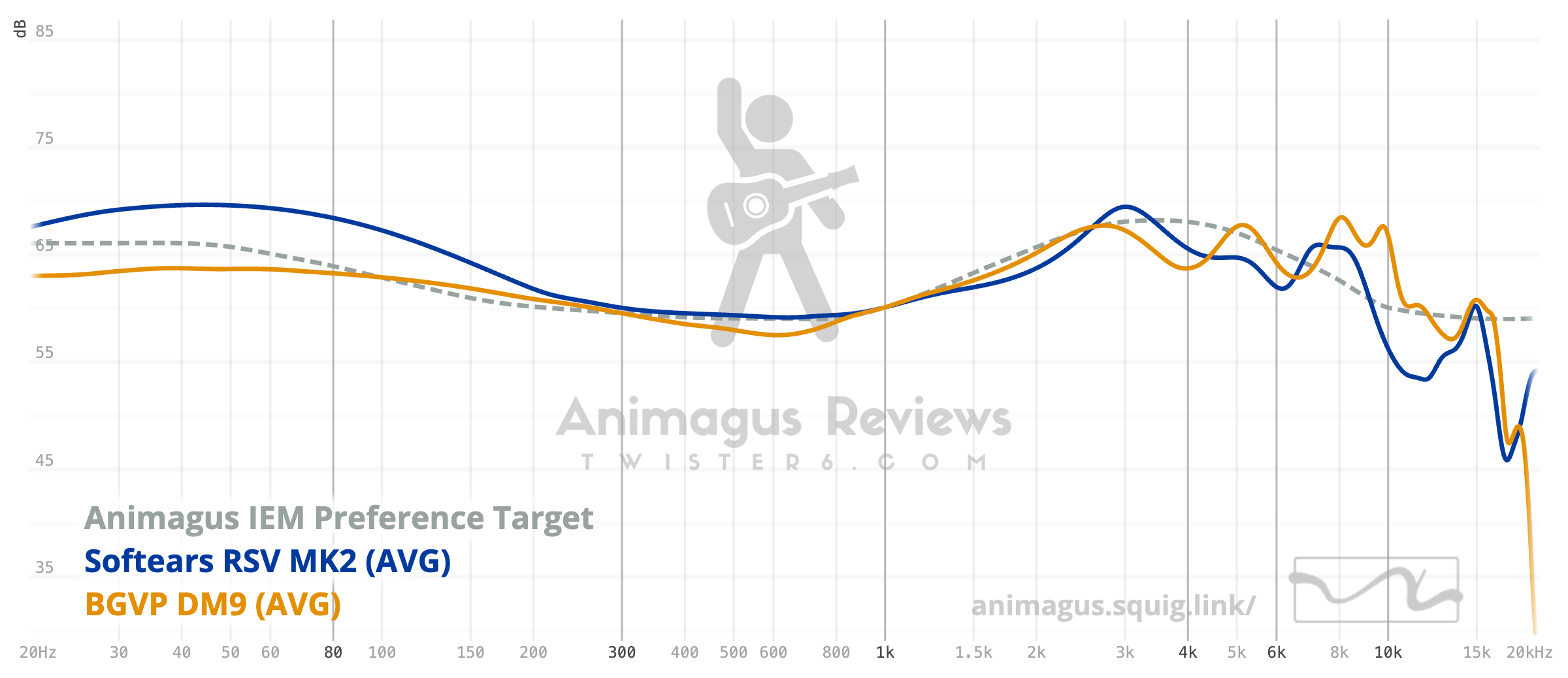
The DM9 is distinctly more technical and presentation-driven than the RSV Mk2. It emphasizes speed, separation, and treble articulation, producing a sharper, more energetic sound that highlights microdetail and transient attack. In comparison, the RSV Mk2 sounds smoother, more relaxed, and more tonally grounded. The DM9’s treble presence gives it a sense of air and clarity that can be impressive but also more fatiguing over time, while the Mk2 maintains a calmer top end that integrates more naturally with the mids. Bass on the DM9 is punchier and more agile, but less cohesive with the midrange than on the Mk2. The DM9 suits listeners who prioritize technical performance and excitement, while the Mk2 is better suited to those who value coherence and natural tone.
Bellos Audio X4.
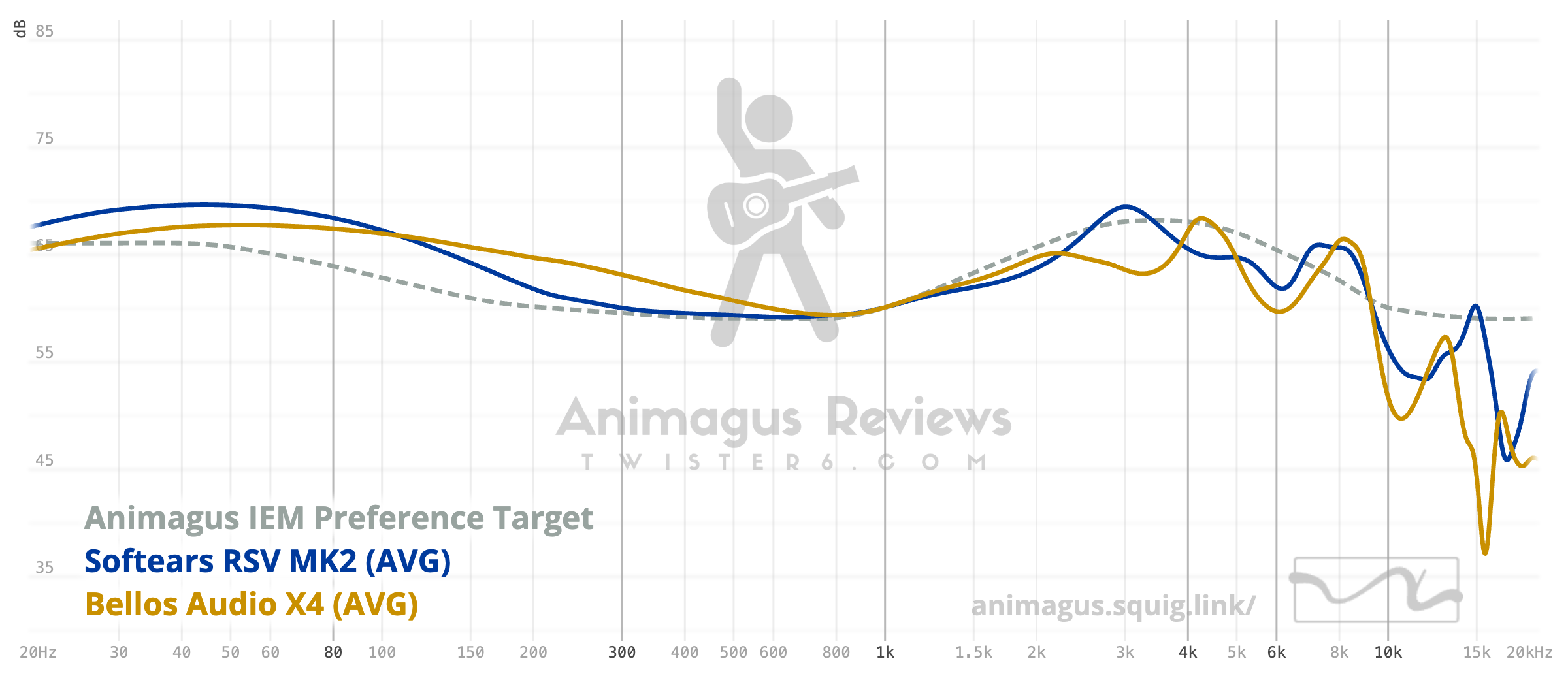
The Bellos Audio X4 and Softears RSV Mk2 differ fundamentally in how they use coloration. As I highlighted in my X4 review, the X4 is intentionally coloured with a bold, energetic presentation that emphasises contrast, density, and a more stylised tonal balance rather than neutrality. Its bass is punchier and more expressive, its midrange has a distinct character that prioritises engagement over strict realism, and its treble adds excitement and texture rather than restraint. The RSV Mk2, in contrast, is tuned for tonal accuracy and natural timbre, sounding smoother, more linear, and more cohesive across the spectrum. Where the X4 aims to sound vivid and characterful, the Mk2 focuses on realism, balance, and long-term listening comfort. Technically, the X4 feels more immediately striking and dynamic, while the Mk2 sounds more refined and composed. The choice ultimately comes down to whether one prefers a coloured, energetic presentation or a tonally faithful, musically natural one.
Elysian GAEA.
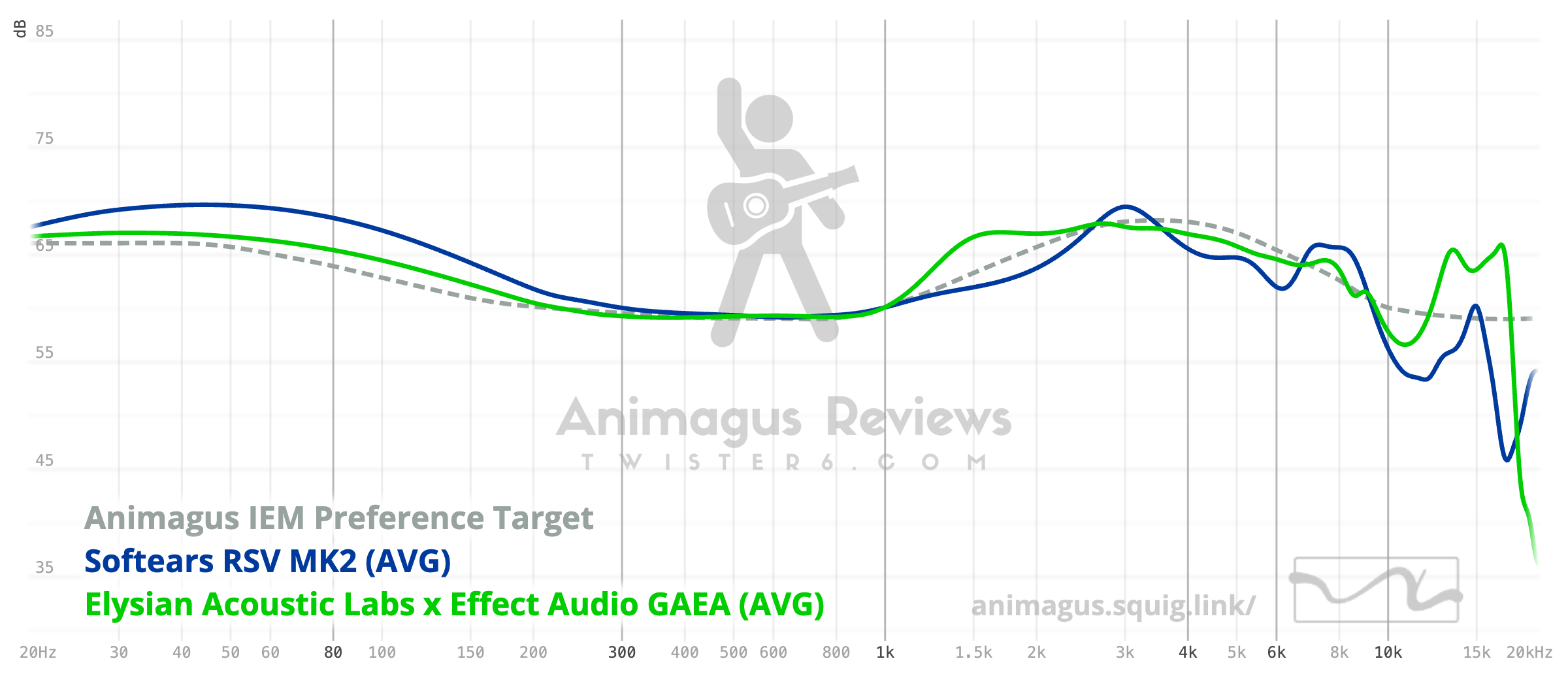
GAEA presents a bolder, more assertive tuning compared to the RSV Mk2. It delivers greater bass weight, more forward upper mids, and a treble presentation that emphasizes immediacy and presence. This gives GAEA a more aggressive and engaging character, particularly with rock and metal, but it can also sound more demanding and less forgiving. The RSV Mk2, by contrast, adopts a more restrained and balanced approach, with smoother treble transitions and a midrange that feels more natural and less pushed. While GAEA excels at excitement and drive, the Mk2 excels at tonal accuracy and listening comfort. The difference ultimately comes down to whether the listener prefers energy and impact or refinement and realism.

Conclusion.
The Softears RSV Mk2 doesn’t try to reinvent what made the original RSV well-loved. Instead, it takes that warm-neutral, natural-timbre-focused foundation and lifts clarity, refinement, and spatial organization to a noticeably higher level. The result is a more mature, more precise, and more spacious version of an already good tuning. It still isn’t for listeners seeking heavy bass or hyper-detail, but for anyone who values coherence, vocal naturalness, and fatigue-free resolution, the Mk2 is one of the most polished and tastefully tuned all-BA monitors in its range. In direct A/B comparisons, the original RSV now sounds softer, less defined, and slightly blurred. The Mk2 is simply the more complete execution.

 Twister6 Reviews