
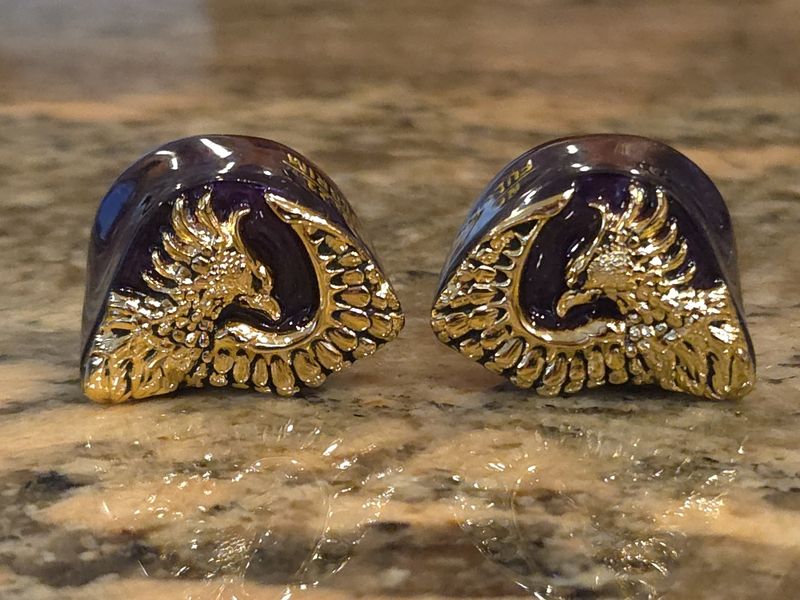
A pair of A&O Fulgrim IEMs was borrowed from Musicteck for a few days and tested using SP4000 (with DAR enabled) and Baroque Stage eartips.
Intro.
I have mentioned eartips and source dependency in many of my IEM reviews. The effect of such dependency could range from subtle to noticeable, with the latter being quite obvious, particularly in the treble, as I started listening to Alpha & Omega Fulgrim while switching between different eartips and sources. I first heard Fulgrim when its prototype was introduced at the CanJam NYC show early this year. What stood out to me was its powerful, rumbling bass, which was very well-tuned without overwhelming or muddying the mids. But I also recall treble being a bit on the energetic side, though it didn’t cross the threshold of harshness to my ears.
Based on the feedback after the show, A&O finetuned Fulgrim by scaling down the 7-9kHz region by 2dB to achieve a more natural, balanced rendition of the upper frequencies. Since I have been using SP4000 a lot lately, that was the source I started my testing of Fulgrim with, but right away, I noticed something was still bothering me, as the first pair of eartips I used were SpinFit W1. After trying a few different pairs, I began to see a pattern: narrower-bore eartips reduced Fulgrim’s soundstage, pulled the mids back, and introduced more bass and treble into the mix, creating the perception of a slightly more U-shaped tuning with a more revealing presentation of the treble.
Not until the wider-bore Baroque (and then Baroque Stage) eartips landed on the nozzle of Fulgrim did I realize I had arrived at something special here. So, why am I bringing this up in the intro of my first impressions review of these IEMs? I read several Fulgrim impressions and spoke with some Head-Fiers whose sound analysis opinions I hold in high regard. I found that some impressions didn’t precisely align with what I’m hearing, all due to differences in eartips and the sources people used to audition these IEMs. Of course, everything related to sound is subjective. Still, in this particular case, I found it could make or break your listening experience with Fulgrim.
Different eartips bore openings relative to the Fulgrim nozzle:


Now, with this disclaimer out of the way, let’s find out what I heard after spending a few days with Alpha & Omega Fulgrim IEMs.
Design.
I can’t discuss the unboxing experience for Fulgrim, since I only received IEMs with their premium round leather case and nothing else.
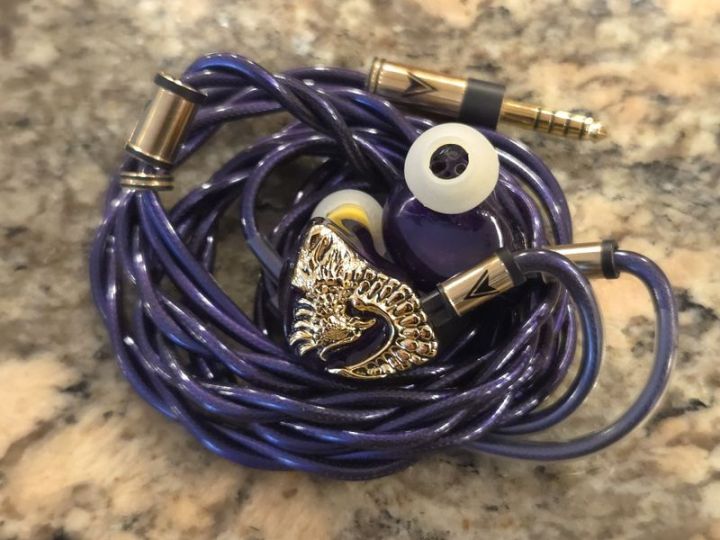
As you get Fulgrim’s out, the first thing you notice is the faceplate design. It is different, bold, in-your-face, perhaps even polarizing, while the bird “flexes” its feather muscle. While many IEMs feature smaller artwork and/or a frame around the edges of the faceplate, here the image of the Mystical Phoenix spans across the entire faceplate. The shells are deep purple, just like the included matching stock Aura cable, and are a bit on the bigger side. However, with the correct set of eartips, they feel comfortable even in my average-sized ears. But I don’t discount the fact that people with smaller ears could feel some discomfort during extended listening sessions. The nozzle is also bigger, one of the reasons, again, I mentioned using wider-bore opening eartips so you don’t cover any sound tube bores at the tip of the nozzle. Depending on the eartips’ selection and the seal tightness, you may also experience occasional driver flex, which is becoming familiar with many DD-based IEMs nowadays. The fit is always subjective and will depend on the anatomy of your ears. You can see how these fit in my ears in the picture. In general, despite the shells’ large size, I had no issues with fit.
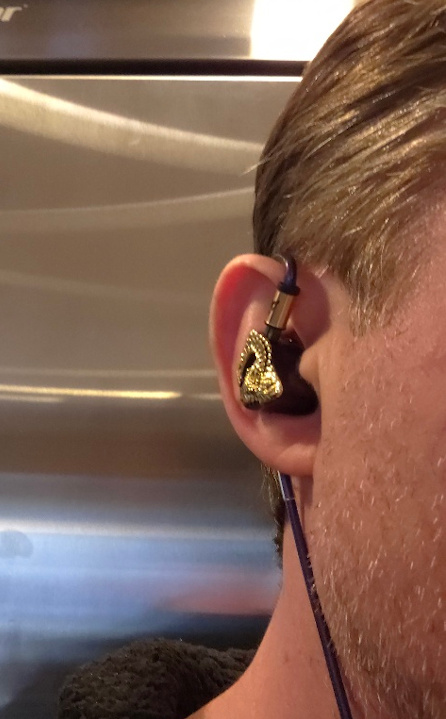
Another essential thing to note: despite a large open DD port next to a non-recessed 2pin connector, there is no sound leakage. When I first looked at these shells, I thought otherwise, but Fulgrim passes the “wife test” in the bedroom with no complaints and also provides adequate sound isolation.
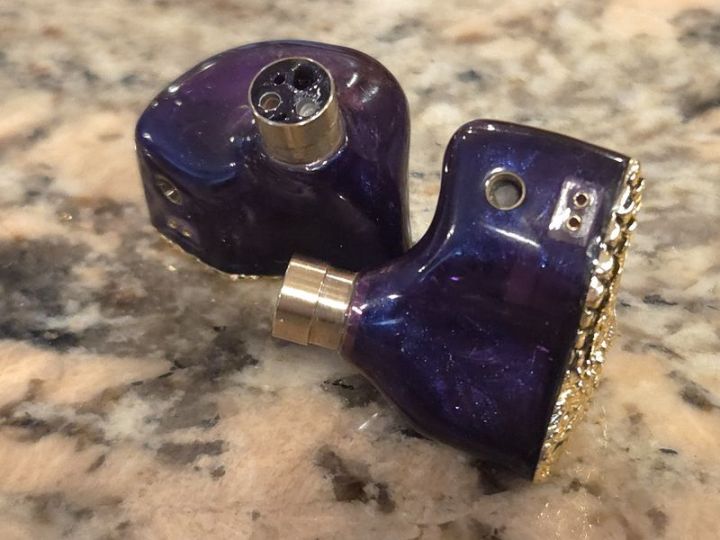
As for the design, Fulgrim features a tribrid design with 13 drivers, controlled by an 8-way passive crossover. A Beryllium Dynamic Driver covers the bass, then 6 BA drivers cover the mid-range, with 2BAs for lower mids, 2BAs for mids, and 2BAs for upper mids. 6 Electrostatic Drivers cover the treble, where 2ESTs cover highs and 4ESTs cover ultra-highs. Fulgrim has a 10-ohm impedance and a lower sensitivity of 104 dB.


Sound Analysis.
I analyzed Fulgrim sound performance driven by SP4000 and some other DAPs, using stock cable and Baroque Stage eartips while playing a variety of test tracks, such as Agnes Obel’s “The Curse”, Sandro Cavazza’s “So much Better” (Avicii remix), C-Bool’s “Never Go away”, Ed Sheeran “Shape of you”, Alan Walker “Darkside”, Galantis “Hunter”, Iggy Azalea “Black widow”, Indila “Boite en argent”, Dua Lipa “Love Again”, Counting Crows “Big yellow taxi”, Bob Marley “Jamming”, David Elias “Vision of her”, Michael Jackson “Dirty Diana”, and SaberZ “Without your love”. This pair of Fulgrims has been through the CanJam SoCal show and other auditions, accumulating the burn-in mileage. I was told they need at least 100 hours for the sound to settle in.
The effect of eartips on FR measurements of Fulgrim – purple hits the sweet spot!
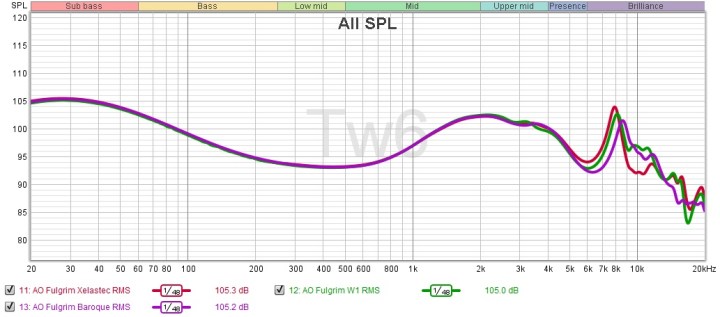
To describe Fulgrim’s sound in one sentence, I would say: An audiophile basshead delight with a balanced W-shaped sound signature, rich, detailed tonality, deep, powerful bass, and plenty of natural, revealing clarity. The tuning is very unique, focusing on the bass, which stands out and grabs your attention, while also blending with the rest of the sound to deliver a relatively coherent performance from all 13 drivers. It’s like you are in a studio with floor-standing speakers around you, where all the soundwaves blend in together in one, and, thanks to the bass, you feel the sound resonating through your bones, physically connect with it, rather than listen to it.
As I mentioned earlier, you really need to experiment with different eartips here. Because narrow-bore eartips, like W1 or Type-E, reduced the soundstage to my ears, while wider-bore opening eartips like Baroque or Crystal, opened up the sound, making the soundstage bigger and naturally expanded in all three directions without any exaggeration. However, the sound still had a bit more depth and height than width. Imaging features a highly realistic 3D placement of sounds, approaching a holographic level with a relatively accurate positioning of instruments and vocals, enabling you to pinpoint everything perfectly in the mix. Fulgrim is not precisely a very technical IEM. However, I found its layering and separation of instruments and vocals to be quite decent, allowing for easy distinction of everything in the mix without congestion or veil, even with its mighty bass presence. However, since Fulgrim doesn’t have much air in its treble extension, don’t expect high-precision sound layering.
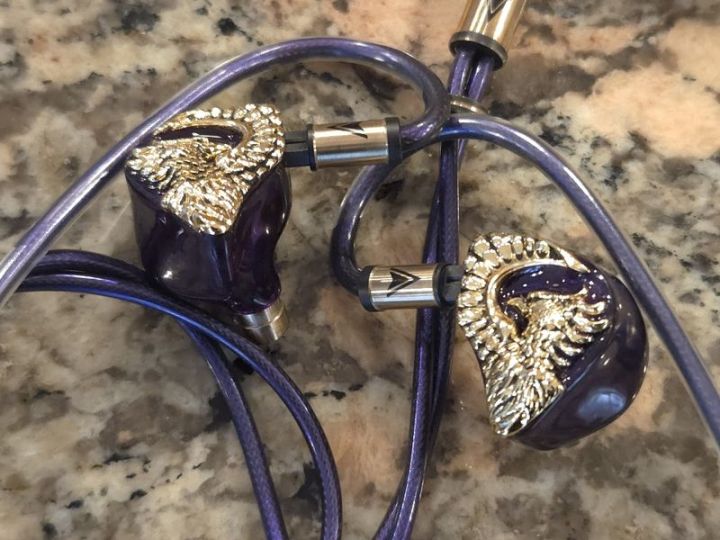
In more detail, the bass is deep, powerful, masculine, and physical with a fullness and bloom that you would associate with floor-standing speakers. There is a greater emphasis on sub-bass rumble, with mid-bass being bouncy and rounded, and notes having a decent attack speed (though not the fastest) and excellent decay control. You feel the weight of the bass in the way the DD driver pushes the air, yet it never overpowers or dominates the mids, and has plenty of control to blend in with the mids without muddying them. I actually switched from Baroque XL to Baroque Stage L to relax the seal a bit. The bass tuning here is addictive and fun, making you want to switch to tracks where the bass hits harder. And here comes a cliché: the power of Fulgrim’s bass only comes out to play when called upon. In acoustic tracks, you hear it in the timbre of the instruments, making them sound deeper, more textured, and natural. In EDM tracks, it will slam hard with sub-woofer rumble that tickles your eardrums and resonates down your throat without causing any discomfort. With any music track you throw at these IEMs, you will both hear and feel the non-fatiguing weight of the bass.
Mids have a fuller body, which gives instruments and vocals weight and texture. And again, you have to pay close attention to the eartips you are using. Narrow-bore tips pulled the mids back, with more emphasis on bass and treble, making the signature a bit more U-shaped. Wider-bore tips fixed the balance, bringing mids more forward. Lower mids are tuned to be slightly above neutral, not too thick, with a natural coloring, ensuring a seamless transition between the bass and the upper mids. Upper mids are clear, detailed, and natural. The proper pinna gain in the upper mids enhances their presence without pushing them too mid-forward, yet forward enough to be perfectly balanced with the bass. Mids have excellent detail retrieval and plenty of natural clarity.
If you haven’t guessed by now, I can’t start discussing treble without bringing up the eartips again. Take your time trying different eartips, but, as already mentioned, I found the wide-bore eartips to provide the most natural and detailed treble rendition to my ears. There is more emphasis in the mid-treble range to give the sound, especially the mids, higher definition, natural, revealing clarity, and upper-end balance. The lower treble is carefully tuned to avoid any harshness. The upper treble is also slightly rolled off, with modest airiness and extension. By the way, that’s where relaxing the seal, and in my particular case, transitioning from Baroque to Baroque Stage showed an improvement with more airiness and better sound layering. Don’t expect to hear the long tail of cymbal crushes or have extra air between layers of the sound. However, to my ears, the sound is still well-layered and has a pretty good vertical dynamic expansion range.
Source pair-up.
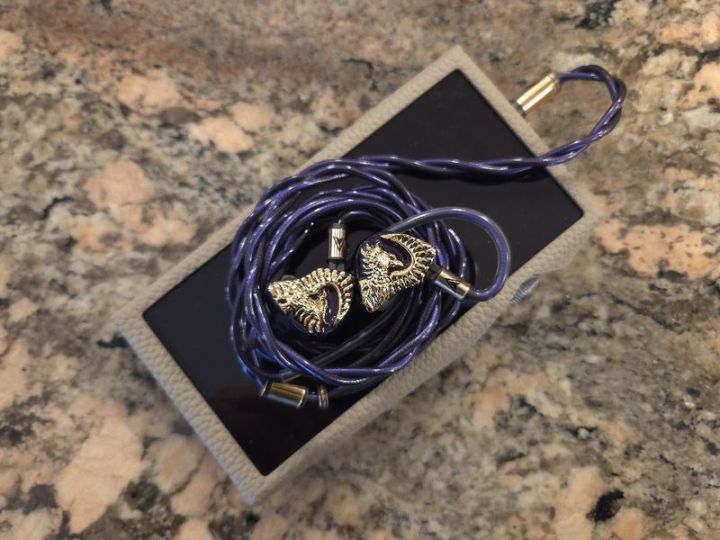
With its 104dB sensitivity, I noticed that Fulgrim is a bit power-hungry and requires a higher volume to drive it properly. It could scale up with amp, but I personally preferred it directly from SP4k. Although SP3kM and P6Pro sounded nice as well, SP4k had the widest soundstage expansion (with Advanced DAR enabled), followed by SP3kM and P6Pro. Additionally, it pairs great with the Nipo A100 dongle. In general, neutral or warmer sources are probably better with Fulgrim, but not brighter ones, such as the DX320Max Ti. Noticed the same with amps, where the more revealing nature of C9ii gave a treble crisper sound, while the PB5 was smoother and more textured up top.
Overall, I found SP4000, SP3000M, P6Pro, LPGT, RS8ii (still on beta fw), and other DAPs, along with the PB5 amp, to have great synergy. I also enjoyed Fulgrim with N6iii w/R202 (in R2R mode) and DX340 w/amp17. But, as already mentioned, I wouldn’t recommend the DX320Max Ti or the C9ii amp here.
Cable pair-up.
I’m aware that some people are skeptical about the contribution of cable to the audio chain. It’s not my intent to start an argument here. Instead, I would like to share what I hear during my testing. What makes sense to me is that a metal wire is a material with physical properties of resistivity, conductivity, and purity, all of which act as a filter between your source and earphones. Variations in these physical properties can affect the conductivity of an analog signal, resulting in a change in sound ranging from subtle to noticeable. If discussing cables bothers you, please skip this section. Otherwise, enjoy these short impressions.
stock vs HanSound Kunpeng – brings mids a little more forward, making them slightly more resolving. Also, expands imaging a bit, making it more holographic.
stock vs HanSound Quentin – mid-bass sounds a little stronger, adding more punch to the low end, mids are a touch more resolving, and there is a bit more crunch in the treble.
stock vs Beat Audio Orbit Saga – expands the soundstage and imaging, making it more holographic. The bass sounds tighter, faster, and more articulate. The mids have more transparency, a little less color; still very natural and resolving, but with a little less texture, improved detail retrieval, and improved layering. The background is super black.
stock vs EA Centurion II – to my big surprise, the soundstage sounds reduced in width with a lot more depth and height. Also, there is more sparkle in the treble. This pair-up doesn’t work well with Fulgrim.
stock vs EA Chiron – more holographic imaging, and brighter treble. It wasn’t my favorite pair-up either.
stock vs EA Code 23 – improved imaging, made the bass tighter and faster, but also made the treble brighter.
stock vs Eletech Odyssey – expanded soundstage and imaging; more revealing upper mids and treble.
stock vs Eletech Ode to Laura – very expanded soundstage and imaging, pushing it to the max of the holographic level. Mids are more forward and revealing, and treble has better extension and airiness, but also a little more revealing.
stock vs Eletech Euclid – improved imaging, making it more holographic, while the soundstage remains the same, still a powerful bass with a bit of stronger mid-bass punch, natural mids with slightly more resolving tonality, and still natural resolving treble.
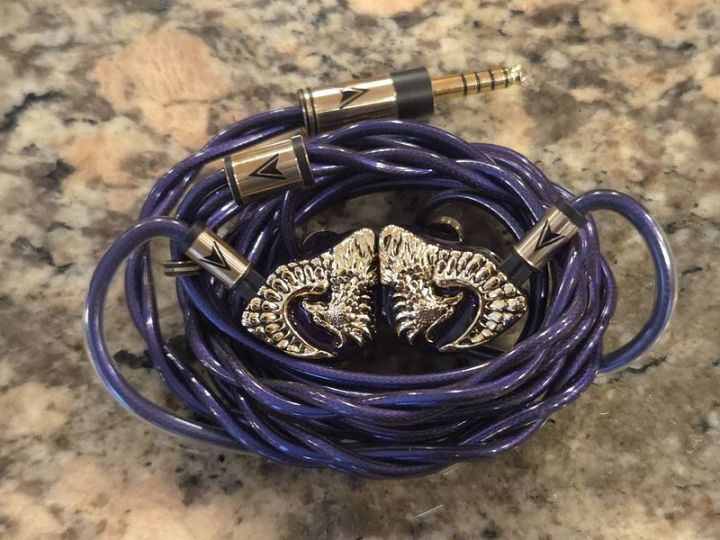
Fulgrim stock cable, Aura, was designed exclusively for Fulgrim by Astral Acoustics, in a matching purple finish, with cryo-treated OCC silver cores and OCC SPC shielding. Personally, I was fine with a stock cable, and based on what I’m hearing, it has an OK pair-up synergy here. I also heard there is another alternative, Luna, cable, which some auditioned at the SoCal show, but I didn’t have a chance to listen to it. So, I did my own cable rolling above. Despite some of these cables priced as high as Fulgrim itself, more expensive doesn’t necessarily mean better sound, because I actually preferred a cheaper silver/gold Eletech Euclid cable with these IEMs over others.
Everything is subjective, but again, if you want to finetune the sound of Fulgrim, start with eartips, not the cable. And as it turns out, Eletech Baroque Stage eartips and Eletech Euclid cable both have a great synergy with Fulgrim, as I hear it.
*** UPDATE ***
I was able to borrow an Astral Acoustics Luna cable after the CanJam Dallas 2025 show and spent a day testing it with Fulgrim, which I also borrowed from Musicteck again. Based on what I’m hearing, Luna has a very focused and distinct sound fine-tuning characteristic, where Fulgrim gained a bit more weight in the bass, more body in the lower mids, and slightly scaled down mid-treble emphasis. The combination of these changes gives Fulgrim a fuller body with more organic tonality in mids and vocals, and a perception of a smoother and more natural treble without compromising the resolution of upper frequencies, although making them a little less revealing. In my testing of Fulgrim with a stock Aura cable, I preferred more neutral and warmer sources, while with Luna, you can also consider more revealing sources. And especially with a smoother treble, it allows you to raise the volume when listening to these IEMs without causing any high-frequency fatigue.
At 19.5AWG, in comparison to a stock Aura, the Luna 7N 0CC SPC is a thicker cable. However, it is only 15g heavier than the Aura. The cable is still ergonomic, feels as comfortable as the stock cable, and remains non-microphonic. I did notice that I had to raise the volume by a few notches to match it with a stock cable, which probably explains Astral Acoustics’ mention of “impedance tuning” behind the cable’s tech.


Conclusion.
I wasn’t familiar with the origin of the “Fulgrim” name until I Googled it, finding a reference to a mystical creature from another universe, known for his relentless pursuit of perfection and sometimes referred to as “The Phoenician” due to his perceived ability to rise from the ashes of failure. I understand the reference to the pursuit of perfection, but I’m not really sure if the “ashes of failure” are even applicable here. Alpha & Omega is a relatively new brand I discovered last year after sharing my impressions of their debut Omega IEMs, which I found quite maturely tuned for a newcomer.
I’m aware that the Omega release was well received and stood out for its bass performance, offering three switches to fine-tune the sound, with options ranging from L-shaped to a more balanced sound signature. It looks like Fulgrim took it to the next level, both in tuning and price, delivering audiophile-quality basshead tuning while maintaining a balanced W-shaped sound signature at an eye-watering cost. Just like with many other IEMs, you do need to spend some time with the tip, source, and cable rolling. My “eureka moment” came when I switched to Baroque wide bore opening eartips, then moved to the Baroque Stage, which offers the same sound characteristics with added airiness and enhanced treble extension.
What makes Fulgrim stand out is its powerful, physical bass impact and deep, textured rumble that you can feel, resonating down to your jawbones without being overwhelming. And the overall sound has a fuller body and clear, detailed mids, which scale up with the Stage version of Baroque, showing improved layering and separation, including enhanced airiness and better treble extension, while remaining naturally crisp and non-fatiguing.
I spent a very short time with these IEMs, miss them already (that bass!!!), made my wife sick and tired hearing about it at home, and probably annoyed a few people on Head-fi by constantly bringing it up lol. Now, I can’t wait until after CanJam Dallas to borrow them from Musicteck again.

 Twister6 Reviews