
Sound Analysis.
Here is how I hear Dionysus cable where for the testing I used various IEMs and A&K SP4000 as a neutral natural source while playing the selection of my usual test tracks, such as Agnes Obel’s “The Curse”, Sandro Cavazza’s “So much Better” (Avicii remix), C-Bool’s “Never Go away”, Ed Sheeran “Shape of you”, Counting Crows “Big yellow taxi”, Galantis “Hunter”, Alan Walker “Darkside”, Iggy Azalea “Black widow”, Indila “Boite en argent”, Robin Schultz “Oh child”, Dua Lipa “Love Again”, David Elias “Vision of her”, Michael Jackson “Dirty Diana”, and SaberZ “Without your love”. By force of habit, the cable had plenty of burn-in time, over 100 hours as recommended by the manufacturer.
Please understand that I’m not referring to the bass, mids, treble, or the soundstage expansion of the cable since wires by themselves don’t have the “sound”. Instead, I’m conducting the sound analysis based on a pair-up of the cable by describing how I perceive the sound change of various IEMs under test as I switch between their stock cable and Dionysus.
EE Odin (stock PWA 1960-2w Copper vs Dionysus) – here the soundstage expansion evens out, considering that with stock cable Odin has a little more depth than width, now becoming wider and more round-shaped, even feeling like the sound was wrapping around my head. While imaging in relation to sound placement remains holographic, I felt as though I was sitting a few rows closer to the performer. The mids/vocals were not as much out of your head, and instead, were closer, bringing more focus to them. With the sound, there is a slight boost in sub-bass rumble, and the mid-bass punch is also faster (in terms of sound attack), tighter, and the overall bass is more articulate. The stock cable makes the Odin’s bass more neutral and relaxed. As already mentioned, with Dionysus, the mids/vocals feel closer and also more resolving. It’s not the same as a boost in treble definition to make the sound brighter. Instead, it was more resolving, revealing, and more micro-detailed. Odin already has a more mid-forward tuning. So, if you enhance its upper mids, bringing them more forward and making them more revealing and resolving, you can throw off the tuning balance. But Dionysus balanced it out with the enhancement in the bass by scaling up both Odin’s lows and mids without making the treble brighter or harsher.
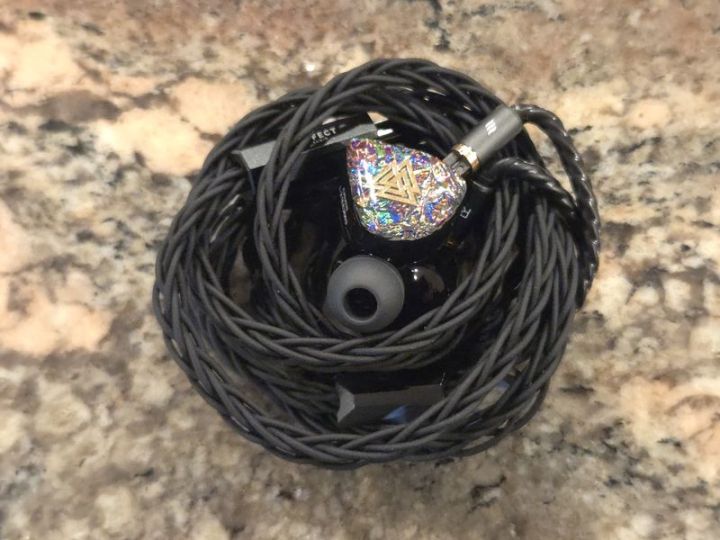
EE Odin MK2 (stock Gold/Silver/Copper vs Dionysus) – before any sound analysis, from an aesthetic perspective, Dionysus, with its black/gold finish, is a perfect match for the Odin MK2. From a sound perspective, there is a significant difference in soundstage expansion when compared to the stock cable. With a stock cable, MK2 sounds more intimate, as if you are playing a sound in a private studio. As you switch to Dionysus, the sound expands in all three directions, including a more holographic sound positioning. The sound tuning remains neutral, but the bass rumble now has more texture, feels slightly elevated, and has improved definition. Even the mid-bass punch feels like it gained a bit more weight. The vocals sound more resolving, and I don’t mean that as more revealing, but with improved resolution and retrieval of details. Even the treble gains a bit more airiness, which helps open up the sound, contributing to the improvement in soundstage expansion. I don’t find Dionysus to alter Odin MK2 sound drastically, but it does enhance it with a very tasteful finetuning.
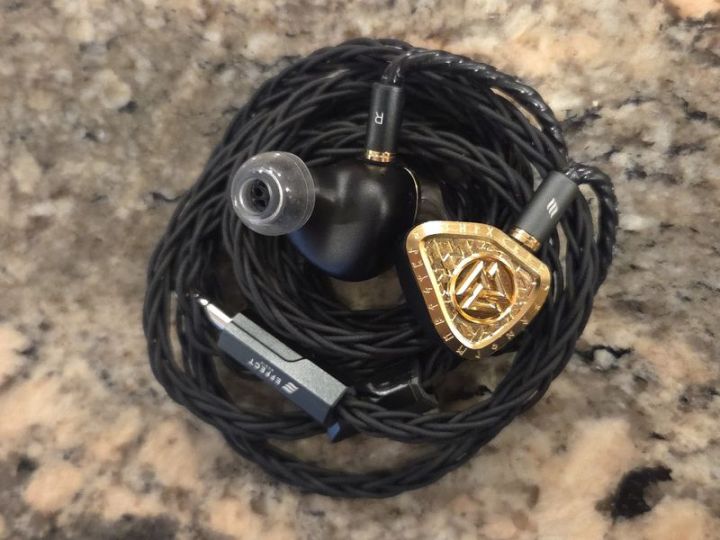
FirAudio RN6 (stock Copper-plated Silver vs Dionysus) – this was another match made in heaven from an aesthetic perspective, considering the black/gold finish of both the IEM shells and the cable. And it gets even better when it comes to the sound pair-up. RN6 has a large holographic soundstage to begin with, and with Dionysus, it becomes even more 3D, providing a “cinematic” enhancement, if you will, with the sound almost wrapping around your head. The sound enhancement was something else. RN6 is known for its L-shaped audiophile bass-head level of performance. With Dionysus enhancing the focus on mids/vocals, the signature shifted to a more refined W-shaped performance, with mids coming more forward to balance out lows and highs. The bass scaled up, not in quantity, but in quality, becoming more layered, gaining more volume without weight or loudness, and becoming more authoritative with more oomph. This was a very impressive transformation. Mids, aside from being a little more forward, gained more focus, also improved resolution, and the treble gained more control and slightly more airiness. As of now, I think I’m going to keep Dionysus permanently attached to RN6.

Canpur CP622B (stock Eletech Socrates Copper vs Dionysus) – In this pair-up, the changes are more subtle, yet still noticeable. CP622B is known for its expansive soundstage (thanks to the magic of those dual Sonion BCD drivers), and with Dionysus, the main difference I hear is that you feel as a listener to be closer to the stage. Therefore, the effect here is more related to imaging than soundstage expansion. In terms of the sound, I do hear a bit more rumble in sub-bass. I think the effect of bass improvement with Dionysus is more noticeable with DD driver IEMs, but even with CP622B, I do hear more texture and slightly elevated sub-bass rumble. Upper mids are also a little more forward and more revealing with Dionysus. Dionysus strips away a bit of the warmth of the CP622B, making its mids more revealing and resolving, while retaining their texture. The treble sounds very similar, perhaps with a touch more sparkle added in the pair-up with Dionysus. Btw, from the aesthetic perspective, it’s also a cool match between CP622B and Dionysus.
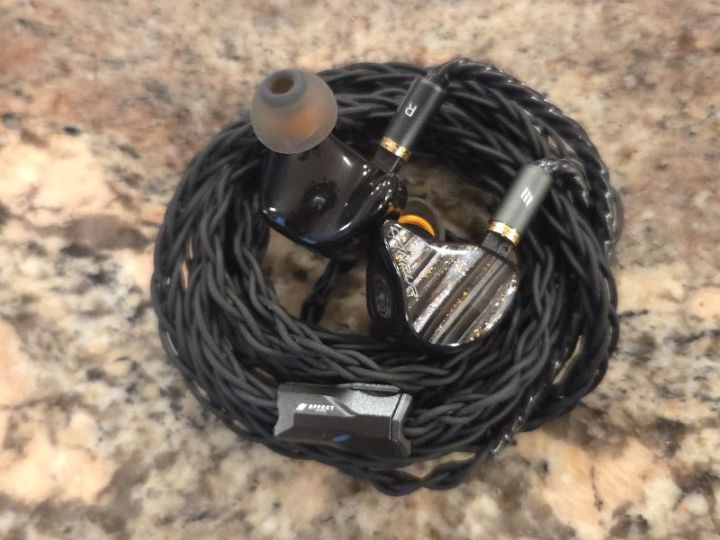
Aroma Jewel (PWA FirstTimes Copper vs Dionysus) – as many already know, I don’t use Jewel with its stock cable, and often prefer to use it with FirstTimes. There are minor changes in this pair-up, but they provide a very delicate and meaningful finetuning of Jewel, to polish its “shine”, no pun intended. The soundstage width remains the same, big, wide, and open. However, the imaging relative to sound placement is more 3D-like. The bass impact is not too far off, but there is a bit more weight in the sub-bass rumble, which translates into a slightly fuller low-end perception. Up top, the treble has a little more sparkle and airiness, which gives the mids/vocals a little higher resolution. It’s not a drastic change, but rather a fine-tuning of Jewel as it transitions from PWA FirstTimes to Dionysus. However, at a fraction of the price, if you already have Jewel, it makes a lot more sense to upgrade its cable to Dionysus.

Comparison.
While in the sound analysis above, I conducted a comparison of various popular IEMs with either their stock, premium, or upgrade cables relative to Dionysus, I was asked by some of my readers who were curious how Dionysus stacks up against other EA cables, the reason I’m specifically using AxC II (Ares S II x Cadmus II hybrid), Eros S II, and the original Fusion 1 paired up with Odin in the comparison below.
Dionysus vs AxC II – this was a surprise to my ears because, from a tonality perspective, the sound enhancement introduced by these cables is not too far off. Dionysus is a little more revealing at the top, but the most noticeable difference lies in the technical performance between these two cables. Dionysus soundstage expands wider, making its imaging also more holographic, like movie-theater 3D expansion. There is also an improvement in layering and separation of the sounds, with more air between layers, and the vertical micro-dynamics of the sound being more expanded. I went back and forth a dozen times, and kept noticing that with AxC, it felt like I was listening to music, while with Dionysus, I was hearing the same music, but it felt like it was coming through live, due to the enhancement in micro-dynamics of the sound.
Dionysus vs Eros S II – as expected, I found Dionysus’ soundstage to be broader and more holographic, especially with the vocals’ placement, which brings you closer to the performance, as opposed to being more distant with Eros. Odin with Eros S II exhibited a softer bass performance, particularly in the slower attack of the notes, resulting in a sound with a slightly more laid-back presentation. At the same time, Dionysus made Odin’s bass notes faster, tighter, and punchier. Dionysus also enhanced Odin’s treble, making its extension airier. And again, I noticed how with Dionysus vs Eros S II, it felt like I was listening to a live performance of the same sound.
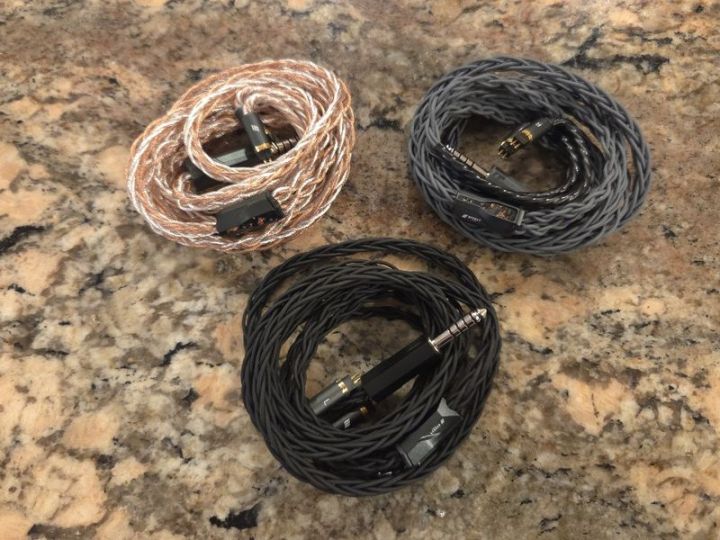
Dionysus vs Fusion 1 (OG) – this is a comparison to the original Fusion 1, as I haven’t yet tested Fusion 1 mk2. Both cables bring more focus to mids/vocals with Odin, which also brings you closer to the performer on stage compared to other cables, where vocals in Odin sound more natural. While the imaging is very close, and both enhance the width of the soundstage, I still felt like Dionysus did its “magic” to wrap the sound a little behind you, expanding it a touch wider. Another thing I noticed was that while both improved the sub-bass rumble, with Fusion 1, the mid-bass punch was a bit more relaxed, while Dionysus came through with a tighter, stronger, and faster bass punch. Additionally, with Dionysus offering slightly better treble extensions, including more airiness, Odin sounded a little more resolving/revealing with Dionysus compared to being a bit smoother up top with Fusion 1.
Conclusion.
I’m going to sound like a broken record, repeating myself. Still, Effect Audio’s Signature Series II is a no-brainer if you are looking for high-quality budget cables, even though I’m still having a hard time calling them “entry” level due to their advanced design and sound quality. Aside from being more affordable than other higher-end EA cables, they look great, sound great, and have sexy hardware. And if you already have the original Ares S, Cadmus, and Eros S, upgrading to Ares S II and Cadmus II makes more sense. Both are now 8-wire versions, priced lower than the 8-wire version of the corresponding original Sig Series cables, and they exhibit a more noticeable sound improvement over the original 4-wire and 8-wire versions, especially the Cadmus II. AxC II also stands out with a unique crossover sound characteristic, borrowing from Ares S II and Cadmus II.
With the introduction of Dionysus, you now have more options to fine-tune the sound of your IEMs, albeit with a slightly higher price tag compared to other Signature Series II cables. However, Dionysus offers wire material such as Gold-plated Silver, found in EA’s Ultra-Premium series of cables, at a fraction of their price. Premium wire costs more money, driving the price higher; that is common sense. But you are not just paying extra, relative to other Signature Series II cables, because of the exotic wire material, but also getting an improvement in sound performance. With many IEMs I tested, I found Dionysus to add more weight to sub-bass rumble, bring the upper mids forward, while also improving the retrieval of details, and even adding more air and extending the treble, in addition to enhancing soundstage imaging. In comparison to other cables in the SSII series, Dionysus also demonstrated an improvement in the perception of vertical sound dynamics, which surprised me.
However, as I usually mention in the conclusion of my cable reviews, everything depends on the pair-up synergy between the source, the cable, and your IEMs, and the essence of the cable lies in fine-tuning the baseline signature of your IEMs. Ultimately, it’s not always about finding the best overall cable, but rather the best cable for your IEMs, regardless of the cable’s price. There is no magic “EQ” silver bullet or fairy dust behind the cable. If you’re not satisfied with the sound of your IEMs, consider getting a pair of monitors with a different sound signature. However, if you are limited by a budget of $400 plus change, Dionysus does offer something unique in tuning compared to other Signature Series II cables. I know that some hard-core audiophiles believe that exotic wire material cables must come at an exotic price and yield diminishing returns. I think many will be surprised at the sound finetuning improvement Dionysus has to offer at its non-exotic price point.

 Twister6 Reviews