

The young heir to King Solomon?
PROS: Exceptionally natural and realistic W-shaped tuning, Deep, authoritative sub-bass with natural slam and rumble, Clean, well-separated midrange with excellent tonal accuracy, Fairly neutral, fatigue-free treble with class-leading natural detail retrieval, Large, three-dimensional soundstage with precise imaging and layering, Outstanding build quality and shell ergonomics, Truly luxurious unboxing experience, Phenomenal artistic metal carry case, Premium stock blue cable with excellent handling and striking design.
CONS: Lower-mid scoop may reduce warmth for listeners who prefer thicker mids, Treble lovers seeking extra sparkle or air may find it too restrained.
Introduction.
BGVP has long occupied a distinctive position in the personal audio space, known for its willingness to experiment with driver technologies while steadily refining its tuning philosophy over successive releases. Rather than chasing a single house sound, the brand has consistently explored different interpretations of musical balance—sometimes bold, sometimes restrained, but rarely forgettable. With the Astrum, BGVP signals a more deliberate and mature intent, positioning it not merely as another high-driver-count premium IEM, but as a statement product designed to showcase how far the company’s tuning and industrial design sensibilities have evolved.
This review takes a close look at the BGVP Astrum – an ambitious hybrid in-ear monitor that combines multiple driver technologies with an unusually high emphasis on presentation, craftsmanship, and tonal balance. On paper, Astrum promises deep sub-bass authority, natural midrange clarity, and a restrained, realistic treble, all wrapped in a package that aims to feel unmistakably luxurious from the very first interaction. The question, as always, is whether BGVP’s latest IEM manages to translate that ambition into a genuinely cohesive listening experience, or whether it gets lost in the increasingly crowded $500–$1,000 segment. Let’s find out.
Links – BGVP Official | Musicteck (US distributor)

Technical Specifications.
- Driver Configuration: Dual 8 mm Coaxial Horizontal Symmetrical Dynamic Drivers, Dual Knowles Balanced Armature Drivers, Dual Third-generation SONION EST Drivers.
- Crossover: Four-way physical + electronic crossover
- Impedance: 12 Ω
- Sensitivity: 111 dB
- Frequency Response: 20 Hz – 40 kHz
- Connector: 0.78 mm 2-pin
- Termination Plug: 4.4 mm Balanced
- Shell Material: Handcrafted preserved flower resin
- Stock Cable: 8-strand graphene ACOOL copper cable, 0.78 mm 2-pin (4.4 mm termination), with custom aesthetic Y-split components
- Packaging Elements: Designer package with integrated lighting and quicksand effect; artistic metal carry case included
Unboxing Experience.

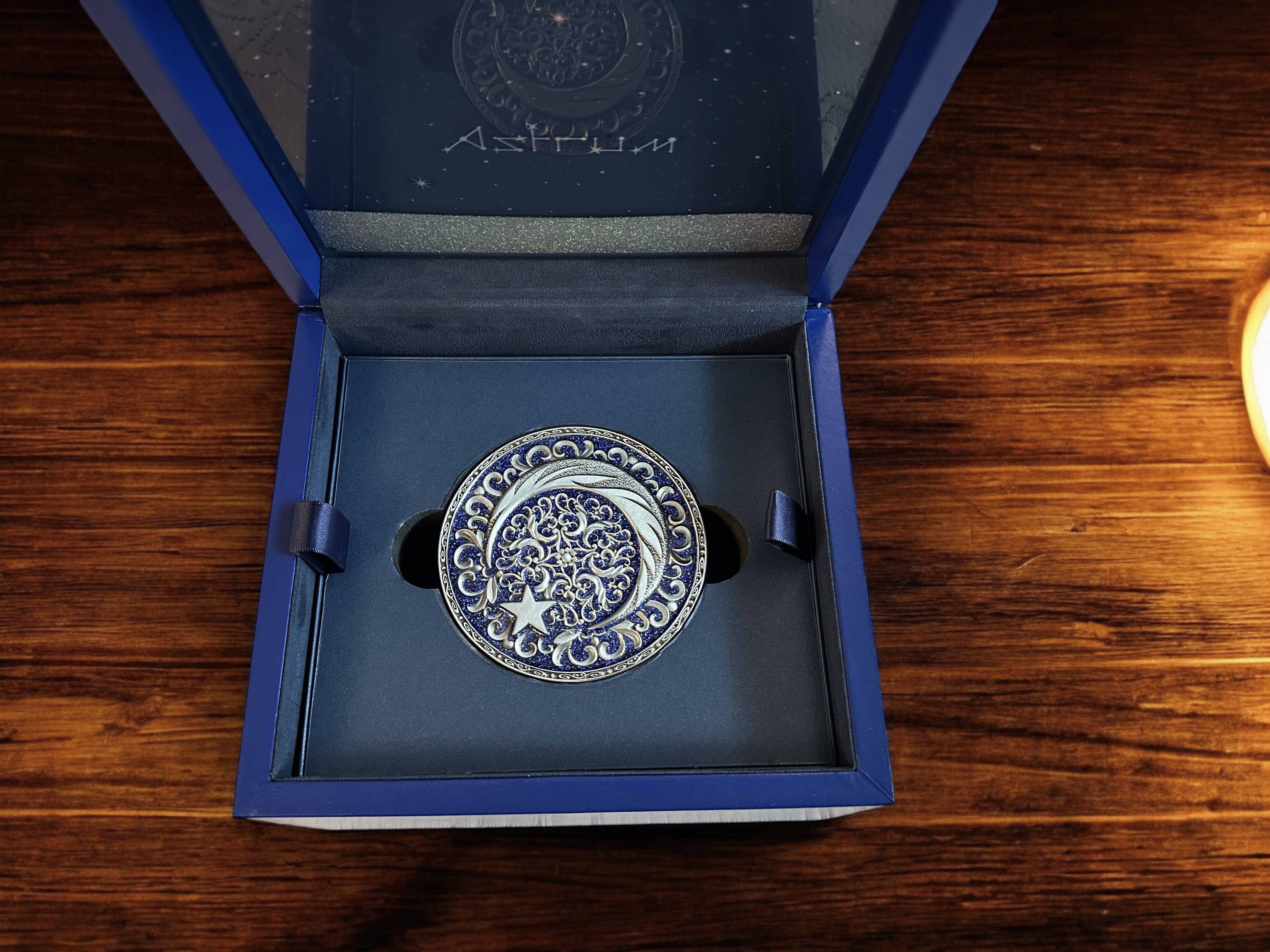
BGVP has gone far beyond a conventional “premium box” approach with the Astrum and instead created a genuinely theatrical unboxing experience. The outer packaging immediately signals that this is a very premium product, but it is only upon opening the box that the Astrum truly distinguishes itself. BGVP employs a layered presentation design incorporating integrated lighting elements and a flowing quicksand-style visual effect, which activates as the box is opened. This illumination frames the earpieces dramatically, reinforcing the Astrum’s celestial, cosmic theme.
This is not packaging designed merely to protect the product in transit, it is designed to make the unboxing feel deliberate and ceremonial. Every layer feels intentional, from the way accessories are arranged to how the IEMs are visually elevated as the center piece of the experience. It is one of those rare unboxings where the presentation feels aligned with the sonic philosophy – refined, immersive, and emotionally engaging rather than flashy for its own sake.

The accessories themselves are equally premium. The artistic metal carry case is a highlight and deserves special emphasis. Machined with intricate detailing and a solid, reassuring heft, it feels closer to a luxury desk object than an accessory you casually toss into a bag. This is a case you want to use, not one you reluctantly tolerate. The inclusion of such a distinctive, high-quality storage solution further reinforces the sense that BGVP intended Astrum to feel special long before a single note is played.
Overall, the Astrum’s unboxing experience comfortably sits among the most luxurious and thoughtfully executed in its class, rivaling—and in some respects surpassing—offerings from brands at significantly higher price points.
Build Quality.
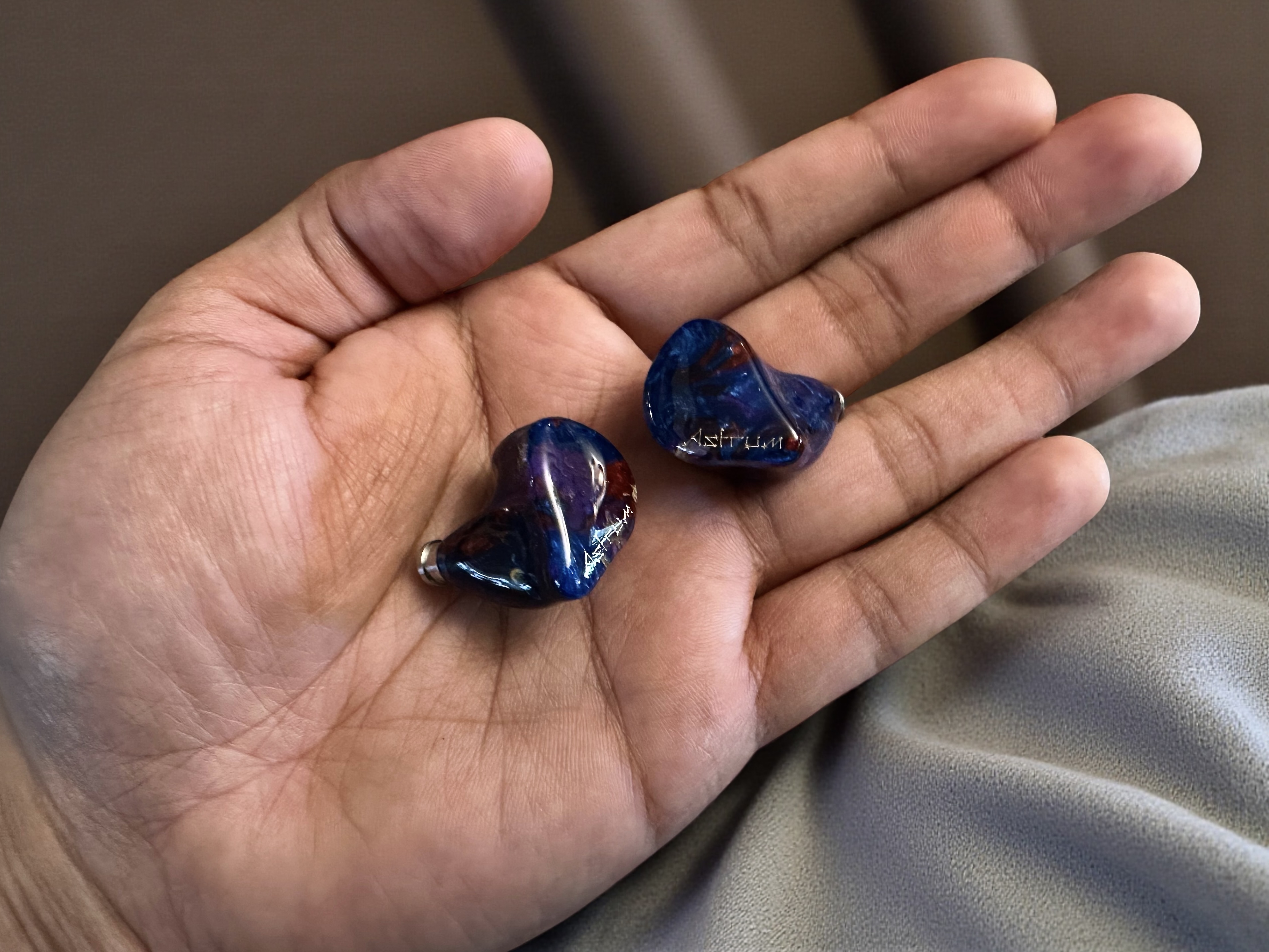
The Astrum’s build quality reflects the same level of care and craftsmanship evident in its presentation. The shells are handcrafted using preserved flower resin, a process that results in subtle visual variations from unit to unit. No two Astrums are exactly alike, lending each pair a bespoke, almost artisanal character. The finish is smooth and refined, with excellent consistency in shell contours and no visible imperfections or uneven seams.
Despite the visually rich resin construction, the shells remain ergonomically sound. Weight is well managed, allowing the Astrum to sit securely in the ear without pressure hotspots during long listening sessions. Venting has been intelligently implemented to balance comfort and acoustic performance, ensuring stable bass response without causing driver flex or discomfort.
Connection hardware is equally well executed. The Astrum uses 0.78 mm 2-pin connectors, seated firmly and precisely, allowing for easy cable swaps without looseness or alignment issues. The stock cable deserves particular praise: BGVP includes an 8-strand graphene ACOOL copper cable that not only looks striking in its deep blue finish but also feels supple, durable, and premium in hand. The artsy Y-split and jack hardware are not generic off-the-shelf parts; they are custom-designed, visually cohesive with the Astrum’s aesthetic, and contribute meaningfully to the overall luxury feel.
Taken as a whole, the Astrum’s build quality is exemplary. It combines artisanal visual design with robust construction and excellent ergonomics, managing to feel both luxurious and practical. There is nothing fragile or ornamental about it – this is a premium IEM built to be used regularly, not merely admired, and it succeeds convincingly on both fronts.

Sound Analysis.
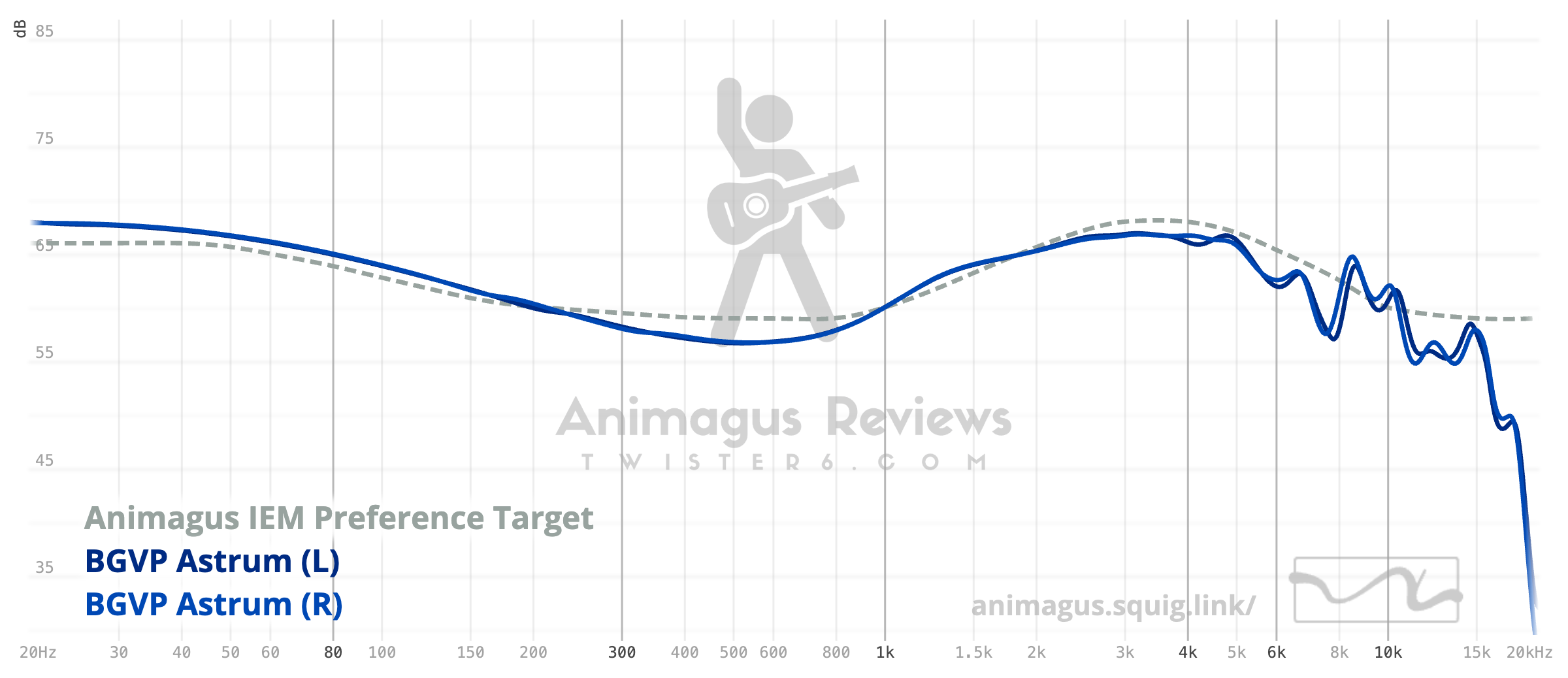
BGVP Astrum presents a very natural, realistic, and punchy W-shaped signature that is immediately convincing. A roughly 9 dB sub-bass shelf delivers genuinely natural slam and rumble, while a slightly scooped lower midrange around 500 Hz keeps the presentation clean and well separated. An approximately 8 dB ear-gain rise anchors vocals and lead instruments with clarity, and the treble remains notably neutral, avoiding artificial brightness. The result is a convincingly three-dimensional soundstage with strong imaging and separation, paired with class-leading natural detail retrieval that is achieved through balance and control rather than treble overemphasis.
Let’s dig in deeper…
Bass – Astrum’s low end is one of its defining strengths. The sub-bass shelf delivers a satisfying sense of depth and rumble, yet the emphasis is on realism rather than brute force. Bass notes have a natural attack and decay, with excellent control and minimal bleed into the midrange. Kick drums sound physical and grounded, while bass guitars retain their harmonic structure instead of collapsing into a one-note thump. Importantly, the bass never feels detached from the rest of the frequency range. It integrates seamlessly into the midrange, contributing to a cohesive and organic presentation that works equally well with acoustic recordings and electronic material.
Midrange – The midrange is where Astrum truly showcases its tuning maturity. The slight lower-mid dip around 500 Hz provides breathing room for complex arrangements, allowing instruments to occupy their own space without congestion. At the same time, the midrange does not sound hollow or artificially cleaned up. Vocals are rendered with excellent tonal accuracy and density. Male vocals retain chest resonance, while female vocals sound open and expressive without excessive forwardness. String instruments, pianos, and guitars benefit from the Astrum’s strong timbral fidelity, sounding convincingly “real” rather than hi-fi enhanced. This is a midrange tuned by someone who clearly values musical authenticity over short-term wow factor.
Treble – Treble on the Astrum is refreshingly neutral. There is no attempt to manufacture detail through aggressive upper-treble boosting, and the result is a top end that sounds natural, controlled, and highly listenable. Cymbals shimmer realistically, with proper metallic decay rather than splashy glare. High-frequency transients are clean and well defined, yet never sharp. This approach directly contributes to Astrum’s class-leading natural detail retrieval. Detail is not forced upon the listener; instead, it emerges organically from a low-distortion, well-balanced response. The Astrum reveals micro-information because it is clean and coherent, not because it is bright.
Technical Performance.
Astrum delivers a convincingly three-dimensional soundstage with excellent depth and layering. The stage is not artificially wide, but it is proportionally expansive, with strong front-to-back projection that enhances realism. Imaging is precise and stable, allowing instruments to lock into position with confidence. Separation is particularly impressive in dense mixes, where Astrum maintains clarity without resorting to exaggerated treble contrast. This is a technically accomplished IEM that prioritizes spatial realism over showmanship, and the result is a presentation that feels immersive and believable rather than spectacular for its own sake.
Comparisons.
BGVP DMA.
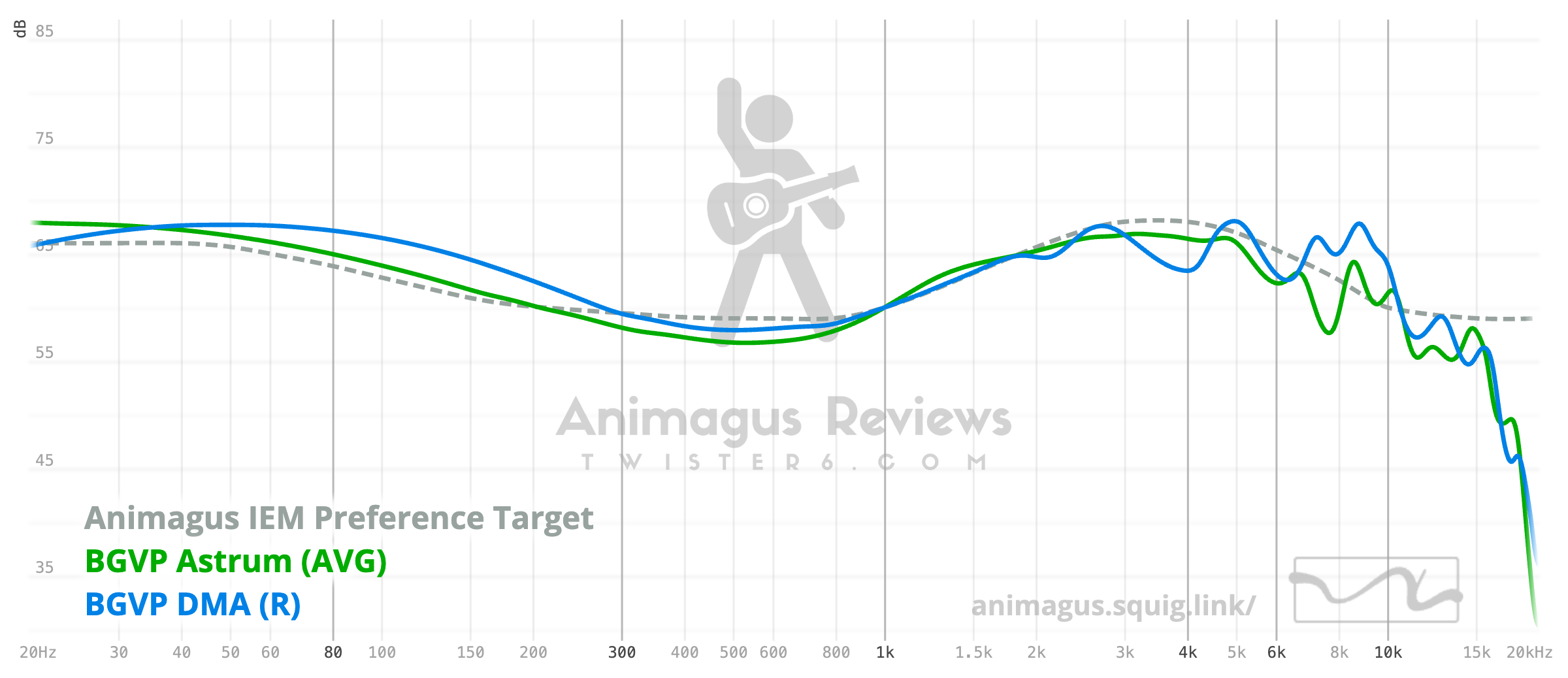
While both the Astrum and DMA hail from BGVP’s mid-tier, their sonic philosophies diverge meaningfully. The Astrum delivers a refined, natural W-shaped signature with a deep and controlled sub-bass shelf, a slight lower-mid dip that enhances clarity, and a neutral treble that emphasises realistic instrument timbre and smooth detail retrieval. In contrast, the DMA leans into a thicker, more visceral presentation driven by its inclusion of bone-conduction drivers and a more pronounced low-mid emphasis. This gives DMA a midrange body that feels more robust and forward, particularly on bass-rich tracks, but it can come at the cost of midrange separation and airiness. Where Astrum’s bass feels textured and extended down low, DMA’s low end is impactful but less layered; instruments in dense mixes tend to blend with DMA’s warmer midrange, whereas Astrum maintains cleaner delineation. Treble on Astrum remains neutral and clean, whereas DMA’s BA/BCD combination retrieves detail capably but lacks the EST-style openness and natural decay Astrum achieves. On staging, Astrum yields a wider, more three-dimensional soundscape, while DMA feels equally impressive but very minorly more intimate, suiting listeners who favour fullness over refined spatial imaging. Overall, Astrum’s strength lies in natural dynamics and refinement, and DMA in physicality and warmth.
BGVP DM9.
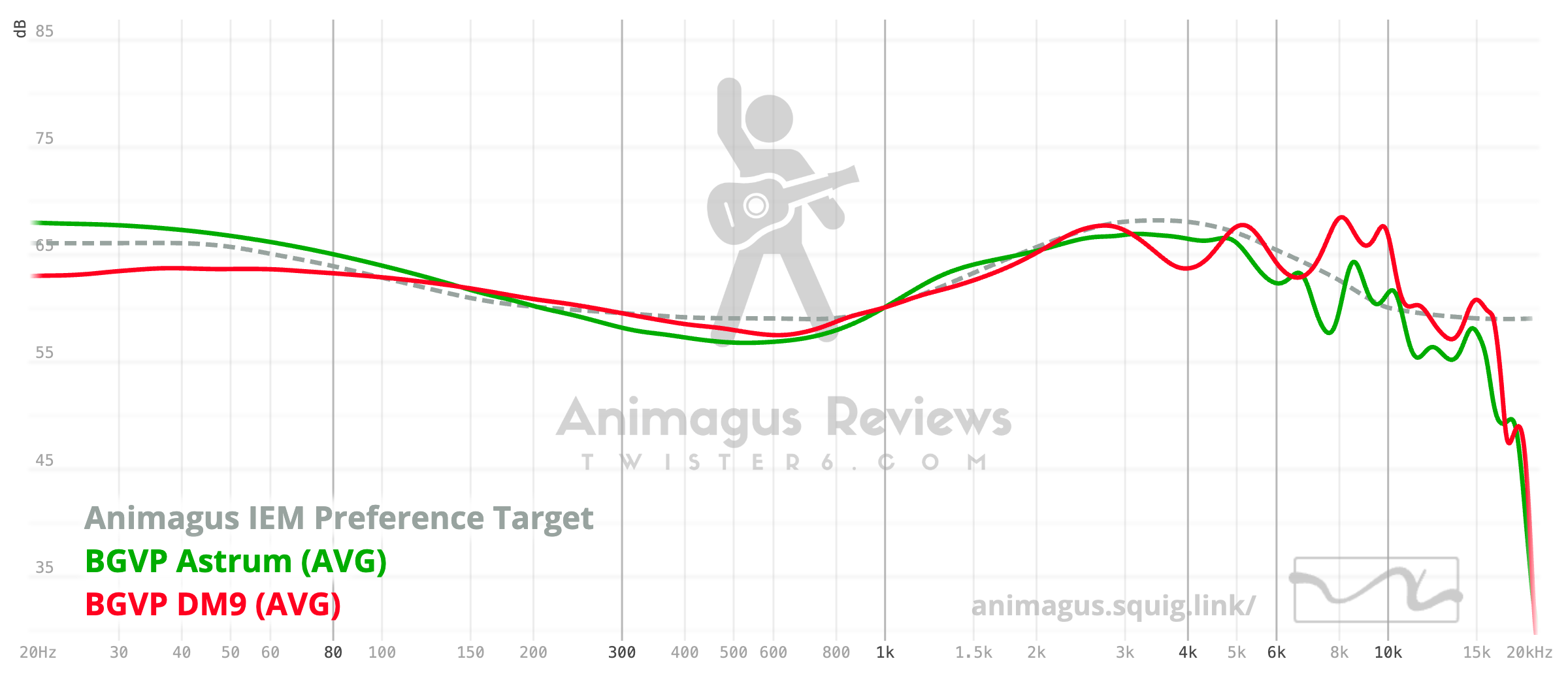
BGVP’s DM9 and Astrum share a high driver count and hybrid philosophy, but their tuning priorities diverge. DM9’s driver configuration emphasises technical resolution and detail retrieval, often resulting in a more analytical sound with emphasis on treble sparkle and separation. Its dynamic driver is large and capable, but the low end tends to prioritise speed and control over the deep sub-bass rumble that Astrum delivers with a dedicated 9 dB sub-bass shelf. As a result, Astrum feels more impactful and visceral in the lowest registers, while DM9’s bass is precise but less weighty. Midrange on DM9 is highly resolving and can lean brighter, which benefits microdetail but sometimes at the expense of warmth and timbral naturalness; Astrum’s tuning, with slight lower-mid smoothing, renders vocals and instruments with a richer, more natural body. Treble on DM9 is bright and airy, appealing to those who seek high-frequency definition, but this can come at the price of listener fatigue over long sessions—whereas Astrum’s neutral treble provides extended detail without glare. In staging, DM9’s technical presentation results in excellent instrument separation and pinpoint imaging, but Astrum’s wider, more immersive 3D presentation favors spatial realism. For technical headphone enthusiasts, DM9 appeals with its analytic prowess; for musically oriented listening with a naturalistic signature and deeper bass presence, Astrum has the advantage.
Softears RSV MK2.
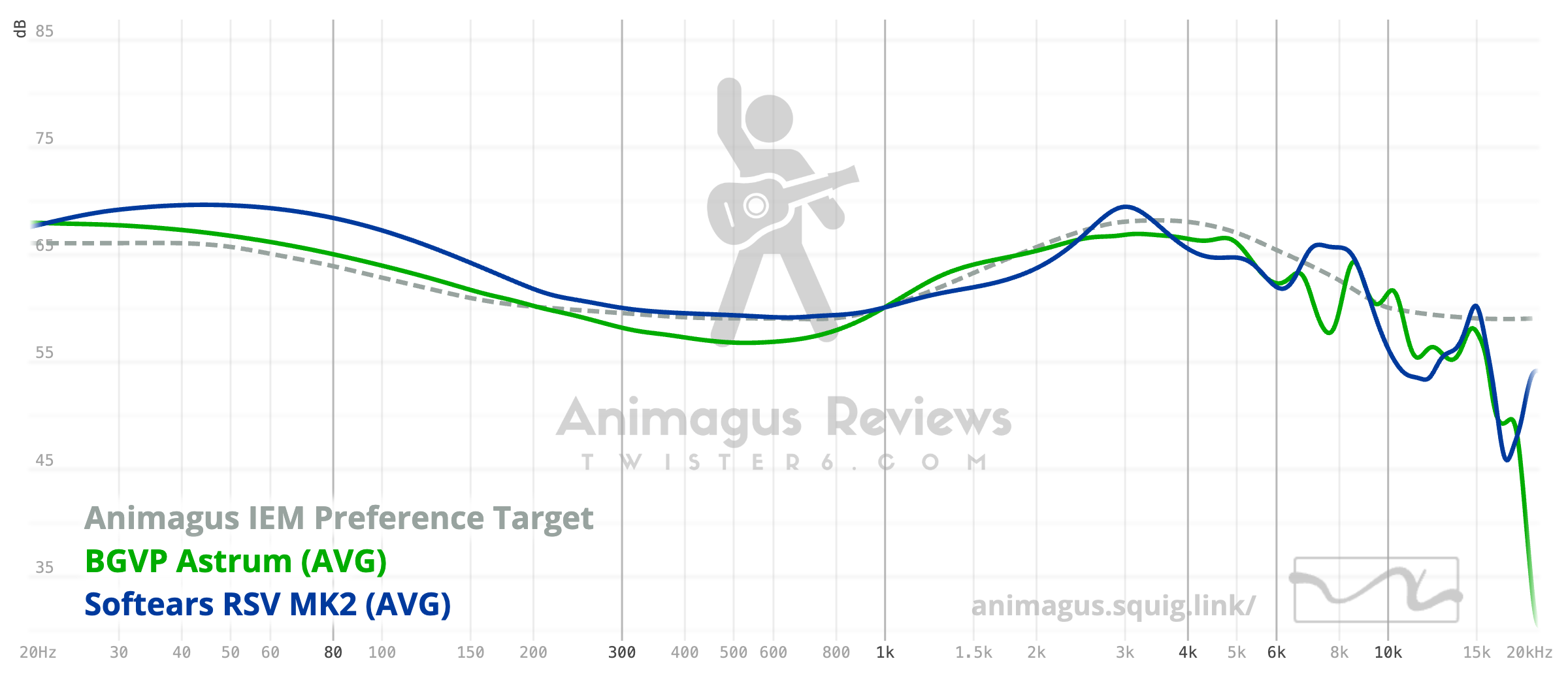
Comparing Astrum with the Softears RSV MK2 highlights the contrast between a hybrid tuned for organic realism and a multi-BA design that emphasizes clarity and control. The Astrum’s hybrid array of dynamic, BA, and EST drivers produces a sound that marries body, depth, and natural texture with a deep sub-bass shelf and neutral top end. Softears RSV MK2, driven entirely by multiple Knowles BA drivers, approaches its tuning with a controlled, analytic sensibility. Its bass is tight and punchy but typically does not match Astrum’s depth or visceral rumble; RSV MK2’s bass remains more measured and linear in character. In the midrange, RSV MK2 delivers articulate and highly resolved vocals and instruments, but its BA timbre can sometimes sound thinner or more clinical compared to Astrum’s dynamic-backed warmth and richness. Treble on RSV MK2 can feel more reference-leaning and detail-forward, which benefits resolution but lacks the natural treble extension and smoother decay that Astrum’s EST drivers provide. Imaging on Astrum tends toward a wider, more immersive stage, while RSV MK2 maintains a precise but more disciplined presentation. If you prioritize BA-style resolution and controlled bass, RSV MK2 excels; if you want musicality with deep, realistic low end and a natural soundstage, Astrum has the edge.
BGVP Solomon.
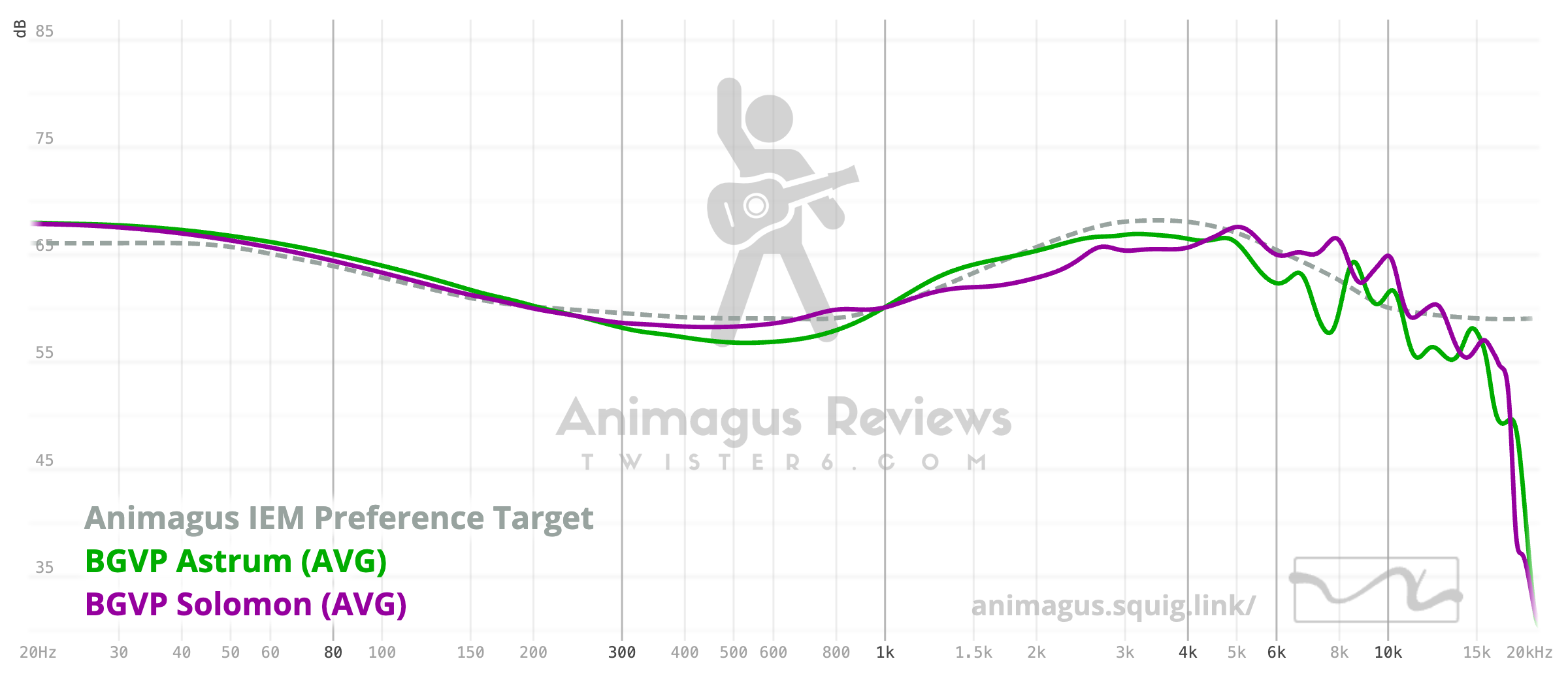
The BGVP Solomon and Astrum both aim for high end performance but differ in execution. Solomon uses a large array of drivers—including dynamic, BA, EST, and bone-conduction elements—to create a layered and expansive sound that can be described as “maximalist.” This results in a multi-textured low end with strong weight and presence, particularly in upper bass and lower mids, giving mixes a richer body. However, this density can occasionally blur separation compared to Astrum’s more measured low-end emphasis, where the 9 dB sub-bass shelf provides deep, controlled rumble without compromising clarity. Midrange on Solomon is detailed and lush, but its larger driver count and aggressive staging can sometimes overshadow the natural vocal timbre that Astrum preserves through its balanced tuning choices. Treble on Solomon is expansive and airy—more so than Astrum’s neutral top end—potentially appealing if you like a more dramatic high-frequency sense. The Astrum, on the other hand, focuses on realistic imaging and natural decay rather than breadth alone. While both achieve wide and layered soundstages, Astrum’s presentation feels more coherent and less overtly engineered, making it preferable for listeners who favor musicality and natural instrument placement over technical fireworks.
Custom Art Hybrid 3 Pro.
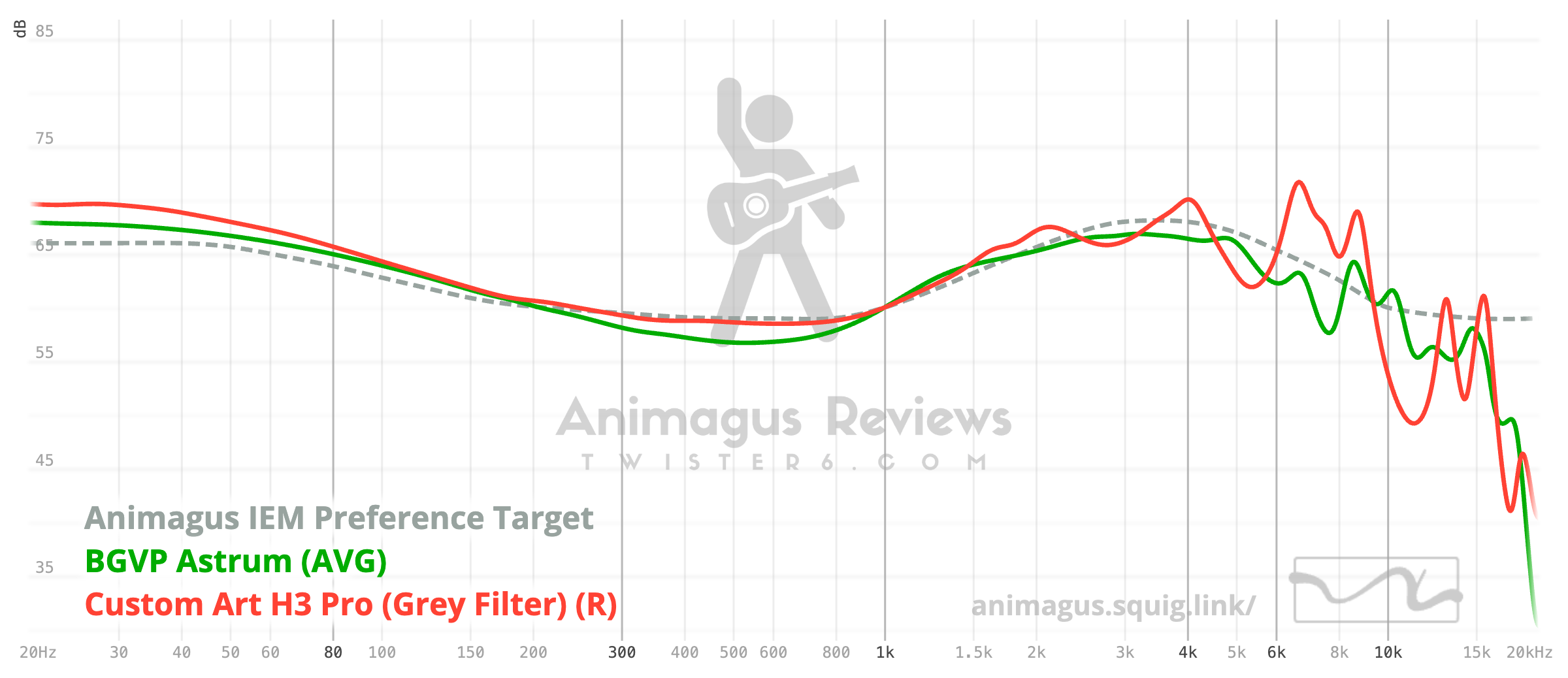
The Custom Art Hybrid 3 Pro represents a different hybrid approach with separate dynamic and planar elements, enabling tunability via vents that can shift bass character. Compared to Astrum’s tuned sub-bass shelf, H3 Pro’s bass control is flexible but can depend heavily on vent choice; with vents open, lows can sound more forward but less controlled, and with vents closed, bass can tighten but lose some depth. Astrum’s bass remains consistently deep, textured, and cohesive irrespective of external adjustments. In the midrange, H3 Pro’s planar and dynamic drivers deliver clean detail and neutrality, but the planar timbre, while smooth, is inherently different from Astrum’s blend of dynamics, BAs, and ESTs, which yields a more lifelike instrument body and vocal presence. Treble on H3 Pro goes for a sparkly and exciting presentation, leading H3 Pro an analytical approach whereas Astrum goes for easy going natural timbre and sparkle. On staging, H3 Pro maintains solid soundstage, layering and separation which has distant width and depth while Astrum’s goes for a more natural soundstage arguably feel more organic and yet spacious.
Conclusion.
The BGVP Astrum comes across as a thoughtfully tuned IEM that emphasises balance, coherence, and musical realism rather than chasing extremes. Its hybrid implementation delivers a convincing combination of deep, well-controlled sub-bass, a clean and articulate midrange, and a neutral treble that prioritises natural timbre and long-term listening comfort. Detail retrieval is handled in a composed and organic manner, emerging from clarity and low distortion rather than from overt treble emphasis. This approach gives Astrum a sound that feels grounded, realistic, and consistently engaging across a wide range of genres.
That said, Astrum’s restrained tuning philosophy means it may not immediately impress listeners who prefer a more analytical or high-energy presentation. Those accustomed to brighter, more forward treble tunings may find the top end comparatively relaxed, and the slight lower-midrange dip, while beneficial for separation and cleanliness, can come across as leaner for listeners who favour a denser, warmer midrange. But these are not cons in my opinion. They in fact contribute nicely as strengths for a person like me who sometimes favours natural sounding, easy to listen to IEMs.
Astrum’s premium presentation and elaborate unboxing experience clearly reinforce it as a statement piece not just for its price point but IEMs in general, and the overall execution remains consistent with BGVP’s intent to deliver a complete, well-rounded product rather than a narrowly focused tuning exercise.
In the context of the $500–$1,000 IEM segment, the BGVP Astrum stands as a refined and musically honest option. It is not designed to appeal through extremes, but through balance, natural tonality, and coherence. For listeners who value realism, comfort, and a composed presentation that holds up over long listening sessions, the Astrum presents a strong and thoughtfully executed choice. This again shall be an IEM that I can strongly recommend!

 Twister6 Reviews