
The Audiophile Witchcraft!
PROs: two sound tuning options with a noticeable change, balanced sound signature with a very clean, clear, resolving, musical tonality, deep sub-bass rumble with a fast, tactile mid-bass punch, big soundstage with holographic level imaging, all-metal durable shell design with a detailed faceplate craftsmanship, premium accessories including new PWA Shielding+ cable.
CONs: price, cable stiffness due to extra shielding material, and eartips’ sound dependency (affecting the treble).
A pair of UM Pentara IEMs was borrowed from Musicteck for testing and analysis.
Intro.
I have been asked about this before and probably already gave my explanation, but I do bring up CanJam in the intro of many of my reviews. I only get a chance to attend the NYC show early in the year, and I get to hear many new releases and prototypes. Then I decide which one I would like to review. Also, with some of my recent reviews labeled as First Look, when I’m overwhelmed with review work, it is less pressure to borrow a pair of new IEMs, to listen to and decide whether I would like to write a shorter review. Of course, my definition of “shorter review” is probably different from many others, because writing a 4500-word review is often “short” for me lol But, regardless if this is a First Look or a full review, which usually even hard to distinguish, I will put as much effort into each one, with all the details to paint a picture of the product so my readers can get a good idea about it.
This review won’t be an exception because it all started at… the CanJam NYC, where I was pretty surprised to find many Special Edition collab releases showcased at Musicteck tables. Every manufacturer has its design vision, both for the sound tuning and the looks of the products it supplies to customers. On the other hand, a retailer like Musicteck is closely connected to customers and has a better picture of their demand. That is where the magic of the collab happens. It’s not about slapping a label with the “A x B” logo or merely fine-tuning the existing sound of another product, but about working together from the ground up to create something new and exclusive. That’s how I first learned about this particular UM x MT collab, hearing the early prototype of Leo’s (MT) side of Pentara tuning. I didn’t even know what this IEM would be called, and I wasn’t 100% sure it would have two sound tunings.
The tuning of the prototype I heard at the CanJam NYC show intrigued me, and I was curious what it would evolve into. I stayed in touch with Leo and Andrew, but I didn’t hear any other intermediate prototypes beyond that early one. I even forgot about it until Musicteck announced this new UM x MT Pentara release, which got an overwhelming number of positive impressions from the recent CanJam show. So, how can I say no to getting a chance to test it when everybody said it’s one of the best UM tunings they heard 🙂 Again, want to be clear, I’m not trying to be an influencer or someone who uses “the best ever…” in my reviews to hype the product. Instead, after reading other people’s comments, I was the one who got hyped up to request a demo to hear it. I only had this demo for a week. Still, it was enough time to put together this detailed First Look review I would like to share with you today. So, here we go!
Design.
I can’t discuss the unboxing experience for Pentara, since I only received the IEMs and the cable, and nothing else. Thus, I will move straight into the design section of the review. However, just recently I have seen other unboxing pictures where a typical premium partitioned leather case (not sure if it is still by Dignis) was included, along with blue protection sleeve/pouches, and Eletech Baroque and Baroque Stage eartips.
As I already mentioned, Pentara is a joint project between Unique Melody (UM) and Musicteck (MT). Traditionally, UM designs its IEMs with a specific sound signature in mind, using a particular custom cable, with many of its latest releases featuring Peter Wong’s PWA cables. On the heels of Quill Satin’s collab release with MT, where Leo (of MT) had a significant contribution to design and tuning, he took on the next challenge of working with UM on this new collab between the two companies. And unlike previous UM releases, Leo envisioned an IEM with two complementary sound tunings, one more UM-traditional and another being his take on it, each telling its story around the Pentagram symbol, embracing the image of the Pentagram Witch, which I learn that it stands for mastery, rebellion, and mystery.
One can only assume that the Pentara name was also derived from the Pentagram reference. I know that some people probably won’t care about the story behind it, but it is essential to understand that neither the name nor the tuning, or the two tunings in this particular case, were random. Pentara’s product page on Musicteck has a lot of an interesting background story. I don’t want people to think that the story was written as part of the afterword marketing to promote the product, as some other manufacturers do. I’ve been following this story since early this year, when Andrew and Leo let me listen to the UM x MT collab prototype at CanJam NYC, back when it was just a single-sound-signature IEM, a prototype of Leo’s side of the Pentagram Witch story.
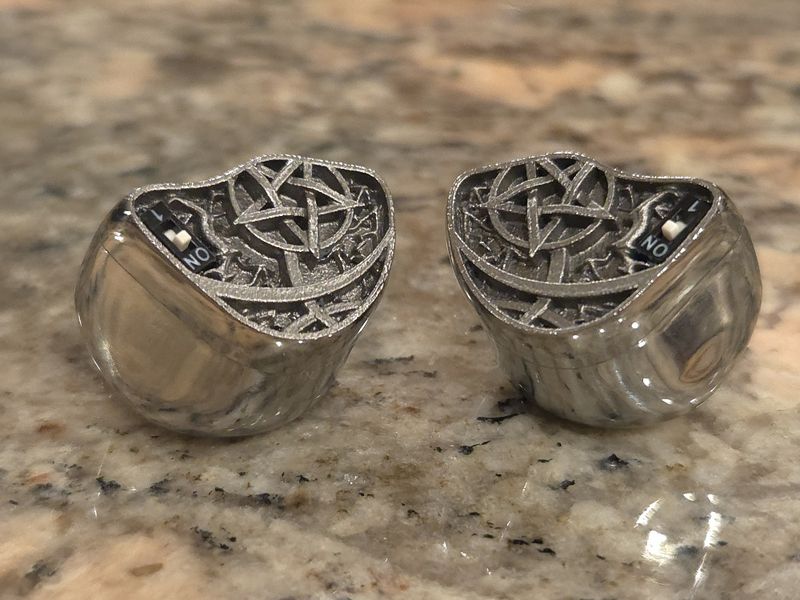
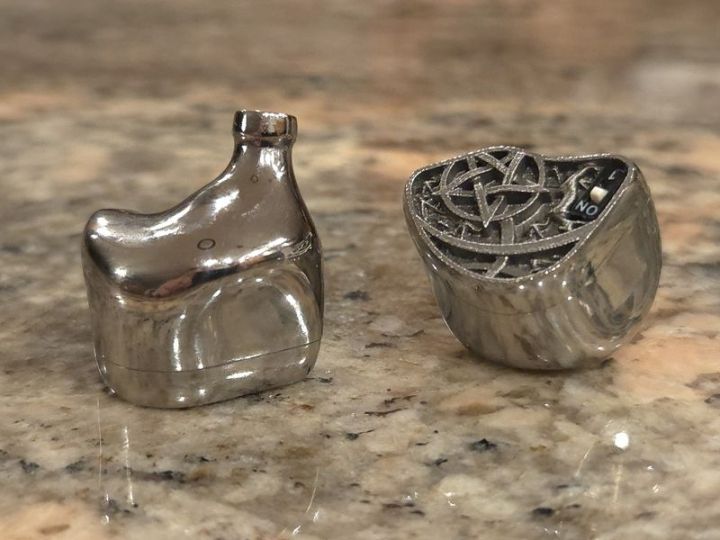
The story also came through in the interesting design of these Titanium shell IEMs, with their all-metal mirror-polish shell and high-precision 3D-printed faceplate. The metal shell has a traditional UM universal fit design, with a smooth, curved body, a small pinhole bass vent, a non-recessed 2pin connector, an average-length nozzle, a mesh screen covering the tip, and a decent lip at the tip to keep eartips secure. The smooth body of the shell contrasts with a faceplate bearing the Pentagram symbol and other elements associated with the Witch in the story. Also, you can’t miss a toggle switch that allows you to switch on (Leo’s MT tuning) or off (marked as 1, UM’s tuning).


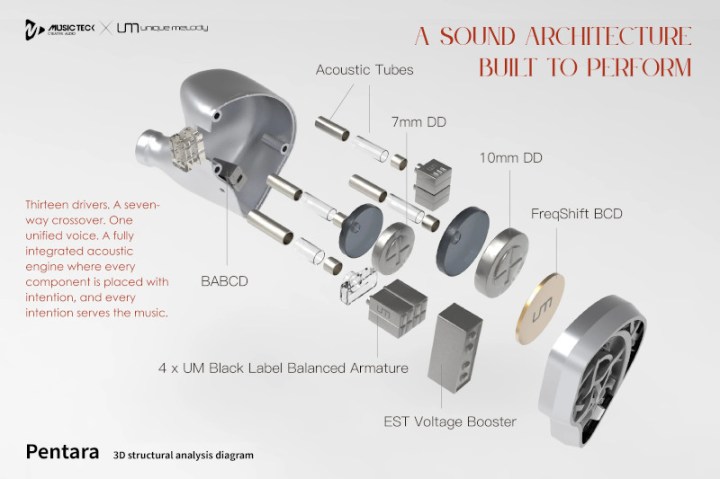
Now, besides the Pentara name being derived from the Pentagram symbol, the five-point star could also symbolize the 5 driver types under the hood of Pentara (my interpretation). The total number of drivers here is 13, partitioned under a 7-way pure acoustic crossover. I find this to be an advanced flagship-level design with five driver types: DD, BA, EST, BA-BCD, and FreqShift BCD. In more detail, you have:
- 10mm DD for sub-bass
- 7mm DD for bass
- 2 Sonion Composite BA-BCD for mid-bass and lower-mid
- 2 UM Black Label BAs for mids
- 2 UM Black Label BAs for treble
- 4ESTs for ultra-high
- 1 FreqShift BCD for full-range treble
As expected, a custom PWA cable was also provided, called PWA Aurolite Shielding cable. It uses traditional PWA all-metal hardware with a matching, shaped connector housing around a 4.4mm balanced plug (featuring the UM x Musicteck logo), a Y-split (with a cable name), a retractable chin-slider, and a compact, rounded 2-pin connector housing (with L/R markings). This is a copper wire cable with 28 AWG conductors, 4 per side (8 total), with PW’s latest Shielding+ layer, twisted in a COAX design structure. It uses a PVC jacket and tight nylon braiding, which also contributes to some of the “traditional” PWA microphonics when the cable rubs against your shirt on the move. Also, due to an extra layer of Shielding+ material, the cable feels stiff.


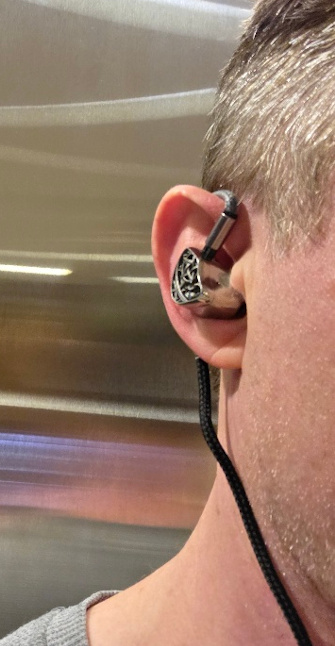
Another comment to add, the shells look solid and durable, built like a tank. Also, it gives you the impression that they could be on the heavy side. But to my surprise, they were only 10g each, and I felt very comfortable wearing them during a few extended listening sessions without any ear fatigue or pulling their weight down. Also, despite a unique 3D faceplate design, there were no sharp edges to the touch. Furthermore, the switch has a nice, secure click-action. Still, it is not hard to toggle with a fingernail, even while wearing Pentara shells in your ears, making it easy to make an a/b comparison without taking them out or needing any extra tools.
Page 2 – Sound analysis, Source, and cable pair-ups, Comparison, and Conclusion.

 Twister6 Reviews