
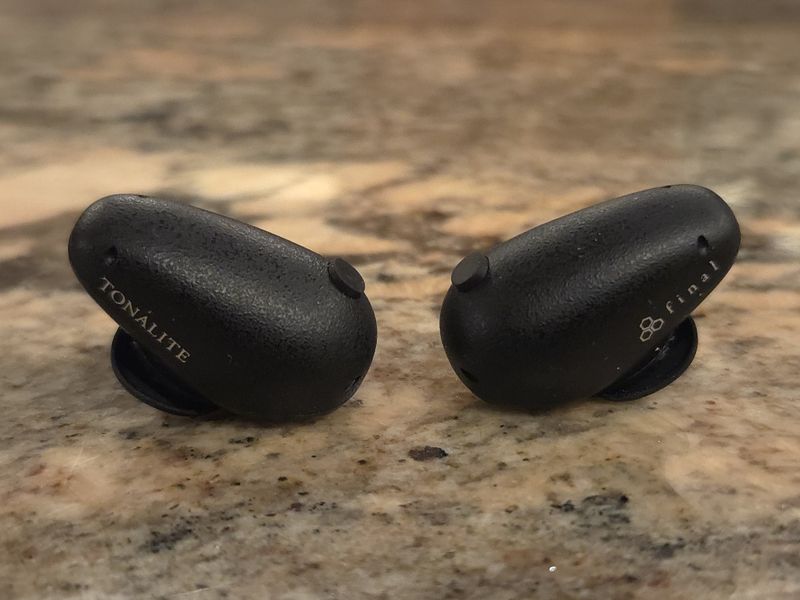
Calibration.
The main selling point of Tonalite is its capability to personalize the timbre based on measurements of the user’s anatomical features. These measurements are guided by Final app and obtained through a head scan and ear photo capture (with your smartphone) using a provided headband with AR stickers aligned with your ears (without Tonalite in your ears), a process that takes about 10 min. It is followed by ear canal measurements with Tonalite in your ears, like sonar pings, another 10 min process. Based on these measurements and the collected data, Final creates a unique 3D model acoustic avatar, which is then processed further through acoustic simulation with Final’s Auditory Model (in the cloud), taking another 5 min. The final step, no pun intended, is sending back the Personalized timbre tuning to integrate into Tonalite, the last 5 min of wait, which stays with the earphones regardless of the source you pair them with.
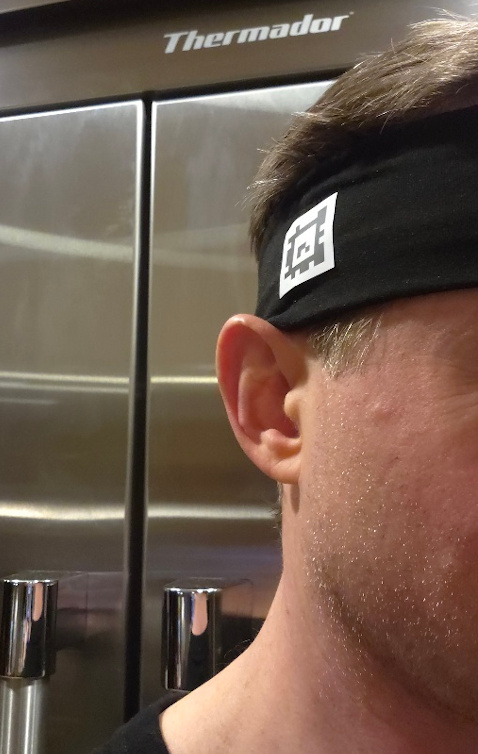
The whole process does take a bit of time, but with the app guidance, it is straightforward to follow, saves intermediate steps, and allows for retakes. As I was telling someone about the Tonalite calibration process, they mentioned Personalized Spatial Audio on AirPods Pro. Tbh, compared to the more involved process of Tonalite calibration discussed above, Apple’s approach is very primitive, takes seconds (convenient since when I was using Xs Max with AirPods Pro 2, every time I deactivate it and re-enable back, I had to do scan again), feels a bit gimmicky to me, and nowhere near the sound results obtained with the Tonalite Personalized DTAS profile. I’m not criticizing what Apple has come up with, and I’m sure they use some algorithm that captures the distance between your ears and the general shape of your head as you turn in front of the iPhone’s camera. But the iPhone’s process is nowhere near what Final is doing here.
At the same time, I have a feeling that some of the consumers who don’t have an audiophile “experience”, the type I get questions from about not being able to distinguish the sound quality of Apple’s 3.5mm dongle and $4k summit-fi DAP, might be in the same boat here, questioning the results of Tonalite Personalized calibration :). I’m just being realistic and think that Tonalite will benefit more audiophiles who can appreciate what this calibration has to offer and don’t have to compromise many features of popular consumer TWS earphones, regardless of whether we are talking about Apple or other brands.


Sound Analysis.
I analyzed Tonalite sound performance paired up with S25 while playing a variety of test tracks, such as Agnes Obel’s “The Curse”, Sandro Cavazza’s “So much Better” (Avicii remix), C-Bool’s “Never Go away”, Ed Sheeran “Shape of you”, Alan Walker “Darkside”, Galantis “Hunter”, Iggy Azalea “Black widow”, Indila “Boite en argent”, Dua Lipa “Love Again”, Counting Crows “Big yellow taxi”, Bob Marley “Jamming”, David Elias “Vision of her”, Michael Jackson “Dirty Diana”, and SaberZ “Without your love”. Tonalite had over 100 hours of playback time by the time I finalized my sound analysis notes.
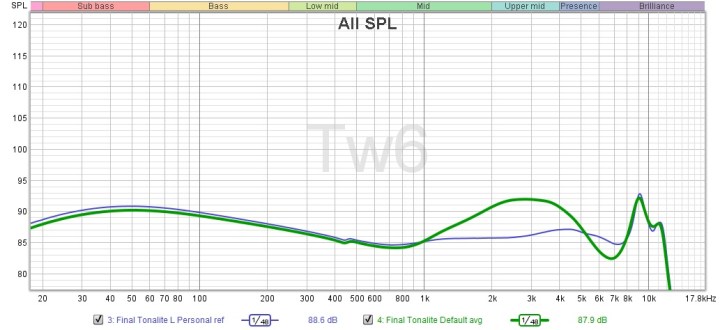
General – this is a default sound tuning of Tonalite, featuring a balanced sound signature with a natural, neutral, resolving tonality. The overall sound is smooth and laid-back, with a decent level of natural clarity. The soundstage is nicely expanded, quite big actually, with the presentation of the sound more in front of you, putting you in front of the music. Layering and separation are OK. The bass has a polite sub-bass weight, an average attack speed, and a mid-bass punch, giving it a more rounded, slightly laid-back presentation. The bass weight is not exactly neutral; it is somewhat elevated but not boosted or exaggerated. Mids are clear, detailed, natural, with fuller-body tonality, naturally resolving, and a bit more forward presentation. Treble is clear, natural, with a little extra mid-treble presence and a hint of shimmer. But the overall smoother, more natural tuning of Tonalite doesn’t exaggerate this shimmer, while it helps with clarity in the upper mids.
Personalized (-8 => Ref) – this is the DTAS Personalized timbre setting based on my 3D head scan, with a noticeable transformation from the General setting. Based on the changes as I’m hearing it, not a placebo effect, it looks like the Final’s algorithm calibration really takes into account the physical aspects of sound expansion relative to my head anatomy. Before noticing other tuning differences, the first thing that stood out to me when switching from General to Personalize was the soundstage. While the soundstage width/depth/height remains similarly expanded, maybe just spreading a little wider, the imaging takes a step toward the more holographic expansion, placing the sound around you, almost wrapping around you in a 3D effect, where you are no longer in front of the sound but surrounded by it. The sound signature remains balanced, but the bass now gains a little more weight, and the mids’ presentation is slightly pulled back while also gaining a little more body and texture. It felt like the tuning of Tonalite was injected with steroids, inflating its more laid-back, flatter performance with higher resolution, improved layering and separation of the sounds, and a more dynamic vertical expansion. The bass gained more oomph and sub-bass rumble, the mids gained more clarity and presence without becoming more revealing or forward, and the treble’s shimmer gained more control, or perhaps the perception of it improved due to better balance with the upper mids.
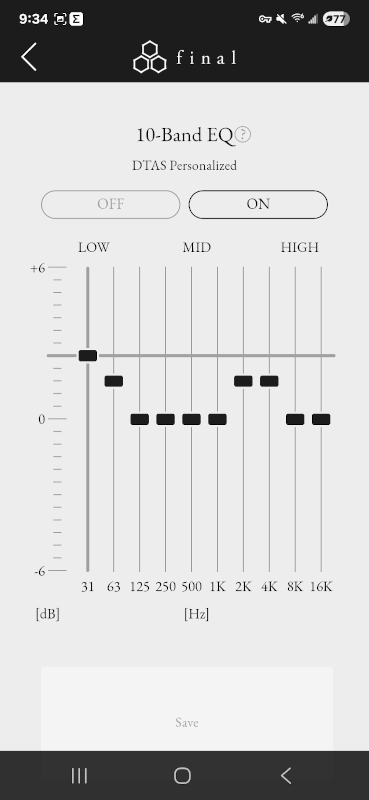
The technical improvement from General to Personalized is more noticeable, and it doesn’t sound like an EQ change, because I hear more technical than tonal improvement. I did have to scale down the intensity of the Personalized setting from its ref (-6) to ref- (-8), which made the treble sound a little more natural and slightly boosted the bass. Then, I finalized this setting with an EQ boost of sub- and mid-bass, and brought the pina gain of the upper mids a little more forward as well (boosted 31Hz by 2.5dB, 63Hz by 1.5dB, and did a pinna gain adjustment with a 1.5 dB boost at 2kHz and 4kHz). This was my ideal sound setting.
EQ application.
In the 8k mk2 app, the EQ setting is semi-parametric, with bands where you can adjust the frequency and boost/cut each one by 3 dB. As already discussed, Tonalite offers 10-band Paragraphic EQ, 31Hz, 63Hz, 125Hz, 250Hz, 500Hz, 1kHz, 2kHz, 4kHz, 8kHz, and 16kHz, adjusting each band by +/-6dB in 12-steps (0.5dB each).
For now, only one EQ profile is allowed, since once you set it, it is stored with the TWS pair and applied to the earphones regardless of the source, as with other Tonalite settings. The EQ adjustment had a natural effect, without creating any audible artifacts, fine-tuning the sound in small steps. I appreciate the finer granularity of 0.5dB adjustment per step, allowing me to fine-tune the sound, where, as I already mentioned, I boosted 31Hz by 2.5dB, 63Hz by 1.5dB, and made my own pinna (ear) gain adjustments, boosting 2kHz and 4kHz by 1.5dB each. I’m not a fan of EQ adjustment because I often use high-end IEMs across many different sources, all with different EQ implementations. It could create a nightmare of keeping track of which IEM goes with which source and app and the corresponding EQ adjustment, so I leave it alone. Here, you adjust the EQ from the app, and it saves it with a pair of IEMs. Then I can use it with my smartphone, my wife’s smartphone, my laptop, or a DAP, and the sound profile stays with the TWS pair no matter what source.
Noise Canceling.
Tonalite Noise Canceling “Ambient Sound” is not as open as Apple’s transparency mode, but somewhere between their transparency and adaptive modes, letting outside sound in while still giving you some noise control. It is closer to Apple’s Adaptive mode. The Noise Canceling mode has Sound Quality and Noise Reduction modes. Noise Reduction has the strongest noise cancellation, not as deep as Apple’s, where you feel like you are in a sound chamber, but it still offers decent noise reduction. Noise-Canceling Sound Quality mode relaxes that deep cancellation a little bit. In Sound Quality mode, the sound “quality” is more balanced, with improved layering and separation, and better resolution. Switching to Noise Reduction mode makes the sound more consumer-tuned, closer to AirPods Pro 2, with a noticeable bass boost and fuller-bodied mids, while layering/separation/dynamics are scaled back. When switching to Personalized DTAS mode, only Sound Quality Noise Canceling mode is enabled. I was using Tonalite with Personalized mode and Noise Canceling noise control, and the active noise canceling was perfect, not 100% as deep as Apple’s, but not too far off either.

Source pair-up.
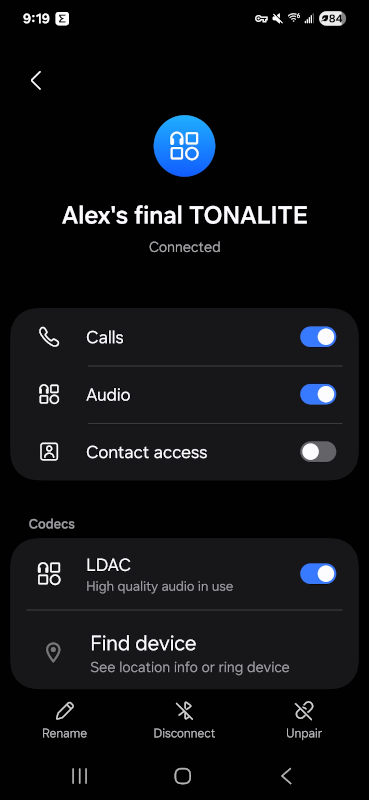
Tonalite on S25 (LDAC) vs iPhone (Xs Max) – nearly an identical sound quality and technical performance with Noise Canceling enabled. I was a bit surprised, considering the LDAC connection of S25 vs whatever inferior protocol Apple is using.
And I found the same across different Android sources, where switching between my S25 and other DAPs yielded nearly identical sound quality and technical performance in Tonalite.

Comparison.
The comparison was conducted using Tonalite TWS with stock eartips and paired up to S25 unless stated otherwise.
S25/Tonalite vs iPhone/AirPods Pro 2 – Pro 2’s default sound signature is more V-shaped, with slightly boosted bass and treble, a fuller body, and somewhat pulled-back mids. In comparison, Tonalite is more balanced, still natural and musical, but with less exaggerated low end and treble, and more dynamic, layered, resolving sound. One thing to note is that the General setting of Tonalite has a narrower, less holographic soundstage, while its Personalized DTAS tuning setting scales to a broader, more holographic expansion. AirPods Pro2’s soundstage is not small, but it expands more in depth/height than in width, and its imaging is a bit closer to the center. I’m not even comparing to AirPods Pro because its sound is thinner, more center-focused, with more tunnel-expansion soundstage; Pro 2 is superior in tuning to Pro.
Another comment is about their active noise comparison. AirPods Pro 2 Noise Cancellation mode is deeper, making you feel like you are inside a big void, isolated from the world; its transparency mode lets sound in but sounds a bit too open, while adaptive is somewhere in between.
Personalized Spatial Audio on AirPods Pro 2 can’t be compared to DTAS head-scan calibration. Apple performs a fundamental test using the camera to determine head shape and the relative position of the ears. Running this test on AirPods Pro 2 slightly improved imaging, from being center-focused to spreading a little wider, but it was not even close to the more holographic soundstage expansion of Tonalite, with improved layering and sound separation.


vs ZE3000 – ZE3k reminded me of the General tuning of Tonalite, although 3k still has a slightly narrower, more center-focused soundstage expansion and less dynamic sound performance. Both have balanced sound tuning, but even in General mode, the Tonalite is more neutral than the ZE3000’s fuller-body, sparklier tuning. But once you switch to the Personalized DTAS sound profile, the difference becomes more noticeable, from a larger, more holographic soundstage expansion to a more dynamic, layered, textured sound tuning, making ZE3k feel “deflated” in comparison. To stay competitive in today’s TWS market, I know that Final recently released ZE3k SV (special version) with ANC and other enhancements at a reduced (in comparison to ZE3k OG) price, but I don’t know if the sound tuning remains the same or has changed to appeal more to consumers. Based on what I have read online, SV uses a larger driver, has a bassier profile, and adds app support with ANC, EQ, gaming mode, and LDAC support, and a reduced price from $150 to $89
vs ZE8000 mk2 (8k sound on) – 8k priced around $350-$400 – In this comparison, the Tonalite Personalized DTAS sound profile technical performance is very close to Final’s flagship 8k performance. They both have a very similar, large, open, holographic soundstage, good sound separation, and a vertically expanded, dynamic sound. The difference here is in tuning, which is somewhat different. 8k has a V-shaped tuning with a more elevated sub-bass weight and rounder mid-bass punch, fuller (thicker) body, smoother mids, and more sparkle in treble. Tonalite is more balanced, a lot more balanced in tuning, with less coloring and more transparency in mids, and a little less sparkle in treble. By default, 8k has this rich, analog, syrupy sound tuning, with an organic, musical tonality, and I typically use it with an EQ setting of reduced 60Hz, boosted 3.2kHz-4.8kHz, and reduced 12kHz, making it more balanced and less colored in mids. Tonalite tuning is more balanced, less colored, more resolving, with more air between sound layers (noticeably better layering), even after applying the EQ “correction” to the 8k default sound profile. Both have good technical performance, but tuning varies. I also noticed that Tonalite’s noise canceling is a bit stronger in Noise Reduction mode and lets more background sounds through in Ambient Sound mode than 8k. I know, 8k is a flagship, but I preferred Tonalite with its Personalized setting over the 8k, even with the EQ setting. Furthermore, Tonalite’s touch controls are easier to access and more intuitive, with multiple tap-control options.


Conclusion.
As I started testing Tonalite and shared about it with a few of my audiophile friends, I was asked whether I think Final reinvented the TWS “wheel.” It would be a bold statement to make, since in the current day and age of audio technology, it’s not that easy. But it certainly felt like Final put a lot of effort into improving this wheel, especially when it comes to blurring the lines between the audiophile and consumer worlds, merging the best of each into a single advanced audio device that should appeal to both groups. They were also smart to launch a Kickstarter campaign to attract more consumer attention.
On the one hand, you have a sleek, ergonomic device with great active noise-cancelling, a long playback time, convenient wireless charging for the case, and an easy-to-navigate app to access various settings. On the other hand, you have a detailed, natural, resolving tuning, with a large soundstage and imaging, and excellent technical performance, using an advanced algorithm to customize the sound through 3D head scanning. And as a bonus, you also get quality EQ adjustments that stay with the earphones, along with the customized sound tuning, regardless of which source you pair with.
While I don’t necessarily consider myself a TWS expert who has tested every single pair out there, I personally appreciate every aspect of the Tonalite design and enjoyed active noise canceling and super-clear phone calls as much as the actual audiophile-caliber tuning. And when it comes to the tuning and changes associated with 3D head scanning and the corresponding calibration, going from General to Personalized mode wasn’t just a gimmick or an EQ change, because I hear an improvement on a technical level, not just the tonality. I was very impressed with Tonalite tuning and functionality, which are now my daily drivers.

 Twister6 Reviews