
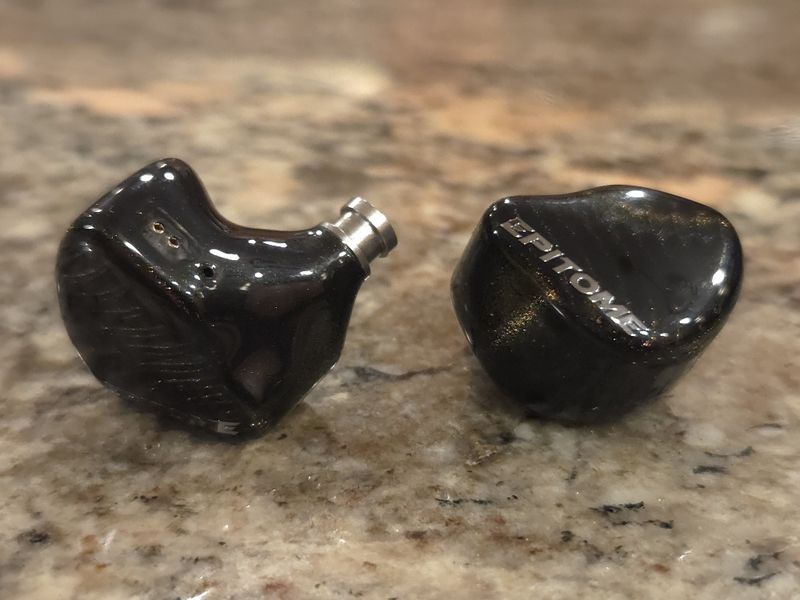
As I mentioned earlier, this review will have a slightly different structure, taking you on a journey through my audio discovery of Epitome. This journey started with a selection of eartips, which I find crucial in how you will perceive the sound of these IEMs.
Eartips Selection.
The selection of eartips is always crucial for any universal in-ear monitor and will significantly affect the sound, particularly the bass impact and treble energy, depending on the seal. Due to a large opening in my ear canals, I usually opt for the largest eartips to achieve a better seal. Also, please keep in mind that eartips impressions are subjective and will be based on the anatomy of your ears. My suggestion is to build up your eartips collection and try each one with every new IEM you get to find the pair that yields a perfect sound for your ears. But even with my usual eartips disclaimer above, I highly recommend starting the sound analysis of Epitome by going through all the included eartips, as well as dipping into your own collection. In this test, I was using Epitome with its silver-plated “audiophile” alloy cable.
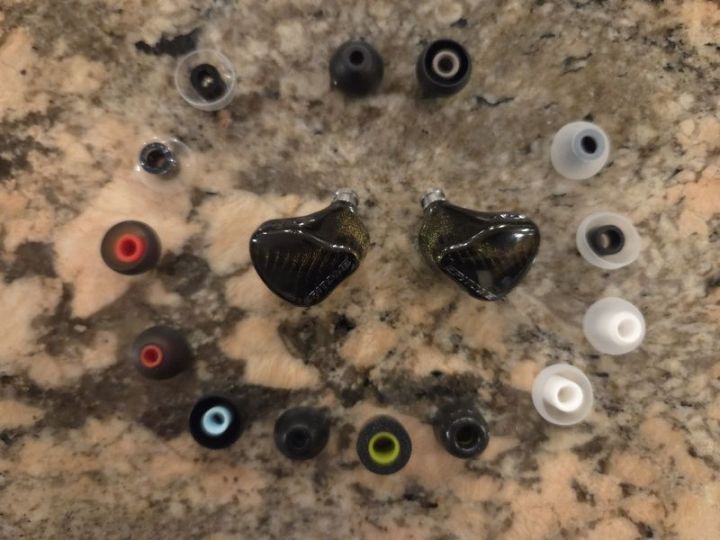
Here is an overview of the included stock eartips.
white silicone eartips with a black, medium bore opening core (baseline sound) – warmer, smoother tonality; mid-forward signature; neutral bass with a subtle rumble texture and laidback mid-bass punch, smooth natural mids with relaxed presentation, smooth natural treble; narrow soundstage width with more depth/height while imaging is actually closer to holographic level within the L/R width constraints; great sound isolation due to more springy nature of the eartips cap.
clear sticky medical-grade silicone eartips with a black, larger-bore opening core – even the largest size of these eartips didn’t give me a good seal due to the soft nature of the silicone cap, resulting in significant bass attenuation and poor isolation. These were no-go for my ears.
white silicone eartips with a white, medium bore opening core – these had a softer silicone cap, with slightly less isolation than white/black eartips; as a result, the bass is more attenuated down, while mids are more forward, and also treble gained a bit more sparkle; also, soundstage opened up in width just a little bit. If you want to focus on vocals and don’t mind bass being left behind, this one is not a bad option.
black foam eartips with a bit of a shiny lacquer-ish type of finish, and larger bore opening core – still a narrower width soundstage with more depth/height, and the imaging is more center focused, creating a more intimate sound presentation; the sound tuning hasn’t changed much except the bass has deeper rumble and gained a little more weight. I’m usually not a fan of the included foam eartips with other iBasso iems, since they have a wider bore that doesn’t stay secure on the narrower nozzle of their IEMs. With Epitome’s larger nozzle diameter, these stayed on securely, provided excellent sound isolation, and added more bass weight/texture, though the soundstage was more intimate in this pair-up.
black silicone eartips with a shorter, narrower-bore opening and a multi-color core – these were not easy to slide onto the larger-diameter nozzle of Epitome. But I found them to introduce a consistent sound improvement, where the narrow bore opening eartips open up/widen the soundstage, and also bring more sparkle to the treble; I can also hear a bit more rumble in the bass; isolation was also not bad.
black silicone eartips with a longer, with medium-narrower bore opening, red core – the soundstage is a touch wider, and the treble has more sparkle and air which brings more clarity and improves the resolution of the mids; the core of these eartips was stiff, and due to their narrower design wasn’t easy to put on the wider nozzle of Epitome; also, softer silicone cap of these eartips made the isolation more relaxed.
Since black silicone with a shorter, narrow-bore opening core eartips provided the best sound for me with Epitome, I went straight for the Final type-E eartips, which have a similar design, though their core stem is longer and less stiff. These were my favorite eartips in pair-up with Epitome since they opened up the soundstage width a bit, keeping the imaging closer to a holographic level. To my surprise, the bass had more texture and rumble, and the treble had more clarity, which improved the upper-mid resolution. Perhaps it was meant to be, since we are talking about type-E/Epitome eartips selection, relative to my ears, of course! The next step was to find the best cable pairing.
Cable pair-up.
I’m aware that some people are skeptical about the contribution of cable to the audio chain. It’s not my intent to start an argument here. Instead, I would like to share what I hear during my testing. What makes sense to me is that a metal wire is a material with physical properties of resistivity, conductivity, and purity, all of which act as a filter between your source and earphones. Variations in these physical properties can affect the conductivity of an analog signal, resulting in a change in sound ranging from subtle to noticeable. If discussing cables bothers you, feel free to skip this section. Personally, I think these impressions will be interesting to those who would like to know how I arrived at the cable that works best for my ears with Epitome. Also, please keep in mind that I was using type-E eartips here, and compared the sound with other cables relative to the stock silver-plated alloy cable.
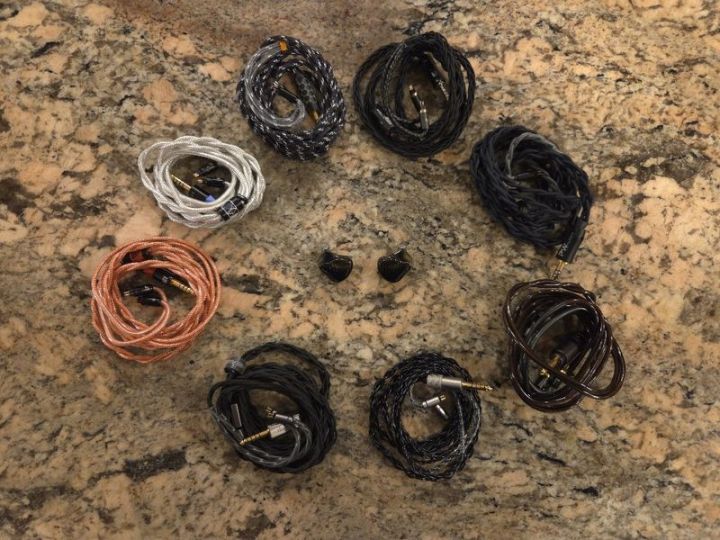
The stock copper cable with a modular connector – this cable has less midrange coloration, improved detail retrieval, and a bit more crunch in the treble, which enhances resolution and helps push the imaging to a more holographic level. The soundstage expansion is still a bit confined. It is not narrow; it is just an average width, but the imaging is more 3D. Going from silver-plated to this Copper cable is like lifting a veil off the sound, with a noticeable improvement in detail retrieval. The bass is still neutral, and the treble lacks a bit of airiness, but the treble extension has improved as well.
Eletech Euclid (silver/gold) – smoother, warmer tonality, decent resolution; neutral bass, more forward vocals, smoother treble; more height/depth than width, while imaging is holographic. This one brings Epitome to a more mid-forward, laid-back sound.
Eletech Aristotle (copper) – switching to this copper cable injected the sound with more energy, unlike the laidback presentation of Euclid silver/gold cable. The sound is tighter, faster, less colored, and with improved detail retrieval. It sounds similar to the stock copper cable, except here the treble has a little more air and crunch.
HanSound Quentin (copper) – here is where things are starting to take a turn toward a more noticeable improvement: the soundstage actually got a bit wider, with still more depth/height, and the L/R spread is wider than in previous pair-ups, while imaging is on a 3D holographic level. Bass is still neutral, with more elevated sub-bass rumble/texture, and mid-bass punch is faster and tighter; mids are clear, detailed, natural, and more forward; treble is actually crisp, airy, and more extended.
EA Dionysus (GPS, Silver, Copper, Silver/Copper alloy) – this pair-up came as a huge surprise, as I was expecting a different sound from the exotic blend of these wires, which includes lots of silver. Instead, it was an improvement over Quentin/copper cable. The soundstage here gains some width, still not perfectly rounded, having more depth/height, but L/R spread is wider in comparison to other cables, and imaging remains holographic. The bass has a deep, textured sub-bass rumble, and the mid-bass packs a little more punch. Now, mids are a touch less forward and more balanced with the bass and the treble, which brings more weight to the bass. Mids are still clear, detailed, natural, but not as shouty and a bit less forward. The treble is also crisp, airy, and with better extension, but it sounds more natural than in a pair-up with Quentin. This was by far my favorite cable pair-up.
EA Code 23 (copper) – this cable also had an excellent pair-up synergy with Epitome, probably among the best. I already expected this copper cable to work great with Epitome, which actually made the pair-up with Dionysus still a big surprise, because Epitome w/C23 sounds almost the same as w/Dionysus, except with C23, you get an even wider soundstage, making the expansion nearly spherical. The only thing is that C23 is rather thick and stiff, while Dionysus is soft, pliable, and very comfortable.
PWA FT (copper) – since copper paired up so well with Epitome, why not try the almighty FT cable with it? But to my surprise, I found the soundstage was a bit narrower, with much more depth/height than width; even the imaging was more center-focused, with sounds placed closer to the center. The bass weight was slightly reduced, pushing the mids forward. The sound was very natural, resolving, layered. But it was not enough to make me like this pair-up.
Out of the cables I tested, I found EA Dionysus to have the best synergy and comfort with Epitome IEMs. Please keep in mind that I didn’t test every single cable under the sun, and this is based on my favorite cable pair-up among the reasonably priced cable choices I tried.
Source pair-up.
With the sensitivity of 113 dB and impedance of 17 ohms, Epitome IEMs are very easy to drive with any source. But not every source had a great pair-up synergy with it. So, for my next step in this audio journey, I used Epitome with type-E eartips and a Dionysus cable and went through several portable sources.
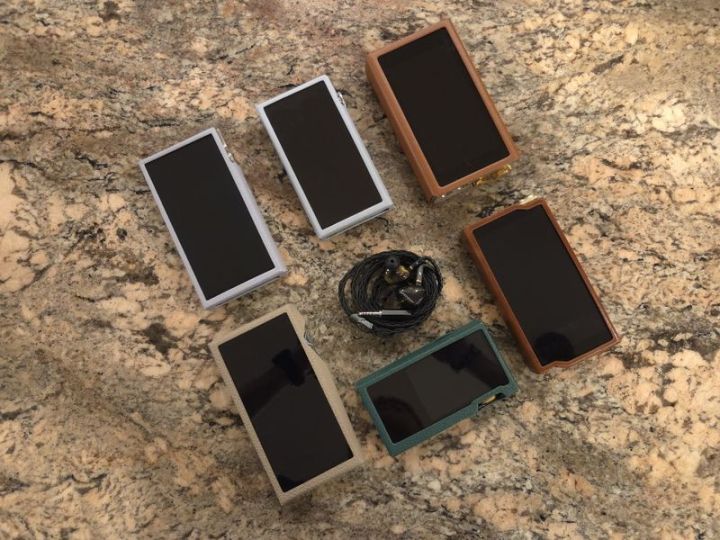
iBasso DX320Max Ti – here, the sound of Epitome is more revealing in tonality, more balanced in the signature, wider in soundstage expansion, with a deeper sub-bass rumble and stronger mid-bass punch. The overall improvement in sound presentation was quite noticeable, especially as I switched from a more mellow, laidback DX270 to the DX320Max, but… the mids’ tonality lost its musical sweetness, sounding colder and less analog. I like almost everything in this pair-up except for that colder tonality.
iBasso DX340 w/amp18 – the Epitome performance in this pair-up reminded me of DX320Max, with a wider soundstage, a more balanced sound signature, punchy bass, and mids that sounded a bit more natural (compared to DX320Max), with more of that analog coloring that gave vocals and instruments nice texture. The sound wasn’t warm, but had just enough coloring to connect you closer to the performer. The only thing: if you are sensitive to waterfall hiss, Epitome unfortunately exhibits it with amp18. So, in quiet passages of the sound or as one song stops and before the next one begins, you will his that pesky waterfall hiss with Epitome.
iBasso DX270 – the sound is more center-focused in terms of soundstage expansion, smoother in tonality, and more laid-back in overall presentation. This pair-up wasn’t my favorite with Epitome.
A&K SP4000 – the tuning of Epitome with SP4k is more natural and still delivers great detail retrieval. Epitome has a bit more balanced sound signature here, with a slight mid-forward emphasis and a neutral bass tuning. The tonality is neutrally natural, with a clean, clear, less colored, and more transparent sound tuning, and a quite natural, non-analytical retrieval of details. The bass has a decent sub-bass rumble; the mids are clear, natural, and detailed; and the treble is clear, natural, and very detailed. Even with Advanced DAR enabled, the sound width is above average, with more depth/height than width. I really enjoyed this pair-up.
L&P P6 Pro – you never know what to expect when you hit the play. P6P is an R2R smooth analog source. Well, with Epitome, it was much more revealing than I expected, given my previous testing with DX270. The soundstage is not the widest, but it’s wider than average; bass was clean and punchy, with a nice rumble; mids were clear and more revealing, placed forward; and treble was clear and well controlled, with a nice, well-controlled crunch. The overall signature was more mid-forward in this pair-up.
Hiby RS8ii – this pair-up was very close to SP4000, being more balanced, except that SP4k sounds a little warmer and slightly wider, while RS8ii has a stronger bass punch and a touch narrower soundstage. Also, RS8ii had a bit of waterfall hiss with Epitome, not as much as DX340/amp18, but you can hear it when pausing or in quiet passages of songs.
Galaxy S25 w/iBasso D17 DAC/amp – as soon as I hit the play button on my phone, I had a big smile on my face. The soundstage expansion was above average, and the imaging was a little more center-focused. There was also a faint waterfall hiss when idling or in quiet sound passages. But all that didn’t matter because Epitome with D17 nailed the tonality, with a balanced sound signature, including a deep, textured rumble, a more rounded, slightly elevated mid-bass punch, natural, detailed, balanced mids, and well-controlled and well-defined, clear, natural treble. I would have loved a slightly wider soundstage, but other than that, it was an excellent pair-up.
Galaxy S25 w/iBasso DC Elite – ok, so after going through all these multi-kilobuck sources, some with just OK pair-up synergy, I came to… a dongle that turned out to be among the best pair-up sources for Epitome. It’s like these two were made for each other. In theory, DC Elite should be a mini-DX320Max. With DC Elite, the Epitome probably had the widest soundstage opening, approaching a spherical shape, and maintaining that holographic imaging of how sounds are placed in space. The sound signature is more balanced, with a deep, textured rumble of sub-bass, tighter, faster mid-bass punch, natural, detailed mids with a nice analog texture, and a perfectly balanced presentation without being too forward, and crisp, well-controlled, clear, detailed treble. There was zero waterfall hiss; the sound was not too warm or too cold, it was just perfect.
Galaxy S25 w/NiPO A100 – this was another excellent pair-up, and again, with a dongle rather than a DAP. The tonality and overall performance were close to DC Elite, with the sound just a bit warmer. The only thing here is that the soundstage was a bit narrower, and there was a faint waterfall hiss.
Galaxy S25 w/stock copper cable and USB-C adapter – ok, now, I felt completely dumbfounded. The soundstage expansion was big, probably the widest I heard Epitome in comparison to many other sources, almost wrapping around and behind me, and, as expected, the imaging was holographic. The tonality is more neutral, very clean and clear, with almost zero coloring. I miss some of the sweet smoothness of Epitome mids here; it was almost too clean, leaning toward the sterile side. It wasn’t bright or revealing, just neutral, with slightly more forward presentation of upper mids. One thing to note: while using the HibyMusic app on my S25, I had to disable its Exclusive HQ USB audio access and turn off USB Audio Performance mode to control the volume of this USB-C tip/adapter on my phone. Would this replace a dedicated DAP/dongle? Not really, but it makes it convenient to listen to podcasts, news, and other non-music media on your phone. Still, I was very impressed by how this adapter expanded the soundstage width of Epitome.
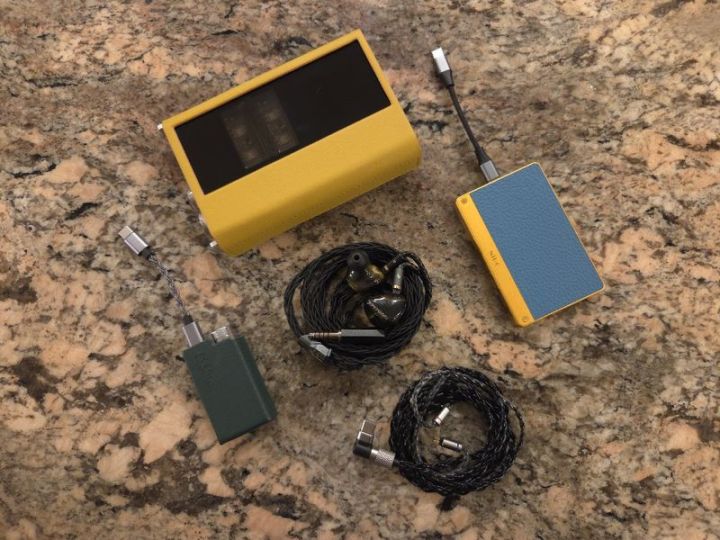
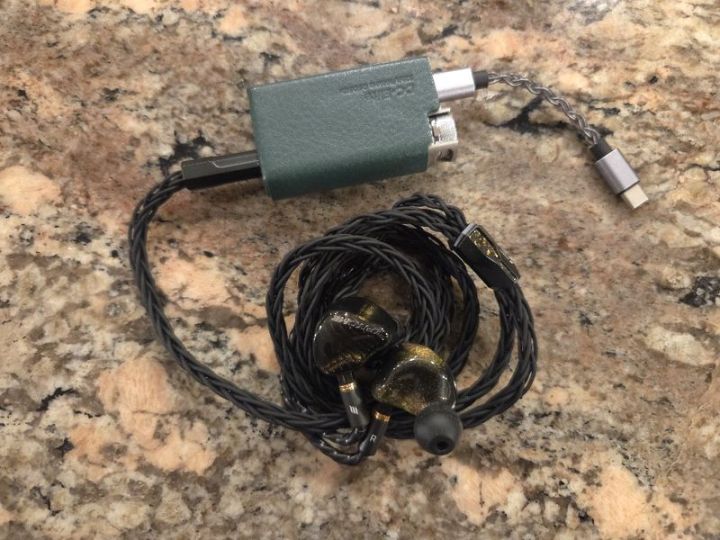
At the end, among the sources I tested, DC Elite, D17, and SP4000 were my favorites. But I was especially surprised by the Elite dongle, which nearly took the crown at a fraction of the price of the other sources. Between Epitome iems, type-E eartips, and Elite source, I found the synergy of E^3 power! And if you add another “E” from the Effect audio Dionysus cable, you can turn this into E^4 🙂

 Twister6 Reviews