
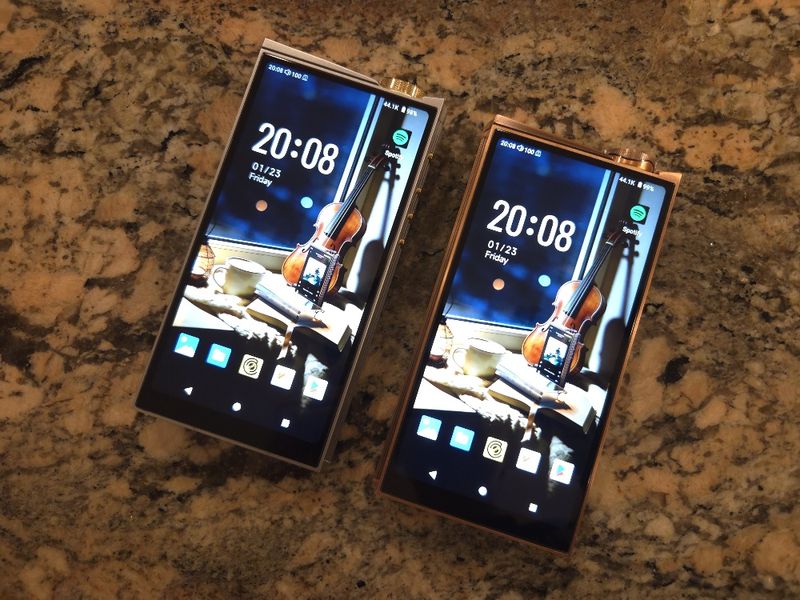
EvoAria Evo One Ti and Cu DAPs
Evo One Ti and Cu editions were borrowed from Musicteck for a short evaluation period to test and compare these new summit-fi DAPs.
Intro.
While it feels like the EvoAria brand came out of nowhere with its debut of the Evo One Ti and Cu DAPs, this DAP has already generated a lot of buzz, especially after the last Guangzhou High End Audio show at the end of December, where it was well-received and drew a lot of positive comments. But is this really a brand-new company or the evolution of something audiophiles are already familiar with? Many people who discussed EvoAria also mentioned Thomas, who is behind many Cayin releases, including N8ii, N30LE, and C9ii. So, naturally, it made sense for the design of Evo One to draw its inspiration from Thomas’s previous work.
There were also rumors about the eye-watering price of this DAP, higher than the previous N30LE, and as pre-orders began and the price was confirmed, I was curious about how audiophiles would respond. Well, I was told it is selling out, with most of the units from retailers in Asia already claimed, and some people even ordering both versions to decide later which one to keep. I guess that is just the way the audiophile market works today. Everything is driven by demand, with audio enthusiasts willing to pay a premium. But just because you set a high price tag, you have to deliver a product with a corresponding high level of performance.
When I learned that Musicteck had a sample of each unit, I asked to hear it briefly. Of course, with my “luck”, the timing couldn’t be worse due to the impending snow/ice storm on the East Coast, so I end up spending only a few hours with the Ti version before rushing to ship it ahead of storm to Head-Fi HQ (for CanJam NYC preview video), and then a few days with the Cu unit before it was shipped out to its next destination. I already shared some brief impressions in the Watercooler thread on Head-Fi and, with more questions coming in after my posts, decided to write a First Look brief review to have all the info in one spot. So, here we go!
Design.
I can’t discuss the unboxing experience for Evo One yet, since it’s an upcoming release with packaging still being finalized at the moment of writing this review. But I do want to comment on the included leather case. Evo One is a big DAP, so it made sense that a temporary leather case was included with Ti and Cu versions to enhance and secure the grip. But it is a temporary case that still needs to be finalized, especially the display cutout, which I found made it harder to swipe down the notification bar in some apps. I have no doubt the final case design should address it.


I don’t want to spend too much time on the design and under-the-hood details in this First Look overview of these DAPs, especially since not all the intimate details are available yet. Both have a solid premium build and a design that feels like a scaled-up N30LE, with a crafted volume wheel in the upper right, tactile-response playback/power buttons on the right, two NuTube pre-drilled windows on the left, and various ports at the bottom. In there, you will find multi-function 3.5mm and 4.4mm ports that can be configured as PO, LO, or Pre-AMP. Then, you have a separate USB-C data port and USB-C power port, as part of an independent charging circuit. You will also find an I2S output port and a spring-loaded microSD card slot.


These DAPs are not light; as I weighed them on a scale, Ti is 578g, and Cu is 736g. Each one features a crisp 6” display with 1080×2160 resolution. They use the same Qualcomm QCS8550 processor as in the RS8ii, including 16GB of RAM (LPDDR5-4200MHz) and 512GB of storage, so expect smartphone-like performance, not just on paper but in real-world use; confirmed to be super-fast. The battery is 10,000 mAh and supports 45W PD 3.0 Fast Charging. I ran a quick battery test and found that in Class AB with Tubes, P+ power, and 4.4mm BAL output, it gave me about 10 hours of local hi-res file playback. This is a decent battery performance for a powerful DAP.

Evo One’s design is based on the AKM chipset, with 2x AK4191EQ filters/modulators and 4x AK4499EXEQ DACs. It uses two NuTube 6P1 modules as part of their Triple Analog Audio Architecture with dual Tube Hybrid (Lumina and Velvet) modes and one fully Transistor mode. The amplification section is fully symmetric, fully balanced, and fully discrete. Another very interesting piece of info I found is that the difference between Evo One Ti and Cu is not just in the chassis material, as you would usually find in many other DAP designs. Each of these Evo One DAPs has a separately engineered PCB layout to deliver a distinct sound tuning.
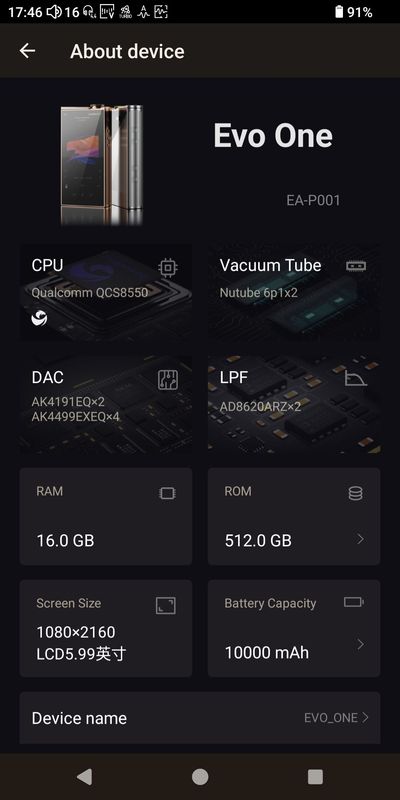
Regarding settings, you will find many commonalities with other Cayin and Hiby DAPs running the optimized Android 13, which is also featured on the Evo One. I noticed the Global Parametric EQ was there as well, and you get access to Working Mode settings. In there, you can access Android Mode with full DAP functionality, including streaming, Pure Audio Mode, which makes HibyMusic the main interface and disables access to other Android apps, USB DAC Mode to bring up the DAC interface when Evo One is connected through USB to an external source, and Bluetooth Receiving Mode, which should turn Evo One into a wireless DAC/amp.


Sound Analysis.
I analyzed Evo One sound performance while playing a variety of test tracks, such as Agnes Obel’s “The Curse”, Sandro Cavazza’s “So much Better” (Avicii remix), C-Bool’s “Never Go away”, Ed Sheeran “Shape of you”, Alan Walker “Darkside”, Galantis “Hunter”, Iggy Azalea “Black widow”, Indila “Boite en argent”, Dua Lipa “Love Again”, Counting Crows “Big yellow taxi”, Bob Marley “Jamming”, David Elias “Vision of her”, Michael Jackson “Dirty Diana”, and SaberZ “Without your love”. Both DAPs were presumably burned in with many hours of playback on each.
As I always say, I prefer to describe the DAP sound by comparing it to other DAPs and its pairing with different IEMs/headphones, since the DAP itself doesn’t have a distinct sound. What we perceive is how it sounds through connected IEMs/headphones, or the differences in sound between source comparisons using the same pair of IEMs/headphones. This is my subjective opinion, detailing how I hear it while analyzing the Evo One sound. Unfortunately, I spent very little time comparing both units in a rush, since I only had a few hours of listening with Ti and a few days with Cu.
I can confirm that it’s not a gimmick, and the tuning of these Evo One DAPs definitely varies between the Ti and Cu versions. Actually, the sound tuning did feel like N30LE on steroids. I hear a pitch-black background, no hissing, even with sensitive IEMs. Ti has a more open, expanded soundstage, especially wider L/R separation, while Cu is a bit more intimate in its expansion, with more depth. Ti sound is more neutral, tighter, and dynamic, with lots of clarity. At the same time, Cu has its strength in lusher, fuller body mids, richer musical tonality, and an overall more laidback sound presentation. Both DAPs offer a natural, analog, resolving tuning and, thanks to many available sound-shaping options, can scale up or down in the level of “sweetness” they add to the sound without compromising resolution or detail retrieval. But relative to each other, Cu takes the lushness to the next level, while Ti takes the pair-up synergy with your favorite IEMs and Headphones in a relatively more neutral direction.


Each Evo One unit offers many sound-adjustment settings, which I consider one of the DAPs’ strongest features relative to other flagships. Of course, pure Transistor (solid-state TR) and Tube (assuming a hybrid mode with TR and Tubes) are the two main sound options. In Transistor mode, you can still hear some added note weight/texture, but the sound is cleaner, tighter, faster, and has faster transients of notes in comparison to Tube mode. But Transistor’s mode also does not have the typical sterile, solid-state sound, and you can still hear that delicate analog texture.


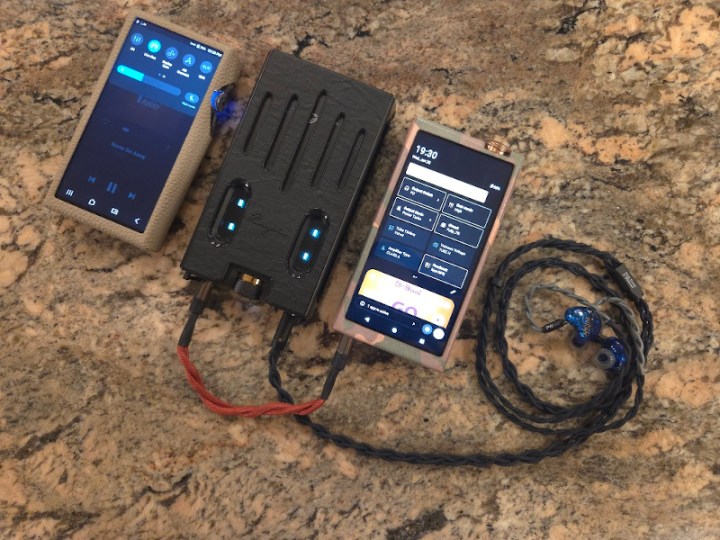
When you switch to Tube mode, that is where the fun begins, giving you even more sound-tuning options to change the Output Power Mode (P, P+, Turbo), Tube Timbre (Lumina, Velvet), Vacuum Tube Voltage (H/L), Amplifier Type (Class A vs AB), and Dual FeedBack (NFB vs non-NFB). Users of N8ii, N30LE, and C9ii will be well familiar with many of these. Turbo Power mode seems to switch to Class A, since the amplifier selection was set to A and greyed out. Also, I assume that a reference to DC Turbo might provide an additional boost when the USB-C power port is connected, though I ran out of time to test it. With all these settings, it made sense to run some comparison tests against C9ii (Evo One vs Evo One LO + C9ii), where C9ii was set to Tube/Classic/Hyper/Anode H, which yields the most tubey tonality from that portable amp. Here are my quick sound observations using Evo One Cu:
- Evo One Cu with P+/Class AB/Tube-Lumina sounds closer to Cayin C9ii (Tube/Classic/Hyper/Anode H).
- Evo One Cu with P+/Class AB/Tube-Velvet sounds warmer than C9ii (Tube/Classic/Hyper/Anode H).
- Evo One Cu with P+/Class A/Tube-Velvet adds more body/texture in mids when compared to its Class AB amp type.
- Evo One Cu with Turbo/Tube-Velvet has the most vacuum-tube-like tonality, with a smoother, warmer, and more laid-back sound presentation.
- Evo One Cu with Turbo/Tube-Velvet/Feedback NFB makes the sound super syrupy, very smooth, velvet, laidback sound presentation with a slower attack.
- Evo One Cu in Tube mode, while switching tube Voltage between H and L, affected the soundstage: H expanded the sound a bit, while L gave it a bit more intimacy.
Since I had a few days to spend with Evo One Cu, the observations above are related to that DAP. Based on my brief comparisons, Ti would scale down the tonality to a bit more neutral level, although you should expect the same level of sound-shaping options with similar results.
Line Out test.
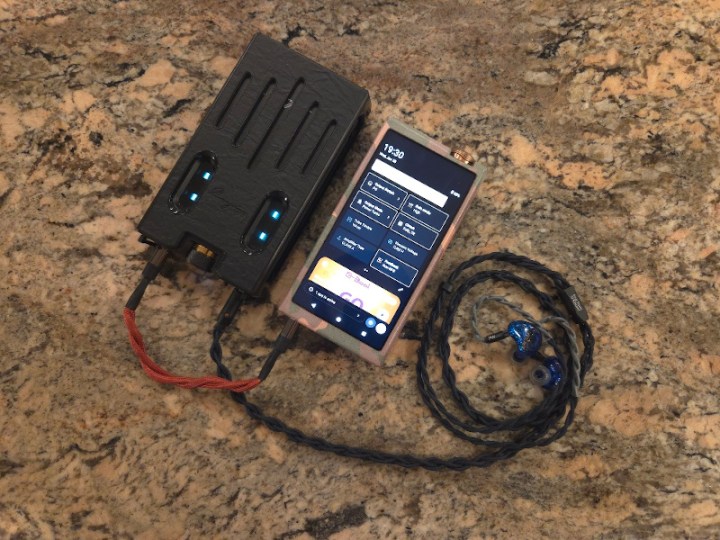
I have praised SP4000 in the past as having one of the cleanest LO outputs. Given the similar AKM chipsets and advanced board layouts across these DAPs, it made sense to compare Evo One (Cu) vs SP4000 with the C9ii amp. One thing to note, Evo One LO can be driven by either Solid-State TR or Hybrid Tube/TR mode, yet another sound-shaping option under the belt. In LO/Tube mode, you can even change the Tube timbre (Velvet/Lumina) and adjust Vacuum Voltage H/L, adding more texture and slight diffusion/distortion to the sound. But, while in pure Transistor mode, the sound was very tight, super clean, with a deep black background, and nearly identical to SP4000 LO at 4V. I guess these two DAPs can share the LO crown now.
Conclusion.
I raised a question in the intro of this review about whether EvoAria is really a brand-new company. On paper, it is the name of a new company. But in reality, it felt very familiar, like an evolution of N30LE, taken to the next level by fusing N30LE with C9ii, and then refining the sound and technical performance, including two differently designed (based on PCB layout) versions, Ti and Cu. Perhaps, that’s where the “Evo” part comes from, the Evolution. It is not a cheap product, raising the summit-fi price bar, but it also raised the performance bar relative to N30LE. It is unmistakably a flagship-level release, on par with other summit-fi releases I recently tested and reviewed, offering even more sound-shaping options on top of its super-fast, open, optimized Android-smartphone-like performance. I’m not gonna try to justify the pricing, it is expensive, and this DAP will not be for everyone. Audiophiles are constantly searching for the best pairing synergy with their IEMs and Headphones, with some investing in a single IEM cable upgrade that costs more than the Evo One itself. That is just a reality of this hobby, for some people.
I didn’t spend enough time with Evo One, which is why this review falls under my First Look category. Still, even in the short time I had with its Ti and Cu versions, I was quite impressed by its technical performance and the amount and quality of its sound-shaping options within a DAP, allowing me to fine-tune the DAP’s sound to perfection with a few IEMs and Headphones I tried. With CanJam NYC just around the corner, I’m looking forward to visiting Musicteck’s tables to spend more time with these DAPs, especially the Ti version, since I’m now more familiar with the Cu version.

 Twister6 Reviews