
The Core of a Tiger!
PROs: properly matched amp with integrated cable, 2pin universal connection allowing Core amp/cable to be used with other IEMs, high-quality cable and solid build, compact, inline amp box; Core IEM with amp/cable offers a big, open soundstage with holographic imaging, deep, textured bass, fuller body, natural, detailed mids, and energetic, high-resolution treble.
CONs: price, battery indicator, occasional interference with some sources, source and eartips dependency (affecting treble).
Aroma Core was borrowed from Musicteck for testing and analysis.
Manufacturer website: Aroma. Available for sale from authorized retailers like Musicteck.
Intro.
Aroma Jewel has been covered, probably in hundreds (literally) of my reviews over the last 3+ years. It quickly became my reference IEM, which I use when analyzing DAPs, DACs, amps, cables, eartips, or comparing them to other IEMs. It’s an IEM I’m intimately familiar with and use as an essential analysis tool. Aroma’s other big follow-up release, Fei Wan (FW), was a great IEM as well, but tuned toward the fun side, with more emphasis on bass and treble. Given the timelines of Jewel and FW releases, the recent announcement of their new flagship didn’t come as a surprise, but its unique design direction caught many off guard, including me.
When rumors about Core started circulating, I got questions about whether I’m planning to test and review Aroma Audio’s new IEM. The interest rose even higher when people realized it’s not just an IEM but the whole matched IEM/cable system with an inline amplifier. Also, it became apparent from the questions I received that many were interested in which tuning path Core will take, Jewel or FW. Thus, when I had the chance to borrow Core from Musicteck for a week, along with Fei Wan, I decided to focus my review on analyzing Core and how it compares to their other flagship siblings. Here is what I found after spending a short time with Aroma Audio Core, their 10th anniversary release.
Unboxing/Accessories.
I can’t discuss the full unboxing experience of Core, since I only received the IEMs and the amp/cable without the official packaging. Along with Core, a leather storage box and a double-pocket mesh sleeve were included. The storage leather box is spacious, measuring 155mm x 85mm x 50mm, in a titanium color/texture to match Core’s faceplate, with felt inner lining, a mesh pocket under the cover, and plenty of room for IEMs and amp/cable. Also, it was a good idea to include the mesh sleeve for keeping shells from banging against the metal amp box.


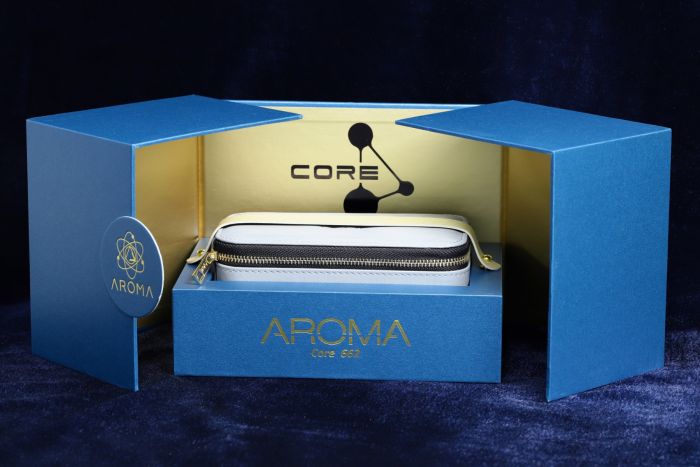
When I visited the Aroma Audio website, I saw a very elegant packaging box, with a cool display presentation as you open it; picture shared below. Once I find out more about whatever else comes included, I will update this section of the review.
Design.
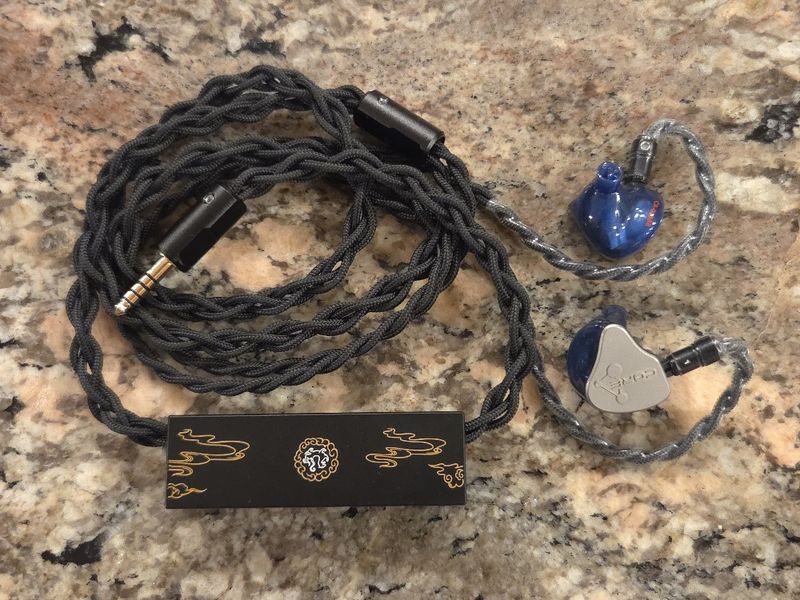
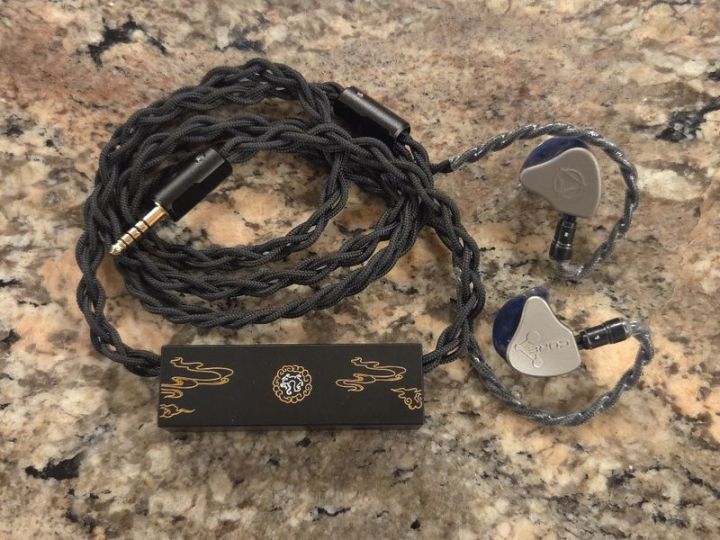
When you get Core out of the box, the first thing you will notice is that this is not a traditional IEM release. It consists of two parts, the IEM itself and a detachable cable with an integrated amplifier. The cable-amp combo is called White Tiger. The important point of the design here is that the cable-amp is detachable from the IEM shells via a standard 2pin connector, meaning you can use Core IEMs with another cable, or use other IEMs with the White Tiger cable-amp combo.
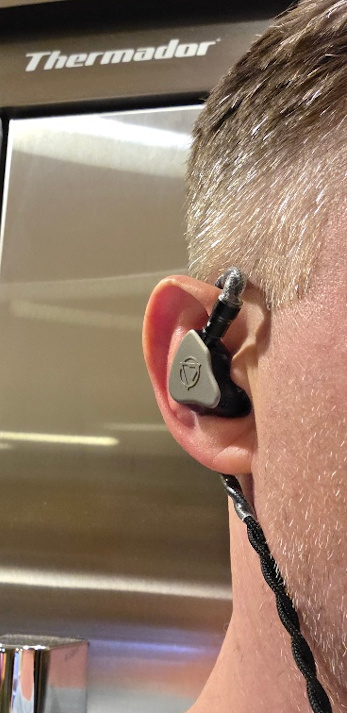
Considering the number of drivers packed inside, the 3D-printed shell size is not that big, just a little bit bigger than Jewel and FW. It uses a similar blue acrylic material to Jewel. But unlike Jewel and FW, Core uses an all-new titanium alloy faceplate with the Aroma logo on the right and the Core logo on the left. I was happy to see a recessed 2pin connector socket. There is also a bass driver pinhole port in the same position as featured in Jewel and FW. The nozzle diameter is average, with a secure lip at the edge and a tip with a 4-bore opening, corresponding to a 4-way crossover of sound tubes.


The fit was very comfortable, despite the shell being a little bigger than FW and Jewel.
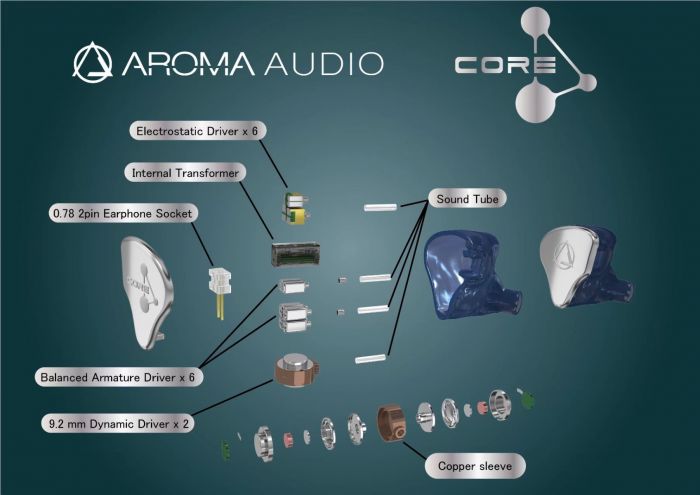
Inside, you have a 14-driver configuration of tribrid DD/BA/EST design, with drivers partitioned in 4 groups according to 4-way crossover per the following breakdown:
- 2 × Low-frequency DD, each 9.2mm, using the same patented design as FW with Coaxial Phase-Pair configuration.
- 4 × Mid-frequency BA
- 2 × Upper-mid BA
- 6 × High-frequency EST
The White Tiger is a combination of the cable and amplifier box. The cable uses 26 AWG Litz wires, 4 braided conductors, each with G-UPOCC (Graphene-Enhanced single-crystal copper) wires, along with shielding conductors to minimize external interference. The tight nylon-braided jacket was surprisingly not as microphonic as I find in other cable designs. The cable was terminated with a 4.4mm balanced plug, having a custom housing that matches the Y-split and 2pin connector. No chin-slider was included, and a small, round connector housing has a small R/L printed marking and an adjacent heatshrink earhook.
The cable comes with an inline amp inside a compact aluminum alloy enclosure. This amp box is positioned between the 4.4mm plug and the Y-split, being closer to the plug (5” away from it). This way, when connected, it almost looks like a dongle next to the source, without weighing down the IEM/cable above it. This aluminum amp box is: 75mm x 22mm x 15mm, and weighs 70g (with cable plug and amp box on a scale). The box includes a rechargeable battery with a USB-C charging port and an LED charging indicator. Just have to remember to use a 5V charger or USB-A to USB-C cable that supports 5V only (it will not work with PD, QC, or other Smart chargers above 5V).


On the cable plug side, the box has a small power button you press and hold for 3 seconds to turn the device on, along with a status LED next to it. I don’t know exactly what the battery playback spec is, since I haven’t had Core long enough to run all the proper testing. The provided spec is rather limited, indicating a supported load impedance of 16-600 ohms, an impressive SNR of 129dB, and a very low noise floor of 1.9uV. Per spec, the output power rating is between 230mW @32ohm and 88mW @600ohm. Not sure why Aroma Audio provided the spec up to 600ohm, considering Core IEMs have 25ohm impedance and 98dB sensitivity. You can certainly use other 2-pin IEMs with it, while the provided 600ohm spec is more appropriate for full-size headphones that use different connectors anyway.
Not much information is provided about the amp box’s internal design. But one thing is clear, there is no volume control, and amplification of Core IEMs w/box versus Core IEMs with a regular cable didn’t yield a big difference in PO output volume from the same source. As one can understand, since there is no volume control, it wouldn’t be recommended to use it from the fixed-output LO of your source, but rather from the PO output. In my opinion, Core amp-cable functions more like a post-amp buffer.
Page 2: Sound Analysis, Eartips pair-up, Source pair-up, Comparison, and Conclusion.

 Twister6 Reviews