
Sound Analysis.
I analyzed Core sound performance using SP4000 and RS8ii DAPs, PO output, while playing a variety of test tracks, such as Agnes Obel’s “The Curse”, Sandro Cavazza’s “So much Better” (Avicii remix), C-Bool’s “Never Go away”, Ed Sheeran “Shape of you”, Alan Walker “Darkside”, Galantis “Hunter”, Iggy Azalea “Black widow”, Indila “Boite en argent”, Dua Lipa “Love Again”, Counting Crows “Big yellow taxi”, Bob Marley “Jamming”, David Elias “Vision of her”, Michael Jackson “Dirty Diana”, and SaberZ “Without your love”. The Core I received had already undergone proper burn-in.
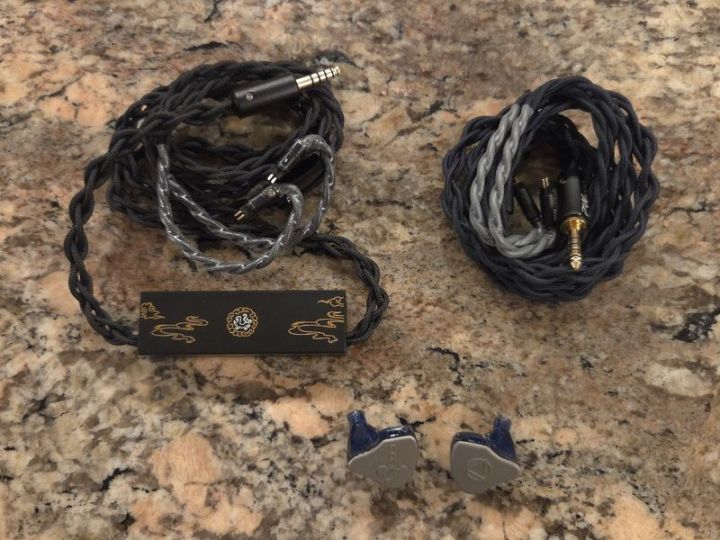
I want to start my sound analysis of the Aroma Core a little differently by first analyzing the contributing factor of the amp “box” itself. As a reminder, the box refers to the cable with an integrated amplifier, while IEMs are the Aroma Core IEMs by themselves, without it. When I mention “Core”, I mean the Core IEMs together with their integrated amplifier/cable.
While testing Aroma Core IEMs and switching between the box and PWA FT cable, I hear the soundstage has a similar holographic imaging, but the L/R separation is wider with the box. From a technical perspective, the soundstage width, which is more expanded with a box, was the only thing that stood out; from a tuning perspective, the difference was much more noticeable. With a box, the tuning is more balanced thanks to an improved treble control. With a separate cable (PWA FT), the lower treble is harsher, with a higher level of piercing brightness that tends to overpower even the mids and bass. Also, with a separate cable, the bass was looser. Once you switch to the box, aside from the soundstage spreading wider, the bass is tighter and more precise, with shorter note decay, and the treble intensity scales down. It still has a similar upper-frequency FR response, with a pronounced definition, energetic crunch, and airy extension. The quality remains the same, but the scaled-down quantity creates a different sound perception with a less fatiguing presentation of the Core’s upper frequencies. I assume that Core IEMs were tuned specifically with a matched White Tiger amp/cable.
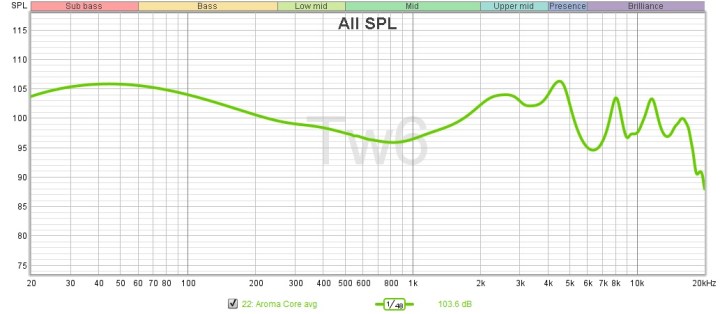
Together with amp/cable and IEMs, I hear Core as having a W-shaped sound signature, with a focused, well-separated emphasis on lows, mids, and treble. Yes, the sound is balanced, but it is also well-separated, unlike some other IEMs with a coherent multi-driver design that blend into a single “big” driver. It’s different here, less coherent, where you can easily shift your focus to deep sub-bass rumble, smooth, natural mids, and crystal-clear, revealing treble. The tonality is a blend of warmer, colored tuning on one side of the spectrum, balanced with a more revealing, higher-definition crunch in the treble on the other side of the spectrum.
Such tuning makes it work with many genres of music where you want to preserve the natural musical timbre of the instruments, especially in the low end, and at the same time give the sound higher resolution up top to extract more details and cut through the warmth of the mids. But such tuning is not exactly forgiving with poorly recorded tracks, especially those plagued by sibilance.
With the help of the Core box, the soundstage is well-rounded, expanding proportionally in width, depth, and height. Imaging, relative to sound placement in space, is also expanded to a holographic level, with relatively accurate sound placement. The layering and separation of the sound are not at the highest level due to the Core’s unique tuning. Since lows and mids are more organic, the revealing part of the treble cuts through that to raise resolution, but it doesn’t add more air between the layers of the sound. But everything is still clear, with instruments and vocals easily distinguished in the mix, preventing congestion, mud, or a veil. That’s where, again, I appreciated the box’s contribution compared to a regular cable, balancing the sound, tightening the bass, and improving treble control.
In more detail, the bass has a rumble with elevated weight, is very deep and full, and has an impressive bloom. The mid bass is more rounded, blending with sub-bass, but it maintains good note decay control without muddying the lower mids. Here, the mid-bass feels like an extension of the rich, textured sub-bass rumble. The inline amp improves bass definition compared to a regular cable with the same IEMs.
Mids have a fuller body, with lower mids being definitely above neutral. Not too much to muddy the sound, but they give instruments and vocals fuller body weight and more organic tonality. Mids do sound natural and detailed, not micro-detailed, but still with a natural clarity. Again, when comparing the sound with and without a box, scaling down the lower treble brings more focus to Core’s upper mids.
When I started listening to Core, I really enjoyed its lows and mids, but had a bit of trouble connecting with the treble, which stood out and felt disconnected (pun intended) from the rest of the tuning due to its intensity. Not until I went through some eartips rolling did I hit the nail on the head when I switched to narrower bore W1 eartips, delivering a more balanced tuning. The treble still has an energetic crunch, bringing higher resolution to the sound. Core treble emphasizes the lower treble more and slightly less on the mid-treble. I didn’t hear sibilance, but with the wrong eartips or a poor recording, the lower treble can stick out with an edgy “tsk, tsk, tsk” artifact. It didn’t work for me with a separate cable, making the treble too intense. And it didn’t work for me with wider bore opening eartips. With W1 eartips, I achieved a perfect balance between upper mids and lower/mid treble, giving me a more natural resolution and good extension.
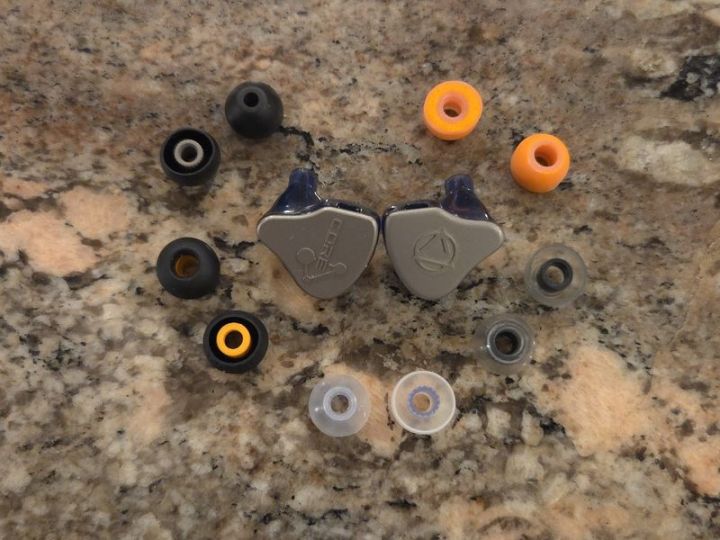
Eartips Selection.
The selection of eartips is always crucial for any universal in-ear monitor and will significantly affect the sound, particularly the bass impact and treble energy, depending on the seal. Due to a large opening in my ear canals, I usually opt for the largest eartips to achieve a better seal. Also, please keep in mind that eartips impressions are subjective and will be based on the anatomy of your ears. My suggestion is to build up your eartips collection and try each one with every new IEM you get to find the pair that yields a perfect sound for your ears.
Azla Crystal – deep bass texture with elevated rumble, fuller body, natural, organic, detailed mids, energetic treble with more emphasis on lower-treble presence.
Eletech Baroque – provides greater clarity in the mids but also increases treble intensity.
Symbio W – I felt like it did “W” scale up, giving more punch to the mid-bass, pushing upper mids a bit forward, and also scaling up mid-treble by adding more “tsk tsk tsk,” which I wasn’t a big fan of.
SpinFit W1 – realizing that wider bore eartips bring more energy to the treble, I went the opposite direction, switching to W1. Here, the sound still retains its deep bass texture with elevated weight, more organic, fuller body mids, and the treble is just a bit less intense than with Crystal, giving upper frequencies more control and making them sound more natural.
Final Type-E – I thought going down the narrow-bore path would further improve the sound with Type-E, but it shrank the soundstage width and made the treble sound a bit plasticky.
Relative to my ear anatomy and sound preferences, W1 were my favorite eartips with Core.
Source pair-up.
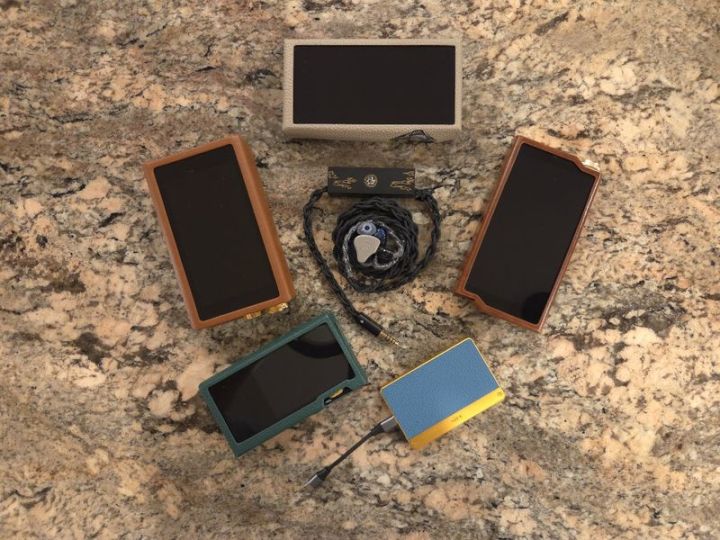
With a sensitivity of 98dB and an impedance of 25ohms, Core is easy to drive with its own inline amp box, which was designed to match these IEMs perfectly. But not every source had a perfect pair-up synergy, especially since I was driving it from the source’s PO.
A&K SP4000 – deep bass texture with elevated rumble, fuller body, natural, organic detailed mids, energetic treble with more emphasis on lower-treble presence.
Hiby RS8ii – the mids became a little smoother, and also sounded like an edge was taken off the lower treble. The sound is a little smoother than SP4k.
L&P P6Pro – the bass weight is a bit more elevated, more bloom, mids sound more musical, more organic, and the treble was natural, clear, and detailed.
iBasso DX320Max Ti – more elevated bass rumble, improved sub-bass texture, less colored mids, and more elevated lower-treble emphasis. The sound took on a bit of a V-shaped signature, with more emphasis on sub-bass and lower treble.
NiPO A100 – the sound was more balanced, great textured bass, natural, detailed mids, and less intense treble. The only problem was a very faint waterfall hiss in the background, which could be due to a ground connection between my S25, Core amp box, and A100 dongle. It was only audible while idling or in quiet passages of the song.
I did notice that, in a few instances, there were occasional bursts of EMI noise with various DAPs when my smartphone and laptop were nearby. I can’t point to whether that interference was picked up by the amp/cable or through a ground connection between the source and the amp/cable. Not all sources have a proper ground connection for a 4.4mm jack, and I’m not sure whether the battery ground in the amp box is connected to the Pentaconn plug’s ground. Either way, I didn’t find that as a showstopper, and it was rather random.
Comparison.
The comparison was conducted using Core with W1 eartips and SP4000. The focus of my comparison was on hearing how Core stacks up against Fei Wan (FW) and Jewel.
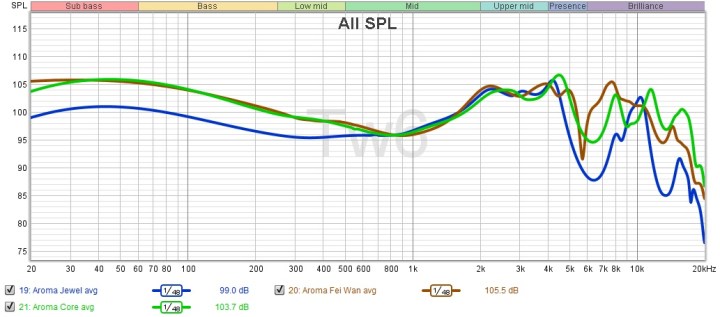
Core vs FW – Core sounds like its tuning was derived from FW. The soundstage expansion is not too far off, and it is quite similar in terms of shape and imaging. They both have a very similar bass quantity and quality when using Core with a regular cable. But once the amp box is in the picture, Core’s bass has more physical rumble and becomes more multi-dimensional, which makes FW bass sound a bit flatter in comparison. The FW’s lower mids sound a bit leaner, while its upper mids sound more forward and revealing. In comparison, Core mids have a fuller body, sound a bit more organic, and are smoother. Their treble does vary as well. Fei Wan’s treble tuning is more linear across its lower and mid treble, with slightly more emphasis on mid treble, which makes its treble sound a bit more natural. Core’s treble emphasizes lower treble more than mid-treble, raising the definition of upper mids and making upper frequencies a bit more energetic in comparison. Also, Core has more airiness and better treble extension. I was thinking if I could call Core an upgrade of FW. When it comes to the bass, and given that they use the same 2xDD driver, the White Tiger amp/cable definitely scales up bass quality. But when it comes to the treble, I would consider Core being a side-grade to FW.
Out of curiosity, I connected FW to Core’s amp box. I found a noticeable improvement in how bass scaled up in rumble, texture, becoming more physical, layered, faster, and tighter.
Core vs Jewel – These two have a lot more different tuning. The soundstage expansion is quite similar, and Core’s imaging is a bit more holographic. But when it comes to tuning, the only thing they have in common is the mids: clear, natural, detailed. Although Jewel’s lower mids are more neutral, Core has a fuller body. Then, everything else was quite different. Jewel has a more neutral bass, scaled down by about 5dB across sub- and mid-bass. Quality itself is not too far off, but the difference in quantity is very noticeable. And the same at the other end of the spectrum. Despite a similar 6xEST highs, Jewel has a more natural, smoother, relaxed treble, while Core hits you with higher energy, greater intensity, a brighter tonality, and more airiness. While you can argue about Core being an upgrade/side-grade of FW, relative to Jewel, these are just two differently tuned complementary IEMs, the same way I felt about FW vs Jewel.
With the same curiosity as before, I connected Jewel to Core’s amp box. I found a noticeable improvement in bass, scaling up the rumble, punch, and texture, expanding its quality and making it more multidimensional, less flat than before. I also noticed some improvement in airiness and treble extension.


Conclusion.
I probably mentioned this one too many times: it’s hard to reinvent the wheel when it comes to today’s audiophile world. But many manufacturers still try, especially when it comes to tweaking of variables in the audio chain where the source and the cable play important roles. Seeing IEMs, even at entry level, with custom cables is already the norm, just like with many summit-fi models that come bundled with premium cables. Some even go to extremes, like the infamous FUGAKU audio system with an integrated DAC/amp and cable/IEM system, where all the components were matched and “permanently” interconnected. Aroma Core takes a similar yet different approach by matching the amplifier, cable, and IEMs, while giving you the option to disconnect the earphones and use them with a regular “passive” cable, or to use their White Tiger amp/cable system with any other IEMs. Plus, if your source LO supports an adjustable, dynamic output, you can connect it to the line out. Otherwise, in most cases, this post-amp buffer setup can work directly with the PO of your source, so you don’t have to worry about double-amping saturation.
In terms of the design itself, one can assume that Core (2xDD/4BA/2BA/6EST) is a combination of Jewel (DD/4BA/2BA/6EST) and Fei Wan (2xDD/4BA/6BA) with a similar shell ergonomics, DD porting, 4-sound tubes, and 4-way crossover driver grouping. On paper, it almost makes you believe you will be dealing with Jewel, given a similar mids (BAs) and highs (ESTs) driver setup, and FW bass with an identical 2xDD Coaxial Phase-Pair config. But once you start listening, you quickly realize that Core’s tuning is based heavily on FW’s fun-tuning DNA. Except, with the help of White Tiger amp/cable, FW bass performance scales up. Ironically, both FW and Jewel bass performance scales up with White Tiger amp/cable, which I hope Aroma might release standalone one day.
Core is not cheap, but in general, many audiophiles who buy flagship TOTL IEMs end up upgrading the cable, bringing the total cost above Core. Here, you get IEMs and an integrated amp/cable, which still allows you to exchange the aftermarket cables. But at the end of the day, sound quality matters most. Core IEM with amp/cable offers a big, open soundstage with holographic imaging, deep, textured bass, fuller body, natural, detailed mids, and energetic, high-resolution, revealing treble. On top of that, you get a properly matched amp with an integrated high-quality cable, and a 2pin universal connection that allows the amp/cable to be used with other IEMs. IMHO, while Aroma included an inline White Tiger “box” with their latest Core IEM release, they exhibited an “out of the box” thinking with something different. And my only wishful thinking here is for Jewel v2 with 2xDD bass drivers of Fei Wan and Core 🙂

 Twister6 Reviews