
The SEquel!
PROS: a choice of a balanced natural tuning (Volta SE) or a U-shaped fuller body tuning (Sonora SE), powerful 2DD driver bass performance, expanded soundstage (Volta SE), deep elevated rumble (Sonora SE), beautiful all-metal refreshed shell designs, premium SPC XL cable with custom hardware, and a premium collection of accessories.
CONS: price, the fit (subjective), universal only.
The product was provided to me free of charge for review purposes in exchange for my honest opinion.
Manufacturer website: PlusSound. Available for sale directly, Volta SE and Sonora SE, or from authorized retailers.
Intro.
I’m no longer surprised when I read PlusSound Audio announcements about new IEM releases. Their original Allegro from three years ago was a bit of a shocker, not gonna deny it, especially considering its mature level of design and sound tuning, which I didn’t expect from a cable company. A year later, after that release, I didn’t expect Volta and Sonora either, and was pleasantly surprised that, while each one came with a further reduced driver count, neither cut corners and still offered quality tuning, just in a different flavor. Half a year later, without skipping a beat, PS already had the ‘II’ (MK2) version of Allegro, scaling up its tuning and technical performance to the next level.
While being on a roll, MK2 versions of Volta and Sonora made sense, except that these were announced as Special Edition (SE) releases. A thought crossed my mind: why SE and not MK2? That is something I will address in the conclusion of my review, but one thing to keep in mind is that the MK2 version usually succeeds the original, which typically gets phased out. Allegro II replaced the Allegro, while SE versions of Volta and Sonora became available alongside their original (OG) versions. Something to ponder on as I will dive deeper into PlusSound Volta Special Edition and Sonora Special Edition’s latest releases, which I spent a few months with and am now ready to share about!
Unboxing and Accessories.
Both IEMs feature a very similar unboxing experience, varying only in color theme to distinguish between Volta SE and Sonora SE. The packaging itself is very compact, actually, a bit too compact at 6.5” x 4.75” x 2.5”, and filled to the top with many useful and well-thought-out accessories, no fillers here. Starting with the exterior sleeve, the front showcases the faceplate design in its corresponding colors, along with a model name. The back of the sleeve has a detailed technical spec. With the sleeve and top cover removed, you will find a traditional PlusSound plexiglass insert bearing their proud message: “Designed and Hand-Assembled in Los Angeles, California, USA”. Keeping up with a color scheme, the message is printed in silver (Volta SE) and gold (Sonora SE). While some people don’t care about unboxing and skip this section, manufacturers put so much thought and heart into designing the packaging, which I look forward to and enjoy acknowledging.


Inside, you will find many accessories common to both IEMs. The only difference is the color of the leather storage case (grey Volta SE, black Sonora SE), the leather (or pleather?) storage drawstring pouch (black Volta SE, brown Sonora SE), the leather double-pocket drawstring IEM bag (grey Volta SE, brown Sonora SE), and the leather cable organizer band (grey Volta SE, black Sonora SE). The rest are a cleaning tool, a cleaning cloth, a 2-year warranty card (metal), a metal eartips holder card, and 3 sets of eartips, which you will find packed tightly under the leather stand inside the storage case. There are PlusSound Silicone eartips (S/M/L), hybrid eartips (S/M/L) with a stickier silicone cap and foam core filling, and Comply Foam eartips (S/M/L).


The leather storage case is custom, in grey (Volta SE) or black (Sonora SE). It’s a rectangular case with a heavy-duty gold-plated metal zipper, and it measures approximately 6” x 4” x 2”, with internal storage space of about 5.5” x 3.75″ x 1.75″. The exterior material is genuine high-quality leather with a stamped PS logo on the top cover. Inside, the case is lined with a soft felt material to keep everything protected and scratch-free. Under the cover, you have a polyester pocket that’s a bit tight but has enough room to store microSD cards, and maybe a cleaning cloth or tool.
Inside the case, PlusSound included their premium black-leather Stand, which they usually sell as a separate accessory. The Stand features 2 semi-enclosed corner pockets for IEMs (or CIEMs). The pockets have plenty of room, even for large custom shells, have a cutout for IEM nozzles, and allow the cable to remain attached while extending down the middle to wrap around the organizer spool below. There is more than enough room for a thicker XL or 8-wire cable and a large 4.4mm plug, keeping it away from the shells.


The cable.
The included cable for Volta SE and Sonora SE is a premium PlusSound SPC (UP-OCC Silver Plated Copper) XL with 4.4mm balanced termination. This cable is based on Type 6 litz, except that, after experimenting with a different wire geometry, PS decided to combine the wires into 6x Type 6 bundles (Type 6×6 Litz), each with 36 groups. The resulting XL cable features two conductors, Left and Right, each 18 AWG. While it looks thick, I found it soft and pliable, with minimal microphonics. It was even softer than PS Plus series cables, thanks to their proprietary insulation and multi-varied dampening cores. I have covered SPC XL in a separate review, which you can search for on Tw6. What makes this version stand out is the custom all-black hardware, including a matching plug and connectors with black accents, a chin-slider ring, and a Y-split. Actually, the Y-split between these IEMs has a slightly different insert design that attempts to match the surface artwork of the corresponding Volta/Sonora SE shells.
Just like its less flashy SE shell design changes I will cover next, the cable design is also more subtle, to match the new black shell body, and to make this cable more universal “looking” when used with other IEMs.


Bonus Accessories
One optional bonus accessory I received for testing with these IEMs was PlusSound’s new flagship Palladium Fusion Hybrid (PFH) cable. I’m planning to have a separate review of this cable since it definitely deserves one. But since I decided to use this cable in my Cable pair-up section of this review, I wanted to cover more details of the design. It’s an expensive cable, no question about it, although its cost remained the same as their last Palladium Plated Hybrid (PPH) flagship introduced almost six years ago. In today’s audiophile world, everything else, relative to IEMs and cables, has doubled/tripled in price. So, relatively speaking, while it was expensive six years ago, by today’s flagship price standards, PFH would be considered to be priced “reasonably.” Just stating the facts. But keep in mind that PS offers plenty of fine cables starting at $200, so you always have choices across different price tiers to find the right cable that fits the pairing synergy with your IEMs.
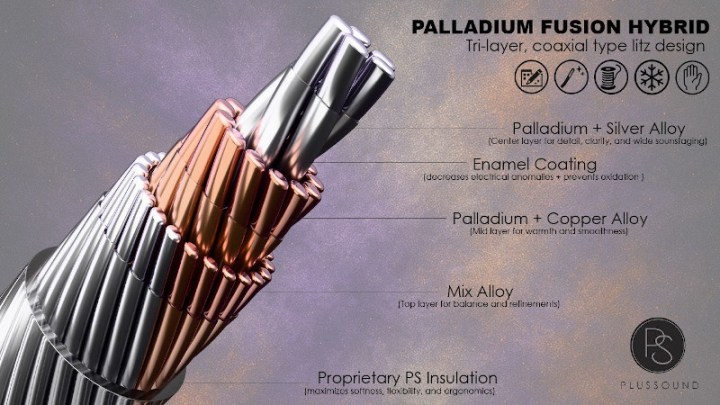
According to PlusSound, the PFH cable features a new design that infuses palladium into copper and silver strands. The cable version I received is their EXO 4-wire with a round braid, where each 25AWG wire features three layers, each with multiple strands of different sizes, tightly wound with no damping cores. As mentioned on the PS website, the outer layer consists of palladium, copper, and palladium-silver alloys that also serve as a shield for the two inner layers, isolating them from electrical interference and providing a black background. The middle layer, made entirely of palladium copper, helps with flexibility. In contrast, the center layer is made of palladium silver and has the largest-diameter strands. Furthermore, every strand is coated with a thin layer of enamel to prevent oxidation, and their proprietary insulation provides maximum flexibility and durability. The final production wire undergoes cryogenic treatment enhancement.
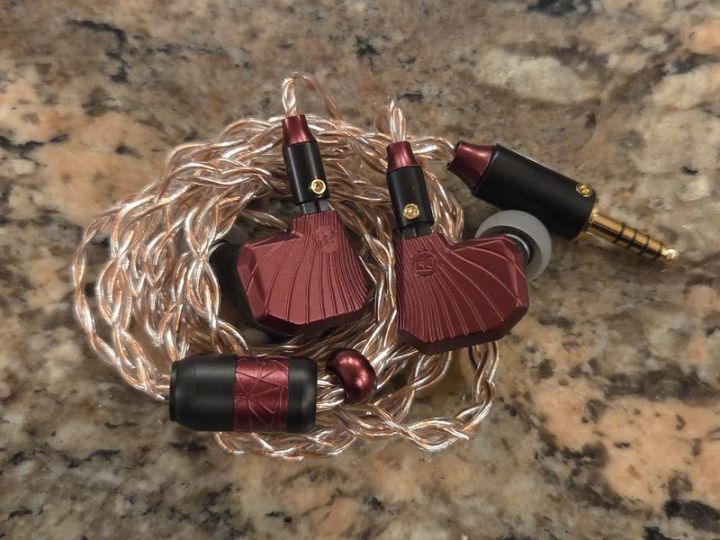
This 4-wire cable is very flexible, light, and non-microphonic. It features an advanced design with exotic (expensive) material wires, all of which contribute to its price tag. And just like with all PS cables, you have a lot of options to customize this cable based on the number of wires (you can have a 6-wire or 8-wire design), lots of different sleeve options, configure the overall length, type of connectors, termination end, Y-Splitter, chin slider, and even left and right indicators. Configuring PlusSound cable often feels like going through a CIEM earphone designer. The version I received was a perfect color-match for Sonora SE, and not only the color match, but… more about it later!
Design.
Similar to the unboxing and accessories, I’m going to cover both IEMs in the same section because of their design overlap.
Volta SE and Sonora SE feature a tribrid design with DD/BA/EST drivers. Volta SE uses 6 drivers per side, 2xDD 10mm drivers in an isobaric config (covering sub-lows and lows), 2xBA drivers (covering mid-lows, mids, and mid-highs), and 2xEST drivers (covering highs and super-highs). Sonora SE uses 8 drivers per side, 2xDD 10mm drivers in an isobaric config (covering sub-lows and lows), 4xBA drivers (covering mid-lows, mids, and mid-highs), and 2xEST drivers (covering highs and super highs). The drivers are partitioned across a 6-way crossover network and arranged inside the 3D-printed acoustic chamber. On paper, the driver config and partition of SE models are identical to those of OG. Still, the tuning has been changed, courtesy of the newly updated crossover network design and all-new internal wiring.


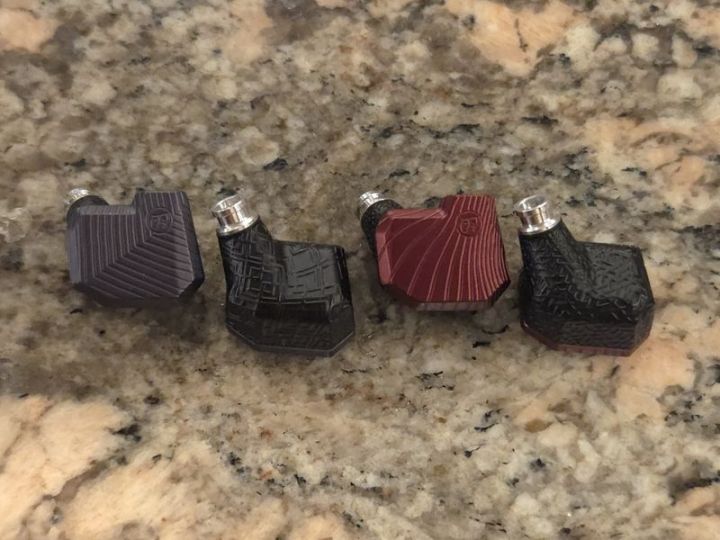
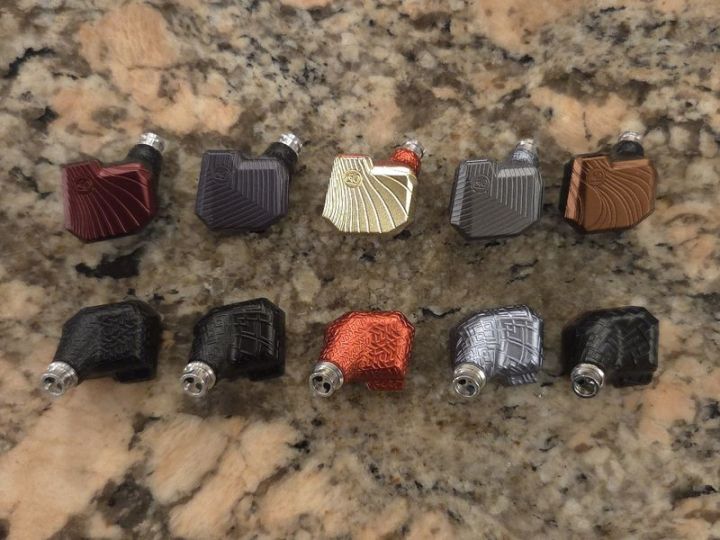
The shell design of SE is identical to that of OG; only the color scheme has changed. The exterior design is beautifully crafted and features a polished, anodized, and cryogenically treated aluminum faceplate and body, and a shorter/wider nozzle with a lip to secure eartips and 3-bores at the tip. Volta SE has a dark grey line-pattern faceplate and a deep black modern-pattern body, while Sonora SE has a dark burgundy line-pattern faceplate and a deep black modern-pattern body. The shell/faceplate coloring is more subtle now. Similar to the corresponding OGs and Allegro II, there was one long slit-vent on the back, possibly for DD drivers, and it still provided decent sound isolation and no driver flex. Also, the 2pin socket is partially recessed, but not deep enough to hide the 2pin cable connector. According to PS, the 2pin connector is their in-house designed cryogenically treated 0.78mm rhodium-plated tellurium copper with PEEK insulation. The internal wiring is also custom, using Copper XS and Silver XS proprietary, in-house-designed, cryogenically treated Type 6 UP-OCC wires for drivers and cable sockets, including proprietary PC insulation.
Volta SE


Sonora SE


Inside out, it’s a mature design, similar to Volta/Sonora OG, which brings me, again, to the topic of how it fits. Sound tuning is a matter of personal preference, while the fit depends on your ear anatomy. With the original Allegro, the combination of a bulbous shape of the shell body and a short nozzle could be a problem for some ears, and it took me a little while to find the right set of eartips to extend the shell a little bit further out to fit more comfortably in the concha area of my ear. Volta/Sonora OG and SE feature an updated shell body with a less bulbous and more ergonomic design that feels more comfortable. However, I still found the upper corner of the shell, opposite the nozzle, digging a bit into the concha area of my ear, something that could be resolved with different eartips. I know you can’t please everybody. Still, the Volta/Sonora OG and SE shell design is an improvement over the original Allegro, even to my picky ears. But I hope, when the time comes for the MK2 release of these IEMs, PlusSound would consider rounding off the upper corner.
The fit


Page 2 – Sound Analysis, Eartips selection, and Cable pair up.
Page 3 – Comparison, Source Pair up, and Conclusion.

 Twister6 Reviews