
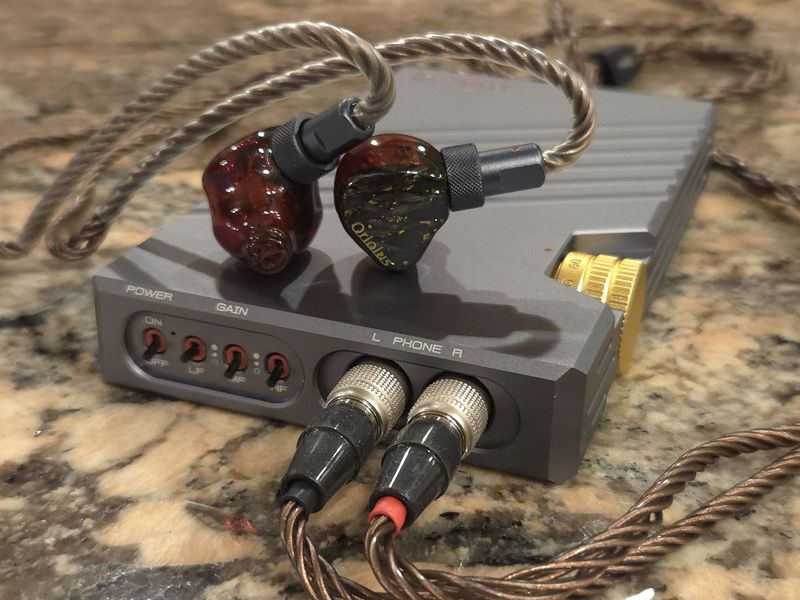
Sound Analysis and Comparison.
I analyzed Traillii Ultra sound performance using SP4000 LO, while playing a variety of test tracks, such as Agnes Obel’s “The Curse”, Sandro Cavazza’s “So much Better” (Avicii remix), C-Bool’s “Never Go away”, Ed Sheeran “Shape of you”, Alan Walker “Darkside”, Galantis “Hunter”, Iggy Azalea “Black widow”, Indila “Boite en argent”, Dua Lipa “Love Again”, Counting Crows “Big yellow taxi”, Bob Marley “Jamming”, David Elias “Vision of her”, Michael Jackson “Dirty Diana”, and SaberZ “Without your love”. The Ultras I received had already undergone proper burn-in for many hours before, during, and after the recent CanJam NYC. In all my sound analysis of Ultra, I used the stock IC cable. The comparison with Traillii JP (Original version) and Traillii Ti was performed using SP4000 PO. Also, I used Azla Xelastec eartips, although I also tried Eletech Baroque (just a touch more sub-bass rumble and treble sparkle) and SpinFit W1 (more soundstage depth and extra treble sparkle). However, I didn’t notice big, drastic changes with different eartips. In general, due to Traillii’s traditional shorter nozzle design, you need to use eartips with a good core grip to keep them securely attached around the nozzle tip.
Since my sound analysis includes comparison notes with JP and Ti versions, I would like to title this section of the review “Sound Analysis and Comparison”. Furthermore, the LxMxHx setting refers to Low, Mid, and High gain settings on the amp, with 0-baseline and then 1- and 2-boost settings.
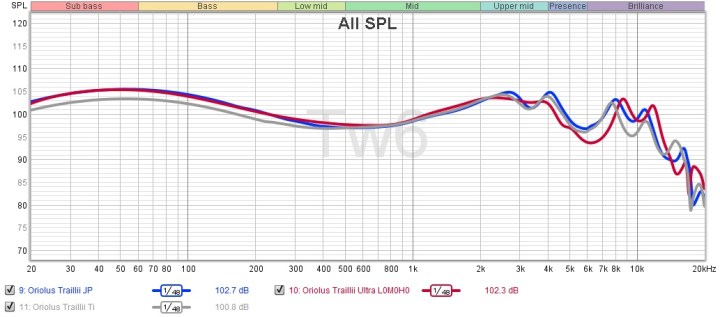
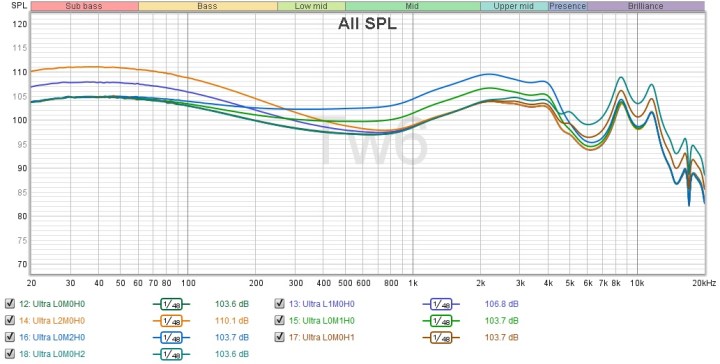
Traillii Ultra (UL) soundstage is noticeably wider than JP, stretching and wrapping around your head, while the depth/height of the stage is similar to JP. The imaging between these two has a similarly holographic feel, relative to the sounds’ positioning in space. In its default L0M0H0 setting, UL bass is very similar to JP, with the same weight of the textured sub-bass rumble extension and rounded, slower mid-bass punch. As you boost the bass by one notch (L1), surprisingly, while the weight and impact of the bass scale up, the perception of the mids and treble stays relatively the same, without pushing them back or drowning them out behind the low end. And, it’s not just the weight of the bass that scales up. I also hear improved articulation of bass notes, with faster attack and shorter, snappier decay, one of the reasons the bass remains tightly controlled without hovering over the mids. While the bass was more boosted, its articulation, control, and technical performance reminded me of Ti, except it felt more physical, more DD-like, rather than BA. Boosting the bass to the max (L2) made the bass a little bloated, this time creating the perception that the lower mids gained more body. That could be compensated by boosting the mids higher as well, but the sound lost some of its musicality with the mids being shouty and more in your face. I would say that, to my ears, obviously a subjective opinion, beyond the L1M1H0 setting, Traillii’s tuning lost its “magic” with either too much bass or too-forward mids, which ruined the overall tonal balance.
Compared to UL’s default M0 setting, the JP mids are a bit smoother and warmer, while the UL mids are more resolving and better at detail retrieval. Their tonality is not too far off, but the technicality of the mids is improved in UL with better layering and separation of sounds and a bit more air between the layers. I never thought of JP mids as sounding congested or dense to my ears, but when you go back and forth in this comparison, Ultra mids open up, with improvements in dynamics and layering. When you flip the mids switch on UL to M1, the presentation of mids becomes more forward, a little more revealing, even a bit colder, especially noticeable in vocals, and reminds me more of Ti performance. I liked it, but it lost a bit of smoothness. One more switch to M2, and mids now sound shouty and somewhat hollow, so I preferred either the original M0 setting or M1. With mids at M1, bringing the bass one notch up to L1, works with some of the sources, improving the linearity of the lows to mids transition, but it was source/DAC dependent. Still, I found it fascinating how with these changes in lows and mids, the treble remained the same. But overall, Traillii is known for its natural, resolving mids. And Ultra still captures it in the M0 setting, but also lets you bring them further forward, with improved resolution and more revealing tonality when switching to M1.
Now, with the treble, the sparkle between JP and UL is similar, but UL is a bit crisper and has more airiness, assisting in the layering of its mids. In comparison, the JP treble sounds a bit more relaxed, even a bit smoother. Ti treble has more airiness than JP, but UL treble still felt lighter and more transparent. UL treble feels lighter, with more clarity and precision, giving the sound more micro-details and an extra natural-tonality shimmer. But switching the treble to the H1 and H2 added even more shimmer, saturating the highs and making them sound unnatural to my ears. With treble, I preferred to stay at the original H0 default position.
So, with Ultra, I enjoyed the default setting L0M0H0, which gave me technically enhanced tuning that felt like a step up from JP and Ti, especially for mid transparency and treble airiness, and was similar to JP’s bass weight with tighter articulation like in Ti.
Boosting the bass, L1M0H0, sounded more like what I would have expected from Traillii v2, the Bird with a more physical bass that could be mistaken for DD instead of BA, with a clear, natural, detailed, layered mids, that were technically-enhanced from JP and Ti, and airy treble that reminded me of Ti performance but with even better clarity and precision.
Also, boosting the bass and the mids (L1M1H0) took the previous bass-boost tuning and enhanced the mids with a more forward presentation and a change in tonality. It improved clarity, giving the sound a solid W-shaped tuning, although at the expense of slightly reduced sweetness. With a bass boost, my ears adjusted to the new tuning instantly, but with a mid-boost, it took a few seconds to adjust, after which it felt as natural.
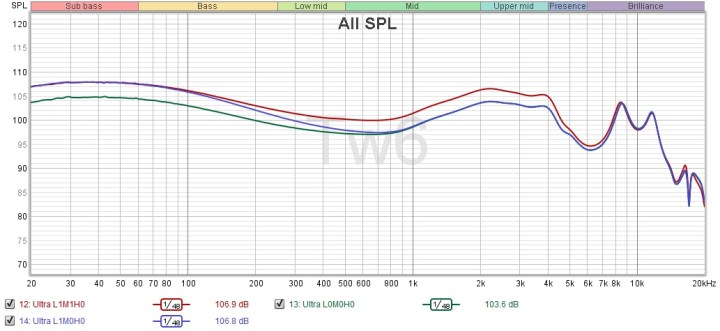
The bottom line: L1 boost was almost a must-have here, not only boosting the weight and impact of the lows but also adding more control and articulation to the bass, making it more layered and multi-dimensional. With the mids boost, I couldn’t decide which one I like better, the M0 or the M1 setting, as it varied depending on the DAP/DAC pair up, as well as playing different genres of music. With treble, it was an easy choice for me because I preferred H0.
Another thing to note. In my experience, when dealing with Parametric or Regular EQ, or other IEMs with crossover switches, adjusting one frequency group always affected the perception of the others. Here, it was a very precise, surgical boost adjustment of a specific frequency range, compensated by something like an active crossover adjustment. I measured the gain of each band separately and then combined them in this FR graph.
Interconnect Cables
Stock IC cable vs Orochi IC – Orochi IC gives the sound a touch more smoothness; however, the change wasn’t very drastic here.
Source pair-up.
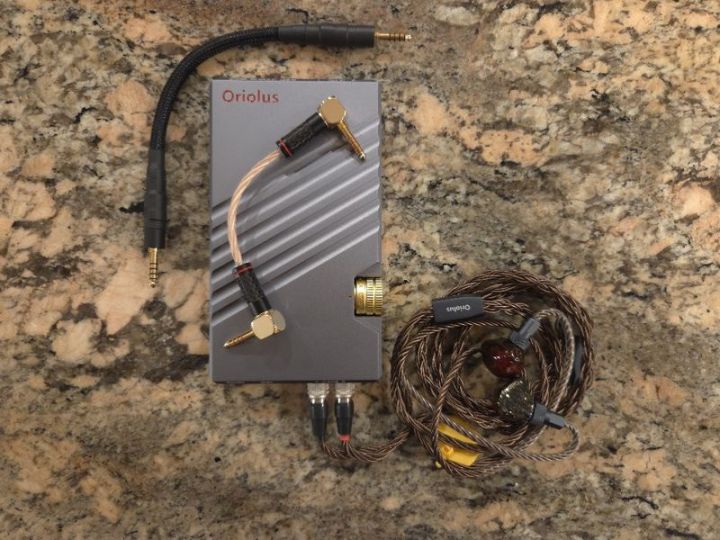
Source pair-up with Traillii Ultra (L1M0H0 setting), stock IC cable, 4.4mm input, and LO of the following DAPs.
A&K SP4000 – big expanded soundstage with nearly 3D holographic level of imaging; deep, textured sub-bass rumble and elevated, slightly rounded mid-bass impact that you can feel, like a physical DD driver bass that pushes the air, except here the bass is delivered by BA drivers. Mids have a smooth, fuller body, natural tonality, with lots of clarity and an impressive level of resolution without going into organic thickness or revealing micro-details. Treble has an airy sparkle with a very impressive mid-treble resolution that stands out due to the contrast of forward upper mids (pinna gain) and scooped out lower treble to bring higher definition and more attention to mid-treble. The L1M0H0 setting was great in this pair-up.
L& P6 Pro – still very impressive soundstage expansion, except imaging is a bit closer to the center. The sub-bass has a slightly more elevated rumble, while the mid-bass is a little more laid-back here. Mids are slightly more pulled back, smoother, and more organic to the point where I preferred to switch to L1M1H0 to boost the mids’ presence. With that boost, mids are still smooth, natural, musical, but they are also more balanced with the lows, and have improved definition. Treble was similar to other pair-ups, with a well-controlled, resolving, natural sparkle. L1M1H0 was my preference here.
iBasso DX320Max Ti – very big expanded soundstage with nearly 3D holographic level of imaging; deep, visceral level of bass with a faster mid-bass punch. Even when I dropped it to L0M0H0, the bass was still very impressive with a fast tactile response. With the L switch up one notch (L1), the sub-bass rumble is deeper, richer, and more textured. Mids have a great natural resolution, a bit less coloring and more transparency, but still sound natural, layered, and quite resolving. Treble is crisp and still natural, non-fatiguing, with a great resolving definition. In this pair-up, I enjoyed both L0M0H0 and L1M0H0 settings and actually didn’t mind the bass at its baseline level.
Hiby RS8ii – big expanded soundstage with nearly 3D holographic level of imaging; I liked it here with L1 boost to give the sub-bass more weight, texture, and extra rumble. The mid-bass is a little more laid back, not as fast or snappy, but the sub-bass is what really draws your attention in this pair-up. Mids are smooth, natural, detailed, and very musical. They are just a bit pulled back, and I enjoyed it with M1, similar to another R2R pair-up like in P6 Pro. That boost not only improved the definition of mids but also their resolution. The treble is smooth, natural, still detailed, but a bit more reserved here. But when I tried to boost it to H1, it became less natural, so I went back to H0. In this pair-up, I really enjoy L1M1H0 settings.
A&K SP3000M – the imaging was closer to a holographic level, but the width narrowed slightly, with more depth than width here. I liked the L1 boost here, which gave sub-bass more weight and even improved the punch’s speed, although the bass still has a bit of a laid-back presentation. Mids are smooth and detailed, very musical, but not too thick or veiled. Treble has a very nice, snappy, natural sparkle, very similar to SP4k. I enjoyed the L1M0H0 setting, with the L1 boost that was a must to give the bass its extra weight.
Cayin N6iii w/T201 – big expanded soundstage with nearly 3D holographic level of imaging. This pair works with either L0 or L1, since the mid-bass was tight, articulate, and snappy, but L1 adds a nice level of sub-bass texture and weight, with a very addictive rumble that works well underneath the mid-bass punch here. The mids are a little more forward, very clear, detailed, with a bit less coloring and more transparency, reminding a lot of the 320Max pair up. Even the treble was crisp, natural, with extra resolution and excellent definition. I really enjoyed this pair-up with either L0M0H0 or L1M0H0 settings.
BONUS Comparison.
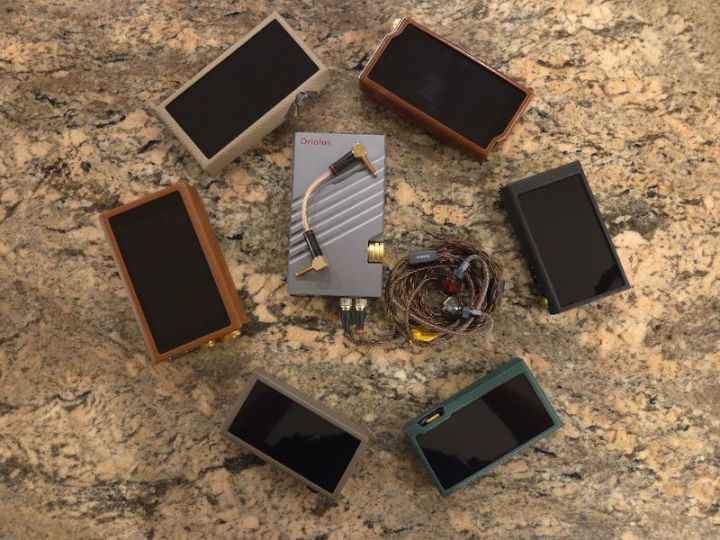
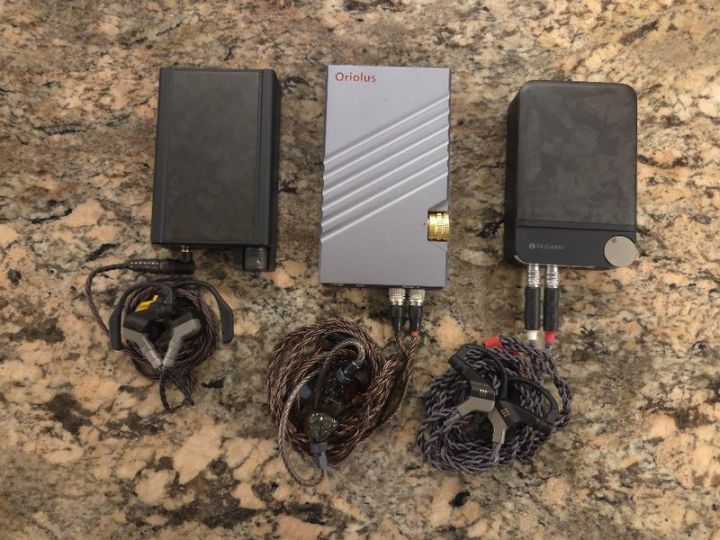
Traillii Ultra vs Brise Audio FUGAKU & BEP-001 + WATATSUMI amp.
Traillii Ultra is closer in tuning compared to BEP-001/WATA (a prototype of Brise Audio IBUKI standalone IEMs), given their more natural, resolving, fuller-bodied mid-range rendition. Overall, the Ultra Bird has more resolving warmth, while BEP-001/WATA provides more transparency, and FUGAKU is more revealing up top. With treble, Ultra adds a little more sparkle and airiness, while BEP-001/WATA keeps it a bit smoother. But when you go back to the lows, where Ultra absolutely benefits from L1 boost, you get more dynamic oomph from BEP-001/WATA even though Ultra, with its BA bass, presents a serious challenge to their DD driver performance. I spent a very short time with all three. It’s a tough call between BEP-001/WATA and Traillii Ultra, and I have a feeling that, for many, it will come down to their preference for mids, with either less coloring and more natural transparency (BEP-001/WATA) or more texture with organic resolving smoothness (Traillii Ultra).
Conclusion.
While I only spent a short time with this new Ultra Bird, it was clear to me that Traillii Ultra combines the best of Traillii JP and Ti, and then takes it to the next level. Its soundstage carries the same holographic imaging, maintains the same height and depth, and expands the width to create a more 3D effect. The bass carries the rumble, the fullness, and the bloom of JP, along with the articulation and control of Ti. When you boost it to L1 level (a must, IMHO), the bass scales up not only in the weight of the rumble and impact of the mid-bass, but also becomes more layered and multi-dimensional. The Ultra’s mids carry the same natural musical sweetness as in JP, inherit Ti’s detail retrieval and resolution without the colder transparency, and take it to the next level with improved layering and sound separation. And the crisper treble of Ultra shifts the focus from lower-treble presence to more mid-treble definition and upper-treble extension, giving the treble more airiness and improving its clarity without an ounce of harshness, as long as you don’t boost the H level of the DPA 10 amp.
Through my testing, a big question remained in my mind: Will Traillii Ultra become the long-awaited v2 of the Bird, replacing the original Traillii JP? I think that Ultra is a great complementary addition to Traillii JP and Ti. It is a standalone, transportable audio system with unique sound processing and controls such as low/mid/high gain settings, putting the listener in the driving seat to fine-tune the sound of this new Bird to their liking. I absolutely loved its (Ultra) tuning, especially the bass boost, which I couldn’t get enough of. But despite all that, I still would like to see the v2 version of the original Traillii. Given the Traillii Ultra’s advanced design, I don’t know if it is feasible to replicate its exact tuning (L1M0H0 setting) in a pair of standalone IEMs. But I really hope they will try. In the meantime, if you are a fan of Oriolus Traillii JP, have been waiting for their follow-up release, and don’t mind a transportable design, Traillii Ultra is the way to go!

 Twister6 Reviews