
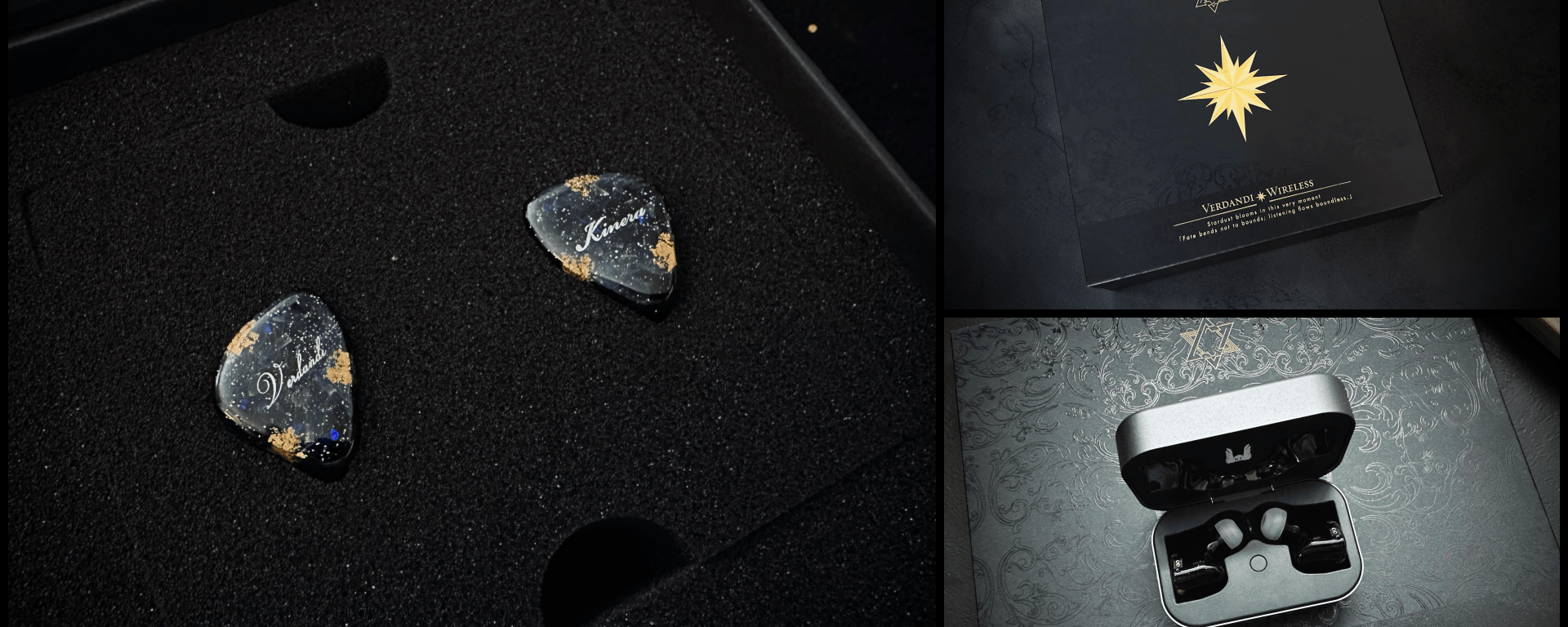
That alone tells you the intent – this is not tuned for convenience-first consumers. This is a statement product aimed squarely at audiophiles who’ve historically dismissed TWS as compromised. The question is not whether Verdandi TWS sounds good. The real question is whether Kinera has managed to translate a multi-driver, high-resolution wired philosophy into a latency-bound, battery constrained wireless system without collapsing its core identity.
Website – Kinera Official ($1299-1399)
Technical Specifications.
- Driver Configuration: 1 Dynamic Driver (6mm liquid diaphragm) + 1 Bone Conduction Driver + 2 Knowles Balanced Armatures + 2 Sonion Electrostatic (EST) drivers
- Driver Topology: Quadbrid hybrid system (DD + BA + EST + BC)
- Frequency Response: 20 Hz – 50 kHz
- Impedance: 14 Ω
- Sensitivity: 105 dB
- Bluetooth Version: Bluetooth 5.4
- Chipset: Qualcomm QCC3091
- Supported Codecs: SBC, AAC, aptX Adaptive, LE Audio
- Wireless Range: Up to 20 meters (open environment)
- Battery Life: ~6 hours (earbuds) + ~18 hours via charging case (total ~24 hours)
- Battery Capacity: 65 mAh (earbuds) + 600 mAh (charging case)
- Shell Material: 3D-printed resin with multi-layer hand-painted faceplates
- Connectivity Mode: Dual-mode (True Wireless + optional wired via 0.78mm 2-pin interface)
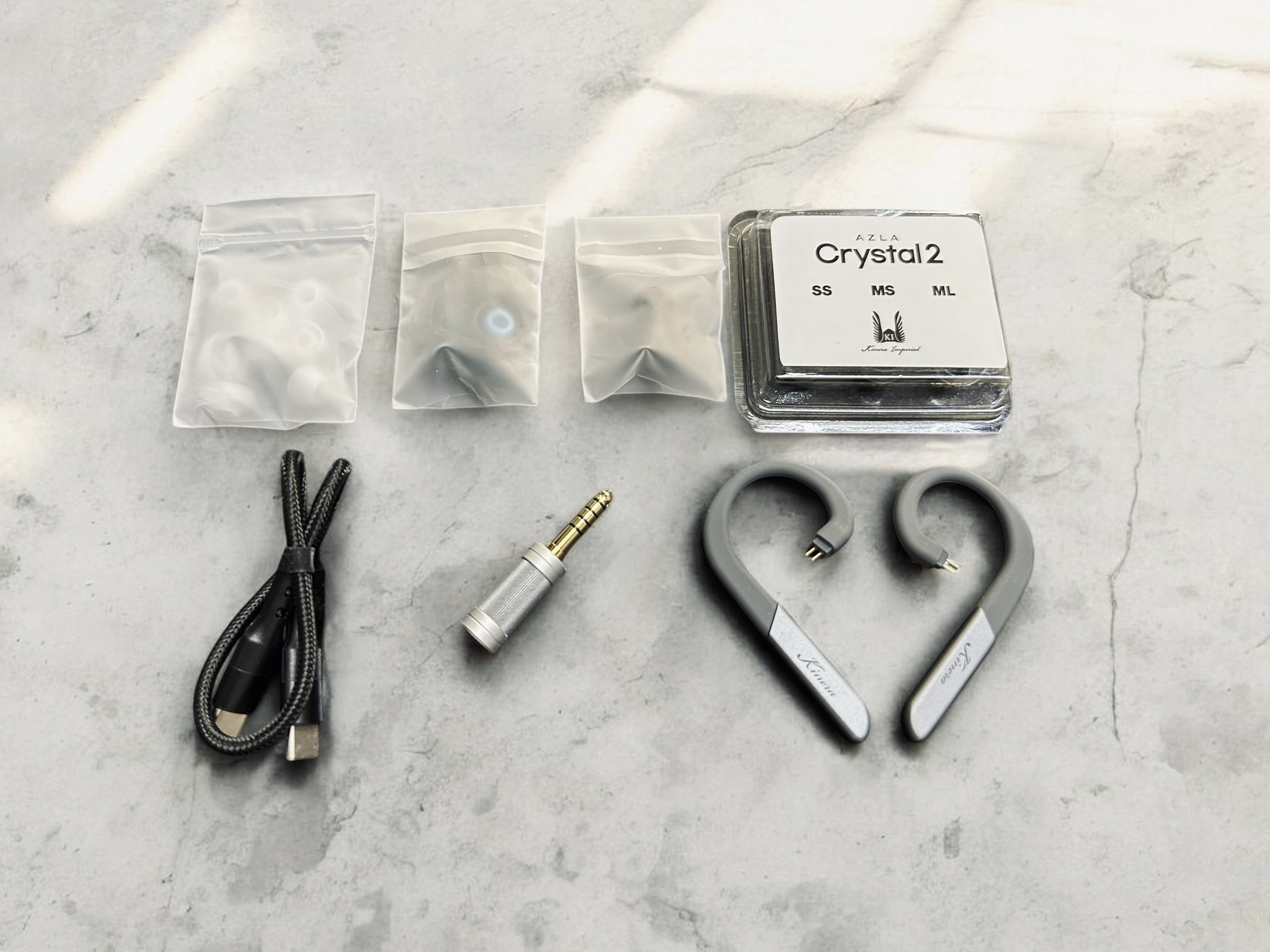
- Included Accessories: Multiple eartip sets (Final Type E, AZLA SednaEarfit Crystal, foam, Kinera K-07), charging case, cable, ear hooks, cleaning tools
Unboxing Experience.
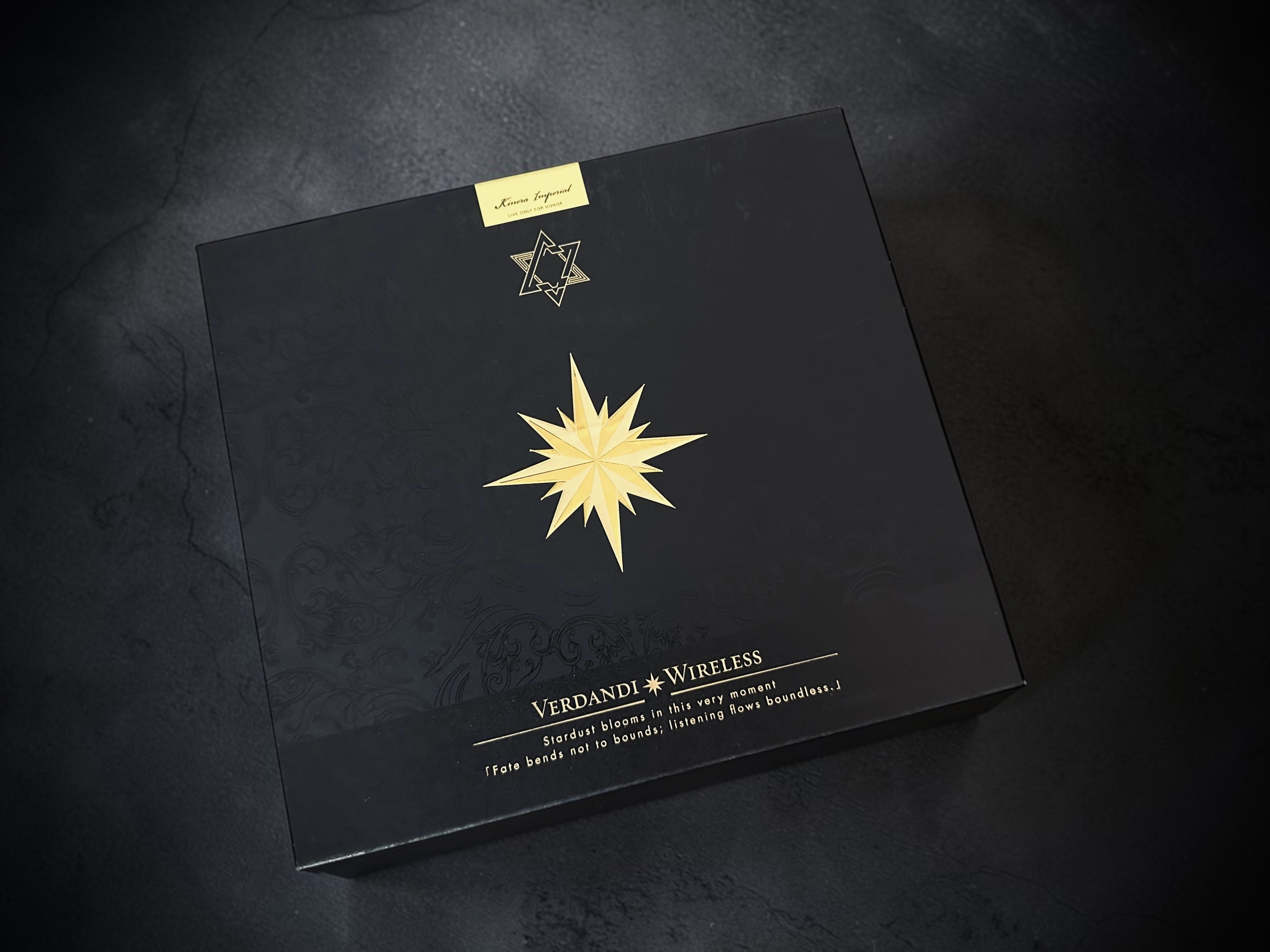
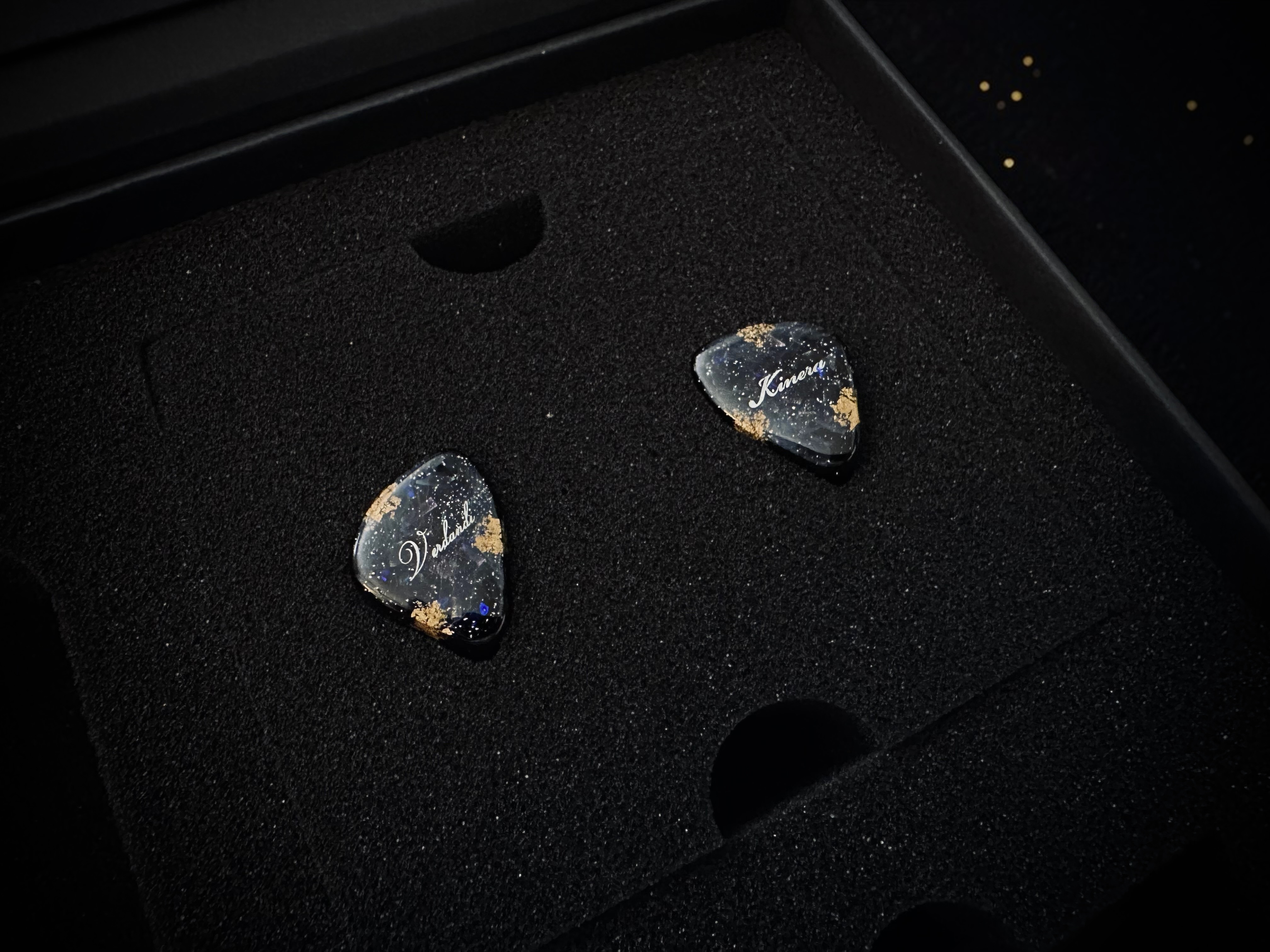
The Verdandi TWS arrives with a presentation that is clearly positioned to reflect its premiumness, leaning more toward a luxury unboxing experience than a typical TWS retail package. The outer box is large, finished in a sleek black with gold and silver foil embossing, giving it a deliberate sense of visual weight even before opening. Inside, the layout is meticulously organised, with each component seated in dedicated cutouts, creating a structured and almost IEM-like reveal rather than a conventional wireless earbud presentation. The accessory set is unusually extensive for a TWS and mirrors what you would expect from a high-end wired monitor: multiple premium tip options including Final Type-E, AZLA Sedna Earfit Crystal, Kinera’s own K-07 silicone tips, and foam variants, along with a cleaning brush, cloth, ear hooks, and a proper carrying case. There is also the inclusion of a charging module, Type-C cable, and notably, an optional 4.4mm wired cable, reinforcing the hybrid identity of the product. The overall experience is not just about presentation, but about density—there is a clear attempt to deliver a full ecosystem of accessories that aligns more with a kilobuck IEM than a typical TWS, and in that sense, the unboxing feels deliberate, premium, and unusually complete for the category.

Build, Design & Ergonomics.
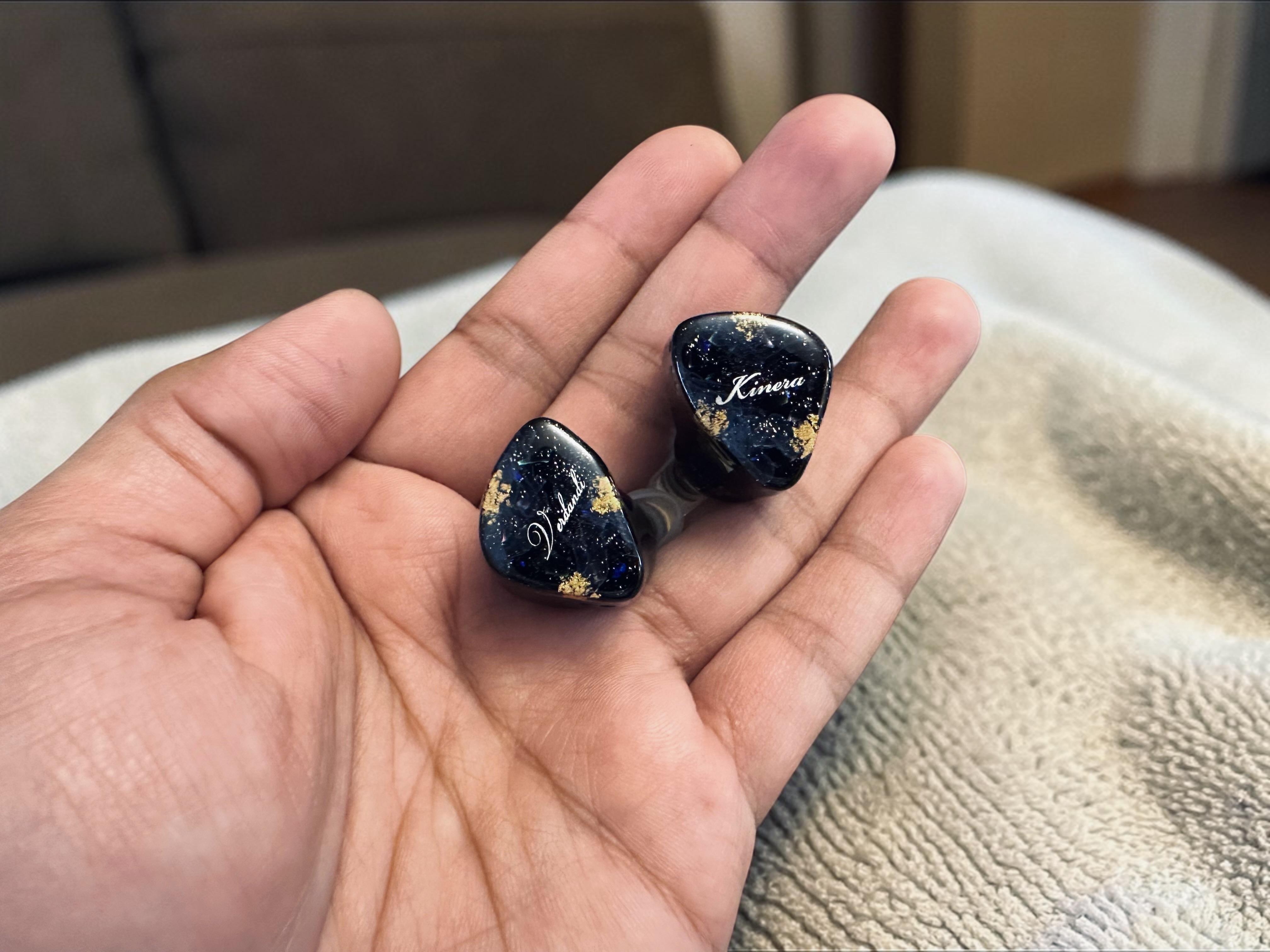
Kinera retains its signature aesthetic DNA here – organic resin shells with intricate swirl patterns, leaning heavily into that jewellery-like presentation they’ve become known for. The shells are not subtle, nor are they compact. This is a physically substantial TWS design, and it immediately departs from the ergonomic minimalism of mainstream competitors. The bulk is not accidental. Housing six drivers per side including EST units and a bone conduction element demands internal volume, and that directly impacts both nozzle diameter and shell geometry. In practical terms, this means fit is highly anatomy-dependent. Medium-to-large ears will accommodate it comfortably, but smaller conchas will struggle with both insertion depth and shell protrusion.
The Verdandi TWS extends its premium positioning beyond the earpieces themselves, with a level of material choice and finishing that is clearly intended to align with its flagship status. The charging case feels notably robust, with a dense, well-damped hinge mechanism and a cleanly finished exterior that avoids the plasticky feel common in most TWS implementations. It has a reassuring weight and structural rigidity to it, giving the impression of durability rather than disposability, and the overall execution leans closer to a high-end accessory than a functional afterthought. Complementing this is the included blue leather carrying case, which stands out as one of the more refined inclusions in the package. It is compact but well-constructed, with a soft yet structured leather finish that balances protection with portability, and it comfortably accommodates the earpieces and accessories without feeling cramped. This is not just cosmetic—it reinforces the product’s positioning as a hybrid between a traditional IEM system and a wireless solution.
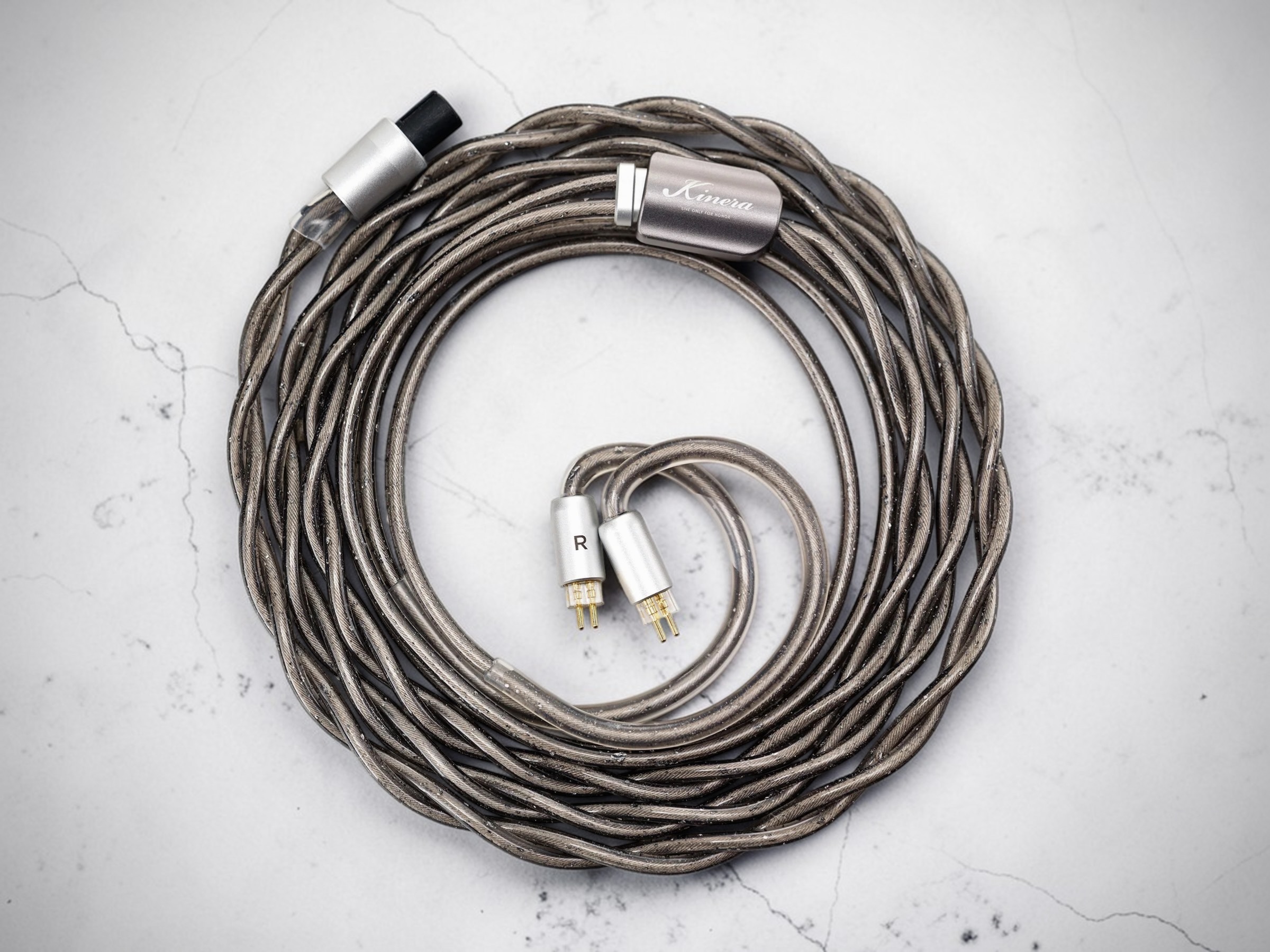
The included cable further strengthens that identity. Rather than being a token addition, it is a properly executed, high-purity cable built using mono-crystalline copper with silver integration, designed to complement the quad-brid driver system when used in wired mode. The construction feels dense and durable, with tight braiding, secure 2-pin connectors, and well-machined terminations, reflecting the same level of attention typically reserved for standalone upgrade cables. In use, it does not feel like an accessory—it feels like an integral part of the system’s dual-mode design. Taken together, the charging case, leather pouch, and cable form a cohesive accessory ecosystem that is unusually complete for a TWS product, and more importantly, executed with a level of material quality and intent that aligns with its flagship ambitions rather than undermining them.
Fit and Comfort.
Wireless Platform & Usability.
The Verdandi TWS uses Bluetooth 5.4 with a Qualcomm QCC3091 chipset, enabling stable transmission and support for higher bitrate codecs like aptX Adaptive. Latency is well-controlled for casual video consumption, though not class-leading for gaming. Connectivity stability is solid, with minimal dropouts even in congested RF environments – clearly a benefit of the newer Qualcomm stack. Battery life is respectable but not exceptional, which is expected given the driver complexity and power requirements of EST elements. This is not an endurance-focused TWS – it prioritises acoustic performance over runtime efficiency.

App Support & Control Ecosystem.
A concerning aspect of the Verdandi TWS – and frankly one that feels out of step with its flagship positioning – is the lack of a dedicated, properly localised control app like the Sonys, Samsungs and OnePlus’. Instead of offering a standalone, purpose-built application, Kinera has awkwardly bundled whatever control functionality exists into something called the “Kinera Music” app, which, in its current state, feels more like an afterthought than an intentional part of the product experience.
The implementation is quite simply incoherent. A lot of the app’s interface is in Chinese, including critical sections such as the manual and system prompts, making it effectively unusable for a large portion of its global audience. There is no meaningful localisation effort here, which is inexcusable at this price point. Even navigating basic functions becomes guesswork unless you are already familiar with the language.
Functionally, things don’t improve. The app does not work properly on iOS as Kinera Verdandi TWS just doesn’t show up there, immediately cutting off a significant portion of users from any form of software-level control. On Android, where it does function, the feature set is extremely limited. You are essentially restricted to:
- EQ interface with custom EQ-ing and presets
- Switching between standard mode and transparency mode
- Basic Settings
Even here, the execution is a bit underwhelming. The transparency mode is particularly poor – it sounds artificial, processed, and lacks the natural pass-through quality seen in far more affordable TWS implementations. It does not integrate seamlessly with the listening experience and feels more like a checkbox feature than a properly engineered one. The inclusion of a manual within the app could have been a redeeming factor, but even that is entirely in Chinese, reinforcing the sense that software support was not designed with a global user base in mind.
When you contextualise all of this within a product that sits at approximately $1299-1399, the disconnect becomes difficult to ignore. From a purely conceptual standpoint, the most impressive achievement here is that Kinera has managed to take the original Verdandi quad-brid platform and make it function wirelessly. That, in isolation, is genuinely innovative. However, when you evaluate Verdandi TWS as an actual true wireless system, the cracks become very apparent. TWS products at a fraction of the price – such as the OnePlus and Samsung’s Buds lineup or Sony’s WF-1000XM5 – not only offer vastly superior features and app ecosystems, but also more refined usability, better integration, and far more polished feature sets overall. In other words, while Verdandi TWS may push boundaries in acoustic ambition, its software and user experience layer feels several tiers below what the market that even at budget levels has already normalised.
Multi-driver TWS IEMs.
It’s also important to contextualise Kinera’s effort within the broader market, because the idea of integrating multi-driver architectures into a TWS platform is not entirely unprecedented. Manufacturers like BGVP, with products such as the Q3 (1DD+1BA), have already explored hybrid driver configurations in a true wireless format, combining dynamic drivers with balanced armatures to push beyond the limitations of single-driver TWS designs. What Kinera is doing with the Verdandi is undeniably more ambitious in scale, bringing EST drivers and bone conduction into the equation, but it is not the first instance of a brand attempting to bridge the gap between traditional multi-driver IEM design and wireless implementation. The distinction, therefore, lies less in the concept itself and more in how far Kinera has chosen to take it, both in terms of complexity and execution.
Sound Analysis.
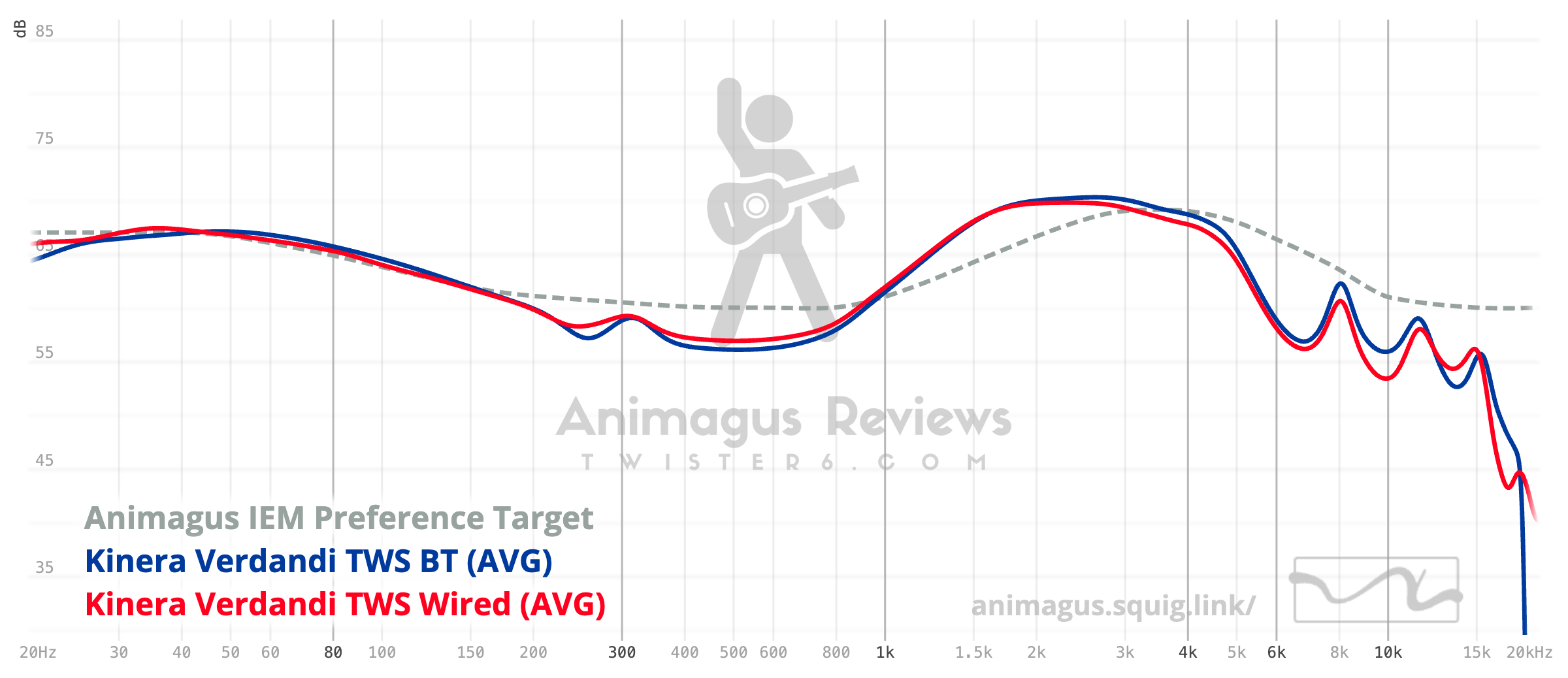
The Verdandi TWS immediately stands out with a clean, structured and deliberately tuned presentation that prioritises separation, control and midrange focussed over outright excitement. This is not a neutral or reference-style tuning – it is clearly coloured, with a subtle sub-bass lift, recessed lower mids, an early upper-mid rise, and a smooth, slightly warm treble shaping the overall character. The result is a sound that feels open, articulate, and composed, but also distinctly engineered rather than naturally balanced. That approach works well for clarity and fatigue-free listening, but it comes with trade-offs – the ear gain starts earlier than ideal, pushing vocals forward in a slightly pre-positioned way, while the lower midrange lacks depth and density, reducing note weight and realism. The treble, while smooth and controlled, is also restrained and slightly warm, limiting air and extension. What you get, ultimately, is a presentation that favours cleanliness and separation over tonal richness and absolute accuracy.
Let’s dig in deeper…
Bass – The bass is primarily sub-bass focused. There is enough low-end extension to give tracks a sense of foundation and rumble, but it never becomes dominant or intrusive. The sub-bass sits slightly elevated, adding presence without overwhelming the mix. Where the Verdandi diverges from more fun and engaging tunings is in the mid-bass. It is noticeably controlled, which keeps slam and physical impact cleaner and more neutral. Kick drums and bass lines sound tight and articulate, but don’t expect weight and punch that visceral bass head tunings of the average TWS IEMs. This is a conscious decision. By keeping the mid-bass in check, Verdandi avoids bleed into the midrange and maintains a clean, well-separated low-end. The trade-off is clear: you gain clarity and control, but the body and authority in the bass presentation is on the neutral side.
Midrange – The midrange is the defining element of Verdandi’s tuning, and also where its compromises are most evident. The lower mids are recessed, which reduces midrange warmth and note thickness. Instruments and male vocals sound leaner than they should, lacking some of the harmonic density that gives music a natural sense of weight. This contributes heavily to the overall sense of cleanliness, but also makes the presentation feel slightly under filled in the lower-midrange. As the response moves upward, the ear gain begins earlier than ideal, rising from around 1 kHz into the upper midrange. This brings vocals forward quickly, giving them strong presence and clarity. Female vocals, in particular, benefit from this, sounding articulate and well-defined. However, because this rise starts early rather than peaking more naturally, vocals can feel slightly pre-positioned, as if they are pushed forward ahead of the rest of the mix. It enhances intelligibility, but slightly affects depth and natural progression. Overall, the midrange is clear, resolving, and forward, but lacks the fullness and natural layering that a more balanced lower-mid response would provide.
Treble – The treble is tuned with restraint. It is smooth, controlled, and generally non-fatiguing, but also somewhat uneven and slightly warm in overall perception. There is a softening in the lower treble that reduces attack and sharpness, which makes the Verdandi easy to listen to over long sessions but at the same time, there are small pockets of energy that bring out detail, but they are not sustained across the entire range. As you move higher, the treble begins to taper off, limiting the sense of air and openness. Despite the presence of EST drivers, the tuning does not fully capitalise on their potential for extension and sparkle. Instead, it opts for a little too safe and controlled top end. The result is a treble that supports detail and clarity, but does not deliver the final layer of brilliance or air that would elevate the overall resolution.
Technical Performance.
Technically, the Verdandi TWS performs very well for the TWS category, though much of its performance is closely tied to its driver and tuning choices. The soundstage width and depth is very nice for a TWS but just average when you consider it being an IEM at the $1299+ mark. Imaging is precise and stable, with clear positional cues and good separation between elements. Layering is one of its stronger aspects – the combination of restrained mid-bass and recessed lower mids allows different elements to occupy distinct spaces without overlap. Resolution is solid, particularly in the midrange where detail retrieval is strong and consistent. However, the slightly restrained treble limits the perception of micro-detail and air at the very top end. Overall, Verdandi TWS’ technical performance is impressive for a TWS, but falls short for the kind of technical performance one expects at this price from a wired-wireless hybrid IEM.
TWS Bluetooth vs Wired Modes.
One of the more interesting aspects of the Verdandi is the difference between its Bluetooth and wired implementations. The Bluetooth mode is, somewhat surprisingly, the better-tuned of the two. It retains slightly more presence in the treble and a bit more balance overall, resulting in a sound that feels more complete and open. The wired mode, in comparison, sounds a touch more subdued. The treble rolls off earlier, which makes the presentation darker and less airy. The lower mids also feel marginally leaner, further reducing tonal weight. The differences are not drastic, but they are noticeable enough that the Bluetooth mode ends up being the more engaging and better-balanced listening experience. This suggests that the internal DSP is doing more than just maintaining the signal—it is actively refining the tuning.
Comparisons.
Original Kinera Verdandi (Wired).
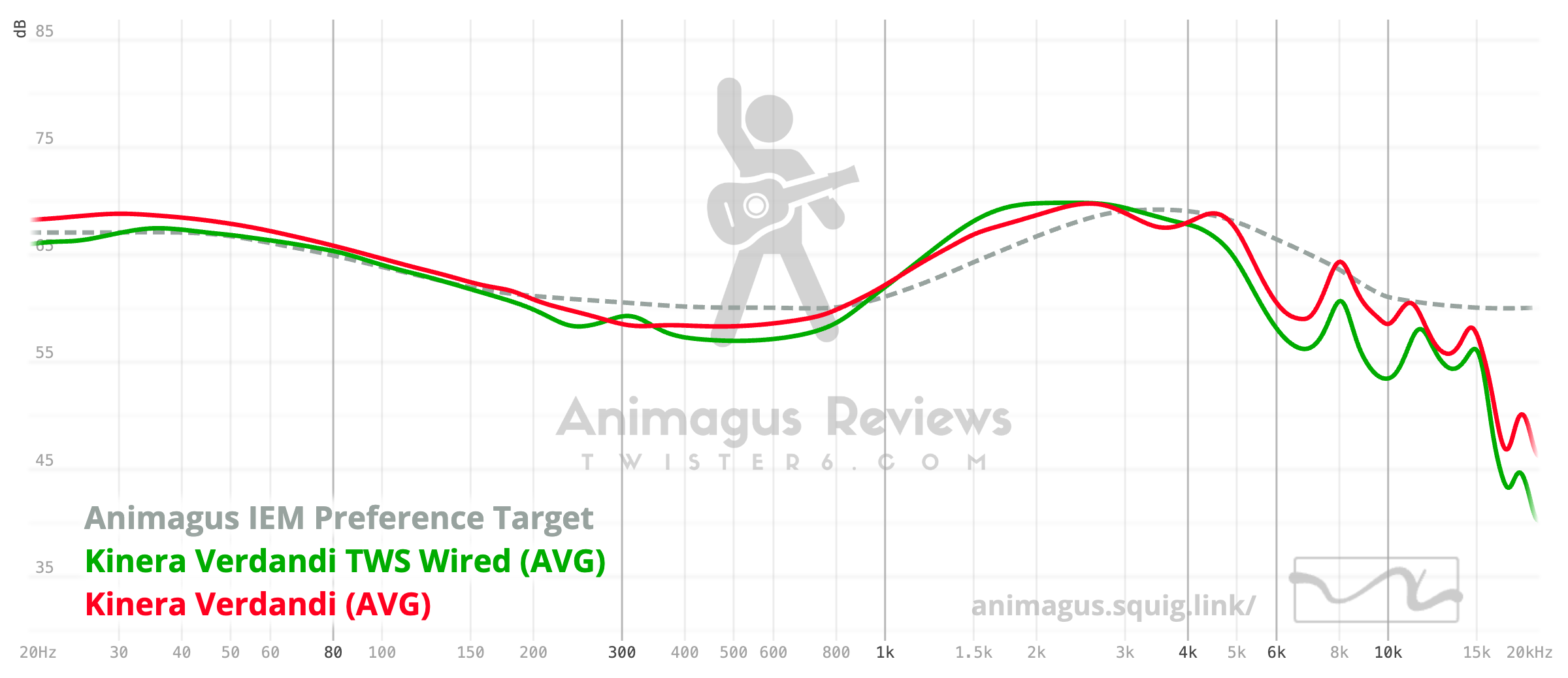
Compared to the original wired Verdandi, the TWS version feels like a tonally simplified and slightly compromised reinterpretation. The wired version had better lower-mid density and note weight, more natural ear gain progression and superior treble extension and air. The TWS version retains some of the overall tonal DNA – particularly the clean presentation and sub-bass focus – but loses a degree of refinement and coherence. The biggest regression is in the treble. The wired version made better use of its EST drivers, delivering more air and extension. The TWS version, in contrast, sounds more rolled and constrained, which limits its perceived resolution. Technically, the wired version is clearly superior across the board – resolution, staging, layering, and timbre. The TWS version feels like a downscaled version prioritising practicality over absolute performance.
Sony WF-1000XM5.
The Sony WF-1000XM5 sits at almost the opposite end of the tuning philosophy spectrum. Sony’s approach here is unapologetically consumer-leaning—elevated bass, fuller lower mids, and a smoother, slightly rolled treble, designed to sound rich and pleasing out of the box. Compared to Verdandi, the XM5 immediately comes across as denser, warmer, and more grounded. The biggest difference is in the midrange structure. Sony retains lower-mid body, which gives vocals and instruments a more natural weight and realism. Verdandi, in contrast, sounds leaner and more separated, but also less organic. Where the XM5 fills in the space between notes, Verdandi clears it out. Bass is another clear divergence. The XM5 delivers more mid-bass punch and physicality, making it more engaging for casual listening. Verdandi’s bass is tighter and more controlled, but also less impactful. Treble-wise, both are relatively safe, but in different ways. Sony smooths things over broadly, while Verdandi has a more uneven but slightly more resolving treble structure. However, neither is particularly airy or extended. Technically, Verdandi is clearly ahead. It has better separation, layering, and imaging precision, largely due to its leaner tuning and multi-driver setup. But as an overall product, Sony is far more complete—better app, better integration, and a tuning that will appeal to a much wider audience.
Samsung Galaxy Buds Pro 3.
Samsung’s Buds Pro 3 follows a more modern Harman-influenced tuning, with a balanced low-end, relatively natural midrange, and a more energetic but controlled treble compared to Sony. Compared to Verdandi, the Samsung sounds more tonally correct. The lower mids are better filled in, vocals have more natural body, and the ear gain is more realistically positioned. Verdandi, by comparison, sounds more “engineered”—cleaner, but less natural. Bass on the Samsung is more evenly distributed between sub and mid-bass, giving it a better balance of rumble and punch. Verdandi still has cleaner separation, but it lacks that cohesive low-end weight. Treble is where Samsung pulls ahead in terms of balance. It has better extension and a more continuous response, giving it more perceived air and openness. Verdandi’s treble, while smooth, feels more uneven and slightly constrained. From a technical standpoint, Verdandi still edges ahead in layering and micro-separation, but the gap is not as large as you would expect given the price difference. Samsung, overall, delivers a more coherent and tonally accurate presentation, even if it is less resolving on paper.
OnePlus Buds Pro 3.
The OnePlus Buds Pro 3 is tuned to be more engaging and energetic. It features a stronger bass response, slightly recessed mids, and a more lively treble, giving it a more V-shaped presentation compared to Verdandi’s mid-forward approach. Compared directly, the OnePlus sounds more fun, more dynamic, and more immediately engaging. It has more punch, more sparkle, and a stronger sense of contrast. Verdandi, on the other hand, sounds more controlled and refined, but also more restrained. Midrange is where Verdandi pulls ahead. Despite its leaner lower mids, it still offers better vocal clarity and separation, whereas the OnePlus can sound slightly pushed back in the mids due to its bass and treble emphasis. Treble on the OnePlus is more energetic and extended, giving it a greater sense of air. Verdandi sounds smoother but also more muted in comparison. Technically, Verdandi is superior in imaging and layering, but the OnePlus closes the gap with a more engaging tuning. And when you factor in the massive price difference, the OnePlus starts to look like the more practical choice for most users.
Conclusion.
The Verdandi TWS is one of those products where the intent is immediately obvious, but so is the scale of what Kinera has attempted to execute. Rather than simplifying the original Verdandi’s architecture to suit the constraints of a wireless platform, Kinera has chosen to carry forward a genuinely complex quad-brid configuration into a TWS form factor. That alone is not a trivial engineering exercise. Power management, crossover implementation, driver integration, and spatial constraints in a fully wireless system introduce limitations that do not exist in wired designs. In that context, the Verdandi TWS is not just another tuning experiment, it is a technically ambitious translation of a high-end IEM concept into a format that typically does not accommodate this level of complexity.
On paper, that is genuinely impressive. In practice, it results in a product that behaves less like a conventional TWS and more like a wireless extension of a multi-driver monitor. The fact that Verdandi manages to retain a sense of separation, layering, and structural organisation that reflects its quad-brid intent is a credit to its implementation. For a TWS, the level of staging, imaging stability, and layering coherence on display here is notably way above the Sony/Samsung/Oneplus TWS category baseline but the tuning choices on the other hand are not up to the mark. The shortcomings of the original wired Verdandi are only exaggerated by this TWS version – the reduced lower-mid density impacts tonal realism, the early ear gain alters vocal naturalness, and the treble, despite the presence of EST drivers, remains conservative in extension and air. These are not oversights as much as they are trade-offs, and they reflect the difficulty of fully realising a complex hybrid architecture within the constraints of TWS hardware. The result is a sound that is technically interesting and easy to dissect, but not as competent against the competing wired IEMs in this price segment.
Outside of sound, the limitations become more pronounced. The absence of a properly implemented control ecosystem significantly undermines the usability of the product. There is no standalone control app and the Kinera Music app is incomplete, non-functional on iOS, and limited on Android. At this price point, that is not a secondary concern – it directly affects how the product competes in the modern TWS landscape, where even significantly cheaper alternatives provide stable, feature-rich software integration. And then there is the price – at around $1299, Verdandi TWS enters a category where it cannot rely solely on its novelty or engineering ambition. It has to function as a complete system. While its acoustic design demonstrates a level of technical execution that is genuinely uncommon in the TWS space, the overall product does not deliver the same level of completeness in usability, refinement, or tonal balance expected at this tier. Competing products, including other multi-driver implementations, have already shown that complexity alone is not enough without cohesive execution across all aspects.
What Verdandi TWS ultimately represents is one of the more serious attempts at pushing TWS design beyond its usual boundaries. It succeeds in translating a quad-brid philosophy into a wireless format with a degree of technical competence that is clearly above average, and in doing so, it demonstrates what is possible when traditional IEM design is applied to TWS without simplification. However, it also highlights the limitations of that approach.
This is not a mainstream flagship. It is a specialised, technically ambitious product that will appeal to a narrow audience – listeners who specifically value the complexity and execution of a multi-driver wireless system or fans of the original wired Verdandi – who are willing to accept the compromises that come with it. For everyone else, particularly at this price point, those compromises remain too significant to overlook.

 Twister6 Reviews