
Bloom Audio
Bloom Audio is a regular now at CanJam NYC and other US-based CanJam shows. And while for the last few years they maintained their NYC show residence in the Royale room, a private, isolated area all the way in the back, to the left of the main Broadway Ballroom showroom area, this year they decided to change things around by moving to the front, still being to the left of the showroom area. The Shubert room made sense because it was closer to the front and easier for visitors to find, but they didn’t realize the actual room would be smaller than the Royale. The floor diagram, when I looked at it more closely, doesn’t have a scale.
Still, that didn’t stop visitors at the room entrance, who lined up to get their swag bags, with Bloom-branded ddHiFi cases stuffed with goodies, including gift cards and accessories. Limited to only 25 bags for visitors on Saturday and Sunday, it drew quite a few people heading straight to their rooms from the get-go. Also, it got crowded really quickly, so I had to come back later. With an ever-growing number of products and a very energetic staff team of close to a dozen, I think Bloom might have to reconsider next year’s room, since they need more space. But one thing to note: even with more products and a smaller room this year, the presentation of the products was better organized and easier to access.


Showcasing a mix of portable and desktop brands from iBasso, Eletech, Fir Audio, Cayin, Campfire Audio, Noble Audio, Meze Audio, Burson Audio, Meze Audio, iFi Audio, Chord Electronics, Focal, Audeze, HiFiMan, FiiO, Astell&Kern, Dan Clark Audio, HEDD, Final, RAAL-Requisite, Audio-Technica, SPL, Questyle, AudioQuest, Thieaudio, DUNU, Moondrop, Ice Lab, Lime Ears, SpinFit, Kiwi Ears, GMA, Topping, Austrian Composer, and many others, there were definitely not enough tables to cover everything. However, it is always a great opportunity to have many different products in one place to mix and match sources and earphones/headphones, and to compare everything, especially for those who are wondering how the portable gear stacks up against the desktop equipment.


In general, this is a big added value for a retailer such as Bloom at the CanJam show, where, unlike at a separate manufacturer table representing only one brand, you can compare different products. Plus, when some manufacturers couldn’t make it to the show, Bloom represented these brands. It is also the only place to find, test, and compare a complete collection of all the latest iBasso products. And speaking of which, the highlight of the Bloom Audio room was a dedicated iBasso Audio area featuring all their latest products, including DX270, DX260 MK2, DX340, DC04U, Nunchaku, Epitome, PB6, D17, and even their latest desktop amp, Kunlun.
DX270 is a very impressive DAP, with its hybrid architecture of 20-bit R2R + 4-bit String DAC, the latest FPGA-Master 3.0, and fast Android 13 performance, with an option to switch to the Linux-based Mango OS. Even with a 12V DC input to bypass the internal battery while boosting output power by 50%, this is a feature-rich, pocket-friendly, and relatively light DAP under $1.3k that also includes a user-accessible battery replacement. What impressed me the most was the level of its smooth, natural tonality, with an immersive soundstage expansion, a deep black background, and very impressive detail retrieval, considering how pure and natural the sound flows. Quite a few people were testing it every time I walked by.
Another iBasso product getting attention was their D17, with a dual discrete R2R and 1bit DAC architecture. This one has a natural analog tonality, expanded soundstage and dynamics, deep bass impact, and dark background. Also, it offers three DAC modes (NOS, OS, SD), dual NuTube amp coloring, FPGA-Master 3.0, high power output, USB-C/OPT/Coax inputs, PO/LO outputs (BAL and SE), and user-accessible battery replacement.
Next to D17, there was a PB6 amp with dual-output modes, either quad JAN6418 tubes coloring or Solid-State Class AB. It adds a warmer analog texture with a smooth, natural tonality, an expanded soundstage and dynamics, a selectable low/high BW filter, 4.4mm/3.5mm inputs and outputs, high power output, a 12V DC input option, and user-accessible battery replacement, with the last two becoming very common with iBasso sources nowadays.
In a rush, I didn’t get a chance to test iBasso’s latest Kunlun, a GaN FET desktop headphone amp with specs up to 7.4W @ 32ohm output power from its 6.35mm SE, 4.4mm BAL, and XLR BAL output ports. I also noticed it was generating a lot of attention, with people testing it using both headphones and IEMs. Plus, I’m quite familiar with the iBasso AMP17 amp card for the DX340, which also uses GaN FETs to deliver a fast, punchy, dynamic, layered sound, neutral tonality, enhanced detail retrieval, a spherically expanded soundstage with holographic-level imaging, and a deep black background. A few people mentioned to me they found Kunlun to be like a scaled-up, standalone version of AMP17.


Another product I briefly auditioned was a brand-new pair of FirAudio Rx6 IEMs. Known as REDUX6 Hybrid, these IEMs are said to be the final installment in the Frontier Series. According to FirAudio, they feature a new proprietary HDX (High Driver Crossover) tech, including an all-new Atom XR module system, an updated aluminum shell with a beautiful stardust faceplate, and a newly designed balanced cable.
The driver config similarity with XE6 and RN6 will certainly raise questions about the comparison. While I didn’t have the other two with me for a side-by-side comparison, in my brief listening to RX6, I can hear cleaner mids and tighter, less elevated bass. The overall tuning had a more detailed, dynamic sound with improved detail retrieval. It sounded familiar, following closer the tuning DNA of RN6 rather than XE6. Once I have had a chance to spend more time with it and review it, I will elaborate on these comparisons.


Final Audio
It was great to see Final Audio and Kyo, their marketing director, back in NYC. If I recall correctly, in previous years they usually shared tables with retailers and distributors, while this year they had their own separate booth. I assume they were only able to reserve a few remaining tables, the ones outside the main show area of the Broadway Ballroom, closer to the elevator. Still, they were super busy, with many visitors stopping by to hear their latest closed-back full-size headphones (DX10000CL) and flagship IEMs, A10000 – each one featuring a unique diamond dome DD. Kyo is always energetic and a pleasure to talk to, but I had to come back multiple times to get a chance to hear their latest flagship IEM release. And even when I finally had a chance to hear A10000, I had to take it to a small side table since the main table area was overcrowded.


It was a busy year for Final, with a very successful Kickstarter campaign for Tonalite TWS, bridging the consumer and audiophile worlds to deliver wireless earphones with a custom sound tuning based on the 3D head scan. I found these to have a spacious soundstage, natural, resolving tonality with strong technical performance, excellent active noise-cancellation implementation, a secure, comfortable fit, a comprehensive app with lots of settings and high-quality EQ, good battery life, new Fusion-G eartips, and even wireless charging for the case. As I mentioned in my Tonalite review, I personally appreciate every aspect of the Tonalite design and enjoyed active noise canceling and super-clear phone calls as much as the actual audiophile-caliber tuning. And when it comes to the tuning and changes associated with 3D head scanning and the corresponding calibration, going from General to Personalized mode wasn’t just a gimmick or an EQ change, because I hear an improvement on a technical level, not just the tonality. I had Tonalite with me at the show, and I usually carry them everywhere I go.
While I didn’t get a chance to hear their closed-back DX10000CL full-size $8k flagship, I heard some people referring to the A10000 IEMs as a “little brother” of the DX10000CL. A10000 features a solid, true diamond diaphragm, chosen in this design for its high rigidity and minimal surface deformation. The shells were also updated with the housing being precisely machined from high-rigidity stainless steel, providing robust support for the driver and suppressing unwanted vibrations. According to Final, the faceplate surface features a Côtes de Genève finish, a wave-patterned precision-milling technique. A10000 came with a very soft, supple ePTFE-shielded, silver-coated cable with in-house-designed MMCX connectors and a 4.4mm balanced plug termination. I was also pleased to see Final include their new Fusion-G hybrid eartips alongside their traditional Type-E eartips. It was released as a standard version priced at $3k and a limited-edition collector’s version (with a gold-plated housing) priced at $3.3k.
I tested A10000 with P6 Pro and found it to have a big, open soundstage. It was naturally expanded, especially given P6 Pro, which, as a source, has a relatively modest soundstage. With an impedance of 13 ohms and a sensitivity of 99dB, they needed some extra juice to compensate for their lower sensitivity, and I’m not sure how they would scale up with other sources, although I have a feeling they will. The sound was very fast, tight, and precise, with a very neutral tonality. The bass was very tight, articulate, and punchy. Nothing was exaggerated in the low end; it was very accurate, layered, and precise. Mids were neutral and resolving, and the treble was also crisp and resolving. Again, we are talking about 5-10 minutes of quick listening in a rather loud environment, and I didn’t find it bright or revealing. By memory, A10k tuning is not as vivid as A8k; it was just very crisp and detailed. To repeat myself, overall, A10000 had a very fast, neutral, detailed sound.


Letshuoer
I don’t know if Awedyo distributor still represents Letshuoer, as they did back in 2023 at CanJam NYC, when I last spoke to them. I don’t remember whether they were at the 2024 or 2025 show, but they were certainly well represented with a full showcase of their latest products at this year’s CanJam.
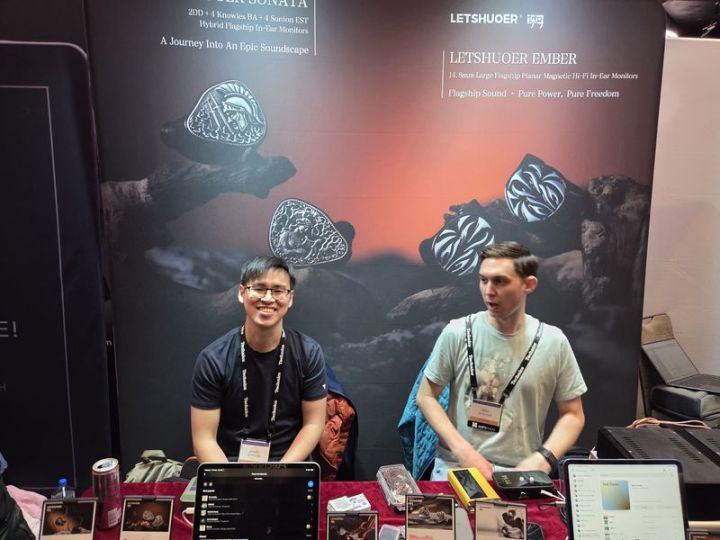
Starting with Sonata, which is one of their current top flagships at $2.3k, with a tribrid design of 2xDD, 4xBA, and 4xEST drivers, someone referred to it as “formerly known as EJ10”, so I wasn’t sure if this was an updated release or the official release under the finalized name. These had a pretty decent, big expanded soundstage with a holographic level of imaging, W-shaped clear detailed tuning, deep punchy bass with more emphasis on sub-bass lift, strong punchy mid bass, close to neutral lower mids with a touch of body, natural, detailed, layered mids that were infused with air from treble, and a clear, crisp, airy, extended, and still non-fatigued treble.


While waiting to hear the Ember, I was suggested to listen to their “budget” $189 pair of Astralis, 15.5mm 5th-generation PMD driver IEMs. I was pleasantly surprised to hear a warmer, bassier tuning with clear, natural mids and very clean, detailed treble. It didn’t have the biggest soundstage, focusing more on depth than width, creating an intimate sound presentation. Overall, a very nice, laid-back sound tuning, something that surprised me considering its PMD driver config, where other IEMs usually sound brighter up top.


It was a good idea that I heard Astralis first, since it made me appreciate the Ember more, their $499, 14.8mm PMD driver collab release with Effect Audio. I also hear it as warmer-tuned IEM, with a bassier sound presentation of deeper sub-bass, softer, rounded mid-bass, and warmer, fuller-bodied mids, with improved detail retrieval relative to Astralis, and more sparkle in the treble. The soundstage opening was also wider and more expanded than Astralis. It has a higher-end cable, but overall, it sounded like a step up from Astralis. Either one is great, especially for those looking for PMD driver IEMs on a budget and preferring a more natural tuning.


Lunch Break.
Talking about the lunch break became a tradition in my reviews, especially after my first CanJam in 2017, when I discovered a buffet on the 8th floor of the Marriott Marquis Hotel’s Broadway Lounge, which made me feel like I was on a cruise. Now, it is “traditional” for me to reminisce about that time, since Marriott dining services decided to cancel it after the pandemic. They still have a continental-style breakfast buffet, but not during lunch. The buffet lunch is not coming back, but I still like to bring it up in my reviews 😀


I know, with such an overwhelming selection of NYC food choices, why not go outside? Aside from wandering around to get an overpriced yet still delicious slice of pizza or a burger, the whole thing is time-consuming. When you are visiting the show for just one day, every minute counts, literally. Thus, taking the escalator to the 8th floor to catch a short lunch break with a delicious smash burger and fries makes more sense to me. Plus, I was able to rest my ears and charge my phone so I could get ready for more pictures and note-taking.

Page 1 – Intro and Overview of the Showroom.
Page 2 – Effect Audio, Melodic Artification, Mysticraft, Dita.
Page 3 – Bloom Audio, Final Audio, Letshuoer, Lunch Break.
Page 4 – Eletech, Forte Ears, Volk Audio, Hidizs, oBravo.
Page 5 – A&K, Moondrop, Faith Audio, Audio-Technica.
Page 6 – Musicteck.
Page 7 – Final thoughts.

 Twister6 Reviews