
Eletech
As I always say, the Eletech booth display is a work of art, just like their products, and its presentation is hard to miss at any CanJam. While I’m familiar with NYC shows in person, I have seen pictures of their tables at other shows, and they capture your attention regardless of whether you are a cable believer or not. And you will find in there not just the cables and interconnects, but also their highly regarded Baroque eartips, IEMs (their special projects like Mona Lisa IEMs collab with Canpur), and premium leather cases. Plus, it is always a pleasure to talk to Eric, one of the main guys behind Eletech, to catch up with the latest developments, prototypes, and the never-ending audiophile gossip around the world. Just like me, Eric hasn’t missed a single CanJam NYC show yet.
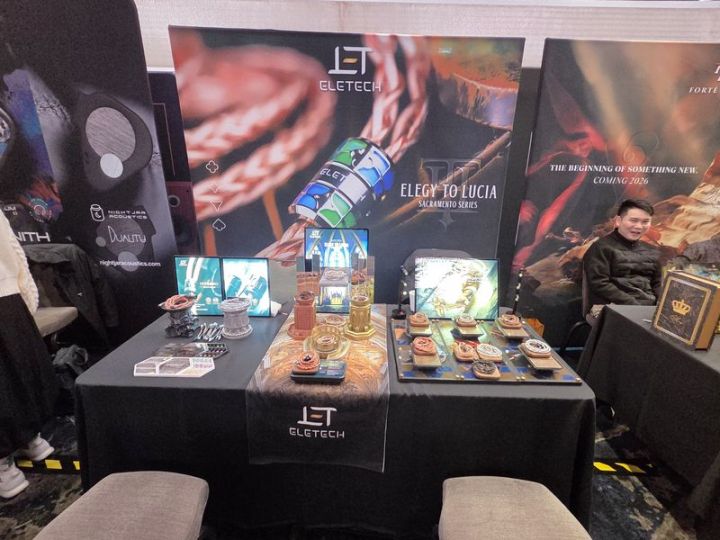
There were a few highlights at their tables, including their latest “work of art,” the flagship Elegy to Lucia cable release from their new Sacramento Flagship Series, limited to just 88 pieces worldwide, in which they sought to combine fine jewelry artistry with premium wire craftsmanship, reflected in its $6.5k price tag. Ironically, some people choose cables to complement the look of their IEMs, while here I have a feeling it could be the other way around. According to Eletech, “… every piece is finished with meticulously machined hardware, crafted through a complex CNC process using 0.2mm tooling, followed by hand‑applied Japanese enamel and gemstone detailing.” And in terms of the wiring, they combined two different cable systems into a single 8-wire configuration: 4W Gold-Silver-Platinum-Palladium Alloy, OCC Copper ‘A’, SPC/Copper Shielding, and 4W Gold-Silver-Platinum Alloy, Gold-Graphene Copper, OCC Copper ‘B’.
I had a chance to hear Elegy to Lucia before the show, the finished cable wire design without the jewelry-encrusted and painted cable hardware. Especially tested with more neutrally tuned (Jewel) or reference-tuned (Traillii Ti) IEMs, it enhances the sound with a rich, textured tonality compared to other flagship cables, highlighting a smoother yet still revealing sound presentation in the upper frequencies without making it harsher. The cable strikes a perfect balance between textured, smooth musicality and brighter, revealing tonality, creating a naturally revealing sound enhancement.
Another highlight at their tables was on the other side of the price spectrum: a set of new cables that looked way more premium for the price, as they were yet to be announced. Relative to testing with Jewel:
Copper – featured very clean, tight, elevated bass, more revealing upper frequencies, and added air in treble. It creates a fast, energetic sound and further expands the soundstage.
SPC – had a more balanced tuning, with more emphasis on upper mids and vocals, adding warmer sub-bass extension, and pushing the soundstage to expand wider and taller.
Copper with a Tin plating – this one surprised me a lot, with very impressive low-end enhancements, especially in sub-bass texture; also improving mid-detail retrieval in a very natural way and expanding the soundstage to a more holographic level. I was very impressed with this cable’s performance and kept recommending it to the people sitting next to me.


Before leaving the table, I noticed a 3D-printed chassis of something that looked like an amp module. Eric shared with me their upcoming project: designing a solid-state, balanced, portable amp, and he brought a prototype to the show to gather feedback. Based on what I heard, it had a warm, smooth tonality and a very clean, laid-back sound presentation. If I didn’t know it was a solid-state amp, I would have guessed it was a tube amp in a blind test because it sounded smooth as butter, adding texture without a hint of distortion. Obviously, it is still a work in progress, but it sounded quite promising and definitely unexpected from Eletech.


Forte Ears
A 2024 newcomer that ended up being “crowned” last year (2025) with the Watercooler award was Forte Ears Macbeth. And this year, Riccardo was crowned again, for his follow-up Mefisto release. The company was founded by Riccardo Yeh, a former International Sales Director at HIFIMAN, who later assumed the marketing role at Eletech and then channeled his love for Western opera and his passion for music’s emotional impact into his own IEM brand and Macbeth and Mefisto releases. Continuing the tradition of pre-release prototype teases, this year Riccardo brought the “V” prototype, with a mysterious banner behind him featuring a quote from La Traviata, Act 3, “Addio Del Passato”. I was told that this info contains a hidden clue to the name of his next IEM release, although I haven’t been able to guess it yet.

Whatever this new release is, I do not doubt that Riccardo is aiming for a threepeat. But for now, visitors to the CanJam NYC show had a taste of this upcoming IEM, with a tuning that I was told is not yet finalized. From what I heard, the IEM had a very smooth, natural sound with a rather balanced tuning. It had a deep, punchy, physical rumble bass, smooth, buttery, organic mids/vocals, and a clear, detailed, relaxed treble. I actually found the tuning to be quite eartips dependent, especially considering the shorter and slimmer nozzle. I can’t wait to hear the final release, and I’m glad to see that Riccardo diversified the tuning with a complementary tonality to his previous releases.


Volk Audio
Since the first CanJam NYC in February of 2017, I have seen Jack at every show, serving as the face of Empire Ears ever since it evolved from EarWerkz. Last year, right before the show, he surprised me by sharing that he is branching out and embarking on a new journey to start his own company, Volk Audio. Co-developed with Michael Graves, a five-time GRAMMY Award-winning sound engineer from Osiris Studios in Los Angeles, Jack and Michael decided to create a new set of IEMs, Etoile, designed as near-field reference monitors tuned to mirror the mastering environment of a sound recording studio.


Debuting around the summertime, Volk Etoile featured a mature 10-driver quadbrid design with 10mm DD bass, 4x BA mids, and 4x EST and 8mm Magnetostatic highs, priced at $3.6k. The debut release was a success, with a balanced sound signature and a natural, highly detailed tonality. However, unlike other balanced-tuned IEMs, Etoile did not attempt to be W-shaped. Instead, it strived to maintain a linear, balanced, engaging, fuller-bodied tuning with a surprisingly resolving and detailed natural tonality. Personally, I was pleased to see Volk Audio not as a side project of Empire Ears, but as a brand with its unique, mature sound tuning.
And while some were guessing about the follow-up to Etoile and the direction the tuning would take, Volk Audio surprised everyone by partnering with Astell & Kern on a collab release, Volk Audio x Astell & Kern Stella. This was not a recycled release; Stella was completely independent of Etoile and had a different quadbrid 12-driver design with a 6-way crossover: 9mm DD + 2x BA lows, 3x BA mids, and 2x Planar Magnetic + 4x EST highs. The shells were crafted from 6061-T6 Aluminum and 9H-hardness Sapphire Crystal glass, and featured an exclusive custom-designed premium cable with 5N LCOFC Copper, 4N Silver, and 24K gold, a 4.4 AEC plug, and a retail price tag of $3.9k.
In my brief listening to these IEMs, I found Stella to have a very large, open soundstage with 3D-level holographic imaging. It had a deep sub-bass rumble, fast, tight, punchy, tastefully elevated mid-bass, natural, detailed mids, and crisp, airy, and quite resolving treble. Compared to Etoile, Stella’s mids are more neutral, less colored, sound cleaner and more revealing, and the treble is also crisper. I actually found Stella’s tuning to be more complementary to Etoile, and I am planning to borrow it in the near future to spend more time with the sound analysis and measurements.
Overall, it was a little bittersweet to see Jack at the Volk Audio tables, even though a few weeks earlier, the audio industry had learned that Empire Ears was closing its doors.


Hidizs
From Sound to Story, that is how visitors were greeted at Hidizs’ booth during the CanJam show, along with Andy from AndyAudioVolt YT channel. In the last few years, Hidizs partnered with WDC (Whale & Dolphin Conservation), carrying a dedicated commitment to supporting and sharing knowledge about the critically endangered North Atlantic right whale. It’s more than just a marketing slogan, as Hidizs is actively contributing to their conservation efforts and has even designed the shells of their MP145 and new MP145 Pro with a faceplate resembling a whale-tale. But before jumping to hear the MP145 Pro, what caught my attention was their newly redesigned miniature AP80 Pro DAP, released as the Pro Max model (aluminum, $189; copper, $269). I have reviewed and closely followed many iterations of the AP80 palm-sized audio-playback DAPs, from AP80 to AP80 Pro and AP80 Pro-X, in a familiar, nearly square shape measuring 61.2 x 54.5 x 13.8mm and weighing about 70g. Now, it was “maximized” to the AP80 Pro Max, with a slightly more elongated, slimmer unit measuring 82.8 x 51 x 15.5mm and weighing about 80g.
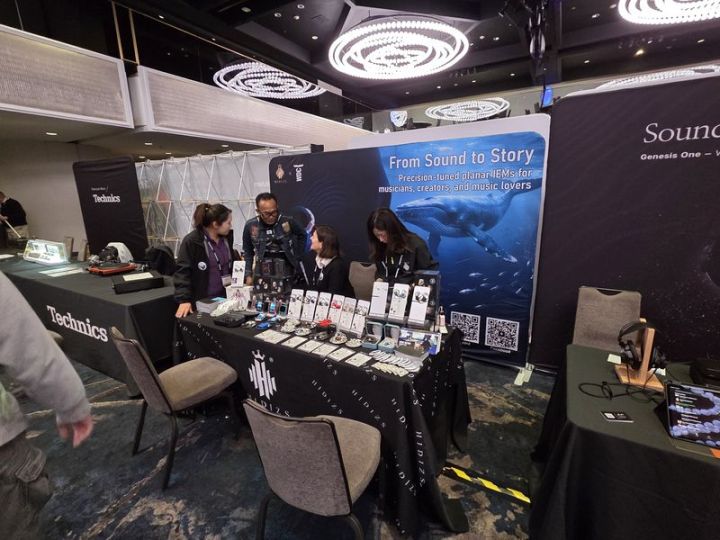
The exterior design of the Max has been improved with better ergonomics, fitting more comfortably in my hand, featuring a 2.95” (360×640) vs the previous model’s 2.45” (480×360) display, adding a 4.4mm BAL port instead of 2.5mm, featuring a new, faster X1600E processor, bigger 1300mAh (vs previous 800mAh) with a longer playback time, updating BT support to 5.1, adding 2.4GHz WiFi connectivity to support native (not Google Play) streaming from Tidal and Qobuz, as well as DLNA & AirPlay. The DAC remained the same as in Pro-X: dual ES9219C, with output powers of 70 mW, SE 3.5mm, and 190 mW, BAL 4.4mm, making it more suitable for IEMs and efficient full-size headphones.
Based on my quick sound analysis, including both Pro Max Aluminum and Copper versions, I can hear the following difference between these AP80 models:
Pro to Pro-X – Pro is a little warmer, less dynamic (more compressed sound), and has a slightly more intimate soundstage. Pro-X has a more neutral, less colored tonality, improved detail retrieval with a bit more sparkle in the upper frequencies, expanded dynamics, and wider soundstage.
Pro-X to Pro Max (aluminum) – the soundstage expansion is similar, but the imaging of Max is more holographic in the way it places the sounds in space. They both have a similar vertical dynamics expansion. Max tonality is similarly neutral, and even a bit crisper up top, with more airiness, which improves layering and separation of the sounds and helps extract more micro-details.
Pro Max Aluminum vs Copper – very similar technical performance, except the Copper version has a little more weight in bass with slightly more sub-bass rumble and stronger mid-bass punch, and also adds a bit more body and coloring in lower mids. Personally, I enjoyed the Copper version the most since it added more natural, musical flavor to the sound.
AP80 Pro Max Copper is my favorite among these AP80 DAPs.


There was also a newly introduced MP145 Pro model, featuring a 14.5mm Planar Magnetic driver with an all-new Ultra-Precision Nano-Grade design that delivers 40% higher magnetic flux, and priced at $169. MP145 Pro was introduced last month as part of the Kickstarter project and successfully funded within hours. In addition to a newly upgraded driver, it also features an updated housing design with a smaller-diameter nozzle (6.0mm vs 6.8mm), which works better with many eartips, and a slightly longer nozzle length for improved fit and extra comfort. Plus, the Pro version comes with a new 6N high-purity SPC 4-core braided cable with interchangeable 3.5mm and 4.4mm connectors.
Just like the original MP145, it comes with 3 types of nozzle filters, each with noticeable sound changes in MP145 Pro: silver enhances high frequencies for more analytical detail extraction, rose gold brings the mids more forward, and red boosts the lower end of the sound. When comparing MP145 and MP145 Pro with the same filter, I can hear that the Pro has a more complementary, revealing tuning, with a tighter, punchier bass, a more neutral body, and greater accentuation in the upper mids and mid-treble, which made the sound more revealing. I actually had to switch to foam (using Symbio F) eartips and a red (bass) nozzle filter on the Pro version to add a bit more body and a more natural tonality to the sound—just a matter of personal preference. Btw, Pro version comes with a large selection of different eartips, including new ‘Sea Anemone’ liquid silicone tips.


oBravo
It has been 7 years since I have seen oBravo at the CanJam NYC show. It was great to see David again, since I hadn’t talked to him in years, and he was beaming with pride as he talked about his latest iteration of the flagship RA release. For those who are not familiar, under the umbrella of Stymax International Co., from Taiwan, the oBravo was one of the pioneers of the first mass-produced PDM and AMT drivers. Since their start in 2006, oBravo spent the first 5 years working solely on R&D, then developed their own PMD and AMT drivers, and in 2015 and 2016 released the first mass-produced IEMs featuring miniature PMD and AMT drivers. R&D and manufacturing costs associated with custom in-house drivers are likely among the main reasons for the premium pricing, which crosses the $10k threshold for the RA flagship. And, sadly, while some other companies claim credit for it, as I already mentioned, oBravo was the first one to shrink and mass-produce Air-Motion-Transformer (AMT) drivers for IEMs.
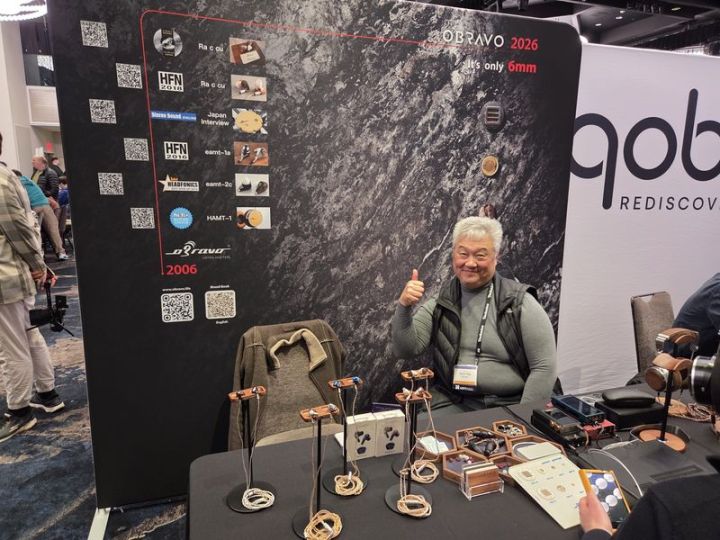
It seems that their flagship RA C Cu model has undergone some fine-tuning and is now at version 21.5. However, the driver configuration remains the same: a hybrid system with a 16mm neodymium dynamic driver and an 8mm AMT tweeter. It features a copper housing and an Acacia wood faceplate and includes a new premium, high-purity copper-and-silver-plated Litz cable, referred to as Newton Signature. One change in the 21.5 version was lowering the impedance from 182 ohm to roughly 168 ohms for better drivability without compromising detail retrieval. It is still a demanding IEM that requires a powerful source to reach its full potential, and David recommended the L&P EA4 portable amp at the table for listening to RA C Cu 21.5. Straight out of my P6 Pro, the sound was very fast, revealing, and micro-detailed. It had a fast, tight bass, clean, natural, colder mids, and crisp, airy treble. Adding the EA4 amp to the audio chain helps these IEMs gain more body without compromising micro-detail retrieval.


Page 1 – Intro and Overview of the Showroom.
Page 2 – Effect Audio, Melodic Artification, Mysticraft, Dita.
Page 3 – Bloom Audio, Final Audio, Letshuoer, Lunch Break.
Page 4 – Eletech, Forte Ears, Volk Audio, Hidizs, oBravo.
Page 5 – A&K, Moondrop, Faith Audio, Audio-Technica.
Page 6 – Musicteck.
Page 7 – Final thoughts.

 Twister6 Reviews