
Astell & Kern
It was great to see A&K back at the show with a multi-table booth, since they skipped last year’s NYC CanJam. This year, Jason, their well-known US representative and the person who answers support questions in every A&K thread on Head-fi, was joined by Leah of A&K and a few others, though most of my conversations were with two of them. The big highlight of their new product presentation was a PD20 DAP. The original PD10 was very well received, with a different design philosophy outside of their usual product lineup. Plus, that portable DAP (PD10) came with a docking station to bridge the gap between portable and desktop setups. One would assume that, following the history of A&K DAP releases, they would continue with small incremental fine-tuning steps toward the PD20 version. Instead, this new design took yet another different direction that no one even expected.
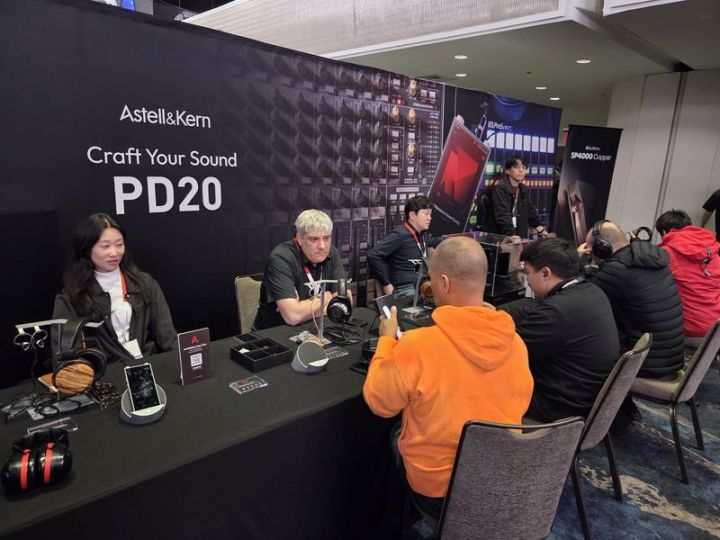
One of the highlights of the PD20 design is the Personalized Sound hearing test feature, which creates a custom sound signature tailored to the user’s hearing. This new feature was developed in collaboration with Audiodo, which is also well known globally for its customized audio solutions. PD20 comes with a pair of neutral reference IEMs that you can use for this hearing test, although you can use any IEMs. I had to run this test twice because the CanJam floor noise was overwhelming, and the second time, I was offered a pair of noise-canceling hearing-protection earmuffs to cover my ears/iems. The test lasted only 3 minutes, and I found it quite effective for comparing the sound tuning before and after the test.
Compared to the original out-of-the-box tuning, it was relatively neutral yet still very dynamic, with a huge expansion of the soundstage. After running the test, the bass was lifted tastefully, not overwhelming, but just with enough sub-bass rumble and tactile mid-bass punch. The mids remained largely unchanged, but the treble was infused with more non-fatiguing energy, which improved the layering and separation of the sound and noticeably enhanced detail retrieval. The overall technical performance was on par, but the sound tuning did improve. It has to be related to Audiodo’s precise equalizer algorithm. Many audiophiles tweak the sound to perfection with EQ, such as the semi-parametric EQ featured in A&K DAPs. But here, it wasn’t a random adjustment. Instead, it was a 3min test which created a custom sound profile which I found quite good. And, it was actually graphed on the screen, showing you a custom sound profile adjustment relative to the baseline FR.


On top of that, another highlight of the PD20 design is a second wheel, referred to as the Sound Master wheel, which is one of the key elements that integrates with the aforementioned Audiodo EQ. You push the wheel to select among the Bass, Middle, and Treble bands, then turn it to micro-adjust that band in 160 steps, from -8 dB to +8 dB. When you access the Custom EQ setting, you can select the adjustment frequency for the Bass, Middle, and Treble bands, as in a Parametric EQ setting. Once you select those 3 fundamental frequencies in the settings, they are assigned to the Sound Master wheel’s 3 frequency bands, whose gains you can adjust with the wheel without access to a touch screen. I have to admit, it felt like being a kid playing with a high-tech toy, putting you in control of the sound adjustment. I mean, you can make the same adjustment on the EQ screen, but it was more fun to push and turn the hardware wheel.
Other features of the DAP included the high-performance ESS ES9027Pro DAC, configured in a quad-DAC independent-operation configuration. Then there is a triple-amp architecture with Class A, Class AB, and Hybrid modes. The amp control was even selectable from the side of the DAP, a slider switch between A/AB/H, so you don’t even need to access settings from the display. The difference between A and AB was noticeable while listening to PD20, with A being warmer and AB delivering a tighter, faster sound rendering. On top of that, when you are in Class A, you can adjust the current, switching between high, mid, and low modes, which also makes a noticeable difference in tonality. The Class A current adjustment was also accessible via a hardware slider switch on the side, so you could control it without turning on the PD20 display.
Overall, the DAP was a relatively light, aluminum chassis at 310g, a nice 6” high resolution display, and apparently the BAL output with a max 10Vrms output level. Plus, it comes with Advanced DAR (Digital Audio Remaster), introduced in their flagship SP4000. I was also quite surprised that it will be priced under $2k. I’m definitely looking forward to spending more time with this unit whenever I get a chance to review it.


Moondrop
While I personally don’t have as much experience with them, I’m still familiar with the Moondrop brand and featured them in my CanJam NYC report last year. It was nice to see them back in NYC this year, though someone mentioned to me that Moondrop, along with several other chi-fi brands at the tables on the right side of the Broadway Ballroom, was part of the Shenzhen Audio product presentation. As far as I can tell, this was their 2nd NYC CanJam. Two newer IEMs at their tables caught my attention, and I would like to cover them here.
The first one was Armature Art 12, a new model priced at $500+, featuring a 12xBA config with 4x BA lows, 4x BA mids, and 4x BA highs. It came with its own USB-C cable, using which with my smartphone yielded a big, expanded soundstage, a bit center-focused imaging; fast, punchy mid-bass, deep sub-bass extension, with more emphasis on mid-bass punch; neutral lower mids, neutral, natural, detailed upper mids; clean, detailed, non-fatigued treble. With my PWA FT cable, since there were no other balanced cables available at that moment, the bass is slower, the sound is more laid-back and smoother, and the soundstage is more intimate. Looks like there is a cable pair-up dependency, or maybe the USB-C cable had some DSP sound profile setting, but it sounded pretty good with the USB-C cable alone, used straight from my S25 Galaxy phone.


Another one was the Meteor, also priced around $549; these tribrid IEMs featured DD, 2x BA, and 4x Planar drivers. I hear this IEM as having a big holographic soundstage expansion; clean, natural, resolving sound tuning. Very tight, deep bass, natural, detailed mids (very clean, resolving, layered, and natural). Extended, detailed, non-fatigued, very clean treble. Overall, Meteor had a W-shaped tuning. I found the shells protruded a bit from my ears, and the nozzle would have benefited from a lip at the tip, but overall, it was a very impressively tuned IEM.


Faith Audio Labs
Faith Audio was a new brand I wasn’t familiar with, but I’d heard a lot about it before the CanJam show, since there was a tour of their IEMs with people sharing impressions in the Watercooler thread. Curious to hear how it sounds, I was glad to find their booth at the show.
Their E1000, priced at $3.8k, features a 10.2mm Full-Range DD driver with a Passive Radiator and comes with a high-purity OFC cable. Tested with my P6 Pro, I hear the soundstage to be wide, not super wide, but above average, and what I consider naturally expanded. The overall tuning was neutral and clean, with sub-bass attenuated and a greater emphasis on tight, articulate, punchy mid-bass. Mids were very clean and resolving, with minimal coloring and a rather neutral body, and the treble was also clean, crisp, non-fatiguing, and tolerable to my ears, which are more sensitive to lower-treble peaks.


Next to E1000, there was U1000, a premium $8k release with a similar 10.2mm Full-Range DD driver, a Passive Radiator, and a higher-end gold-silver alloy cable. Despite a similar on-paper driver setup, this IEM had a noticeably larger soundstage, almost wrapping around your head with more holographic imaging. The tuning was more revealing than E1000, with more analytical extraction of micro-details, a colder tonality, and noticeably brighter, crisper, airier treble.
U was too revealing for my personal preference, and while at their table, I noticed others listening and comparing the two, preferring E as well. I thought the bass response was similar across these two, with a rolled-off rumble and more emphasis on mid-bass punch. What really sets them apart, aside from the price difference, is that the E1000 is more neutral, while the U1000 is much more revealing up top. Also, E1000 had just a “plain” Titanium shell, while U1000 was designed as a luxury statement piece, from the shell to the cable.


Audio-Technica
As I often bring up, I usually focus on portable audio gear when visiting CanJam, such as IEMs and DAPs, but some full-size headphones catch my attention. As many are aware, I don’t have much desktop equipment at home, and the few pairs of headphones I have access to are used in my DAP reviews to see if they can handle harder-to-drive cans. One such pair is the ATH-R70X, which has been near and dear to my heart for the last 10 years and has been featured in dozens of my reviews due to its low sensitivity (<100dB) and high impedance (470 ohms) design. Last year, I was excited to learn about the updated ATH-R70XA, which celebrated its 10th anniversary with an updated headband design and refreshed tuning for its large 45mm DD driver, while still priced at $350. Its tuning has shifted more toward the revealing-reference side, especially with more neutral lower mids and more revealing upper mids. To my surprise, when I gave them another try this year, they sounded a bit smoother up top. I’m not suggesting that the sound gained more body, but it just sounded smoother, maybe due to more burn-in or changes in the earpads (those get broken in as well).
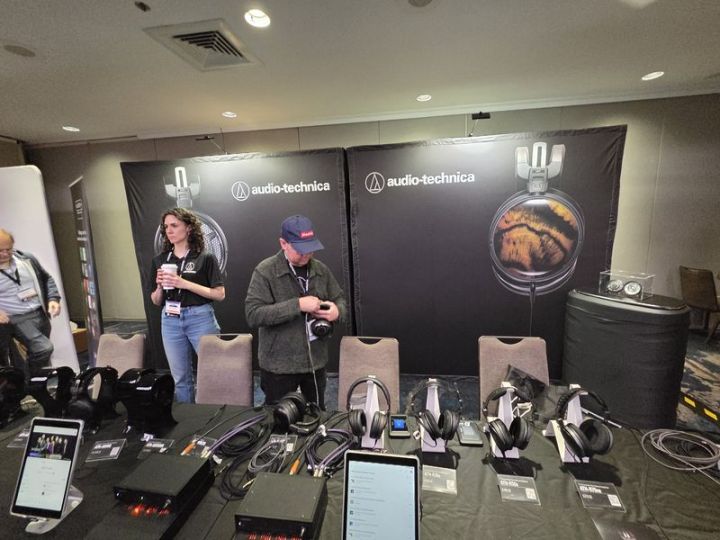
The highlight of Audio-Technica’s tables this year was their newly released flagship model, ATH-ADX7000, open-back open-air flagship caliber, $3.5k headphones, with a 58mm DD driver, a lightweight magnesium frame, two sets of earpads: high-density velvet and Alcantara, A2DC connectors, balanced 4-pin XLRM and SE 6.3mm cables, and the spec of 490-ohm impedance and 100dB Sensitivity. Despite their higher impedance and lower sensitivity, I had no issues driving these straight from the P6 Pro, though, as expected, I had to raise the volume. I found them to have a big, open-back soundstage and a balanced W-shaped, very detailed sound tuning. They had a fast, punchy bass that was very tactile and precise. Neutral natural mids/vocals, slightly pulled back in their presentation, but still very clean, detailed, and natural. Their crisp, snappy treble sounds revealing, but not exaggerated or fatigued. One important thing to note is that the mids were closer to neutral with default velvet earpads. When I switched to Alcantara earpads, I heard more body in the mids (lower mids), and the bass became more rounded and deeper. The sound with Alcantara earpads is more natural, smoother – what I personally preferred and enjoyed with ADX7000.


Page 1 – Intro and Overview of the Showroom.
Page 2 – Effect Audio, Melodic Artification, Mysticraft, Dita.
Page 3 – Bloom Audio, Final Audio, Letshuoer, Lunch Break.
Page 4 – Eletech, Forte Ears, Volk Audio, Hidizs, oBravo.
Page 5 – A&K, Moondrop, Faith Audio, Audio-Technica.
Page 6 – Musicteck.
Page 7 – Final thoughts.

 Twister6 Reviews