
Musicteck
As I say every year, and continue to repeat, CanJam NYC can’t be complete without Musicteck, which has established itself as a regular at the show, making it its 7th NYC appearance, though they are also becoming regulars at SoCal and Dallas CanJams as well. With dozens of products across 5+ tables, they cover a ton of IEMs, DAPs, cables, portable DAC/amps, and dongles. They are also the exclusive US distributor to well-known and rare manufacturers, some of which you can’t even get outside of Asia. This year, Musicteck showcased 100+ products from 40+ brands, and continued to surprise everyone with special-edition and collaborative releases exclusive to their store.


At the CanJam NYC ’26 show, they had current and upcoming IEM releases from Unique Melody, qdc, Alpha & Omega, Volk Audio, PMG Audio, Nostalgia Audio, Oriolus, AME, Aroma Audio, Hisenior, EarAcoustic Audio, Jomo Audio, BGVP, Campfire, Canpur, Elysian Acoustic, Empire Ears, FlipEars, Forte Ears, Kinera, Lime Ears, Melodic Artification, Meze Audio, NGaudio, Noble, Quill Acoustics, Rhapsodio, Softears, Thieaudio, Timsok, Simphonio Audio, Luxear, Palavox, Artpical, and Vision Ears. You can also find DAPs from EvoAria, Shanling, A&K, ONIX, NiPO, Cayin, Lotoo, Hiby, and Luxury & Precision. And there were plenty of cables from PWA, Astral Acoustics, Beat Audio, Brise Audio, Effect Audio, Eletech, HanSound, Vortex, Vast Audio, and Flash Acoustics.
It goes without saying that their booth gets overwhelmingly busy, with people sitting and standing around both sides of the tables. It’s also the place where you can find most of the Watercooler crew hanging around throughout the day, with some (as I heard it last year) continuing to jokingly refer to Andrew as their “dealer” who gets them a fix for their audio addiction. I can’t physically audition everything at the Musicteck tables, so I often ask to borrow some products for a few days after the show. I’m also aware that some people end up going to the SoCal and Dallas shows to hear IEMs and DAPs they missed, especially since the Dallas show is usually less hectic.


Many people still gather to audition the famous Brise Audio FUGAKU. At the same time, this year Brise Audio surprised everyone with their upcoming tri-brid “standalone” IEM, code-named BEP-001, which was later revealed as the IBUKI (a 9-driver, 5-way design with 2x DD, 5x BA, and 2x EST drivers). I had a chance to spend a few days with BEP-001, which is based on a modified IEMs design from FUGAKU with a detachable cable, and I was very impressed with its holographic imaging, deep, visceral bass, natural, detailed mids, and a naturally resolving, clear treble. The final version of IBUKI is just around the corner, with a slightly updated high-quality titanium shell, P-ear connector, and even a slight tuning update, which I can’t wait to test as well.
For the fans of “The Bird”, Oriolus Traillii, who can’t wait for v2 update, Oriolus surprised everyone with their complete audio system, called Traillii Ultra. This system includes IEMs (14-driver design with 4x BA lows, 4x BA mids, 2x BA & 4x EST highs), cables, and an amplifier, and also features a custom, replaceable cable. I wasn’t sure whether this would be Oriolus’ version of FUGAKU. Still, it turned out to be a different design concept: a unique headphone amp with a 3-way, 32-bit DSP-driven digital crossover that splits the audio signal and then processes it in the analog domain, using a 12-channel amp. I also think that its independent gain control of lows/mids/highs was a great idea. However, I found it more useful for boosting bass, with other controls adjusted in compensation, depending on the pairing synergy with various sources. Yes, you still need to connect it to a DAP or a DAC. Nevertheless, Traillii Ultra had a huge 3D holographic soundstage expansion, a very powerful bass response, even for a BA driver that sounds like DD performance, highly resolving musical mids, and clear, crisp, natural treble.
Brise Audio and Oriolus were not the only ones with an audio system design. Joining them was the Aroma Audio Core audio system with a properly matched amp “dongle” with integrated cable, terminated with 2pin connector and a 4.4mm BAL plug. The amp portion of the Core can be used with any other 2pin IEMs, and it does make the Core IEMs (2x DD, 6x BA, 6x EST) come alive with a very big, open soundstage expansion, textured bass, fuller body, natural, detailed mids, and energetic, non-fatigued hi-res treble extension. Again, Aroma was not trying to be another FUGAKU, but rather to come up with something different, using a small, dongle-sized in-line amp to match and elevate the performance of their IEMs properly. For those wondering whether Core tuning leans toward the Jewel or Fei Wan IEMs from Aroma, it is closer to Fei Wan, though it still boosts its bass performance.
Going back to more “traditional” IEMs, I was eager to try the new UM Mest Fortune, featuring a very impressive quad-brid design with DD, 4x BA, 2x EST, and 3x BCD. I have been following Mest releases closely and have always been curious about their next iteration. I didn’t expect the soundstage to be on such a 3D holographic level, expanding in all directions when I first put these in my ears. The tuning had a mild U-shaped sound signature. Still, it stayed quite balanced, carrying a deep, extended rumble, a more rounded punch, neutrally natural, textured mids that were also quite layered and micro-detailed, and revealing mid-treble sparkle, with lots of air and clarity and zero harshness. When I was listening to Fortune, it felt like UM took the best of their Jet Black (deep textured rumble, natural detailed mids) and Maven II Cresent (immersive 3D soundstage and high-res treble) tuning and combined them into one pair of ear-jewels, going back to the eye-candy shell design of Indigo/Mest MK3.
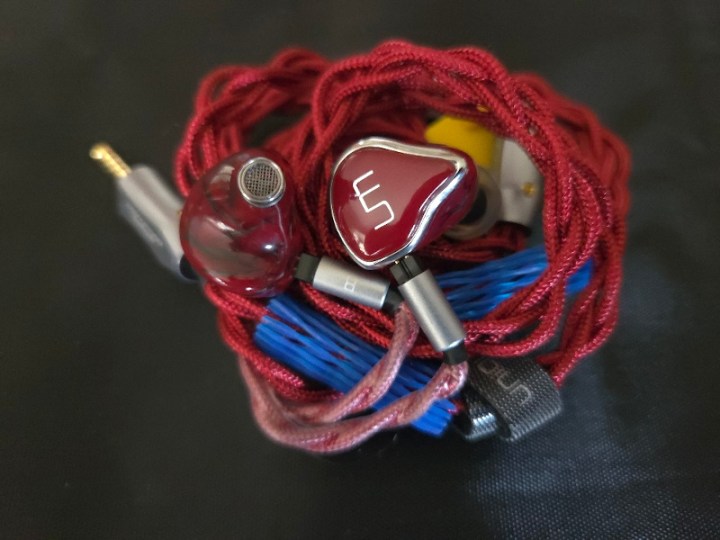
Another product that generated a lot of buzz was Evo One DAP by EvoAria. I had a chance to spend a few days with it before the CanJam, and it’s a very advanced, fast Android DAP, just like your Android smartphone without a “phone” part. The DAP has a ton of sound-shaping options, including pure-transistor and hybrid transistor/Tube modes, tube timbres, vacuum-tube voltage settings, various power-output modes, gain settings, amplifier types, different circuit feedback, etc. And if that wasn’t enough, it comes in Ti and Cu versions, not cosmetically different but actually with a different tuning, with the Ti version able to go from neutral to warm in many incremental steps, and the Cu version able to go from warm to syrupy warm in many incremental steps as well due to all the tuning options. Around the Musicteck tables, I heard quite a few discussions about which one people would prefer, although it will all come down to pairing synergy with your IEMs or headphones.
I noticed so many other new IEMs I didn’t get a chance to test, but heard others talking about at Musicteck tables. There were new flagship releases from QDC Crave, BGVP Wukong (looked like a piece of art), and Palavox Dark Night. Quill Acoustics debuted their new Karma IEMs, Moritz introduced Aura, and I also spotted Hisenior IEMs at the Musicteck table, including their new Mega 7. The Hiby RS8II is not new, but it’s still a very impressive, latest flagship release from them that many were curious about. Another widely discussed DAC/amp was the Lotoo Gungnir, which I heard has a very natural, smooth, fuller-bodied, musical tonality, outputs up to 8.5W (32 ohm), and costs half as much as their previous Mjolnir flagship.
Last but not least, I discovered a new brand that Musicteck added to its catalog – EarAcoustic Audio. Actually, I discovered that brand right before the show when I borrowed some of their IEMs for a few days, skeptical given their budget-level price, and then realized how good they were tuned and how cool their shells looked. Very briefly, Genesis G318S ($249, DD) – found it to have a nicely balanced tuning with a natural, musical tonality; really enjoyed its elevated sub-bass rumble, fuller-bodied mids, and less aggressive, natural-tonality treble. Audio Mix9 ($399, DD/4BA/4 MicroPlanar) – these had a more reference-like U-shaped signature with neutral tuning, emphasizing sub-bass rumble and upper mids, and sounded especially great with vocal tracks. Golden Snake II ($549, DD) is also a rather balanced reference signature, with a natural, resolving tuning that was very clear, with little coloring and plenty of transparency. VSA-PM Crown ($899, Planar Ribbon diaphragm), these had a more revealing tonality, very clean, detail, V-shaped sound sig, with higher resolution treble. Their Fortuna F718S ($1.3k, DD) is their most expensive flagship release, with nicely balanced tuning and a warmer, fuller-bodied tonality that remains very resolving and detailed.


Page 1 – Intro and Overview of the Showroom.
Page 2 – Effect Audio, Melodic Artification, Mysticraft, Dita.
Page 3 – Bloom Audio, Final Audio, Letshuoer, Lunch Break.
Page 4 – Eletech, Forte Ears, Volk Audio, Hidizs, oBravo.
Page 5 – A&K, Moondrop, Faith Audio, Audio-Technica.
Page 6 – Musicteck.
Page 7 – Final thoughts.

 Twister6 Reviews