
Sound analysis.
Before jumping into sound analysis, I left HD668B on burn in for about 100hrs, making sure their dynamic drivers are properly conditioned. Honestly, I didn’t have too high expectations for these, still being a bit skeptical due to the low price. As a result, my surprise was more shocking when I discovered HD668B to be tuned with a tasteful V-shaped full body sound signature and warm detailed tonality.
In more details, I hear a deep low end impact, down to a textured sub-bass rumble and a tight mid-bass which has a bit of a hollow punch. The bass is rather well controlled, articulate, and there is no spillage into lower mids. The lower mids have a nice full body, but there is no muddiness or congestion, while upper mids are clear and detailed with an organic presentation of vocals – not too much upfront, just pushed a little back due to an elevated low end. Treble is surprisingly crisp and detailed, with a good extension, and some nice airiness which helps with layering and separation of instruments and vocals and contributes to higher resolution of the sound. If I have to nitpick, perhaps upper frequencies have a little shade of metallic sheen, but it wasn’t that bad especially when you pair up with different sources.
Soundstage has a good expansion in width, not super wide but definitely way above the average. The depth is not too far out, but you still feel like a few rows in front of the stage, giving a soundstage perception of spreading left/right around you without going too deep. Layering and separation was surprisingly good due to well controlled low end which keeps the sound clean from muddiness without spilling into mids and extra sparkle in treble which adds some air between the layers of the sound.
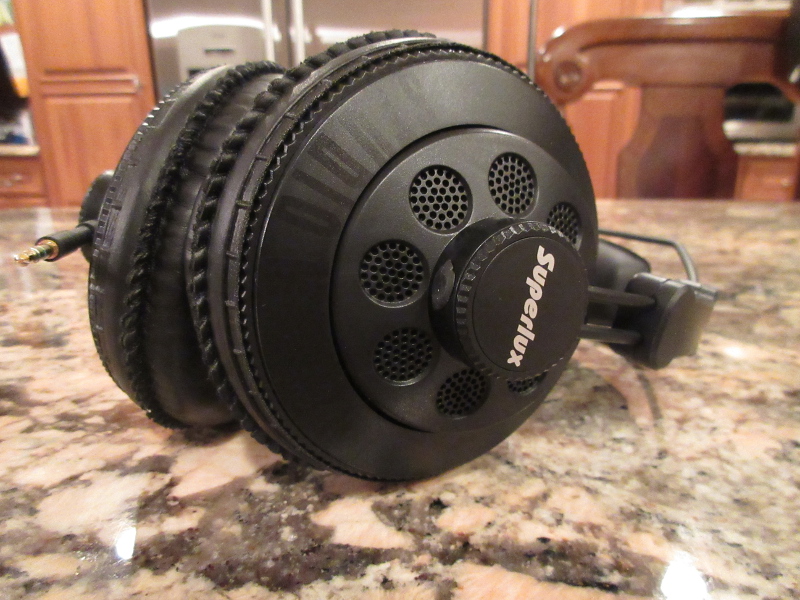
If you are looking for a good isolation, these are definitely not the best for listening on the bus or in the library, after all – this is a semi-open design. But it wasn’t leaking as bad when you step away 2-3ft. I’m sure some will find this semi-open design even beneficial since it could raise the surround awareness without losing too much of the sound details.
Sound comparison.
Considering 98dB sensitivity and 56 ohm impedance, I found HD668B to be a little less efficient in comparison to my other headphones, and as a result I had to push the volume a little higher. Also, it’s clear that more expensive headphones have an edge in build quality and material selection.
HD668B vs ATH-MSR7 – HD soundstage is wider, while MSR7 has more depth. HD has a deeper sub-bass and a little stronger mid-bass, while MSR7 has a more balanced low end. I also noticed that HD has a little faster attack of the mid-bass while MSR7 is a tad slower. Lower mids are similar, while MSR7 upper mids are more forward, balanced, and a little brighter in comparison to HD. I hear treble as being similarly crisp and well defined, though MSR7 has a little more airiness and a better extension. Overall, the biggest difference here is a more balanced signature of MSR7 versus lifted low end and slightly recessed mids of HD.
HD668B vs ATH-M50x – HD soundstage is wider, while M50x has more depth. HD has a deeper sub-bass while mid-bass is similar, perhaps with HD having a bit stronger impact. Mid-bass speed is also similar. Lower mids are very similar, while upper mids in M50x are more balanced and more forward in comparison. Also, M50x upper mids are a little smoother and a touch warmer. HD treble is crispier and has more airiness in comparison to a smoother M50x treble. While I enjoy M50x comfortable fit for extended listening on my laptop, here I actually preferred the sound of HD.
HD668B vs SoundMagic HP150 – HP150 soundstage comes closer to HD width, but not quite there, and HP150 has a little more depth. Also, HP150 sub-bass reaches deeper to the same level as HD, but a little shy of HD quantity, and mid-bass in HP150 is a bit lower in quantity as well. HP150 lower mids are leaner and upper mids are a little more upfront and brighter with an advantage of slightly improved retrieval of details. Treble is rather similar, being crisp, bright, snappy, and with enough extension and airiness to make the sound more resolving and layered. Actually, after closer listening I hear HP150 being a little brighter in upper mids/treble.
HD668B vs Oppo PM3 – HD has more width and both have a similar depth. HD has a deeper sub-bass extension and faster mid-bass punch with more impact. PM3 mids sound more congested in comparison to HD, though they are more forward in presentation. Actually HD upper mids are brighter and more detailed and the treble is crisper, better defined, and with more airiness. PM3 has a very smooth laid back sound while HD has a faster punchier brighter and more detailed sound.


Pair up.
Note 4 – Pretty good pair up, though have to push volume closer to the max. The sound becomes more balanced with a little less impact in mid-bass and a softer sub-bass. But mids are still detailed and treble still has a great extension. I also found upper mids/treble to sound a little brighter. Good soundstage expansion.
LPG – here you will find a great transparent sound, deep extended sub-bass, punchy mid-bass, clear and detailed mids, crisp and airy treble. Soundstage had an impressive width. It was a great pair up, and I enjoyed the sound quite a bit, definitely giving HD668B giant killer stamp of approval while driving this pair of $35 headphones from this $2k source.
DX80 – I found a surprisingly balanced sound with mids a little more forward instead of pushed back, but I think this balanced sound sig change was due to sub-bass and mid-bass being scaled back a bit. Very clear and detailed sound, upper mids are a bit thinner and vocals were not as organic anymore, treble is crisp, clear, and airy. Soundstage was wide.
X7 w/AM2 – in this pair up I found sub-bass and mid-bass scaled down a bit, making the sound more balanced. But it also felt like upper mids came a little more forward. In addition, the bass was tight and punchy, clear detailed mids with plenty of body, and crisp airy treble. Soundstage was wide.
L3 Pro – here the signature was back to v-shaped, with a good sub-bass extension and a nice rumble, and tight punchy mid-bass with a decent impact. Lower mids have plenty of body, and uppers mids are clear and detailed but also a little harsh with a metallic texture and a touch of sibilance. Treble is crisp, airy, extended. Soundstage was wide.
AK120ii – in this pair up I found a little bit less sub-bass, still tight punchy mid-bass with a bit of a polite quantity, lower mids had natural full body and upper mids were a little thin, bright, and quite detailed. Treble is crisp, airy, extended. Upper frequencies have a bit of a metallic sheen. Soundstage expansion was pretty good.
Conclusion.
I’m starting to notice a pattern where many of my “giant killer” discoveries happen by accident, when I’m not even looking for another budget pair of headphones and instead just asked to try something new for fun. Did I get spoiled by flagships? It’s hard not to, and I’m being honest about it. But sometime it’s refreshing to take a step back and to listen to these amazing gems that cost so little. From $5 Monks to $10 KZs and now $35 HD668B – these are all amazing discoveries that show you how creative a manufacture can get by challenging themselves to squeeze every ounce of performance and sound tuning on such a small budget. HD668B is a real deal Giant Killer, and either if you are on a budget or just want to humor yourself with another budget discovery – I have no problem recommending these semi-open full size headphones because they don’t just look cool and ready for modding, but they also sound great!

 Twister6 Reviews
Hello Sir!
I purchased these based on your excellent review but wondering how do you tell if it’s the original or 2016 version?
Thanks,
LS
LikeLike
If you got these now, I’m sure these are the latest.
LikeLike