

Sound analysis.
With OSV3 being a hybrid, I decided to let it burn in for about 100hrs before getting into a detailed sound analysis. I did briefly listen to them out of the box, and felt the sound was a little thicker before the burn in. It’s hard to go by memory, especially when changes are not as drastic, but after 100hrs of standalone burn in while playing a random song in a loop, I felt the sound opened a little bit, becoming more transparent, less congested.
In terms of tonality, OSV3 has a well-executed natural tuning with a mildly v-shaped signature where in my measurements and a sine sweep I found a little dip around 1kHz. The sound has a fuller body with an organic tonality, yet still very clear and detailed, just not too revealing or layered. Layering and separation is more on an average side, but the sound never gets congested or muddy, always under control with surprisingly good retrieval of details and a decent resolution of the sound. I was definitely impressed with a natural tonality of this IEM tuning.
I found OSV3 soundstage to be above average, not very wide in a test with many portable sources, except for SP1000 SS which turns anything into holographic soundstage where OSV3 had no problem scaling up. The soundstage depth extends further, but not too far out of your head. Positioning of instruments was relatively accurate, though I found them closer to the center. With some IEMs I tested in the past, this could affect the accuracy of imaging, but it worked OK for OSV3.
Now, for a more detailed analysis.
Starting with bass, these iems have a good low end extension, with a deep rumble that has a velvety texture. Mid-bass is average speed, not too fast or too slow, with an elevated impact but nothing overwhelming to be considered on a basshead level. Bass does have a little longer decay, giving lower mids more body, but still under control never muddying the sound. Overall, it’s a typical dynamic driver performance with an elevated quantity and analog DD quality, not as fast or articulate as you would find in BAs.
Lower mids have a nice body, above neutral and with enough control to give a smooth transition of bass into mids. Upper mids have a natural organic tonality with plenty of clarity and good retrieval of details, though obviously don’t expect it to be on a micro-detailed level. Here, organic doesn’t mean warm or smooth, but rather a more natural non-fatigue timbre which comes through shining especially with male and female vocals.
Treble has a good level of sparkle, but not too much crunch and reserved airiness. It’s enough to give the sound a good definition and at the same time to avoid any sibilance. It’s not exactly rolled off, just moderately tuned. Coincidentally, prior to receiving OSV3 2pin version, I had a chance to hear their early mmcx based model, and that one had a tuning with more forward upper mids and a little more crunch in treble. This new tuning is smoother and more natural to my ears.


Comparison.
In the following comparison, I tested OSV3 against a handful of IEMs using a more neutral Plenue 2 and a warmer WM1Z as my sources to get a better idea how they compare, while also making sure the volume is matched.
OSV3 vs Simgot EN700Pro – EN700 soundstage is a touch wider, while OSV3 has a more intimate stage feeling. Overall tonality of OSV3 is warmer with a fuller body and more v-shaped signature while EN700 is brighter, more balanced, with mids a little more forward. OSV3 bass extends lower with a deeper velvety rumble and punchy average speed mid-bass, while EN700 sub-bass has less quantity and mid-bass punch is more neutral in comparison. OSV3 lower mids have more body with thicker notes, while EN700 lower mids are lean and more neutral. Up from there, upper mids and treble have more similarities, though due to its neutral signature, EN700 has a perception of more forward and a little more revealing upper mids, while OSV3 upper mids are a little smoother and more natural in tonality. Both have a well-defined treble with a decent sparkle and moderate airiness, though EN700 is a little more airy and splashier at the top. The big difference between these two is the bass impact, more neutral in EN700 which gives mids a little forward presentation and more elevated in OSV3 which pushes mids a little back, giving this iem a more v-shaped sound sig.
OSV3 vs Oriveti New Primacy – remarkable resemblance between these two iems. Nearly the same soundstage width with only a little more depth in OSV3. Bass extension and impact almost the same, a deep sub-bass rumble with a nice velvety texture, and average speed elevated mid-bass punch, fuller body lower mids without being muddy or congested; clear, detailed upper mids with a very natural tonality, and very well defined sparkly treble with just a perfect amount of airiness. The only difference here is in presentation of upper mids, especially noticeable in vocals, where OSV3 have it pushed a little back, giving upper mids more depth/space, while Primacy has upper mids a little more forward, with less depth, closer to the listener. While the tuning resemblance is hard to miss, I still find retrieval of details to be better in OSV3.
OSV3 vs iBasso IT03 – IT03 soundstage is a little wider, while the depth is the same. Bass has a lot of similarities, in both cases going deep with a nice rumble and elevated mid-bass impact, though IT03 bass is a little faster. OSV3 lower mids are fuller, with more body, while IT03 lower mids are leaner, which contributes to a more v-shaped signature of IT03 in comparison to OSV3. Upper mids of OSV3 are smoother and more organic, while IT03 is more revealing and brighter. The same with treble where OSV3 is well defined but a little more rolled off and smoother in comparison to a little splashier IT03 treble with more sparkle and airiness. Overall, IT03 sounds more v-shaped and more fun tuned, while OSV3 is smoother and more naturally tuned.
OSV3 vs Westone UMPro30 v2 – another comparison with a remarkably similar overall tonality. Typical of Um Pro series, soundstage will be narrower in comparison to a wider OSV3 staging. But everything from sub-bass and through mid-bass and lower mids is very similar, just a few subtle variations. Like for example, OSV3 has a little higher sub-bass quantity, but the bass hits as hard as Pro30, though Pro30 mid-bass BA driver is just a bit faster. Both have full body lower mids and clear upper mids which are slightly pushed back in presentation, though retrieval of details is a little better in OSV3. Also, OSV3 has a little more treble sparkle where in comparison – Pro30 sounds more rolled off.
OSV3 vs UERR – starting with a soundstage, OSV3 is wider, while UERR is deeper with more out-of-your-head staging. In comparison to a neutral bass of UERR, OSV3 bass goes deeper with more sub-bass rumble and its mid-bass is more elevated with a stronger punch. Bass is probably the biggest difference in this case. Mids are very close in tonality (natural, smooth, detailed) and in technical performance (average layering and separation). UERR mids have a little more forward presentation, but only because of its more neutral bass impact. Treble has a lot of similarities as well, including a similar level of definition and extension, while the only difference is OSV3 having more sparkle and a little more emphasis on “sss”, but never reaching a sibilance level. In a way, OSV3 is like an updated “fun” version of UERR with stronger bass impact and more sparkle in treble.
Pair up.
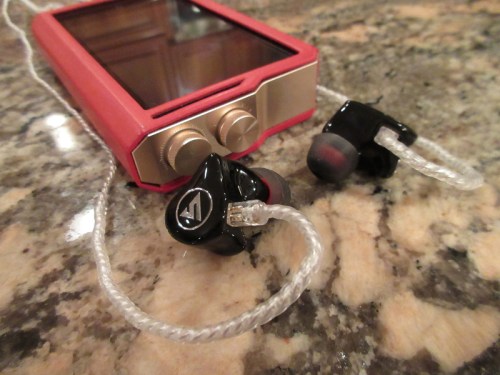
With an impedance of 19 ohm and a sensitivity of 109 dB, OSV3 is very easy to drive with any source I tried. And I actually tried quite a few, including my aging Note 4 smartphone and my old T430s ThinkPad. Usually the phone and laptop scale down the performance, especially my laptop with its noisy HO. But a natural tonality with a great retrieval of detail in OSV3 is quite forgiving, and I enjoyed the pair up even with these lo-fi sources. With high end DAPs, the sound only scales up as I found it below.
Plenue P2 mk2 (baseline test unit) – wide soundstage, slightly v-shaped signature, nice dynamic expansion, more natural smoother tonality with a good retrieval of details and an average layering and separation. Lows go deep and punch hard, mids are a little north of neutral, with upper mids being organic and detailed, treble is well controlled with a nice sparkle and moderate level of airiness.
Hiby R6 (high output impedance) – wider soundstage expansion with an overall sound signature being more balanced, where I still hear bass going deep and hitting hard (maybe a touch harder), mids being very detailed and natural in tonality, slightly more forward in presentation, and treble gaining more sparkle and more airiness (probably the effect of higher output impedance). Definitely a great pair up which improves the sound sig and makes the sound itself a little more transparent.
Lotoo Paw Gold (higher output power) – soundstage has the same width as baseline DAP, and the sound is still slightly v-shaped. The bass here (LPG) hits even harder, especially with a stronger mid-bass punch. Lower mids sound a touch leaner, upper mids a little more forward, but not by too much, and treble has a little more sparkle and airiness.
A&K SP1000 SS (high resolution, holographic soundstage) – soundstage is much wider, the sound is still slightly v-shaped. Sub-bass goes low but a little bit leaner, and mid-bass hits a little harder and sounds faster. Lower mids a little leaner, upper mids are more resolving, more detailed, still sound natural, but more transparent and layered now. Treble has more sparkle and airiness.
Sony WM1Z (high resolution, organic tonality) – soundstage is wider, the sound sig is still slightly v-shaped. Sub-bass goes low with a nicely textured rumble, mid-bass hits hard, but overall bass is well controlled and articulate. Lower mids are a little leaner, upper mids are resolving, very detailed, still sound natural with improved retrieval of details and blacker background. Treble has the same amount of sparkle and airiness.
Conclusion.
Before receiving 2pin OSV3 model, I had a chance to hear their original mmcx model, and I wasn’t too crazy about the tuning where the bass was more neutral and the upper mids/treble where brighter and harsher. Of course, sound perception is a subjective thing, and I’m well aware that some of the budget Chi-fi brands are not always consistent with their QC. But as soon as I received 2pin version of OSV3, I quickly realized that HiFi-Boy updated not only the connector but also the tuning of these hybrid iems. I just wish they would have called it OS V4 to avoid the confusion with a previous version.
But nevertheless, this new “budget” IEM from HiFi-Boy definitely caught me by surprise with its natural detailed tonality and impressive low end extension. I was also very pleased how well it paired up with all of my sources, from lo-fi to summit-fi level, and how well it worked with any genre of music I threw at it. And to top it all off, these also have excellent design ergonomics with a comfortable fit and a great sound isolation. I already mentioned this in a few of my previous reviews that sometimes it’s hard to go back to “budget” IEMs after being exposed to some of the biggest flagships in the industry. Moving forward, I can definitely see myself using and recommending OSV3 because I really enjoyed them.

 Twister6 Reviews