

Switch settings.
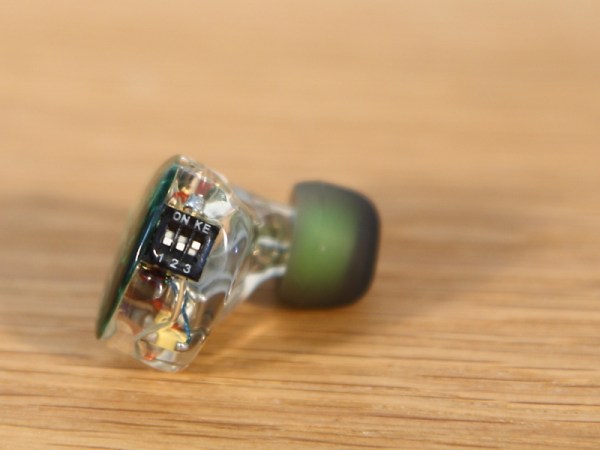
The TSMR-3 Pro have 3 switches that allow 7 different tunings, although there is a distinction between 3 main modes and 4 “mixed tunings”. The three main modes are with one of the switches up.
Main modes:
[100] (switch ‘1’ up – ‘2’ and ‘3’ down) = Bass enhanced mode
As the name suggests, this mode adds a little bit of additional bass emphasis. The bass does not extend deeper to my ears but is just a bit more elevated to add some mid-bass kick and a little more warmth throughout the signature giving fuller notes.

[020] (switch ‘2’ up – ‘1’ and ‘3’ down) = Balanced mode
I do indeed find this a nicely balanced sound and I would not be surprised if this happens to be the most popular setting. My sound impressions below will thus be done with this setting.
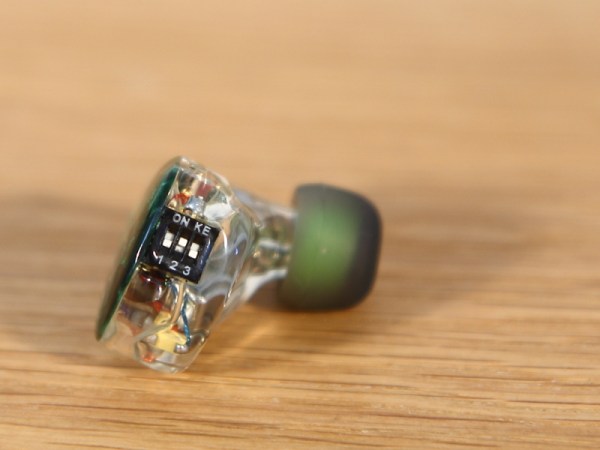
[003] (switch ‘3’ up – ‘1’ and ‘2’ down) = Mid and treble enhanced mode
Personally, I consider this more a treble enhanced mode, and not because the treble is lifted, but rather because everything else seems to be pushed back a bit. Indeed, the overall perceived volume is lower and I get the urge to increase the volume. The sound is a bit thinner and vocals loose some of their foundation, although it is not unpleasantly bright or too thin.
Mixed tunings:
[120] (switch ‘1’ and ‘2’ up – ‘3’ down)
[103] (switch ‘1’ and ‘3’ up – ‘2’ down)
[023] (switch ‘2’ and ‘3’ up – ‘1’ down)
[123] (all switches up)
(note: [000] or all down does not work)
The mixed tunings are indeed pretty much a mix between the different settings that can be interesting to play around with. The differences are quite subtle and can be used if the main modes don’t quite hit the sweet spot for you.
Sound Analysis.
Presentation.
The TSMR-3 Pro are probably not the most technically proficient IEMs in this price range, but they offer a very pleasant musical experience that might well make up for that. They present the music in a “cosy” stage, as the real estate agent might term a small house, but everything is placed well, and separation is good enough to avoid congestion. Do not expect too much in terms of air around instruments though because the treble if too rolled off for that. Perhaps it is this cosiness that gives the TSMR-3 Pro the very coherent feel that makes them musical and quite engaging to the point that you forget about technical performance. Although I feel they lack in that department, I still found myself completely ignoring it and just enjoying the music. A great example of this is that the sound has a grittiness to it, that is the only way I can describe it. It is not quite smooth and yet it comes across as the sort of effect you hear from vinyl, where you have to acknowledge that it technically is not right and yet it adds character. I quite like it, although it does mean that the TSMR-3 Pro don’t always play well with poor quality recordings. With those it can become a bit brittle and sharp, causing them to become fatiguing after a while. That might well depend on personal sensitivities, as I can be quite sensitive to certain treble spikes. Overall, I would say that the TSMR-3 Pro offer an uncomplicated sound that is easy to enjoy and will make your music fun and engaging.
Bass.
The bass of the TSMR-3 Pro is pretty laid back and it does not extend very deeply at all. You can of course switch to the [100] setting to add a little bit of mid-bass impact, but the difference is not huge, and it does not extend the bass any deeper. I did not feel any rumble at all and it becomes quite noticeable when listening to a solo cello, such as in Bach’s cello suites, where I hardly perceived any resonance in the body of the instrument. This means that texture is also somewhat lacking, and the TSMR-3 Pro are probably not going to be the first choice for lovers of good quality bass. (At a considerably lower price, the Final E4000 offer a lot more in terms of bass.) Still, for those looking for a tight and polite bass, the TSMR-3 Pro have enough of a kick that the bass is not lost completely. In the [020] setting everything balances out quite well and yet it is not what I would call a reference tuning, it is too musical for that. It is an unexcited bass that still sits coherently within the signature to set the pace and get your feet tapping. Again, not technically proficient, but enjoyable nonetheless. Being a bass head and a great fan of good quality bass, it does surprise me that I kept enjoying the [020] mode without feeling the need to switch to [100].
Mids.
The TSMR-3 Pro sound to my ears like there is a slight upper-mid lift and a fairly cool sound without getting clinical. There is not a lot of warmth that comes from the bass to add what I personally consider a naturalness to the tone, meaning that timbre is not quite accurate to my ears. Instruments lack some of the fullness I look for, but considering the small stage that has probably been a tuning decision to avoid congestion by keeping instruments sounding on the thin side. The result is still pretty good because the overall impression is coherent and well balanced for the size of the stage.
With vocals the TSMR-3 Pro do slightly better with female vocals because male vocals lack the chestiness that should be coming from the upper bass. Vocals are not the strongest I have heard and there can be some grittiness to female vocals, but like I said earlier, it is not something that bothered me and seemed to be in keeping with the general character of the TSMR-3 Pro. Separation of vocals is pretty good and in choral pieces I thought the image of the choir was really nice. I did not feel that the male vocals were drowned out either, just not as strong as I would like them to be.
Treble.
To my ears the treble is quite rolled off and has some peaks to it. This might well be the reason for the gritty character and where I find that the TSMR-3 Pro can be a little fatiguing with poor quality recordings. Cymbals are a little splashy/tinny sounding and are not well defined in busier recordings such as metal (they disappear into the background). Because the treble does not extend very far, instruments have very little air around them and while that does create coherency, it is a fine balance where I think more can be gained if the treble would be a little less rolled off. Switching to the [003] setting does not help here, as it does not extend the treble or (at least to my ears) lift it in any meaningful way.
As with every aspect of the TSMR-3 Pro, I can’t say these are technically proficient, but at the same time every aspect is well balanced with everything else and so even with the rolled off treble I find myself ignoring it. The peaks do help to give strings a lovely bite, and especially electric guitars are enjoyable to listen to with the TSMR-3 Pro.
Page 3 – Aftermarket cables CS819, GS849, GD849, and Conclusions.

 Twister6 Reviews
Great article. Keep up the good work 😉
But I have a question:
How does the Penon GD849 sound compared to the Penon OS849 or a similar priced Cable from Effect Audio or Plussound?
LikeLike
Thanks Michael! I don’t have the OS849 myself, so I can’t comment on that. I also did not do comparisons with other cables simply because this review was a lot to work through already (3 switches with 7 settings and 3 cables) and I only have Ares II within this price range. So I’m afraid I can’t provide an answer at the moment. I might look into it later and if I do I will let you know.
LikeLike
How TSMR-3 sounds with iBasso dx220?
LikeLike
Sorry, I don’t have access to the DX220 myself, so I would not know.
LikeLike