

Aftermarket cables.
As I indicated in the preamble, Penon sent along a selection of their own aftermarket cables at various price points. The TSMR-3 Pro come with a decent enough stock cable, but I found it was prone to tangling and so the opportunity to try out a few replacement cables was very nice to have as well. Or to say it in other words, any excuse to roll some cables will do.
Penon CS819
- OCC copper/silver-plated copper hybrid
- 8 wires with 19 strands each
- Aluminium/carbon splitter, CNC’d aluminium slider
- Tin-silver solder
- Copper Gold-plated plug
- Cable length: 1.2m
- Price: US$55


The Penon CS819, which has a name like it is a piece of military hardware, is an 8-wire cable with a hybrid composition of pure copper and silver-plated copper. It comes in a very nice little round wooden box, although I believe this might have only been the case for the first batch that Penon released, which if true is a shame because I really like it. Build quality is very nice. The parts used are pretty lightweight and feel very solid, while the braiding is well done to give a supple result. Although it is an 8-wire cable, the overall thickness of the cable is not too big, and the ergonomics are very nice. It makes for a noticeable improvement over the stock cable and falls around my ears more easily and securely, where the stock cable could sometimes be a bit unwieldy thanks to a strong curl in the ear guides. The CS819 does not have ear guides at all, which I generally like, but in this case, there was also no clear bend in the cable either to help orientate the connector when switching cables. This means you have to pay attention to the coloured ring on the connector (red for right, blue for left) and the groove indicating which side should be towards the outside. Not a big deal but requiring a bit more attention (read: I got it wrong the first try because I’m an idiot with the attention span of a… “Hey look at that!”).
Switching from the stock cable of the TSMR-3 Pro to the CS819 makes quite a noticeable difference in sound. The stage becomes a little bit wider and deeper, and the background a little darker. The most noticeable change for me was in the bass, where I felt it sounded more natural, with better textures and went a good way to address some of the critical remarks I had earlier. Male vocals get a better foundation and sound stronger. The overall sound becomes smoother and I felt the extension was a hint better at both ends, although the improvements to the treble were very moderate and it did not add a lot of extra air around instruments. The difference was not dramatic in any way and the musical character of the TSMR-3 Pro was kept very well, so to my ears this is a really good pairing.
Penon GS849
- Gold-plated copper/silver-plated copper hybrid
- 8 wires with 49 strands each
- Tin-silver solder
- The plug contains 68% copper
- Metal/carbon splitter, CNC’d metal slider
- Cable length: 1.2m
- Price: US$189


At a significant step up in price from the CS819 sits the GS849. This is a fancier hybrid cable that combines gold-plated copper with silver-plated copper wires. The GS849 comes in a slightly larger square wooden box and also includes a soft pouch, a cable tie and a shirt clip. Build quality is pretty good, although the cable is quite a bit heavier than the CS819. The parts used for the GS849 are metal rather than aluminium and while it is also an 8-wire cable, the individual wires are made up of considerably more strands making them much thicker. This means the cable is a lot more bulky, but the ergonomics remain pretty good so that it is a comfortable cable to use. No ear guides here either and so you just need to keep in mind that the grooves point outwards to get the connectors in correctly.
Switching from the stock cable to the GS849 the TSMR-3 Pro get a bigger stage (also compared to the CS819) and the GS849 seems to especially add to the width of the perceived stage. Clarity is improved and notes become a little fuller sounding, something that is especially noticeable with vocals that become stronger. The GS849 does not sound as smooth as the CS819 and provides a more detailed sound with a better bass response without adding too much warmth. It also provides more air around instruments and a slightly darker background that defines the notes more clearly and produces a more stable image. The GS849 also maintains some of the brightness in the treble, but it is less tinny than with the stock cable and thus provides a slightly more natural sounding treble.
Penon GD849
- Gold-plated copper
- 8 wires with 49 strands each
- Tin-silver solder
- Copper Gold-plated plug
- Metal/carbon splitter, CNC’d metal slider
- Cable length: 1.2m
- Price: US$239
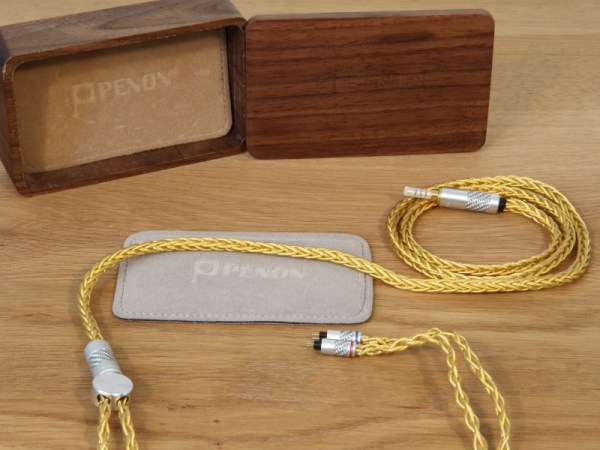
Another step above the GS849 sits the GD849. This is a gold-plated copper cable with a lot of similarities to the GS849, so I am afraid that this section is going to read a lot like a top-secret military document with lots of codes. The GD849 comes in the same packaging and thus you once again get the very neat square wooden box, the soft pouch and the cable tie and shirt clip. Although on paper the wire/strand configuration of the GD849 looks the same as the GS849, the GD849 feels bigger and heavier. The parts are the same, but the wires look thicker and that is also noticeable in the ergonomics that are a bit less supple. It is quite a bulky cable and, in this case,, I started to miss some form of pre-bent ear guides (or a twist of the wires at this point, rather than a braid) because the cable did at times seem to have a mind of its own. Once in place though I did not have too many issues with it, although I am quite used to bigger cables, so it will depend a little on your own personal tolerances whether the bulk of this cable is acceptable or not. It might be advisable to give it a try before buying.
Switching from the stock cable to the GD849 the TSMR-3 Pro get another boost to the perceived soundstage size, giving a little more width but also depth over the GS849. In many ways the GD849 and GS849 produce similar results when paired with the TSMR-3 Pro, but the GD849 is slightly warmer and smoother by comparison. Vocals, especially male vocals, sound quite natural now with a very solid foundation and the bass gets a natural resonance to it. The treble sounds a bit sweeter and I would consider it a more natural sparkle, although I will admit that I generally favour a sweeter treble anyway. Although the GD849 provides an overall warmer tone, its added width and depth balance things out very nicely to sound airy and clear. The image becomes more stable still and layering more precise. I really think this is an excellent pairing, although I am cautious about recommending it considering the cable is more expensive than the IEMs.
Conclusions.
As I said before, I think that the TSMR-3 Pro are probably not the most technically proficient IEMs in this price range, but they offer a very pleasant musical experience that might well make up for that. They are easy to enjoy IEMs and the option to fine tune the signature through the use of the three switches is a nice addition. The switches work really well and each setting sounds coherent.
Penon’s aftermarket cables pair well with the TSMR-3 Pro and provide an interesting option to tinker with the signature a little further. The CS819 provides improved ergonomics and a nice improvement to the sound without costing too much. The GS849 and GD849 provide a more noticeable change to the sound but are both bigger and more expensive cables.

 Twister6 Reviews
Great article. Keep up the good work 😉
But I have a question:
How does the Penon GD849 sound compared to the Penon OS849 or a similar priced Cable from Effect Audio or Plussound?
LikeLike
Thanks Michael! I don’t have the OS849 myself, so I can’t comment on that. I also did not do comparisons with other cables simply because this review was a lot to work through already (3 switches with 7 settings and 3 cables) and I only have Ares II within this price range. So I’m afraid I can’t provide an answer at the moment. I might look into it later and if I do I will let you know.
LikeLike
How TSMR-3 sounds with iBasso dx220?
LikeLike
Sorry, I don’t have access to the DX220 myself, so I would not know.
LikeLike