
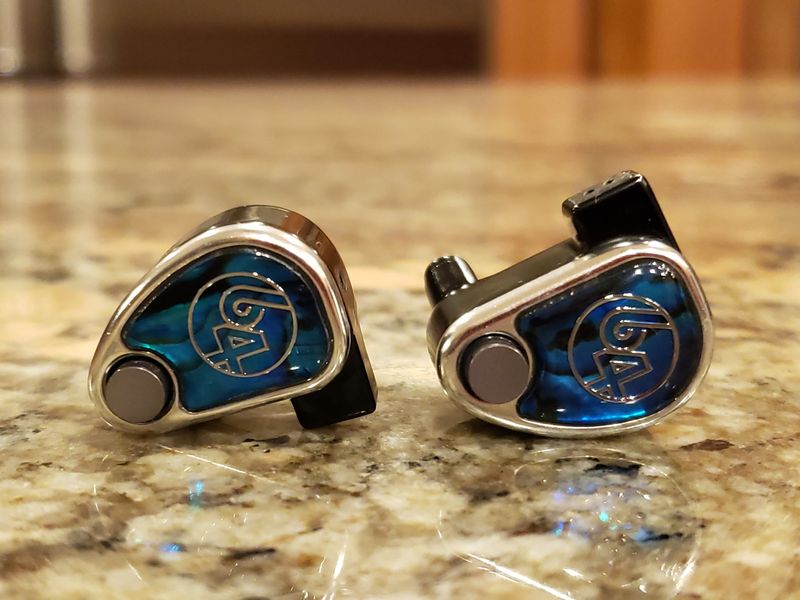
Comparison.
The comparison was done using Nio with a stock cable, SpinFit eartips, and P6, LPGT, and SP2k SS sources, volume matched in every comparison.
Nio (M15) vs 64 Audio N8 (M15) – to start off, N8 has a more holographic 3D soundstage while Nio is wide/deep but not on the same holographic level. Considering the same APEX module used in this comparison, Nio bass response has a little more impact, in both sub-bass rumble and mid-bass punch. Also, Nio bass is a little tighter due to a shorter decay. With mids/vocals Nio is smoother, a touch warmer, and with less forward presentation which positions mids a little more out of your head, while N8 has mids more forward and closer, even a little more revealing and transparent. Another noticeable difference is in treble where Nio is smoother and more natural while N8 is brighter and with a little more sparkle. Despite having the identical driver config and spec and while using the same cable and the same APEX module, based on what I’m hearing these don’t sound identical. They are not night’n’day, but each one definitely has their own sound characteristic with unique fine-tuning.
* this is comparison with Custom N8. 64 Audio only sells N8 as CIEM, while it was brought up to my attention that selective stores have universal demo of N8 which some find to sound different than CIEM version. I can only comment and compare what I have since I never tried store demo of N8 and I think it is irrelevant because you can’t buy uni demo anyway.


Nio (M20) vs EE Legend X – every time I bring up the bass, my readers ask about LX, so there is no way to avoid this comparison which only makes sense with Nio in max isolation w/M20. With M20 Nio bass impact goes up, while soundstage shrinks, and as a result LX soundstage is wider. With bass itself, while Nio w/M20 has a healthy bass slam, it is still not on the same ear-bleeding bass head level as LX, but I still think Nio w/M20 can put a smile even on demanding basshead. With mids/vocals, they quality/tonality is relatively similar, but their quantity and presentation are very different. LX mids are pushed back and a bit recessed, while Nio w/M20 mids/vocals are more forward and more revealing. With treble, LX has a little more sparkle while Nio w/M20 treble is smoother and more natural.
Nio (M15) vs 64 Audio U12t (M15) – relative to the same M15 module and stock cables, I hear soundstage expansion to be quite similar in this comparison. With bass, Nio has deeper and more elevated sub-bass rumble, not by a lot but it is more noticeable. The impact of mid-bass is a little bit lower in U12t, but overall quality of the bass is very similar, just scaled down in U12t. Relative to Nio, lower mids are closer to neutral in U12t while Nio has a fuller body. Upper mids/vocals are similar in tonality and sound a little more forward in U12t, perhaps due to less bass impact which brings vocals more forward. Nio treble is smoother and sounds more organic relative to U12t treble being crisper and brighter, especially in lower treble. Both are relative balanced tuned IEMs where Nio is smoother and with more focus on bass while U12t is more revealing due to more focus on upper mids and lower treble.
Nio (M15) vs 64 Audio Trio – the soundstage here is similar as well, perhaps with Trio being just a little bit wider due to more airiness and treble sparkle. Bass impact and extension of Trio comes very close to matching Nio w/M15 module. Actually, Trio bass sounds even more articulate because of a deeper separation from lower mids which gives it more control, while Nio bass sounds more analog and rounder, like a floor-standing speaker. Mids between these two are quite different. Trio lower mids are neutral and thin which gives more contrast between the bass and its colder upper mids/vocals, all this taking away from the natural body of the vocals. Nio lower mids are fuller, with more body, and upper mids are more natural, warmer, more organic. Treble is where you will find another big contrast where Trio is a lot brighter and crisper, while Nio is quite the opposite, being smoother and more reserved. With an exception of similarities in bass, these are quite opposite in everything else where Nio is more balanced and warmer with more emphasis on low end while Trio is v-shaped with more emphasis on bass and treble.


Nio (M15) vs FirAudio M4 – this is a very interesting comparison because M4 tuning is somewhere between U12t and Trio, bass similar to Trio while mids/treble similar to U12t. Comparing to Nio, the soundstage is close, though added sparkle in M4 treble gives it a wider perception. Bass is very similar to Nio w/M15, from a deep sub-bass rumble to a punchy mid-bass impact. The only small difference is Nio sub-bass w/M15 is a touch more elevated. Mids have a lot of similarities, though some differences as well. Nio lower mids have more body while M4 is not body-shy, just a little closer to neutral. Upper mids are more forward and brighter in M4 while more natural and smoother in Nio. With treble, Nio is also smoother and more organic while M4 is crisper and brighter, similar to U12t comparison, but not as bright/crisp as Trio. Here, it will all depend on how you like your upper mids/treble. If you want it more revealing and with more sparkle, M4 is a good choice, while more natural, musical, smoother is where Nio stands out.


Nio (M15) vs Campfire Audio Solaris ’20 – I’m sure many will be curious about this comparison as well. To start off, Nio soundstage is wider, while both have a similar depth. Regarding tonality and considering M15 module, Nio bass slam is a lot more powerful with deeper sub-bass and more elevated mid bass. Even when I go down N13 and N0 modules, the bass of Nio still has more sub-bass rumble, while mid-bass punch evens out with 10dB N0 module. Mids are a little leaner and more transparent in Solaris due to less body in lower mids, while Nio has fuller body and more organic mids/vocals. Nio treble with M15 module is smoother relative to Solaris treble which has more sparkle. Going down in isolation modules, to N0, treble starts to get closer, but Solaris still has more sparkle and a little more air.


Pair up.
In each source pair up, I was using a stock Premium cable with balanced termination to keep everything stock for consistency. Nio is easy to drive considering its 105dB sensitivity which might need only a few extra volume clicks. Also, due to its LID tech, Nio low 6ohm impedance didn’t seem to cause any issues with different output impedance sources. Also, I didn’t hear any hissing.
Lotoo PAW Gold Touch (LPGT) – natural balanced tonality with deeper bass impact, organic mids/vocals, and natural well defined treble.
A&K SP2000 SS – deeper bass impact, more forward mids, and noticeably crisper treble.
Hidizs AP80 Pro – a little brighter mids and treble, actually treble was quite crisp in this pair up.
iBasso DX160 – more holographic soundstage, deep bass impact, a little brighter mids, natural well defined treble.
Hiby R6 – despite 10ohm output impedance, this is a perfect example of LID at work! The output impedance of the DAP didn’t affect the signature/tonality as much. I still hear a natural balanced tonality with a deeper bass punch, natural resolving mids, and treble with extra sparkle.
Cayin N3 Pro – tube output does Nio a great justice with a more analog smoother tonality, still a deep bass impact, natural detailed mids/vocals, and natural well defined treble.
Hiby R8 – natural balanced tonality with a fast bass impact, natural detailed mids, and natural well defined treble. I enjoyed this pair up with Turbo mode on which gave bass faster speed and mids a little more resolution.
Luxury & Precision P6 – very natural organic tonality and a balanced signature. Deep punchy bass, organic soulful vocals, and natural well defined treble.
Conclusion.
Ever since publishing my N8 review, I always felt this IEM was underrated and didn’t receive as much attention as it deserves. Maybe because it was marketed as IEM for musicians by musician which alienated some audiophiles, or maybe because it was tuned to sound more natural and less micro-detailed, plus some people are not ready for “custom” commitment yet. Whatever it was, I don’t want to speculate, but I was genuinely happy to see Nio released as the universal alternative to N8 with the same driver configuration and a similar tuning.
Actually, despite having identical driver config and similarities in tuning, N8 and Nio still have a slightly different sound characteristics with its own unique fine-tuning. Sure, we are talking about Custom fit vs Universal fit with a seal controlled by eartips selection. But even if we take that into consideration, I still found Nio to have a bass with a better control and a tighter punch, mids/vocals with fuller body, and more organic non-fatigue treble. It doesn’t make one better than the other, but rather will be a matter of a personal sound preference.
Plus, access to APEX/ATOM XL modules gives you a chance to fine tune the sound further. The change in this fine-tuning could go from a subtle to a more noticeable, depending on a module and your subjective hearing perception. And on top of that, module itself relieves the air pressure and fatigue during extended listening session or at higher listening volume. But at the end of the day, you are the one in control of which pill you are going to take, red, blue, or abalone to get to your next sound destination!

 Twister6 Reviews
Will you be reviewing the Da Vinci X from Clear Tune Monitors?
LikeLike
sorry, I probably won’t. Those are older IEMs, I remember listening to them year and a half ago at canjam NYC. They were just OK, but it is an old iem, and manufacturers usually send review samples of their new and upcoming stuff since they are not interested to promote old releases. Also, noticed da vinci x/ix got little attention even when it was released.
LikeLike
I know that you’re not trying to go too crazy with the cable rolling, trying not to exceed 1/2 price of the Nio, but how well does it pair up with the *_PlusSound PPH8_* and how does it compare with the *_Premium Silver hybrid_* and *_Socrates_* cable?
LikeLike
Don’t know how to bold and italic a text in WordPress. XD
I just did it like in the YouTube comments hoping that it will work…
Also… it seems like it can’t be deleted.
LikeLike
WOW, I didn’t even think about trying PPH8 with Nio, and I didn’t expect how well these pair up. Relative to Silver Premium, the soundstage is wider/deeper, literally 3D and you feel like you are in middle of it. Also, mids are a little more forward or maybe bass just a little more attenuated, making mids a little more forward. Of course, keep in mind, this is $2k cable with $1.7k IEM.
LikeLiked by 1 person
I wish I knew more about the IPX connector you write about. I have broken 2 two prong attachments, one sleeping and one exercising. I didn’t see an option for an IPX when I bought them. Is there a way to connect one with the NIOs I have?
That said, the NIO is the BEST sounding IEM I’ve tried,open, airy, true to voice and instrument. But I’ve had to resort to using Sony IER Z1Rs because they are bulletproof and they don’t usually detach and the one time one did, it did no damage. The Nio is a much better sound for me, but they are so fragile, I’m limited in when I can use them. Any solutions??
LikeLiked by 1 person
Only custom 64audio iems have the option for IPX, you can’t retrofit Nio with another connector. If you want to read more about IPX, I covered it in details in my UE Live review a few years ago, here https://twister6.com/2018/09/07/ultimate-ears-ue-live/. Not the best tuned iem, but I have lots of info about IPX in that review. Another option is to look into FIR Audio iems, Bogdan (64audio ex-CEO who started fir audio) came up with RCX connector which is a Rigid version of mmcx. I covered it in my M5 review last year, here https://twister6.com/2019/10/10/fir-audio-m5-2/. Maybe contact FIR audio, and ask Bogdan what he can recommend. He is very familiar with 64audio shells and can give you a good customization suggestion.
LikeLike