
GUI.
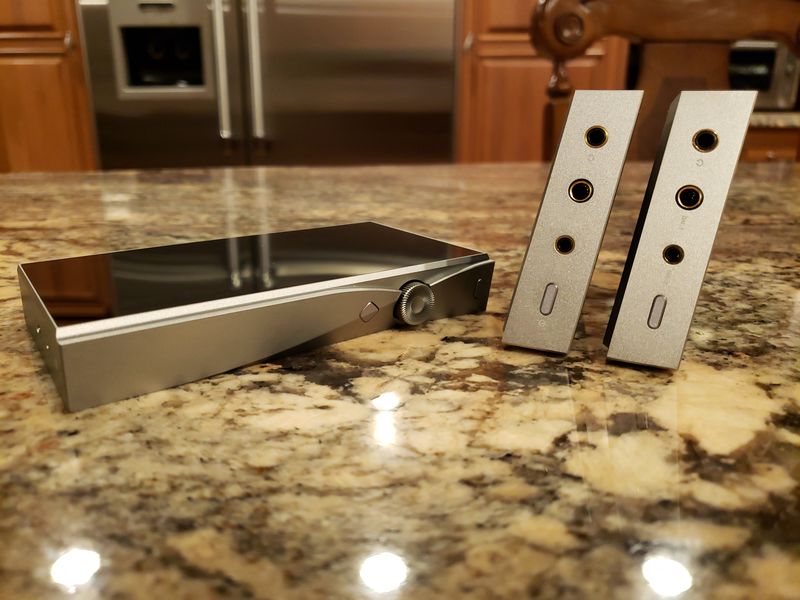
When it comes to A&K DAPs user interface, once you get familiar with one, you will feel like at home using all of their DAPs. Basically, they all share the same interface, even SR25 with its smaller display uses the same GUI, scaled down to fit its screen. But as soon as I powered up SE180, I noticed right away a new addition. Instead of a touch home button underneath the screen (no longer available in SE180), A&K added Navigation Bar at the bottom of the display with a name of a currently playing song, Home button, and Play/Pause and Skip buttons. It is always visible and makes it easy to get back to the main Playback screen or to control the playback from any other screen. The Floating Back button is still there and can be easily disabled by dragging it to the middle of the display or disabled in the Settings menu under Input Method. The button itself could be moved to anywhere along the left/right sides of the screen.

Once you press Power button, you are greeted with “A” logo and arrive to the main Playback screen. The embedded artwork (with cover art) window occupies top half of the screen, tapping on it expands the view and shows lyrics if one is available. Swiping artwork window left/right skips to prev/next song in your playlist. Above it you get a summary of song format (file type, bit depth, and sampling rate), with a link to Now Playing (where you can edit/modify from within) in the upper right corner and a link to Navigation Menu in the upper left corner. Right under the artwork window there is a thin strip of transport control to fast forward/back by swiping through it. You no longer have physical buttons to fast forward through the song, so it is either swiping the transport bar or holding the Next/Prev touch buttons. And in the lower half of the screen, you have a row of controls, additional song info, and playback touch buttons.

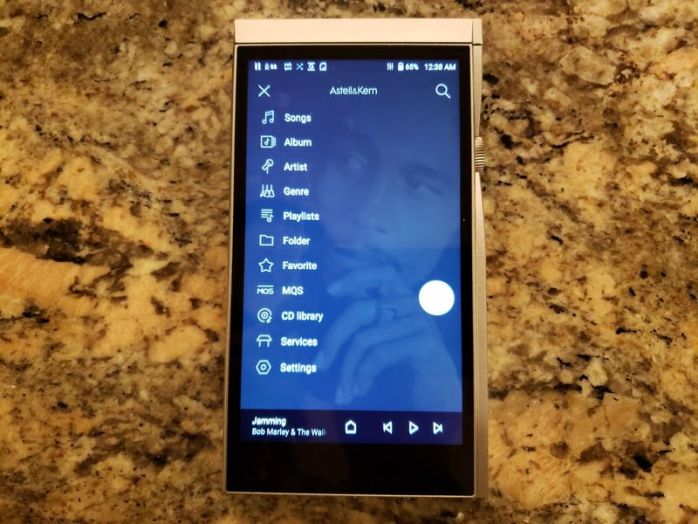
The Navigation menu, accessible by pressing “A” in the upper left corner, takes you to a list with various Sorting option (song, album, artist, genre), Playlist, Folder view, MQS, CD library, Services (streaming), and Settings. You can also access this screen by swiping display to the right from the main Playback screen, where you can also swipe to the left and get into Now Playing screen. Under every sorting option you have other options to add songs to playback queue, different layout to view album (single, double, or triple columns), view artist with every album under each name, genres according to id3 tags, and my favorite Folder browsing which also gives you extra info about internal storage.
Settings menu is very important, but you can also access some of the shortcuts by swiping the screen down to see what’s available in Notification bar area where you can toggle Wi-Fi, Bluetooth, EQ, USB mode, external usb, AK connect, Line Out, Car Mode, Wheel lock, and shortcut to the main Settings menu. Many of these toggle options don’t just enable the function, but if you long press it will take you to the menu of that function. In the main Settings screen, you have Wi-fi, Bluetooth and Codec selection, AK Connect and File Drop, then Equalizer, Gapless, Line Out, L/R Balance, Playback setting, Notification Panel, AMP (normal and high gain), CD ripping, usb mode and usb audio, Car mode, DAC filter (digital filters associated with particular SEM# dac), and other system settings.
SEM1


SEM2


With EQ, you have one blank EQ preset and no other genre specific presets. EQ interface has two modes: Main and Advance. In the Main you have standard Paragraphic EQ sliders for 20 bands (30, 45, 60, 90, 120, 180, 250, 380, 500, 750, 1k, 1.5k, 2k, 3k, 4k, 6k, 8k, 12k, 14k, and 18k) where you can either slide the bar or use a precise 0.1 adjustment, as well as scrolling through available frequencies. As you adjust, it gets reflected in the lower right corner, showing the overall shape of EQ. Switching to Advance, turns EQ adjustment into Parametric EQ with a full GUI view of EQ shape where underneath you have FREQ band selection (a choice of 20), Gain selection in 0.1 and 0.01 steps, and Q bandwidth. Since bands frequency is fixed, I consider this to be semi-Parametric EQ. The interface looks great and the actual adjustment finally has a more noticeable effect on the sound.

Open APP Service.
Open APP Service is implemented in all A&K Android based DAPs, including SP1000 SS/CU, SP1000M, SE100/200, SR25, and SP2000 SS/CU, with SE180 being no exception. More info could be found here where Astell & Kern goes into details about how to install and to use it.
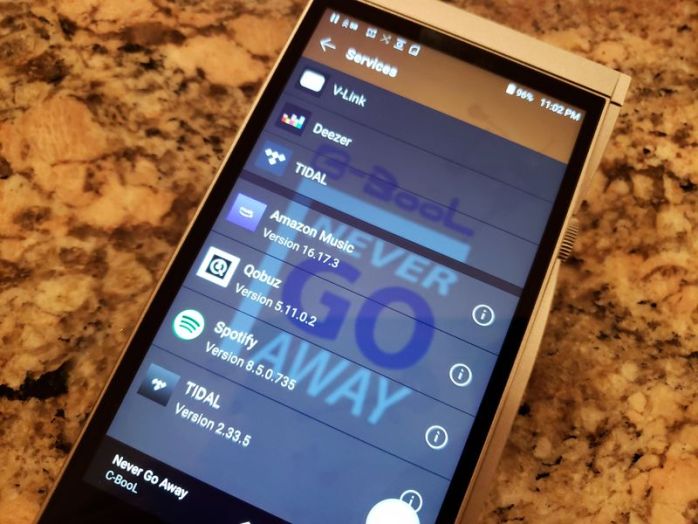
When you start dealing with Android apps, in many cases you do need a Back button for navigation, so Floating back button come in handy when dealing with streaming apps. While Astell & Kern offers a built-in Tidal service (without off-line storage support), for a long time their customers been asking to add Spotify, Qobuz, Amazon and other streaming services. A&K latest DAPs do run on Android, but it’s a heavily modified closed OS without access to Google Play. In a way, it’s a blessing for a manufacturer to keep DAP performance optimized since you don’t have to worry about customers installing and running other unstable apps.
If you decide to install a non-blacklisted app, you need to download APK file (use a site like https://apkpure.com/), copy it to Open Service Folder located on internal storage, go to Services on the DAP, and when you see the app being recognized and listed in there, click to install it. Keep in mind, for example, you will have to install Tidal apk if you want off-line downloads. Also, installed apps will not be updated automatically since you are not running Google Play. You will have to keep track of app updates and manually download and install new versions.
I installed and used without a problem Amazon Music HD and Qobuz.
Page 3 – Sound Analysis, Comparison, Pair up, Connections, and Conclusion.

 Twister6 Reviews
I also auditioned both cards and I suggest you review the SE180ESS vs SE180AKM paragraph ad most od my impressions were exactly opposite. Of course it may be just me and my ears and you have all right to hear it differrently but please review. Perhaps ESS and AKM words were swapped as a part od technical post-editing?
LikeLike
No, I still hear it that way. It is not a night and day difference. And per your suggestion, I just went back to hear and to compare it again. And I edited my sound impressions paragraphs to make it more clear that it will depend on pair up synergy with your iems/headphones. I don’t want people to think they will get 2 totally different sounding DAPs with 2 cards. It’s a subtle refinement. Just curious, where/when did you audition SE180 with both cards? How many hours of burn in did it have? Were they final or pre production? SE180 only going on sale right now and SEM2 won’t be even available for sale until mid July.
LikeLiked by 1 person
Hi. How does a near flagship portable dap like SE180 compare purely sonically with something like an entry level desktop dac like Topping E30, Modi 3, etc? I mean if only their ‘dac’ capabilities are compared then how does an entry level desktop dac (with their big internal capacitors) compare with a near flagship or very expensive portable dap such as SE180?
LikeLike
Not familiar with any desktop equipment. And, dac will need an amp to make the final judgment of a desktop stack against dap like SE180, and based on your question to compare desktop dac to LO output of SE180 using the same external amp. Otherwise, it will be just a misleading speculation. Also, you are right, desktop dac will have juicy power filtering caps, while dap is limited to smaller “battery” filtering caps.
LikeLike
btw, I was talking to a few people about SE200, and heard it created a polarizing opinion as well, with people arguing about hearing the opposite too 🙂 Also, in addition to burn in, there could be difference due to filter selection, as one of the contributing factors. I kept everything on default.
LikeLike
Ok. I fully respect and your review and opinion. Just wanted to make sure.
I listened to pre-prod batch in Krakow, Poland on May 14th. In terms of burn-in this piece was already in another city as a part of a demo tour so the burn-in could be perhaps 100h? To my ears AKM had more coloring and ESS was a bit darker / more black-and white. ESS card sound was tighter, faster, with a blacker background and faster transient of notes. AKM was is more relaxed, laidback, smoother. I listened using Ether C Flow planars with balanced 2.5 TRRS cable. I set filter to “super slow” to get more clarity. I think the gain setting was “low”.
LikeLiked by 1 person
Perhaps, that was part of a pair up synergy. With Empyrean planars, I liked se180akm even better than sp2k and better than se180ess. But either way, nothing is set in stone, we hear how we hear, and the reason why i always suggest to make the final decision after auditioning with your favorite earphones/headphones and playing your favorite test tracks.
LikeLiked by 1 person
Technically, is it a significant SQ upgrade to SR25?
Adding 4.4mm bal is really tempting, but I love my SR25 due to its small size and long battery life
LikeLike
Tbh, nothing is a significant upgrade. Is SP2000 5x better than SR25? Absolutely not! Just like SE180 is not 2x better than SR25. SE180 is an upgrade from SR25, and you will hear technical improvements, but it will depend on earphones/headphones you are using and their synergy with either sources, or the type of music, or just your personal ability to hear a significant vs subtle difference in sound/performance. I have people who are arguing with me their iPhone sounds as good or better than SP2000.. That is how they hear it 😉
LikeLike
“I have people who are arguing with me their iPhone sounds as good or better than SP2000”
LOL
Thanks the detailed SE180 review , enjoy it a lot and happy to know its background hissing is small for sensitive IEM like solaris , i think this is important for some ppl like me
I’ve tried both ESS and AKM module (retailed veriosn) , i do think ESS one sound more crispy , with more sparkle in treble , a colder sound compare with the AKM , AKM vocal sound warmer , bring closer to audience and the soundstage is smaller than ESS , an obvious different , could say sea and sky difference personally when pair up with solaris and legend X SE, haha
I do agree it’s a pair up syergy , ESS with more dynamic , quantity and impact of bass too
I enjoy this DAP , another one is the N6ii Titanium R2R version , what a bass monster ! SE180 bring out fine and detailed sound with sufficient Bass (ESS) , N6ii Ti bring out lots of emotion and thunder bass , but with rather heavy hssing sound with using high sensentive IEM
Looking forward reviews on other new products from you 🙂
LikeLike
Hi!!
How is SEM2 sound with a more neutral IEM like the U18t?
It’s similar to the sound of SP1000 (or SP2000 if you don’t keep SP1000 with you)?
It is really tempting to have an SP1000 DAP in a module like this
LikeLike
SE180 was on loan, so I didn’t get a chance to compare it with SPK, but by memory akm sem2 card will come close. A&K is aggressive with this release to recapture the market, it is really good. .
LikeLike
Hi,
I just discovered this blog and wow it’s great! Well done!
I’d like to ask for some help since I hadn’t read about the DAP’s for a long time, and now I’m a bit “out of date” with what’s going on.
My Plenue 1 is getting old and the display is nearly dead 😦
So I’m looking for something new, with an upgrad of course!
I’m looking for a new one in the upper range, like SE200 or SE180, Cayin N6ii, or maybe Plenue L, or something else like Fiio or iBasso, but really I’m a bit lost with all that stuff…
I read plenty of reviews, it doesn’t always help.
Could you give me some advice?
I’m looking forward to your answer, thx 🙂
LikeLike
Most of the latest daps will be an upgrade to original P1, unless you still prefer its warm tonality. PL and N6ii are rather old platforms, SE200 is getting dated. SE180 modular design is excellent, highly recommend it, plus it’s a great value relative to other A&K daps. And if you want a warmer tonality, Shanling M8
LikeLiked by 1 person
Thank you for the advice.
In my mind I was going on the SE180, the modular design seems very interesting. The warm tonality is also a important point… I’ll let myself some days of reflection, but trying an A&K attracts me since a long time.
LikeLike
Hi, excellent review, thank you. I have a SR25 and bought a Shanling M8; I loved it’s sound with my Vision Ears VE-8 and Effect Audio Janus D. The M8 had some battery issue; I gave it back and got the refund since I could not get a replacement. Very sad. The M9 will come but… I do not know. It looks like a transition model. What do you think about the SE180 for my iems? Or the Hiby R8? Thank you for your advice. BR. Carlo
LikeLike
Both SE180 and R8 are good DAPs. SE180 gives you flexibility to replace dac/amp, though you do have a limited app access since it’s not a fully open android environment. R8 is super fast and sounds great. But, I would also wait for upcoming Hiby’s RS6, more info should be available soon. Otherwise, SE180 is pretty good, especially for iems.
LikeLike
Should I go for SEM2 to get the best in terms of soudstage from VE-8? I do not like a very bright sound. That’s why I was adviced by Effect Audio to add a Janus D. Thanks for your advice, since I have a limited experience in DAP and pairing.
LikeLike
Yes, I would get SEM2 and hurry up cause AKM dacs were discontinued (4493, 4495, 4497, 4499) and I have a feeling they probably have a limited stock before they run out of components.
LikeLike
Hi. please answer the question: is se180 higher than se200 or not. SQ on 2x AK4497 vs 1xAK4499
LikeLike
sorry, never heard SE200
LikeLike
Hi,
Would you do a follow up review in the 2 new cards, namely SEM3 and SEM4?
LikeLike
Sorry, never got to other cards and
se180 was on loan.
LikeLike