
Source.
All listening was done with the Lotoo PAW Gold Touch, Shanling M8 and Dethonray Honey H1, all from the 4.4mm balanced out. I will point to which synergies I used where and why.
Sound Analysis.
As this review kept getting delayed for a number of different reasons -one of them being that I simply couldn’t be bothered to take notes while drifting away in sonic bliss- this section is less of an abstract analysis and more of a long-term, actual day-to-day use review. Shocking, I know, a reviewer actually using a product as intended. The reason I am doing this is that I think it shows off what Code 51 actually is. While it is a very expensive flagship “my precious”-type of cable that people will tend to baby and keep in pristine condition, I personally find it works amazing as a general use cable.
The key issue here is what Code 51 does with the sound of IEMs. First and foremost, Code 51 seems to be able to elevate the transparency of IEMs to ridiculously high levels, even with IEMs such as the Final A8000 that are among the most revealing available. This means that even when I am working and listening to my music casually, I frequently get surprised by the incredible level of information that is conveyed effortlessly by IEMs I thought I knew very well. All simply by switching to Code 51.
-Empire Ears Phantom-
My Phantom have been my babies ever since I got them. After a long time using them and rolling a very large number of different cables at every price point, I don’t get surprised easily, yet Code 51 does manage to do that. Switching to Code 51 I find it expands the stage and introduces airiness, yet unlike other cables, Code 51 does not harm the more intimate character of the Phantom. Listening to the gorgeous vocals of Elisabeth Kontomanou on her album Waitin’ for Spring, it feels like a private performance. Moreover, Code 51 imbues the Phantom with an exceptional sense of realism. It feels like a live performance in a way I have not heard it before. The transparency is superb and vocals are just jaw droppingly good. There is still some of the characteristic warmth of the Phantom, but it does not give the perception of a veil, it is just part of the presentation, which is musical, gorgeous and enveloping you in a holographic blanket of sound.
From memory, as I don’t have that cable anymore, Effect Audio’s Leonidas II resulted in a more extravagant and dynamic pairing. Code 51 is more balanced and yet manages to ooze musicality. Using the Lotoo PAW Gold Touch gives amazing synergy between the three and it is easily one of my favourite setups these days. Highly versatile and performing at an incredibly high level.
-64 Audio Tia Trio-
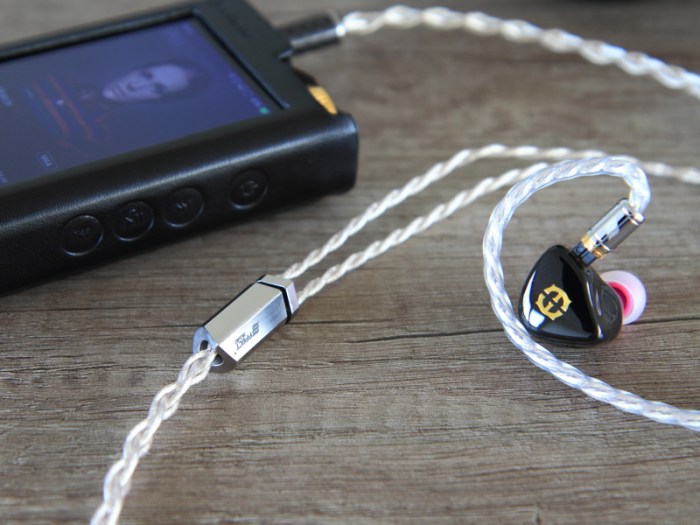
The synergy here is once again absolutely outstanding, especially when I use the Shanling M8. I usually use the Trio with the PlusSound Exo GPS, which has great synergy with the Trio as well. However, Code 51 seems to allow the Trio to perform at their peak performance.
Immediately noticeable is the much more open, airy and extended stage. Usually this will give a sense of distance to the music, but I was amazed by how the increase in transparency allowed even more information to come through. Again, and I can’t stress this enough, it is not done clinically or in any way dry. Instead, the music is organic and natural. The notes feel relatively light and flow with great fluidity, yet there is power and clarity to them at the same time.
The Shanling M8 here gives a bit more of an analogue character to the bass and Code 51 elevates this to an extraordinary level. “Realism” here is once again a word that springs to mind, with the bass coming across as if I am listening to high-end speakers placed at a bit of distance. There is physicality and detail there that I am not used to with the Trio. It feels alive and guttural without being too dominant. Just enough presence to push the Trio’s more V-shaped signature to the highest level. What then to balance that bass with? That Tia treble of course and Code 51 is by far the best cable I have used in this aspect. The Tia treble seems to extend much further and the sparkle is absolutely gorgeous. Addictingly so, and that is coming from someone who has in the past referred to himself as a “treblephobe”. I love this treble.
-Empire Ears Wraith-
This is a true summit-fi pairing, however, the Wraith have an unfortunate reputation thanks to their paradoxical highly sensitive yet power-hungry nature. They need a huge amount of power for the e-stat drivers to fully engage. I have been driving them with an external amp (Dethonray Honey H1) on high gain and the result is big, airy and quite unlike other closed IEMs. They feel as spacious as IEMs with pressure relief systems such as the ADEL system that Empire Ears used to offer. It is a concert hall type of feeling and the tonal balance is quite neutral without sacrificing tonality.
The pairing with Code 51 is less warm than with the stock Cleopatra, but I personally prefer it, especially for classical music. Transparency is incredible and timbre is accurate without pushing towards fuller sounding instruments such as with the Phantom. The stage is big and notes flow through it with an ethereal quality. Although not quite at the level of the Final A8000 with Code 51, which is insanely good in this regard. The Wraith with Code 51 is a more balanced pairing than that, with a natural tone as well as that slightly lighter feel of notes floating (instead of “flowing”). For classical music this pairing results in a feeling of sitting in an empty concert hall with the orchestra playing just for you. The stage is perfectly presented with astonishing precision and every detail and every nuance comes through perfectly, but there is some distance because of the sheer size of the stage. I think this pairing is the most “concert hall” experience I have had with any IEMs I have heard so far.
-Final A8000-
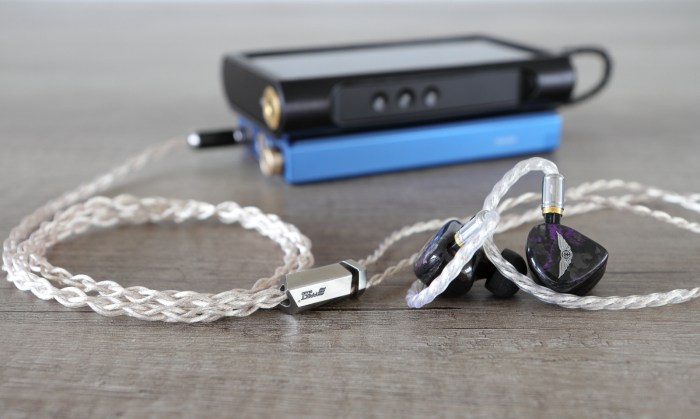
Unfortunately, I had to send the A8000 back before I had enough time to write down detailed impressions. However, I still got to spend a little bit of time with the A8000 and Code 51 pairing, and I felt compelled to include my notes here anyway because the synergy says a lot about the quality of Code 51. The A8000 are bright IEMs, brutally so to be honest and not meant for the faint of heart when it concerns treble sensitivity. Final have however done an amazing job with their tuning and the brightness is not harsh and doesn’t seem to fatigue me even though I can be quite sensitive to that.
The A8000 are at the absolute top of the most revealing and detailed IEMs available today. As such, I would imagine that it is a tough balancing act to retrieve that amount of detail without becoming unbearable to listen to. Pairing Code 51 thus made me a little hesitant because I was expecting it to push the A8000 to just that point. The result though was very surprising. Code 51 managed to lift the already insane level of detail of the A8000 to yet another level, while making the treble sound even more ethereal and perfectly smooth. I can be quite treble sensitive and the pairing A8000 with Code 51 was pure joy and addictingly so. It is like nothing is hidden with this pairing while at the same time it avoids piercing your ears with brightness. Truly very special.
Conclusions.
I think that Code 51 has something neutral about it, but without sacrificing naturalness, a combination that is not easy to achieve. Usually, I find that cables add some level of colour or inject brightness, but not Code 51. Code 51 is absolutely there, it extends the stage, extends the bass and treble, provides air, clarity and improves transparency and resolution, yet somehow manages not to put its mark on the sound. There are very few cables I have heard that are like this, even in this price range. Usually, I find TOTL cables to add something clinical to the sound, even EA’s own Horus did that in my opinion (read: distant memory) and that is not what I personally prefer. Like some exceptionally niche cables I have tried and couldn’t use because those were an ergonomic nightmare, Code 51 brings something especially natural at the highest level and does it with outstanding ergonomics. At this price range I consider Code 51 to be among the very, very best.

 Twister6 Reviews
Hi twister, thank you for your all round trusty review, I was wondering if Code 51 make a good pair with U18s in terms of expanding the sound stage and pushing the vocals forward? What character do you think Code 51 introduce to BA IEMs? Thanks.
LikeLike
Hi Ryan, I don’t have access to the U18s myself and so can’t comment on that. Alex (Twister6) reviewed Code 51 a while back and in his review he used the U18t, that might give you more information: https://twister6.com/2019/12/28/effect-audio-code-51/
LikeLike
Ah omg, I am terribly sorry for mixing you guys up.
LikeLike
No problem, happens all the time. 😉
LikeLike