

Sound Analysis.
I analyzed Indigo sound performance paired up with a neutral LPGT source while playing a variety of test tracks, such as Agnes Obel “The curse”, Sandro Cavazza “So much better” (Avicii remix), C-Bool “Never go away”, Ed Sheeran “Shape of you”, Alan Walker “Darkside”, Galantis “Hunter”, Iggy Azalea “Black widow”, Indila “Boite en argent”, Dua Lipa “Love again”, Counting Crows “Big yellow taxi”, Bob Marley “Jamming”, David Elias “Vision of her”, and Michael Jackson “Dirty Diana”. I let it burn in for about 50hrs before I started taking my notes.
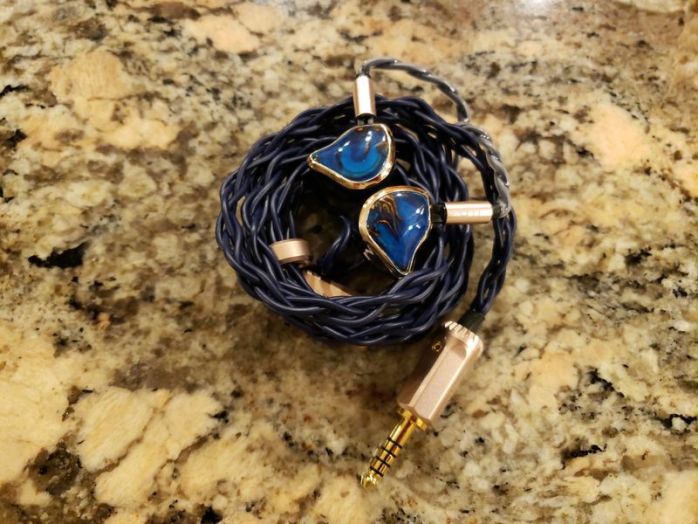
With addition of two more EST drivers, my expectations of Indigo tuning turned out to be completely off. The original Mest/MKII gained popularity and captured the attention of many audiophiles due to its deep analog bass and crystal-clear sparkly treble, with revealing mids not too far behind. That combination yielded a fun tuning with a mildly U-shaped sound signature. So, while going from dual EST to quad EST, one can assume more treble, and maybe even deeper U-shaped or V-shaped signature? But that is not what you are going to hear with Indigo after 40-50hrs of burn in when the sound starts to settle in.
Right away I noticed a balanced tuning with W-shaped sound signature. It is clear that it wasn’t just addition of drivers but the update in both low end and high end of the tuning. The faceplate tuning vent of Mest/MKII was gone, “relocated” to a pinhole vent found at the top of the shell. And along with that, the tuning of the bass also has changed a bit, slightly scaled up in weight of the sub-bass rumble and impact of the mid-bass slam. It is not a drastic change that going to boost the bass significantly. I’m sure UM wanted to stay closer to the original tuning, but the boost is noticeable, and I can also hear more body in lower mids.
The original Mest/MKII had a more neutral lower mids which gave the vocals more revealing tonality and took some body away from acoustic instruments. Original tuning was more about fun signature, while Indigo added more body to the lower mids which gave vocals more presence and acoustic instruments more organic tonality. Then, when you focus on the upper frequencies, you notice a boost in lower treble. That probably comes from additional two EST drivers. This boost was done with a precision to completely avoid any sibilance, and instead give upper mids/vocals a more forward presence.
The mid-treble and overall treble extension are unchanged based on what I’m hearing and multiple measurements. But as a result of a fuller body mids and lower treble change, the perception of the treble tuning has changed, and Indigo treble is much less piercing now in comparison to Mest/MKII. As they say, a little change goes a long way. And all these little changes accumulated into the updated finetuning that I personally found to be quite effective.
The technical performance hasn’t changed. You still have a similar soundstage expansion, wide, with more width than depth, creating a sort of an oval soundstage spacing around you. Imaging still approaches holographic level, and you can still expect an impressive layering and separation of sounds and vocals.
For my own personal preference, I enjoyed original Mest/MKII with more EDM and pop/rock tracks, while the improvement in Indigo tuning that added more body in the lower mids and deeper low end extension made it great with vocal, instrumental, and acoustic tracks as well.
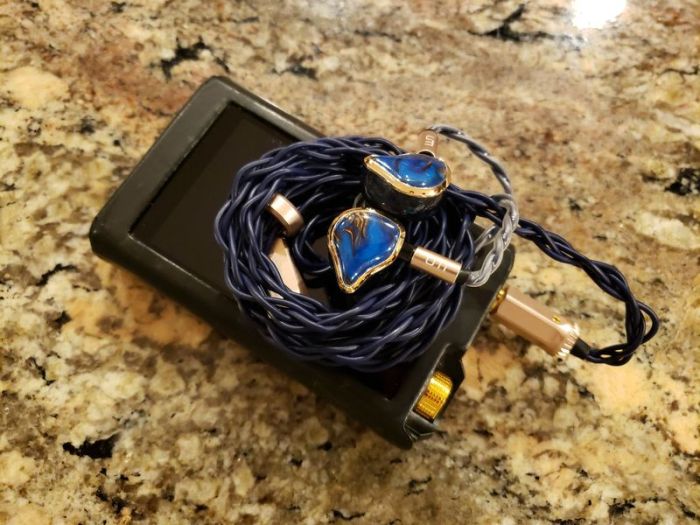
Eartips Selection.
The selection of eartips is crucial to any universal in-ear monitors and will affect the sound, especially the bass impact depending on the seal. Due to a large opening of my earcanals, I usually go for the largest size eartips to get a better seal, but with a slightly bigger diameter of Indigo nozzle, in some cases I had to step down to medium size eartips. Also, please keep in mind, eartips impressions are subjective and will be based on anatomy of your ears. Here, I was analyzing the sound using LPGT and stock cable.
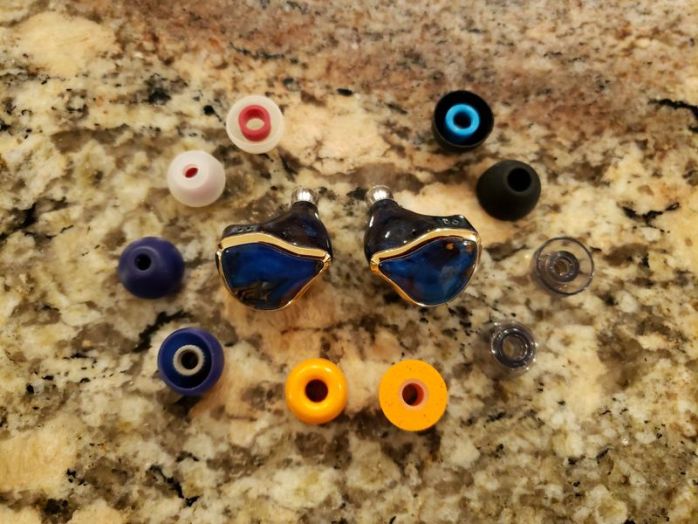
stock AZLA Xelastec – The sound sig I hear is balanced W-shaped with elevated deep textured sub-bass and strong mid-bass impact, natural organic fuller body mids with a decent retrieval of details, and sparkly treble with a good airy extension. I was going between M and ML size eartips, so if the included M size doesn’t give you a good seal, try to get Xelastec ML/L size pack.
stock Silicone – the seal here is more relaxed and the sound sig is between W-shaped and a very mild U-shaped because upper mids/vocals sound a little more distant and slightly reduced in quantity. The low end is very powerful here, and in a contrast with mids, bass scales up a bit because mids sound a little thinner and brighter. Mids/vocals still have a natural tonality, but a little less warm in comparison to Xelastec eartips. Treble has extra sparkle but still staying under a threshold of my harshness tolerance. For EDM track, this is a good eartips pair up.
Symbio F – I tried L and M size, both give a good isolation and similar mids/treble, but the bass was attenuated with M-size, thus I switched to Large for a better seal. The sound sig with Symbio F is balanced W-shaped, with a more even and linear tonality across entire frequency range. While some other eartips give you a little extra bass or treble emphasis, here the tuning was nicely balanced, giving the sound more transparency and less coloring in mids. Bass still elevated and goes deep with a nice textured rumble, but a little less than Xelastec; and mid-bass is more articulate with a better control. Mids have body, but a little less warmth and more transparency, making them sound a little more revealing. Treble is crisp and airy, and still natural.
SpinFit CP145 – with these SpinFits the sound sig is closer to U-shaped tuning where bass and treble are more elevated and upper mids sound more distant. Bass here is scaled up in quantity, I hear a lot more sub-bass rumble and overall bass has more weight and more presence. Lower mids are closer to neutral, thus vocals loose some of the body and warmth. Treble is crisp and bright, not harsh but getting closer. Wasn’t too crazy about these eartips with Indigo.
Final Audio Type E – another pair of eartips with a narrow bore opening, similar to SpinFit where I hear a slightly more U-shaped sound sig tuning. Bass goes deeper, has stronger punch, and overall, more elevated. Mids/vocals are not as smooth or warm, a little thinner and a bit distant, further out of your head. Treble is crisp and bright, not harsh but they are getting a little closer to my personal borderline of tolerance. Wasn’t my favorite pair up.
Xelastec and Symbio F were my favorite eartips with Indigo, a similar conclusion I reached with MKII, but keep in mind, it is very subjective and relative to my ear anatomy. Bottom line, sound does vary with different eartips so don’t jump into the final conclusion until you experiment with tip rolling.
Cable pair up.
I’m aware that some people don’t believe in cables and have very strong opinion about it. It’s not my intent to change those minds. Instead, I’m just sharing what I hear during my testing. What makes sense to me, a metal wire is a material with physical properties of resistivity, conductivity, purity, and unique geometry, all of which put together act as a filter between your source and headphones. Variations of these physical properties can affect the conductivity of analog signal, resulting in a sound change, from a subtle to a more noticeable level. If the talk about cables upsets you, please skip this section. Otherwise, enjoy these short impressions.
stock to EA EVO10 – when I tested MKII with this cable, I heard a little bit of improvement in soundstage. But the overall tonality, sound signature, and the rest of the technical performance are similar.
stock to PWA No 10 – I hear the signature to change slightly, being more U-shaped due to bass being slightly elevated and treble going higher in quantity due to mids being slightly scooped out, making the sound brighter and more revealing. Felt like I was going back to MKII tuning.
stock to Eletech Socrates – another change in sound where in this pair up the bass and mids remained nearly the same while the treble got boosted and became brighter. I know some people don’t believe in cables, but here the change was rather drastic due to treble boost.
stock M3 to MKII M2 – I was very curious about this one, and found that M2 cables made Indigo lower mids thinner and also slightly reduced the impact of the mid-bass. When you switch back to M3, the vocals had more body and mids sounded smoother. The change wasn’t necessary drastic, but was quite noticeable.
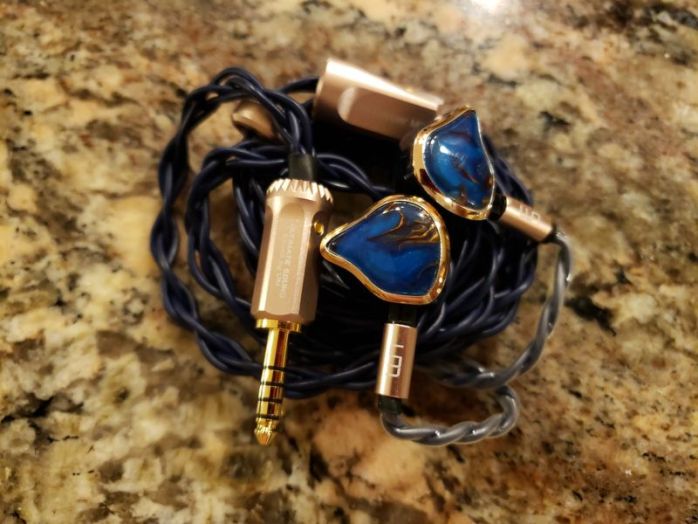
If you have other flagship cables, go ahead, it never hurts to try, to see if you can bring more refinement to the sound. But considering the quality of stock PWA copper cable, I don’t think you need to invest into a cable upgrade with Indigo. The stock cable is great looking, great sounding, and has a great pair up synergy here.

 Twister6 Reviews
Have you been interested in the Elysian Acoustic Labs Annihilator 2021?
I’ve been interested in this IEM because of its superior treble extension in the frequency response.
I mean, some reviewers out there said that the Annihilator 2021 makes other IEMs thus far a laughing stock because other IEMs have a poor EST implementation like having an upper treble roll-off, not having enough sparkle, too dark, etc.
LikeLike
Sorry, no plans to review Annihilator or X, Seems like this one is a mixed bag of impressions, people love how well it renders treble, but not the mids. It felt like FOTM. Btw, which review are you referring to? Can you provide a link? Curious about it.
LikeLike
It was Precogvision’s impressions on the Annihilator, here’s the link: https://www.head-fi.org/threads/precogs-iem-reviews-impressions.937468/page-40#post-16351838
But I think the Annihilator that Precogvision got is the demo version or the Pre-2021 edition because the cable was different.
Here’s the picture of the Annihilator that Precogvision took: https://www.head-fi.org/threads/precogs-iem-reviews-impressions.937468/page-40#post-16350442
Here’s what the Annihilator 2021 cable looks like, it comes with Liquid Links Martini as a stock cable: https://www.facebook.com/elysianacousticlabs/photos/a.1455532574536383/4123619397727674/
Here’s the picture of the demo version of the Annihilator that crinacle took: https://crinacle.com/2020/01/14/cliffnotes-elysian-annihilator-dio-the-exception/
And also, the mids on the Annihilator 2021 were flatter compared to the Annihilator Pre-2021, sample 2, which is more V-shaped: https://crinacle.com/graphs/iems/elysian-annihilator-dio/
I still don’t know if the Annihilator 2021 were thin though.
LikeLike
Hi Twister6, would like to know if you can compare U18t to the UM Melody Indigo, my local dealer still have some spots left for pre order of the indigo. I am kind of interested but would like to know your take vs U18t. Thanks alot.
LikeLike
a very different tuning where U18t has flatter bass, more forward and brighter mids, and brighter treble, while Indigo has more elevated dynamic bass, less forward and smoother mids, and not as bright treble.
LikeLike
Thanks for your reply, I currently find U18t bass is lacking to my taste with M20 module (with M15 to me is like bass is not even there). I listen to alot of female vocals that get quite high in the treble, I am sensitive to treble and sibilance. I love the sound of my HD800s and Hifiman Arya Stealth. My Focal Stellia sounds weird with very shouty female vocals but I like the bass amount on the Stellia and the soundstage is quite nice.
For an iem with good depth, width, great bass, great details and biggest soundstage depth and wide. What do you recommend? Basically looking for a HD800s sound with more bass in an Iem. Thanks alot Twister6.
LikeLike
Not familiar with Hd800s, only heard it needs a powerful amp to make it sound great. Thus, would be hard to recommend equivalent iems to any of the headphones your are using. Sorry.
LikeLike
Hi Twister6,
How would you compare the Indigos to the 64A Nio or U12t? I’ve got my choices down to these three but I’m really torn over which one to go for and haven’t seen any reviews where a comparison is made between these specific models.
LikeLike
Have to go by memory since I don’t have Indigo with me anymore, it was on loan. It’s not an easy decision, but each one offers something different and unique. If you want the biggest soundstage with the best imaging, it’s Indigo. The biggest bass impact Nio, the a great texture analog bass is Indigo since U12t BA bass is good but not the same as DD. The most balanced tuning U12t, probably the “safest” tuning that will work with any genre of music. Ability to tweak the sound, Nio/U12t with their apex modules and optional atom modules from fir audio. The smoothest treble, probably Nio, while Indigo will give you more micro details and more energy in treble. The most tech per square inch and the most comprehensive set of accessories (PWA copper balanced cable, Dignis leather case, Xelastec and Comply tips) – Indigo 😀
LikeLike
Twister6,
Thank you so much for your response, I think. haha You have given me a lot to think about. Using what you wrote the Indigo checks the the most boxes, and they look sexy. Yet, one comment you made has me really on the fence. The U12T has the “safest” tuning that will work with any genre of music. I listen to a lot of different genres. I think musicals and opera are the only two I can outright rule out. Just not my thing, but everything else is fair game for me even if it’s just a song here or a song there. That complicates my decision greatly because I do appreciate good bass and would have preferred to stick to an IEM that has a DD in it. Precog made some interesting comments in a YouTube video about the U12Ts saying they have the least amount of compromises and he’s a basshead. Maybe the U12Ts will fill the bill with the right APEX or ATOM XL module. Or then again there’s the Indigos.
Or…. maybe if I weren’t so concerned about the size of them and fitting in my ears comfortably I would almost wonder if I should just get the EE Odins and be done with it, because two DDs is better than one right? haha I wish there was a place where I lived that had these so I could test all of these IEMs out and make an informed decision.
Thank you again for responding and weighing in on these IEMs. It is much appreciated to finally have at least one person’s comparison of these IEMs from experience they have or had with them. 🙂
LikeLike
Hi Twister6,
How would you compare Indigo to EE Odin in general, especially in bass and treble area ?
How is the fitting in your ear compared to EE Odin ? Is it more comfortable ?
Many thanks in advance.🙏
LikeLike
I don’t have Indigo anymore, was on loan from Musicteck for review. In bass area, Indigo has deeper extension with more rumble and stronger impact, while in treble the Odin has more sparkle and air. So, when it comes to tuning, they are more complementing than competing. The fit will depend on your ear anatomy. I don’t have a problem with either of these, and found both to be comfortable.
LikeLike