

Dongles, dongles everywhere but which one to go for?!
Introduction.
Even though we’re primarily known for our IEM, Headphone and DAP reviews, one of the most frequent questions I personally get are readers asking me which dongle to buy or the best dongle to pair with their transducers. It’s been quite a while since Apple took away the headphone socket and most other manufacturers followed suit – which was the fuel required to not only start the TWS but also the dongle segment. Initially the dongles were just cheap passive 3.5mm to type-C/lightning converters or random active DAC based cheapos but they’ve come a long way since then. For years premium audio manufacturers have been trying to push boundaries to see if they can parallel DAP level performance in smartphones using external DACs designed to offer higher, better quality audio than the internal DACs or cheap 3rd party dongles and now the ‘audiophile grade’ dongles really have started getting REALLY good! Good not just for on-the-go use when you really don’t want to carry a DAP but good enough for a large section of the audience to start questioning the value pricing of TOTL DAPs.
As I receive several questions about dongles every week, I thought I’ll do an article comparing the best dongles under $150 I personally like out of all the ones I’ve had the pleasure of trying so that I can just point our readers to this article every time I get a question about the same in the near future. Why $150 you ask? It’s because you can find good mid-fi DAPs for as low as $200-250 in the used market and the dongles priced upwards of $200 start becoming a bit expensive to buy over a good mid-fi DAP. There are quite a few great dongles under $150 and I think that’s a more reasonable price to spend on one.
Who really needs these dongles? There is no doubt that a good top mid-fi DAP is still superior to most dongles out there as it has the ability to play Hi-Res music bit perfectly because the whole device and circuitry are primarily designed for high quality audio performance but most of these DAPs have their own caveats – they are either not as fast or cool to use, or don’t have as attractive high resolution big screens as smartphones, have too less of a battery life, are a burden ‘coz they’re another device one would have to carry or are too expensive an investment for some. Even audiophiles who have a nice DAP, some just want something extremely portable for on-the-go use that isn’t a burden while others want a higher quality device to use with laptops over the cheap inbuilt DACs. These are the people who are primarily looking to optimise their smartphones and laptops for best audio performance for the cheap and these are exactly the kinda people who this article is for.
Important Note – All the dongles selected for this article are first and foremost under $150, the ones I personally shortlisted out of all the ones I’ve tried and are from popular brands most people know of and can easily find with sellers in their country. If I missed out or didn’t include a particular dongle or a dongle you were looking to buy, please excuse me. I’m sure there are excellent reviews from other competent reviewers that you can refer to. I hope everyone understands that it’s just not possible to include every possible product in the market. The amount of work of getting in touch with every brand and ask for their product, handling customs clearance and paying import duty for each one of them, and then investing massive amount of time testing and comparing like a madman for absolutely no monetary gain in return is an undertaking I wouldn’t wish for anyone. Oh also, one or two dongles used in the article could be out of stock by the time the article is published but I still chose to include them because they serve as good reference points for comparisons and can be found in the used market if one really wants them over the others.

iBasso DC05 ($69).
Links – Official Website
Specifications.
- DAC Chipset: Dual ES9219C Quad DAC+ (TM) Chips
- Output Level: 2Vrms, 13mW, (300Ω Load) 1.73Vrms, 93mW (32Ω Load) 1.5Vrms, 140mW (16Ω Load)
- Frequency Response: 20Hz-40kHz -0.5dB
- Noise Floor: 1.55µVrms
- S/N: 121dBA
- Dynamic Range: 121dBA
- THD+N: -105dBA (320 load)
- Output Impedance: <0.50
- PCM: Up to 32bit/384kHz
- DSD: Native DSD64, DSD128, DSD256
- MQA: 16X
- Weight: 9g
- Length: 105mm
Build.
It’s a well done simple design, built really well – a metal body with 3.5mm socket and metal Type-C connector attached with a well insulated non-detachable cable. Nothing to fault here.

Sound Analysis.
I’d classify DC05’s sound signature as neutral and easy going. It focuses on a clean, neutral bass presentation, linear lower-midrange and well balanced treble. It doesn’t sound coloured and no FR region jumps at you abnormally. It’s of course not the best in the lot when it comes to technical performance but is no slouch when standing alone. It has an average soundstage with fairly good layering and left to right separation considering its asking price. All in all, a no-BS dongle that presents music naturally with a form factor that is very easy to manage on the go. It’s fairly versatile with its pairing and works well with most IEMs without adding significant colour from its end but isn’t the most powerful. So, if you are looking to drive your demanding headphones, this won’t be able to drive the higher impedance ones properly. If you need more power and a significant upgrade in technical performance, keep reading on.

iBasso DC03 Pro ($69).
Links – Official Website
Specifications.
- DAC – Dual Cirrus Logic CS43131
- THD+N: -114dB (3000 load) -111dB (320 load)
- Output Voltage: 2Vrms (300Ω load) 1.77Vrms (32Ω load)
- S/N: 127dB
- Dynamic Range: 122dB
- Frequency Response: 20Hz-40kHz +/-0.5dB
- Noise Floor: 0.9pV
- Output Impedance: <0.120
- PCM: Up to 32bit/384kHz
- DSD: Native DSD up to 256x
- Size: 49.4*21*8mm
- Weight: 10.5g
Build.
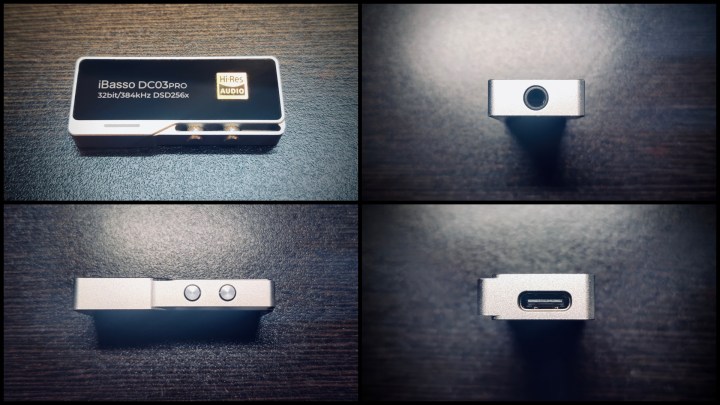
It’s twice the size sideways compared to DC05 but very well designed and built with a combination of plastic and metal. You now get volume up and down buttons on the side and a detachable Type-C cable.
Sound Analysis.
DC03 Pro ups the sound quality as well as technical performance over the DC05. The first thing I noticed was the increased bass punch and slam as well as richness in treble. I perceive a significant boost to resolution and definition of instruments and everything sounds a bit more defined and lively. Left to right separation as well as imaging are an improvement and so is the resolution of depth layering.

DC03 Pro comes with iBasso’s UAC app fully unlocked, which gives users the option to fiddle with L/R Balance, 5 Digital Filters, High and Low Gain modes as well as the option to switch between Normal and Turbo Output modes. I was quite intrigued with the Turbo mode that switches the output voltage. The difference isn’t too substantial but I do perceive it making the sound presentation slightly richer and more holographic when switched on and it’s not merely a placebo of a slight bump in volume. There really is something to it even with easy to drive IEMs.

iBasso DC04 Pro ($119).
Links – Official Website | Bloom Audio
Specifications.
- DAC – Dual Cirrus Logic CS43131
- PCM: Up to 32bit/384kHz | DSD: Native DSD up to 256x
- Size – 59mm*23.4mm*12.1mm
- Weight – 21g
4.4mm BAL Output:
- THD+N: 0.00013% (3000 load)
- Output Level: 3.0Vrms (32Ω load) 4.0Vrms (300Ω load)
- S/N: 131dBA
- Dynamic Range: 128dBA
- Frequency Response: 20Hz-40kHz ±0.5dB
- Output Impedance: <0.40
3.5mm SE Output:
- THD+N: 0.00018% (300Ω load)
- Output Level: 2.0Vrms (32Ω load) 2.0Vrms (300Ω load)
- S/N: 127dBA
- Dynamic Range: 126dBA
- Frequency Response: 20Hz-40kHz ±0.5dB
- Output Impedance: <0.20
Build.
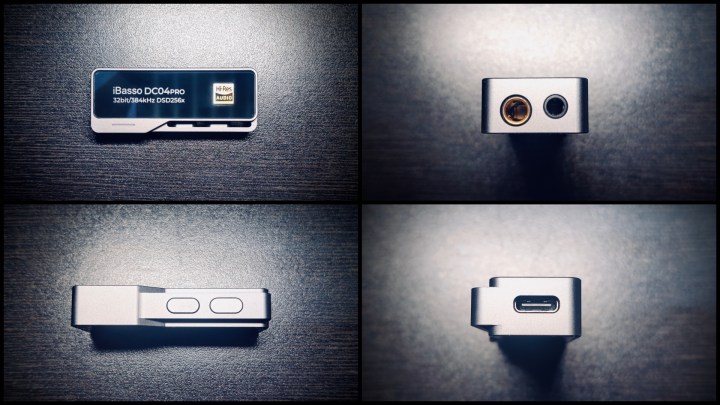
DC04 Pro keeps a similar design as DC03 Pro but has a more rugged build and is slightly bigger in size as it adds the extra 4.4mm BAL output circuitry. Volume buttons are bigger and feel better to use too.
Sound Analysis.
This is the most technically competent dongle out of iBasso’s offerings and also the most musical. It sounds rich with very good bass slam, slightly fuller sounding lower-midrange with crispy, sparkly treble that makes for a very musical and interesting balance that presents music in a very exciting and lively way. The slightly fuller lower-midrange makes it sound very minorly coloured than a more reference sounding dongle like the Tanchjim Space but makes for a fuller bodied listen that pairs very well with leaner sounding IEMs. The resolution, left to right separation as well as imaging are the best out of the iBasso lot and it has the best instrument definition out of all dongles. The soundstage sounds most holographic and has one of the best depth layering with a blacker background than most of the dongles in this article along with Space. It has both a 3.5mm SE and 4.4mm BAL outputs, with the 4.4mm BAL output being powerful enough to drive most headphones in my collection. HD6XX gets to loud levels at 75% volume. Tonally, it pairs really well with headphones like Audeze LCD-X 2021, LCD-XC 2021, DCA Aeon Closed X and Meze 109 Pro.

This again comes with the iBasso UAD fully unlocked and has an added Eco mode over all the options DC03 Pro had.

HiBy FC4 ($89).
Links – Official Website
Specifications.
- DAC: Dual ES9219
- RGB indicator light: Status indicator
- USB port: Type-C
- Headphone out: 3.5mm SE and 4.4mm BAL
- Supported formats: PCM up to 768kHz/32bit | Up to DSD256 native
- Dimensions: 65.3*22.1*11 9 mm
- Weight: 21.7 g
3.5mm SE Output:
- Output Level: 1.9Vrms (32Ω)
- Output Power: 110mW (32Ω)
- THD+N: 0.0008% (32Ω)
- Noise: 1.7µVrms (32Ω)
- SNR: 120dB (32Ω)
- Dynamic Range: 120dB (32Ω)
- Crosstalk Rejection: 72dB (32Ω)
- Frequency response (-3dB): 20Hz – 90 kHz (32Ω)
4.4mm BAL Output:
- Output Level: 3.3Vrms (32Ω)
- Output Power: 340mW (32Ω)
- THD+N: 0.0006% (32Ω)
- Noise: 2.2µVrms (32Ω)
- SNR: 123 dB (320) 123 dB (32Ω)
- Crosstalk Rejection: 98 dB (32Ω)
- Frequency response (-3dB): 20Hz – 90 kHz (32Ω)
Build.
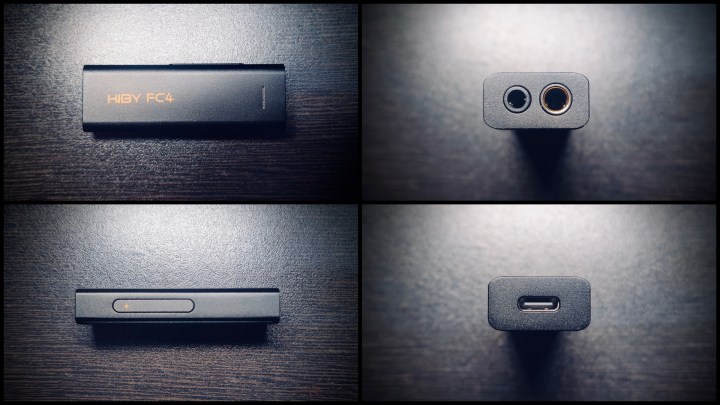
Really good full metal unibody with detachable cable. I quite like its design – the full black finish with faded gold lettering and the LED indicator on the top. The volume click buttons feel nice to use and the 3.5mm SE and 4.4mm sockets are of high quality too. Besides the slightly bigger form factor, there is nothing to fault and this is probably the best built dongle along with DC-4 Pro.
Sound Analysis.
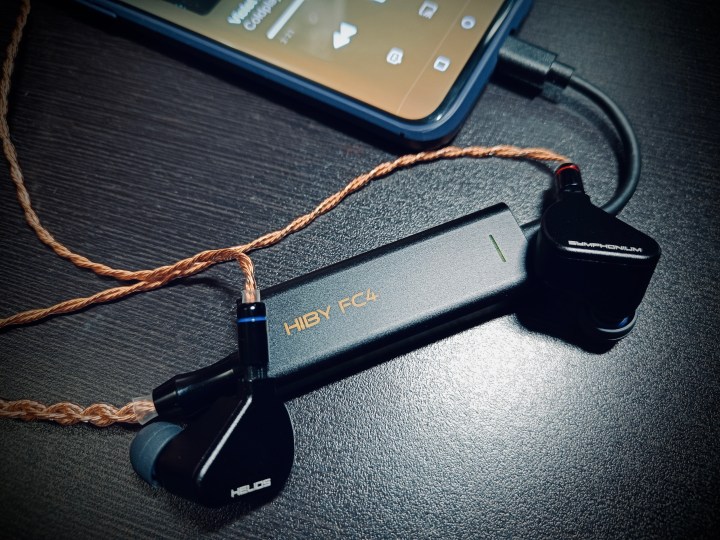
FC4 is a very well done warm signature where bass, upper-midrange and treble get a slight bump to make for a very musical listen. FC4 primarily focuses on vocal performance and instrument definition and the tiny bump to bass increases perception of slam and punch, all the while keeping the overall sound signature sounding very natural and comfortable. It has good technical performance, especially how well it defines the boundaries of the soundstage with good clarity. So, all the instruments panned hard left and right are presented very cleanly. FC4 makes for ideal pairing with bright sounding transducers, where it adds enough warmth and musicality to tone down the clinical sound presentation of the transducer but keeps the resolution and definition intact without things sounding muddy. 4.4mm BAL output with 3.3 Vrms/340mW output is quite powerful to drive even headphones like HD6XX to loud levels at just 75% volume.
Tanchjim Space ($89).
Links – Shenzhen Audio
Specifications.
- DAC – Dual Cirrus Logic CS43131
- Headphone port: 3.5mm SE / 4.4mm Bal
- Input port: USB Type-C Frequency response: 6hz-85Khz
- Background noise: 1.3uV (BAL) 1.luV (UNBAL)
- Dynamic-Range: BAL: 132dB | UNBAL: 127dB
- THD+N: 0.00017% (BAL) 0.00019% (UNBAL)
- Output power: 4Vrms (BAL High), 2Vrms (BAL Low) 2Vrms (UNBAL High), 1Vrms (UNBAL Low)
- Weight: 14.8g
- Size: 4.1*2.1*1.2cm
Build.
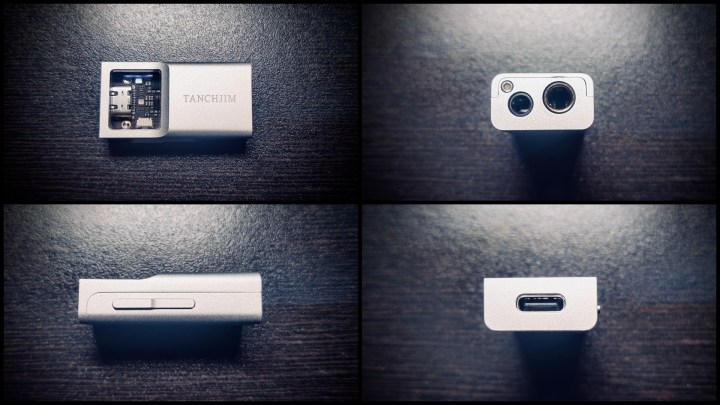
Space is very well built with a full metal body, volume buttons on the side and an attractive clear panel on the top that gives one a sneak peak into the circuitry inside. This is my favourite design out of all dongles in this article.
Sound Analysis.
Space is very aptly named because it is the cleanest, most spacious sounding of all dongles in this article. It offers a very clean, very enjoyable reference class sound signature for an affordable price and is very versatile with its pairing as it plays music very cleanly without adding much from its end. It is the leader in technical performance (along with iBasso DC04 Pro) with very good left to right separation, good depth layering and very good imaging and centre image isolation for its asking price. It takes the cake when it comes to the cleanest audio performance and the ability to space out the panned instruments with good separation between them is unparalleled amongst all dongles in this article. It has the nicest soundstage size with good width and depth. The depth in particular impressed me quite a lot as it is able to resolve the reverb trails disappearing deep into a nice black background very well. The 4.4mm BAL output also has good amount of power to power most headphones in my collection and pairs better than DC04 Pro with headphones like HD6XX that already has some bloom in the lower-midrange and needs more of a reference class source to sound its best. For reference it powers HD6XX to equally loud volume level as FC4 and DC04 Pro at 80-85%.

Tanchjim Space Lite ($45).
Links – Shenzhen Audio
Specifications.
- Earphone Jack: 3.5 SE
- Input interface: USB Type-C
- Frequency response: 6hz – 85 kHz
- Noise Floor: 1uV
- Dynamic Range: 126 dB
- THD+N: 0.0003%
- Output level: 2Vrms
- Weight: 10.9 g
- Size: 3.75 *1.37 *1.00 cm
Build.
Space Lite has an iBasso DC05 style build with a more rugged looking metal body, a plastic Type-C connector and a well insulated, non-detachable cable in between. No-BS, well built to last a long time.

Sound Analysis.
Space Lite quite keeps idea of the sound presentation of its older brother Space intact. It has a very nice, clean, ‘spacious’ sound presentation with very good resolution and separation for its price, in fact hitting above its asking price of $45. What really impressed me was how Tanchjim was able to maintain most of the technical performance of its older brother at its asking price, especially the space and separation between instruments, because other dongles at the $50 mark don’t sound as clean or resolve as much. It has good soundstage size with good width and depth, with the depth layering and black background being ‘almost’ as impressive as its older brother. This really is a proper trimmed down, ‘lite’ version of Space without the 4.4mm BAL powerful output, detachable cable or the clear glass panel design. It does not have the power of Space but its 2Vrms power is no slouch and is able to drive even demanding headphones like the HD6XX to fairly loud levels. Driving IEMs, even demanding ones like the Symphonium Audio Helios is no problem at all.

Conclusion.
If you’ve read the whole article, you must’ve realised one thing by now – your choice of dongle depends on the kind of source you like, what you personally need it to do, how it pairs with your IEMs/Headphones, if it can or can not power your power hungry headphones and finally if it’s ergonomic enough to serve the primary purpose of a dongle – which IMO is to be small enough to carry around providing high quality audio without being a burden.
If you ask me what I like and would go for personally, I sadly don’t have a single answer for you. Instead here’s what I’d do for my use case –
Best value – Tanchjim Space Lite.
Space Lite’s sound performance is a fair upgrade over the Apple dongle and something I’d personally be happy using with IEMs without complaining. It rivals performance of dongles much more expensive and is a significant ‘audiophile grade’ upgrade over your regular run of the mill dongle that your phone company sells. It’s also the most ergonomic of all along with the iBasso DC05 but beats the DC05 in sound performance by quite a margin. If you’re looking for a dongle to primarily drive your IEMs, Space Lite will serve all your needs and more. Plus it has the smallest form factor, which is a big win. If you want more power and need it to drive your headphones too, check out the list below.
Best All Rounder with Good Power.
Tonality –
- Reference, detail oriented signature – Tanchjim Space
- Very slightly tastefully coloured, detail oriented signature – iBasso DC04 Pro
- Warm signature with focus on vocals and instrument definition – HiBy FC4
Technical Performance –
- Power – FC4 = DC04 Pro > Space (Minor difference)
- Resolution & Detail Retrieval – DC04 Pro = Space > FC4
- Instrument realism and definition – DC04 Pro > Space = FC4
- L&R Separation and Imaging – Space > DC04 Pro > FC4
- Soundstage – Space > DC04 Pro > FC4
Ergonomics –
- Space = DC04 Pro > FC4
If I wanted a powerful dongle with a detail oriented signature to power most things in my collection including power hungry headphones, I’d either take the Tanchjim Space or iBasso DC04 Pro. Space if I wanted a very versatile, clean and accurate reference presentation with high levels of detail retrieval and DC04 Pro for a very slightly coloured, fuller bodied presentation with equally good detail retrieval. On the other hand, if I needed a powerful dongle with a warm signature to pair with the brighter headphones and IEMs like DCA Closed X, Audeze LCD-XC, Craft Six and BGVP DM9, to make for an easier listening experience while keeping the focus on vocals and instrument definition intact, I’d go with the HiBy FC4.
Hopefully this article provides a fair picture of how you could shortlist and choose your dongles and helped give you insights into some of the best, most popular dongles you can buy under $150. Cheers!
Gear used for testing and review.
- Phone – OnePlus 7 Pro
- Laptop – Apple Macbook Pro 15″ Retina
Artists I like and listen to.
- Rock – Foo Fighters, Linkin Park, Switchfoot, Imagine Dragons, Daughtry, Green Day, MuteMath, X Ambassadors, Dave Matthews Band, Vertical Horizon, Our Lady Peace, Lifehouse, Fall Out Boy, Breaking Benjamin, Muse, ACDC, Audioslave, Rage Against the Machine, Biffy Clyro, I Am Giant, Normandie, Paramore, Slash & Guns N Roses, 3 Doors Down.
- Pop Rock – John Mayer, Coldplay, Paul McCartney, James Bay, Hunter Hayes, Niall Horan, Keith Urban, The Bros Landreth, Bryan Adams.
- Progressive Rock/Metal – Porcupine Tree/Steven Wilson, Karnivool, Tool, Dead Letter Circus, Periphery, Lamb of God.
- Pop/Soft Rock – Ed Sheeran, Adele, Taylor Swift, OneRepublic, The Script, Gavin James, Magic Man, Maroon 5, Bruno Mars, Charlie Puth, Dua Lipa, The Weeknd, Oasis, Panic! At the Disco, TwentyOne Pilots.
- EDM – Chainsmokers, Zedd.

 Twister6 Reviews
I absolutely love the title of this post. These are some neat dongles indeed. I have a pretty substantial Bluetooth setup that sounds great, but for the price point, these sound like some absolute bargains when it comes to getting the best sound quality. I’m not an audio engineer, so I don’t understand the technical bits, but at least I learned something 🙂 Also, you have some excellent taste in music.
LikeLiked by 1 person
Thanks Amelia! 😀
LikeLike
I find that the Astell & Kern HC2 rivals their SP-3000 and is perfect when I want only to have my iPhone with me.
LikeLike
Which dongle that suitable for progressive rock/ metal between dc04 pro and fc4?
Thanks in advance..
LikeLike
Hello! Sources can’t be divided and decided based on genres. I’ve seen some people do it and it’s flabbergasting for me personally. The differences between sources aren’t night and day but minor in the larger scheme of things and all dongles and DAPs are capable of playing all genres equally well. Majority of the sound in the chain is based on the sound signature of your transducers and you can only tweak and colour it VERY slightly with sources and cables. So, you choose your transducers (IEMs/headphones) based on the kind of signature you like or with an idea of a warm, neutral or bright tilt that works better for the genres you like but the sources should be decided based on the transducer you want to pair them with; the signature of the transducer you want to complement and what you want the source to do.
DC04 Pro, Space and FC4 have slightly different tonalities and they one up each other in different areas of technical performance as shown in the Conclusion section. They’re all versatile enough to use with any IEM and headphone and you can make a decision based on what you value most looking at the breakdown I’ve shown in there.
Or if you tell me your transducers and the kind of setup you’re wanting to make, I can recommend the dongles for you to try accordingly.
LikeLike
Hi Animagus. This is a great article. I am looking for a good dac dongle to run my AKG371 headphones just to listen to music through my phone either via amazon ultra HD streaming or hi res files on the memory card. The 371s can handle a frequency down to 5hz so I was looking for a dac that doesn’t unnecessarily limit their performance with a limited frequency response. Am I right in saying the space is the best dac here in frequency range?
LikeLike
Hey, thanks. All Dongles can play the human frequency range. The differences between them has to do with sound signature and power and not frequency range. You can choose any of these if frequency range is your concern but for best power to run a variety of headphones in your future collection, I’d recommend going with ones that have a powerful balanced output like Space and DC04 Pro. Best you buy a 4.4mm balanced cable for your K371 and use the balanced port of these dongles.
LikeLike
Do you find Space better overall than DC03 pro regarding technicalities, detail retrieval etc.? Soundstage difference really noticeable? You didn’t noticed any coloration, frequency boost in the treble area with Space?
Also your sound impressions with Space are with the balanced output or SE? It seems balanced gives better results, even with efficients iems, according to some reviewers.
LikeLike
DC03 Pro, yes. Plus the more powerful 4.4mm balanced output at the same price point is a big win IMO. Space does sound more open, slightly wider and spacious (Ha!). As for the part about treble, it is revealing of the true signature of an IEM. It doesn’t smoothen out the treble, especially the upper-treble, which a lot of the cheaper and not as well executed dongles tend to do. So, if a transducer has sparkly treble or brighter treble in general, it will portray that. If they don’t, I don’t hear it adding much treble artificially as such. All my impressions in case of dongles with balanced outputs are with the balanced outputs.
LikeLike
Hi. I would like to know your opinion on how these dongles work with planar IEMs and can a warm sounding one like FC4 can improve the lean sound of planar like KZ PR2?
LikeLike
Hello. I haven’t tried the KZ PR2 but if you’re saying it’s lean, FC4 will pair better with it if you want to make it sound slightly warmer and fuller. But if you’re thinking it’ll make it sound much fuller, it won’t. Sources and cables can’t make as significant a difference as EQ. You’d be much better off using EQ than going through several sources for something that EQ can solve for free. With sources it’s more about synergy – stuff locking in well. They’re not an alternative to corrective EQ.
LikeLike
Need one for listening to YouTube videos late nights. No critical listening but voices MUST be super clear.
I’m assuming any of these would be good enough but wanted to check with the experts here.
LikeLike
If just for that, any of these will do. 🙂
LikeLike
Hi. Unfortunately I hadn’t seen this before I purchased the DC03 Pro. Now its return period has passed and I’m stuck with it. Could you suggest me an iem under $200 that’ll synergize well with it? I’m using a BLON 03 and I’m willing to try hybrids or planars with a warm neutral and high resolution sound signature.
LikeLike
Hi. Unfortunately I hadn’t seen this before I purchased the DC03 Pro. I had a tight budget, now its return period has passed and I’m stuck with it. Could you suggest me an iem under $200 that’ll synergize well with it? I’m using a BLON 03 and I’m willing to try hybrids or planars with a warm neutral and high resolution sound signature. I could lose a little bass over the BLONs but I want the same musical tonality and much, much more microdetails and nuances. So far I have thought of the Simgot EA500, Truthear Hexa, Kiwi Ears Melody, and a new player, the Ziigaat Cinno. But I can’t audition any of them, so I’ll have to settle for one.
As you can see, I have some chaotic thoughts. Could you please help me out? Thanks 🙂
LikeLike
I quite like the DC03 Pro. It’s no slouch. It just misses a balanced output, which is more useful for the more demanding IEMs and headphones. Otherwise you should be pretty fine using it for a good while.
Out of the options you listed, I like Truthear Hexa the most. It is a very refined sub-bass boosted neutral reference style IEM which has a more accurate tonality and timbre and is equally musical and fun with the best technical performance at its price but that is if you like your music to sound accurate as per its mix and master. Here’s my review of the Hex for you to get a good idea of its performance – https://twister6.com/2022/12/25/truthear-hexa/
LikeLike