
Mini Godzilla Battle.
Both amps were borrowed for a few days from Musicteck for the review purpose in exchange for my honest opinion.
Website links: Brise Audio Tsuranagi, MASS-Kobo 475.
Intro.
While attending CanJam NYC ‘23 early this year, one of the products on my wish list was Brise Audio Tsuranagi (Tsu) portable amp, though Musicteck table was too busy, and I didn’t get a chance to hear it. I was only able to borrow it after the show for a few days and really enjoyed my time with it. When I shared my impressions on Head-fi, I got quite a few questions asking me how it compares MASS-Kobo 475, another popular portable amp from Japan. Neither of these amps are easy to demo or to obtain a review sample of, especially if you are in US or Canada. But now with Musicteck carrying both in their store, it was a golden opportunity for me, though only for a few days because they can only get a few units at a time since these amps are not mass produced and sell out very quickly.
Since I literally had only two days to listen and to compare these, the impressions are very brief, falling under my In-a-Snapshot review category. So, here we go!
General Design thoughts.
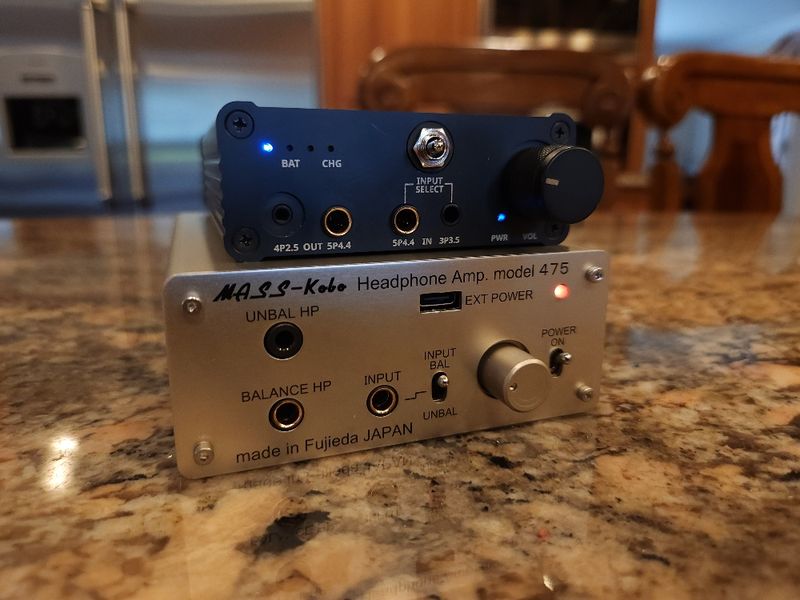
Bigger footprint 475 has all of its ports on the front. With 4.4mm input only, to my surprise it has a switch to select either BAL or UNBAL. This amp came with detailed instructions in Japanese and English, including circuit diagrams, so I’m sure the wiring and connections will be explained in more details there. The output to the left of it has 4.4mm BAL and 3.5mm UNBAL ports, but I was only interested in BAL in/out functionality. Furthermore, you get a power-on toggle switch all the way to the right, a smooth continuous analog volume pot, and usb-c EXT POWER port above it with led next to it. I wish volume knob would have been a little bigger and had a better grip because with usb and LO cables in place, it could get a bit crowded in that area, but, nevertheless, still manageable.
EXT POWER port has a different functionality from what you would expect. It actually allows you to power up and use 475 directly from USB charger, either a wall charger or a battery-bank, without a need to have batteries inside. And speaking of batteries, the bottom of the amp has a sliding door with an access to a compartment for 4xAA batteries. In there, you will also find 4 dip switches for Hi/Lo gain, very important to know because by default it was set to Hi gain which is not as friendly with iems, thus don’t forget to switch it to Lo gain if you are using mostly iems. The demo unit I received from Musicteck had 4 rechargeable AA batteries, and I thought plugging in usb-c cable will charge them up, but it didn’t. Makes sense since it is intended for any kind of AA batteries, thus you only have a basic LED indicator to show when either usb power coming in or battery voltage is high enough and above the acceptable threshold.
On the other hand, Tsu has a smaller and a sleeker footprint in comparison to 475. Here, the ports and functionality are a little more straight forward. The analog volume pot is all the way to the right, used both for volume control and to turn the power on, so there is no need for a separate power switch. The volume knob is bigger and has a secure comfortable grip. As you turn it on, you are greeted with led lights in upper left corner, indicating the remaining capacity of the internal rechargeable battery. There is also a separate power/charging led next to it. For charging, usb-c port is on the back, a cleaner way to declutter the front. Btw, Tsu came with 5V/2A wall charger as part of the accessories, or at least one was included with my demo unit. The front of Tsu has 4.4mm BAL and 3.5mmm SE inputs, selectable with a toggle switch. Then, to the left of it, you will find 2.5mm and 4.4mm balanced outputs. Also, there are 4 screws on the front and the back to take the amp apart.
From the usability perspective, Tsu is more compact, making it more portable. Tsu spec mentions 8hrs of battery life, while 475 spec only lists around 4hrs on 4xAA batteries, but it was confirmed by manufacturer that it is a typo and amp should last 8hrs on batteries as well. 475 also has easier access to a battery replacement on the go and can be used even without batteries as a desktop amp with a direct usb power connection. Both are portable, but the added bulkiness of 475 pushes it more toward transportable. For me personally, I can see using Tsu on the go and 475 at home on the desk.


Sound Impressions and the Conclusion.
Tsu and 475 were tested and compared using MM and Jewel iems and Brise Audio Yatono mini–Ultimate grounded interconnect cable. For my source, I was using Lotoo LPGT (fixed voltage LO setting of 2Vrms), iBasso DX320Max Ti (Gain #2 setting), and A&K SP3000 (fixed voltage LO setting of 4Vrms). Sound impressions were collected using all three sources.


From the get-go, I found both amps to have a dead quiet black background, though for 475 with IEMs you do need to switch to low gain, regardless of the battery or the external USB power use. In high gain, 475 had some background noise with my iems. Also, they have excellent natural resolution, and among the best vertical micro/macro dynamics expansions I heard. And I hear a very precise layering and separation of the instruments and the vocals which gives every sound a multi-dimensional standalone presentation. Furthermore, they both enhance the quality of the bass with extra rumble, making the bass sound more articulate, regardless of if it is DD or BA driver (Jewel vs MM in this case). But to my ears their mids/treble coloring is not exactly the same.
Tsu has more transparency and less coloring with a clean and clear neutral detailed tonality of the mids and the treble, creating a more revealing sound presentation. Not necessarily bright, just very clean and more revealing. On the other hand, 475 adds more body to the sound which gives mids extra coloring density without affecting the resolution or the retrieval of details. As a result of the difference in how I hear the mids between these two amps, I find the treble in 475 to be a touch smoother, while the bass in Tsu (due to the contrast with its more neutral mids) to have a bit more impact. Also, the difference in mids affects the perception of the soundstage expansion, with Tsu spreading wider, more left-to-right, and having more holographic imaging. 475 soundstage expansion is wide as well, though Tsu is just a little wider. But 475 imaging, due to a fuller body mids, has a more mid-centric focus of sound placement.
Both are great portable amps with an excellent technical performance and some difference in tonality of the mids. I enjoyed both amps with my IEMs, especially the expansion of the vertical sound dynamics. But on the go, I feel Tsu will make a better companion, and also will pair up better with warmer and neutral tuned IEMs. 475 was great for a desktop use, especially powered up directly through usb port. Plus, it had more headroom in high gain when driving more demanding headphones like R70x. With IEMs, I found 475 to pair up better with brighter or U-/V-shaped tuned monitors.

 Twister6 Reviews
Sorry, but you seem to have inverted the descriptions of the sound of these models
LikeLike
Had both amps for a day, literally spent 4+ hrs testing it with Jewel iems, direct a/b comparison. Talked to a few of my audiophile friends whose sound impressions split between mine and the “inverted”. So, re-did my testing the next day, with fresh ears and confirmed my findings. Just curious, do you own both amps and which iems or headphones you tried? Cause, I’m noticing a variation in opinion depending on iems (those testing it with Jewel or MM hear it like I do, others using Maestro SE or Grand Maestro and XE6/RN6 hear it the opposite). Thus, I’m curious about your setup?
LikeLike
I’ve listened to the 475 on the Noble Ragnar for quite a while and once managed to listen them briefly with the Tsu as well. It’s quite strange to get such similar yet opposite impressions of these amps.
LikeLike
Agreed with comment above – your impressions are the complete opposite of what I hear and what many others here. Just noting it because potential buyers should note that the sets of impressions you offer are a bit skewed on these amps.
LikeLike
I would also add – it seems the Mass Kobo you were using wasn’t fully charged judging by the light in the photo and you also seem to be using cheap nondescript batteries. Try fully charging, using Eneloop Pro’s and demo again.
LikeLike
Indeed, very strange. As you know, I’m not a noob 🙂 but the reversed impressions? Hmm… The demo I got was only for a day, not coming back, and i took out batteries and had it plugged into usb-c power during auditioning and testing, and also compared using regular fresh AA batteries. Tested it one day, then came back the next day to retest before I shipped it back, and confirmed the same. So, you are suggesting that 475 is leaner and brighter while Tsu is warmer and has a fuller body? Maybe 475 unit I had wasn’t right…
LikeLike
Not exactly leaner but absolutely more energetic with greater transparency and more air in treble. And certainly mid-centric, smooth and warmer would my description of TSU rather than Mass Kobo. Mass Kobo has body in lower mids but it’s about control rather than mid-bass bloom – it gives weight to the presentation. Wouldn’t imagine it was faulty given how well the Mass Kobo units are. Maybe you can demo another time for longer.
LikeLike
Amazing comparison between two legends! It’s perhaps been a while, but out of curiosity would you find any/ both of these as an upgrade over the C9 or at the same level? I was looking between the C9 and the Mass Kobo 475 as a desktop solution to stack with my DAP for at home open back listening. Just can’t seem to find any direct or indirect comparisons between the two. 🤣
Ps I’m stuck on a loop between sign in & posting – is this going through?
LikeLike
Not sure what happened, maybe a glitch with WordPress? But either way, got your comment 🙂 Tsu/475, while having their own subtle differences, are on a different level from C9. Tsu/475 which I heard both were apparently designed by Mass-Kobo guy, have a typical Japanese tuning with more transparency, less coloration, blacker background, improved dynamics. C9 is more colored amp that will give you more analog texture, more warmth in sound relative to Tsu/475. As I usually say, one is not better than the other, they just add a different flavor to the sound which going to affect pair up synergy with your iems/headphones. And if you are dealing with sensitive IEMs, another plus for Tsu/475 since they don’t hiss.
LikeLike