
Everything, including the kitchen sink!
PROS: Triple timbre selection with Solid State and Classic/Modern dual NuTube tuning, fully balanced discrete amp design with Class A and Class AB modes, P and P+ output power modes, solid Titanium chassis, lots of digital and analog outputs, hi-res 6” display, fast Android 12 performance w/665 SoC, 8GB RAM and 256GB ROM, DSD512 support.
CONS: price, size/weight, DAP can get toasty depending on the sound config.
The product was provided to me on loan for a few days for the review purpose in exchange for my honest opinion.
Manufacturer website: Cayin. Available for sale from authorized retailers like Musicteck.
Intro.
Last year when I published my N8ii review, it was titled: Beyond of “everything but the kitchen sink”. Fast forward a year later, and out of the blue Cayin surprised us with their 30th anniversary Limited Edition DAP, named appropriately as N30LE, even including the “kitchen sink” this time. Available in two versions, the regular N30LE will be limited to 300 units while a special fine-tuned N30LE AP (Amber Pearl) version bundled with UM Amber Pearl IEM will be limited to 99 sets. Due to a limited global release and the upcoming CanJam SoCal ’23 where this Musicteck’s demo unit should be showcased, I only had a very short time to audition the standard N30LE version, spending a few days with this DAP to collect my impressions.
But as I was testing N30LE, a Head-fi thread with a discussion about some customers having the issue using N30LE DAP in Class A (or Hyper mode) with specific cables in combination with particular earphones/headphones caught my attention. While I haven’t experienced any of these issues and noticed that not everybody was affected, this was not an isolated case since a number of people reported it. Cayin issued the official response, including the warranty extension to 5 years covering all N30LE units even if you are not the original owner. I will leave this discussion to Head-fi thread since I don’t have anything to report here because I haven’t experienced these issues, but also don’t want to downplay it and want others to be aware of it.
Now, let me share what I have found after spending a few days with this latest Cayin flagship release, N30LE, which I already miss like crazy.
Unboxing and Accessories.
Nothing much to cover about the unboxing since I received N30LE loaner in a leather case by itself without the official packaging.
From the product listing, in addition to the DAP and its leather case, included are a quality USB-C cable, 2.5mm to 4.4mm adapter, 2.5mm to 3.5mm adapter, micro-SD card tray ejector tool, tempered glass screen protector, and a quick user guide. These are the same accessories as were included with N8ii, except for the tray ejector tool since N8ii had a spring-loaded SD slot.
Also, according to Cayin, the case is hand-made from a premium grade vegetable-tanned leather. It wraps around the chassis of the DAP and has a side opening with a magnetic lock flap, making it more secure since the DAP won’t slide out from the top or the bottom of the case. All the ports are easy to access from the bottom, and the top has a convenient cutout to access the volume wheel. Buttons on the right side are covered and easy to feel since the shape is indented into the leather. The back features a crafted metal grill, made popular by Dignis design, for a more effective venting of the heat from the DAP.


Design.
While some might expect N30LE to look similar to N8ii, these two DAPs are quite different in exterior design. With dimensions of 156mm x 89mm x 25mm and a hefty weight of 650g, N30LE is bigger and heavier than N8ii which is 147mm x 78mm x 25mm and at 442g. As a result, while I still consider N8ii to be closer to portable, N30LE tips the scale toward being more transportable. Both N30LE and N8ii are definitely thicker than your average flagship DAP, and one of the reasons for that was upright position of two NuTube modules to let you see the glow of NuTube green “eyes” with both modules on the left side, facing outside through the mesh window in N30LE, unlike the glass window of N8ii.


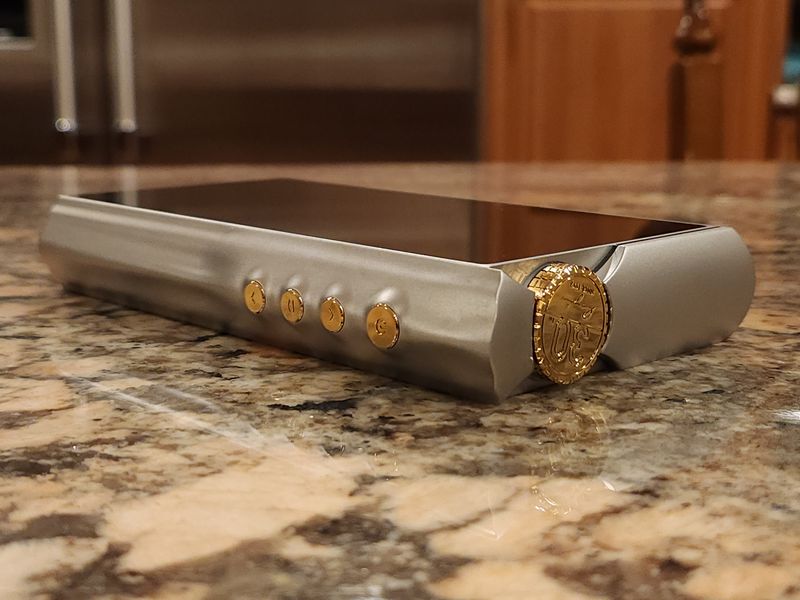
Switching from aluminum (in N8ii) to titanium material (TC21 Ti alloy steel chassis), the elegant design of N30LE chassis is not your typical rectangular brick. The front is occupied by a bigger 6” FHD+ Incell screen display with a higher 2160×1080 resolution and double-tap support, a step up from N8ii 5” OLED display with 1280×720 resolution. The back is all solid titanium with laser engraved etching. The left side has rounded mesh screen with two NuTubes behind it, showcasing the glow of green lights when activated. The right side has a sculptured rounded design with a raised molding forming a base for 4 round golden buttons – a larger power button and 3 smaller playback (play/pause/skip) buttons below it, each with a precise tactile response. This new updated design gives N30LE a more premium look.
The top is rounded as well, including a cutout in the right corner for a “golden” volume wheel with an etched 30yr anniversary artwork that looks like a collectible coin. The volume wheel is open at the top and easy to access from the front and the back. Underneath the volume wheel you have a glowing led ring with multi-color indicator of different playback sampling rates. At the bottom, you have dedicated 4.4mm LO/pre-amp and 3.5mm LO/pre-amp ports, then usb-C port (charging, data, usb audio in, embedded SPDIF, and digital-out functionality) sandwiched with I2S port right underneath in the middle and dedicated 3.5mm PO and 4.4mm PO ports next to it. All the way to the right, closer to the edge, you will find a micro-SD port tray which you access by pushing in the pinhole to open it.


Under the hood.
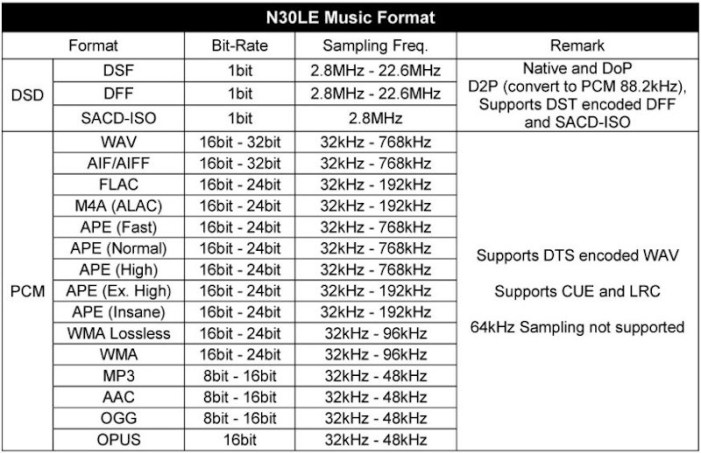
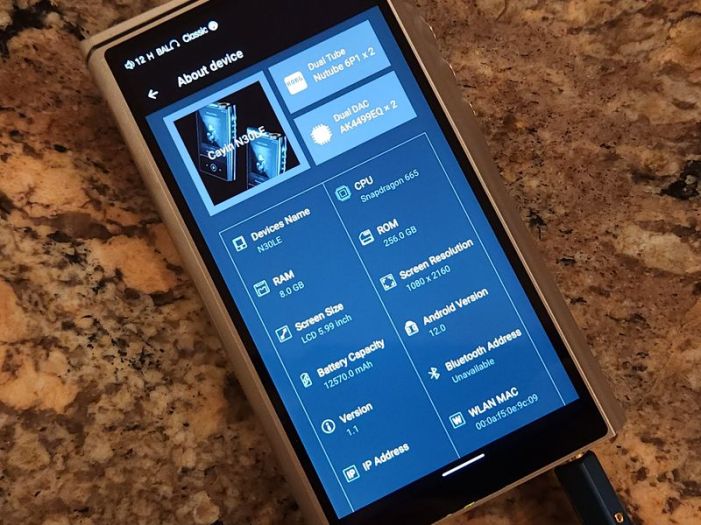
While some might consider N30LE to be “anniversary” refreshed version of N8ii due to general similarities, it actually packs a few major surprises. When N8ii development started, Cayin was planning to use AK4499EQ DACs, but after AKM factory fire that idea was scrapped in favor of the new ROHM BD34301 DACs. So, they end up with a limited stock of the unused discontinued 4499EQ DACs which made its way into N30LE, the reason why this edition is limited using two of these 32-bit chips per DAP. With 4499EQ, PCM decoding supports up to 32bit/768kHz and DSD up to 1 Bit/22.6MHz (DSD512). Also, you will still find dual Korg NuTube 6P1, and in addition to Solid State you also get two NuTube modes, Modern and Classic to give you a total of 3 timbre options. N8ii only had one NuTube mode.
You will still find a standard P and P+ modes which boosts the operation voltage of internal headphone amp to increase the output power (P+). It’s not the same as a gain control, and that one is also available with L, M, H gain settings. With P+ the output voltage scales up higher. Furthermore, you will still find a fully discrete balanced headphone amp design and Class A and AB amp modes tuned at a different bias point, and now you can also have P+ and Class A that wasn’t possible with N8ii. N30LE also introduced a Hyper mode which selects P+ and Class A by default with other parameters maximized to their full potential, though you can still choose the timbre but not the power or class modes.


N30LE is a fast Android streaming DAP running a highly optimized Android 12 OS and using Snapdragon 665 SoC along with 8GB of LPDDR4X RAM and 256GB eMMC internal solid storage, all scaled up from N8ii. If you want to expand the storage, you can add microSD card. The open Android OS, courtesy of Hiby, uses DTA architecture which bypasses Android SRC to make sure audio, regardless of local or streaming playback, is not down sampled. Based on the 3D Benchmark performance from AnTuTu v8.4.3 test app, I found N30LE score to be nearly the same as other DAPs with the same config. But in practice, I felt that N30LE system response was even faster.
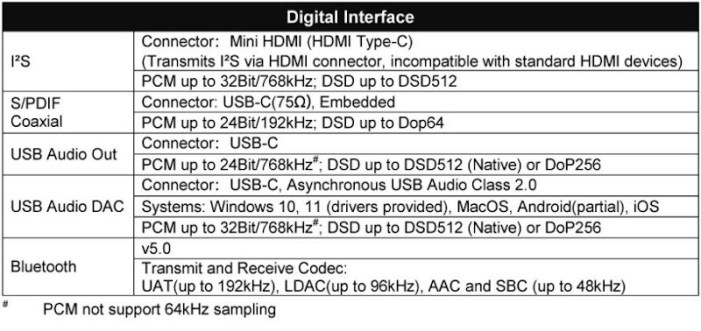
Those familiar with Cayin C9 amp will know that it accepts both Line out and Pre-amp inputs, making N30LE (similar to their N7) a perfect companion for external amp by providing a clean analog signal while bypassing internal head-amp. With C9, when LO is selected, you control the volume from the amp. And when Pre-amp is selected, C9 is at its max volume while you control it by adjusting the pre-amplification input from N30LE. The N30LE power spec, regardless of Solid State, Vacuum Tube, P+ or Hyper, has 3.5mm PO output with 480mW (@32ohm, 0.6ohm impedance) and 4.4mm PO output with 780mW (@32ohm, 1.2ohm impedance). In Line Out, 3.5mm LO offers 1.0/1.6/2.1V (L/M/H) and 4.4mm LO has 2.0/3.2/4.2V (L/M/H). The digital interface is covered by USB-C and I2S ports with the following support.
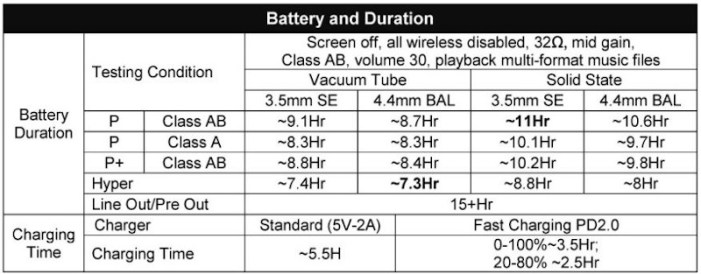
The battery capacity of N30LE went up to 12,570 mAh from 10,000 mAh (N8ii). I didn’t get a chance to run a full battery test, but Cayin provides a comprehensive table with different use scenarios and corresponding battery duration. Also, fast charging is supported, but you have to be aware that when you are playing and charging at the same time, especially in more demanding Class A (less efficient) mode with Tubes (higher current) and the leather case on (less air cooling), N30LE will get warm. Implemented was also Bluetooth 5.0 with a support of all common wireless protocols up to LDAC, and dual WiFi with 2.4G and 5G bands.
Page 2 – Sound Analysis, Pair up and Comparison, and Conclusion.

 Twister6 Reviews
Wow..and that’s what dap did..Hm I’m not that rich..just stay with my endgame system for IEM which is: old in facts extinct Q5S TC(dualAKM4493which in RMEadi2 + dualTHX aaa as amps modules) + cheaps Xduoo MT604 which is 4pentodes = heaven is it..Notes:- I’m convinced that 5G phones with USB or analog or even Bluetooth Available for sourcing output yet able to music streaming sumore Ha3..all cheap sir..Peace!
LikeLike
Today you don’t have to spend a fortune to get a great sounding audio setup. Yes, you can get a usb dac dongle, like RU7, and use it with your phone.
LikeLike
Are you going to compare to other TOTL DAPS like you usually do or is this your new format? Personally I prefer the comparisons vs N8ii and A&K as well as other DAPS I have to gauge how this will sound. I agree DAPS don’t have a sound but your previous format was far more useful to me. Is it possible this is not 1/2 the review being only 2 pages and not 4? I don’t use IEMS so for me the performance vs other DAPS is fundamental as well as the Over Ear comparisons with the likes of Meze Empyrean etc.
Regardless thank you for a preview into this amazing DAP. As usual you are not only the first but also the best.
Regards,
Enrico
LikeLike
Well, originally this was meant to be my in-a-snapshot short review. They can’t sent me a long term review sample because it is a very limited edition and quite expensive. So, I borrowed it for a few days to make a short write up. But it was more then just a “snapshot” review since I added N8ii and Max320 comparison and pair up with a handful of iems/headphones. I’m sorry, it is not my usual complete full review because I only had it for a few days, just not enough time. But I tried to cover as much as I can… That is a reason I prefer long term review samples because I get asked so many questions about comparison and pair ups, especially in my future reviews.
LikeLike
Hello thanks so much for your informative review, I always look forward to your opinion as you have had the chance to compare so many DAPS. So I’m in the process of finally upgrading my A&K CU S1000 and so far the options are HiBy rs8, Sony mz2, A&K SE300, and now also Cayin N30LE. I’m also awaiting an L&P LP7 near future. ( Maybe you can give an exclusive if it is in the process of release). So you have $5000-$6000 and you can only have one DAP out of all those DAPs listed above which one will you keep?
LikeLike
Nobody knows anything about LP7 yet. But out of those you mentioned, N30LE is definitely a front runner for me.
LikeLike
Thank you so much for your review. N30LE vs SP3000 which one would you personally prefer.
LikeLike
As I mentioned in the review, it is not about which one is better, but rather which one pairs up better with your iems/headphones. Its Classic Tube Class A mode might sound amazing with more revealing or neutrally tuned iems, but could fail (lacks resolution, punch) with a warmer tuned iems. There has to be a pair up synergy which you personally prefer… Now, with all that said, N30LE simply gives you more sound shaping options to fine tune that pair up synergy. SP3k is great, but you can look at it as one trick pony. Thus, between these two, my personal preference would go toward N30LE.
LikeLike
Thank you for the great review. between the N30LE and Max320, which is one pair up better with VE Aura that you recently reviewed?
LikeLike
Aura was on a short loan for review thus I can’t do a real a/b comparison. Either sources should pair up well with this iem. If you want a deeper bass impact and more organic mids, N30LE is better. If you want to improve the resolution and have less coloring with more sound transparency, Max320 Ti.
LikeLike
i want to listen to bass notes when it is running riffs and basslines with good voice. I can only afford either the MAX320 or N30LE. Which one should i choose?
LikeLike
If you have to choose, N30LE will be a better choice due to all the available sound-shaping “tools” packed inside N30LE.
LikeLike
If you already had a Hugo2 + SP2000 + Cayin C9 ; would the N30LE be an upgrade, side-step or … just not value for money. We don’t have a local model to test. Will be driving Utopia (22) and the bird
LikeLike
If it would be up to me, I prefer everything in one package 🙂 SP2000 is a slow closed android OS, hugo 2 is just a dac (more neutral, not as colored) and under powered, and then you are adding C9 to bulk up your system. Instead, you can replace it with one N30LE, a compact DAP, super fast Android performance, lots of flexibility of different sound shaping options. That would be my call to replace everything else 🙂 Of course, you will be taking a financial hit selling other gear to get N30LE.
LikeLike
Excuse me as I ask an unrelated question ;]
I’ve been reading you a lot lately as I’m looking to get my first higher end dap and you give excellent details with troves of comparisons.
I almost got the wm1z but after more reading I’ve narrowed it to sp1000 and dx240 as they’ll have the treble and micro-detail focus I’m looking for, I believe?
I was wondering what your take is on some of the older totl daps like the sp1000 and wm1z vs some of the newer mid tier daps out now like the shanling m8, fiio m15s and dx240/300 and if the older totl models still offer a level of sound the new mid tiers can’t quite reach?
They’re similar prices these days so it’s been hard to decide.
Sorry to write in length but I felt the dap sage was the only one I could ask.
LikeLike
Can’t comment on FiiO daps since I haven’t tested any of their latest models. But since you are talking about older models, keep in mind the battery condition and possibility of issues… SP1k is very old, I wouldn’t even bother. DX240 is older, but at least you can “finetune” it with different amp modules. The original wm1z is classic and still highly regarded. Their android MK2 version is slow and not as responsive. Tbh, if you can find a good deal on the original wm1z golden brick, go for it. LPGT is also very good, one of my favorites (very fast boot up, small, responsive).
LikeLike