
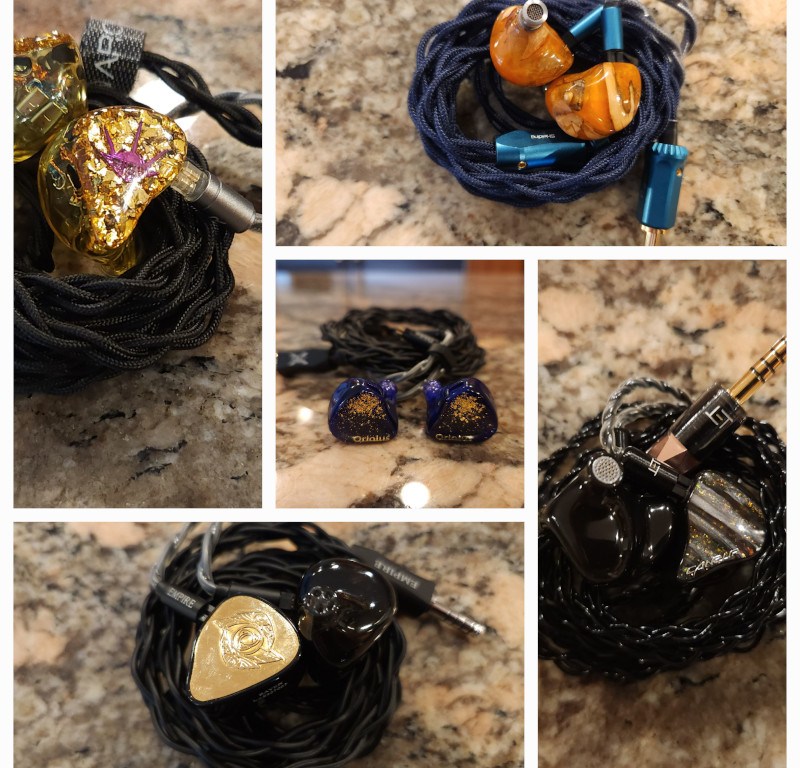
Oriolus Monachaa (Oriolus Monachaa)
Design: quad DD
A bare mentioning of new Oriolus will raise everyone’s eyebrows because many are still waiting and hoping for Traillii MK2. But Oriolus decided to surprise us with something brand new, a quad DD Monachaa. To my surprise, googling this name didn’t bring up any exotic bird species. So how does quad DD design sounds? It sounds pretty much U-shaped to my ears.
Upon initial listening, you are greeted with a huge (as in next level above big) soundstage with 3D holographic imaging. Monachaa has a very deep and lifted sub-bass extension complemented by a rather modest mid-bass punch. Bass tuning is definitely tilted toward the sub-bass. Lower mids are quite lean while upper mids are more forward and revealing. Treble has a very good extension, super crisp, with lots of airy zing. At the initial listening it did sound a bit lean to my ears. But as soon as I switched to Comply TSX eartips, the lower mids gained a bit of body and that treble “zing” was tamed down.
Monachaa is definitely eartips sensitive due to its leaner U-shaped tuning, so I would recommend switching to foam eartips, like Comply, which improved the sound tuning. Actually, once I switched to Comply foam eartips, the tuning of Monachaa reminded me a lot of their Szalayi tri-brid (DD/Planar/BA) IEMs. Just that Szalayi had a stronger mid-bass punch.


Timsok TS-316 (TS-316)
Design: 10.2mm DD
Here comes another discovery surprise. This was the only IEM I received along with its full packaging and accessories which I found to be quite premium, including a leather storage case, nice looking cable with balanced 4.4mm termination and additional 4.4mm to 3.5mm pigtail adapter, and even a pair of tiny velour drawstring pouches to protect its individual stainless-steel shells. The shells had a good fit, beautifully crafted design, and a nice comfortable heft.
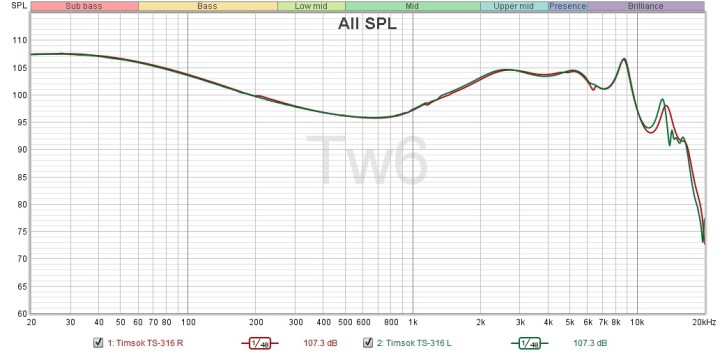
The sound tuning was W-shaped with a natural revealing tonality. I found soundstage to have a rather big expansion and a holographic imaging. The bass was deep, expanded, blooming, mids were clear, detailed, natural, and quite layered, and treble had airy sparkle, adding higher resolution to upper mids without any harshness. I never heard of this brand before, and after googling them was surprised to find a chi-fi level pricing (closer to a half of kilobuck) with an impressive price/performance ratio.


Timsok cables
Along with Timsok TS-316, included were two Timsok cables, one in black and the other one in blue jackets. They both had the same custom hardware and a nice durable build. I have no idea about the wire material used in these cables, but while doing a quick pair up analysis, it sounded like black cable could be copper and blue one could be silver. I actually tried a blue cable with Jewel and found them to have a perfect color and sound match, expanding Jewel’s soundstage, adding more texture to the bass, and clarity to the mids.


Victory Melody V44 MKII (Victory Melody V44 MKII)
Design: 22BAs per side with 8BA lows, 6BA mid-low, 4BA mid-high, 4BA-high
I remember auditioning the original V44 over a year ago, and found it to be quite good, including surprisingly well-done tuning coherency despite of packing 22 BAs per shell. And that is where the model number comes from, having a total of 44 BA drivers between Left and Right large size shells. The original model also featured 2 switches per side, but to my surprise I didn’t see it in MK2 version. Was even doubting myself if I missed it in a hurry, but looking closer at pictures after sending these back, I definitely don’t see any switches.
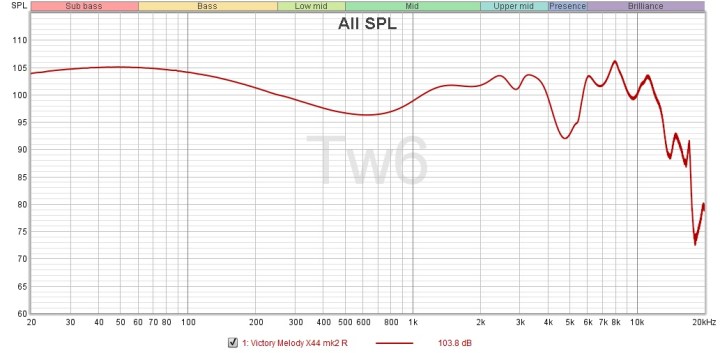
The soundstage of V44 MKII is still wide open, and just like in the original V44, the imaging is focused closer to the center. The tuning of this MKII unit is quite balanced with W-shaped sound sig and a natural tonality. The bass has a rather linear tuning between sub- and mid-bass, and a more rounded presentation with a slower attack. The mids sound very natural, with a fuller body lower mids and smoother, detailed upper mids. The treble also clear and detailed with a natural airy sparkle.
Once thing to add, the shells are big in order to pack 22BA drivers, but they felt quite comfortable in my ears.


Nostalgia Audio NA12 (Nostalgia Audio NA12)
Design: 12-driver tribrid design with 8BAs (2 Low, 2 Mid-Low, 2 Mid-High, 2 High), 2BCD for mids, 2EST for ultra highs.
Nostalgia Audio NA12 is a new flagship model from their professional series. And perhaps as part of being from the professional series, it has a more neutral tuning with a warmer tonality. So, the overall sound is rather smooth, layback, not as airy or as layered. I do hear a more neutral slower bass, smoother and warmer mids with plenty of natural clarity, and also a smoother treble. The soundstage also has just an average width and the imaging is more center focused.
In my opinion, with NA12 being a part of NA’s professional series, these IEMs are suited better for sound producers and musicians who are looking for a flatter neutral tuning with a warmer tonality, or the audiophiles who are after this specific tuning. In comparison to their popular Camelot IEMs, the Camelot’s DD bass adds a deeper extension and more texture, mids were about the same, smoother and more natural, and Camelot has noticeably more presence in lower and mid treble which adds more crunch and air to the sound.


Softears Enigma w/prototype tuning (Softears Enigma)
Design: 12-driver tribrid with 2DD, 6BA, 4EST
Right before the CanJam show I have seen a picture of upcoming Softears Enigma IEMs with its cool futuristic faceplate. But when I had Enigma sample in my hands, to my surprise it had a more generic prototype shell, and I was informed that tuning wasn’t final either. At that point I wasn’t even sure if I should analyze it, but knowing that a few people already shared their impressions, I thought it would be a good idea to mention it as well.
The prototype I heard had a neutral signature with a clear natural tonality, blooming sub-bass boost, fuller body mids, and a big open soundstage. It was lacking in treble extension and could definitely benefit from more airiness, though the treble was still clean and natural. I just hope this IEM will be finalized with a more refined treble tuning because it definitely got high potentials. But please keep in mind, what I have described above is the prototype tuning, not the final production version.

BONUS.
Along with IEMs, I also received the latest wires from Brise Audio, their new Shirogane cables, and a chance to compare the original Cayin N30LE vs N30LE AP special edition.
Brise Audio Shirogane Ultimate (Brise Audio SHIROGANE 8-wire Ultimate)
Design: Pure Silver conductors, each with 49 single-core strands.
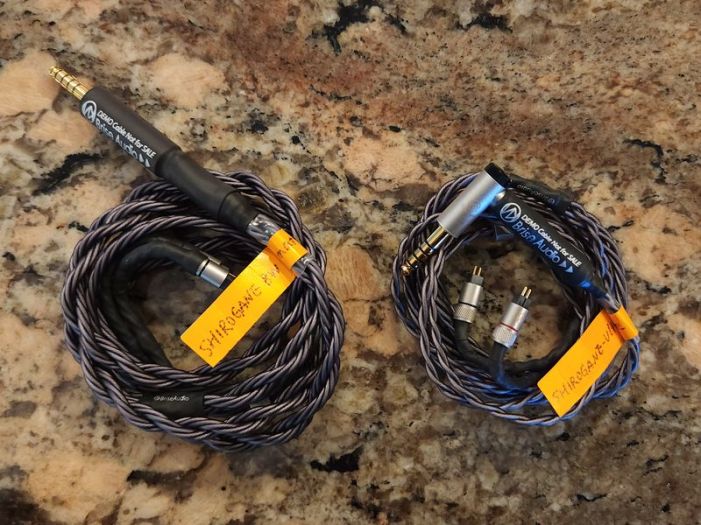
Both Shirogane 4W and 8W are beautifully crafted cables with a typical Japanese DIYish charm which includes a bulkier heatshrink pre-shaped earhooks and handmade heatshrink plugs, L-shaped on 4W and a massive straight one on 8W.
In a number of pair ups with IEMs I tried, both cables add more transparency to the sound, giving lower mids a more neutral presentation with extra clarity, and enhancing upper mids with a crystal-clear retrieval of details while still remaining natural. I also noticed the improvement in treble extension, including more sparkle. Going from 4W to 8W had a very interesting effect of bringing mids/vocals closer to the listener, making your feel like sitting at the first row in front of the performer. As a result of this effect, 8W makes the sound more balanced, even adding a little more body to the mids. And with the improvement in presentation of the mids, the perception of treble was also a little smoother, blending in better with mids. Going by memory, in comparison to Yatono 8W Ultimate, Shirogane cable adds more body and texture to the sound while Yatono had more crystal-clear transparency.
Cayin N30LE vs N30LE AP (Cayin N30LE)
Design changes:
While N30LE is a Limited Edition to begin with, its AP version is even more exclusive, and besides a different shade of the leather case and “Amber Pearl” laser engraving on the back, it also had a few different components. There is a price difference associated with AP version and I know some will try to look into the component cost difference, but usually it doesn’t work that way. From what I understand, the production volume dictates the price and when you go from a small volume of Limited Edition down to an even smaller subset of Special Edition of that Limited Edition, the price goes up. It just the way it works.
But in terms of the actual component changes, from what I have been told the pre-amp transistors were changed from Toshiba 2SK209 to TI JFE150 (AP) where TI part has a higher output current. Then, power amp transistors, 2 pairs, were changed from Toshiba 2SK2145 to Toshiba 2SK389 (AP). 2SK389 have been discontinued for years, very limited in supply, and the remaining stock is being sold at a rather high price. Also, crystal oscillators were changed from Accusilicon AS318 to a better speced Crystek CCHD-575 (AP).
On paper, these are better components, but how does it translate into a sound difference?
Sound difference.
Based on a few blind tests, I can hear AP version to have a slightly wider soundstage with a bit more holographic imaging, noticeable with both IEMs and headphones. The difference I hear is mostly in mids where original has a bit denser and more organic fuller body tonality while AP is a little more revealing, more transparent, with a bit more air between the sound layers.
The sound changes were not as drastic, but I do hear it. And I don’t believe it was due to a placebo effect because I was able to spot these differences in a blind test with the same pair of IEMs and the identical setting between DAPs. So, if any AP versions of N30LE are still available and you are OK with paying extra to squeeze out the last ounce of performance, then why not! Otherwise, if you already bought a regular N30LE version of this DAP, there is absolutely no reason to have a buyer’s remorse!


Conclusion.
There is no too much to write in the conclusion except to be grateful for the opportunity to hear all these new IEMs and to look forward to spend more time with some of these in a near future for a more detailed analysis if I get a chance. And of course, Big Thanks to Musicteck for this golden opportunity where instead of me coming to CanJam, the CanJam came to me!
Page 1 – Canpur, UM, Empire Ears, Aroma.
Page 2 – Oriolus, Timsok, Victory Melody, Nostalgia Audio, Softears, Brise Audio, Cayin.

 Twister6 Reviews
How do you find the Timsokk DD flagship vs more expensive single DD offerings, like IE600, Dark Sky and Final A8000?
LikeLike
I only had Timsok for a short time, don’t have it anymore, and I only heard IE600 for a few minutes back in Feb at Canjam NYC. A8000 is a brighter tuned iems, more emphasis on upper mids/treble so it will have a lot less bass and more revealing/forward upper frequencies. Going by memory of IE600 and looking at IE600 vs TS-316 FR graphs, they certainly “look” similar, but I do recall IE600 being just a bit brighter. But like I said, I’m going by a distant memory since I don’t have a chance for a real time a/b comparison.
LikeLike
Hello,
I’ve never been able to afford to go anywhere and try new gear out, so I appreciate the personal impressions you make.
I use the Dunu Talos as my daily budget iem while saving up for a more expensive set.
I like the vast sound field of the Talos and the way it reproduces instruments. The stage does get a bit bigger when you switch the BAs ‘on’.
In the size of the stage, timbre and bass level enjoyment do you consider the Orilious Szalayi to be a good investment as an upgrade?
Since soundstage and bass is my highest priority (personal taste) is it worth saving up more money to get a bigger level of stage with the Monachaa?
Am I right to assume that the Monachaa has a bigger sound field than the Szalayi?
I appreciate your insight.
LikeLike
Hard to tell since I’m not familiar with Talos at all. Monachaa definitely has a bigger and more holographic soundstage than Szalayi, but if you like your bass impact you would want to look into Szalayi instead of Monachaa. Unfortunately, I don’t have either one with me now to do more testing or the real time a/b comparison. Btw, if you are on the budget, Timsok ts-316 is a great one to consider as well.
LikeLike