
Sound Analysis.
The sound analysis of R8ii was done using various IEMs and headphones (covered in Pair up section) while playing a selection of test tracks, such as Agnes Obel “The curse”, Sandro Cavazza “So much better” (Avicii remix), C-Bool “Never go away”, Ed Sheeran “Shape of you”, Alan Walker “Darkside”, Galantis “Hunter”, Iggy Azalea “Black widow”, Indila “Boite en argent”, Dua Lipa “Love again”, Counting Crows “Big yellow taxi”, David Elias “Vision of her”, and Michael Jackson “Dirty Diana”. I had at least 150hrs of burn in time before I started taking notes; Elna SILMIC II Electrolytic Caps do need a burn in, regardless if some will or will not hear the difference. Also, please keep in mind that all sound impressions were collected while running the initial fw release v1.0_20231128 (build 1229).
I prefer to describe the DAP sound based on the comparison to other DAPs and pair ups with different IEMs/headphones since the DAP by itself doesn’t have a “sound”. What we hear is how it sounds through connected IEMs/headphones or the difference in sound relative to source comparison using the same pair of IEMs/headphones. This is my subjective opinion, describing how I hear it while analyzing the sound of R8ii, and you will get a bigger picture about this DAP’s sound in the follow up sections of Comparison and Pair ups with specific headphones and IEMs.
As I started listening to R8ii, it felt like an evolved, more transparent version of RS8. It has a similar baseline sound DNA with a natural analog tonality, but R8ii sounds cleaner and offers more resolving natural transparency. There are some differences I will cover in the Comparison section of the review, but overall, you are still getting a similar natural tonality, though less neutral and more resolving. Also, R8ii sound presentation has a bit more energy and openness in comparison to a more intimate sound presentation of RS8.
When listening to R8ii, the music comes alive with a deeper bass, especially in sub-bass region which adds richness to instruments, and delicately enhances natural sparkle in treble which adds air and improves resolution of the sound. The overall sound signature is relative balanced, and I wouldn’t say that either bass or treble have more emphasis. But there is an enhancement of the quality rather than quantity which improves articulation of the bass, improves resolution and transparency of the mids, and gives the sound a better definition with natural airy sparkle in treble.
I do hear a very dark background which makes details pop out of the blackness with more clarity thanks to a very clean on/off transition of the notes. With most of the IEMs I tried, noise floor is super black, even with Turbo mode enabled. With a few sensitive IEMs there is a mild waterfall hissing, similar to RS8, but not as bad as with R8. Also, R8ii preserves excellent vertical dynamics where I was able to notice more dynamic transient changes between the peaks of the sounds.
The soundstage expansion is wide, spacious. It is not super wide, but it is wider than RS8 which I personally found to have a more intimate presentation of the sound. Also to note, soundstage did open up after about 50-60hrs of playback. I find R8ii soundstage to have a round shape with a relatively proportional natural expansion in width, depth, and height without any exaggeration. Imaging is pretty good as well, having a realistic and precise placement of instruments and vocals in space. Again, not on 3D holographic level, but quite precise and natural. I kept thinking how Hiby refers to R8ii as a Portable Concert Hall. It did feel like you are not in a small studio and not in a huge stadium environment, but rather inside of a portable Concert Hall with a setting of a natural environment.
The sound signature of R8ii had a great synergy with many IEMs and headphones I tried, making it work with any genre of music, either if it is instrumental or vocal tracks, classical music with natural non-synthesized instruments, or EDM with synthesized instruments. But I also noticed, while it has a natural resolving tonality, it didn’t mask or smooth out imperfections in some of the recording. Thus, I found it to pair up better with more neutral or smoother tuned earphones and headphones rather than more revealing ones, especially those with spicy treble emphasis.

Turbo On vs OFF
Since I listen mostly to IEMs, the only difference I hear is in hybrids with DD bass drivers where to my ears turning Turbo On gave the bass a bit more articulation and sharper attack. With a few headphones I tried, Turbo On was also a must to keep the bass tighter.
Class A vs Class AB
It’s becoming almost a standard feature to see Class A/AB amp mode being implemented in many Hiby DAPs, not just flagship ones. In my testing of R8ii, I heard Class A to give the sound smoother and more laidback presentation while Class AB gives the sound tighter and more energetic performance. With R8ii already having a natural sound presentation, especially in mids, switching to Class A made it more laidback and a bit less resolving. Thus, I preferred to use Class AB, and as a bonus you will get some improvement in battery life.
Darwin Harmonic Controller
To me the most noticeable difference is when you select either 0 or 255 value. When down to 0 and along with Darwin Default LPF, the sound imaging becomes more center-focused. When switching it to 255, the imaging is more expanded, more holographic.
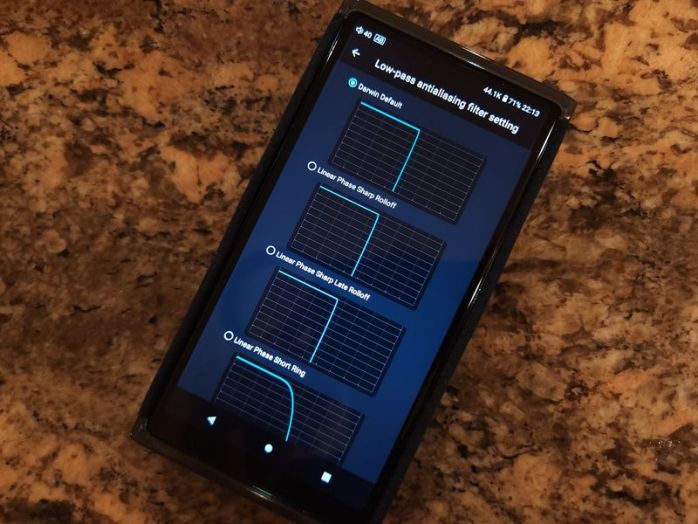
Darwin Low-pass Filters
I find the changes between many of these filters to be rather subtle. The more noticeable difference I hear is between Darwin Default and 0th Order Hold NOS where under NOS it feels like I was switching to Class A from AB, with sound becoming a bit more laidback and smoother in tonality. Darwin Ultimate LPF, which is a hybrid filter, sounds like being somewhere between Darwin Default and NOS. With Ultimate the sound was smoother, but not as laidback/slower as with NOS.
Personally, I preferred Darwin Default LPF along with Class AB and Harmonic Controller at 255 which gave the sound more speed, improved articulation, and sharper retrieval of details. This probably has also to do with the type of music I’m listening to.
Comparison.
In every comparison I was using Aroma Jewel, UM Mentor Multiverse, and FirAudio RN6, volume matched while listening to the same test tracks between DAPs. R8ii was set to Turbo on, Class AB mode, mid gain, Darwin Default LPF, and Harmonic Controller at 255. Also, here I’m mostly focusing on the difference in sound as I hear it. These are just quick analysis notes.
R8ii vs R8 (Turbo on) – R8ii has a touch wider soundstage expansion, stretching more to the left/right in comparison to R8, while imaging was very similar. Also, I hear R8 to have more sparkle in treble and to have slightly more forward, revealing mids. R8ii has smoother fuller body mids, more organic textured tonality, more natural treble, and slightly more rumble in bass. Overall, R8ii sounds just more refined to my ears.
R8ii vs RS8 (Turbo on, Class AB, Darwin Default LPF, HC 255) – I spent most of my time on this comparison, going back and forth. RS8 is Hiby’s flagship DAP, and some will assume that it supposed to be superior in sound performance, but is it really? I do hear R8ii sound spreading wider in soundstage expansion, creating more open space in comparison to more intimate RS8 staging. It’s not wider by a margin, but noticeable with IEMs I tried. I also hear a little more weight in sub-bass rumble and a bit more sparkle in treble with R8ii. Mids are trickier because they sound not too far off, but while using more reference tuned IEMs, you can hear RS8 to have a smoother and more laidback R-2R organic texture while R8ii is more revealing and has a touch more of the analog grit. This difference [in mids] was even more noticeable when I switched to demanding headphones and a bit less with IEMs.
I also noticed R8ii and RS8 share similar, more expanded micro-dynamics. It doesn’t make R8 sound compressed. But when I was focusing on short passages of test tracks while comparing these 3 daps, I was able to hear some vertical peaks being more leveled off with R8, while R8ii and RS8 has more dynamic transient changes. Another thing to note is R8 having more hissing with sensitive IEMs, while R8ii and RS8 kept it lower, down to a min waterfall level.
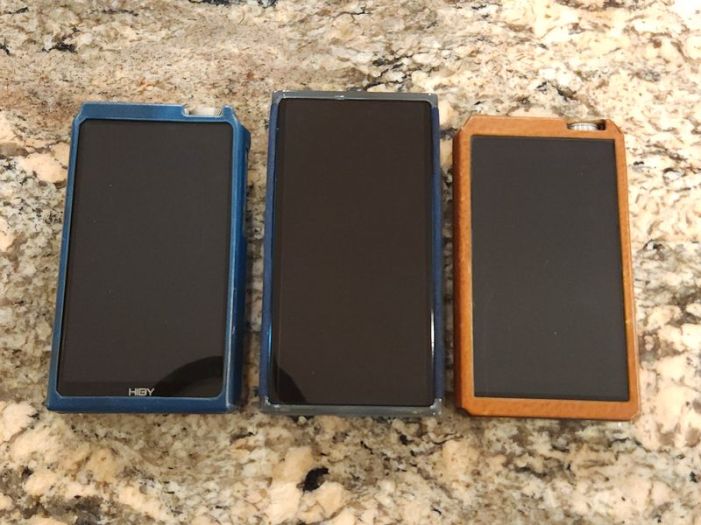
R8ii vs Cayin N8ii (Tube, P, Class AB) – N8ii soundstage is being a bit wider while imaging remains quite similar. N8ii has a bit more revealing tonality up top in treble, even a bit more revealing in upper mids in comparison to a smoother sound of R8ii. I also hear a little more rumble in sub-bass with R8ii, as well as a more natural treble extension. From a technical perspective, both have similar dynamics relative to specific IEMs under the test, but due to more air in N8ii, N8ii has improved layering and separation of sounds. One thing to note, while I had R8ii in turbo mode to boost its output, I had to change N8ii from P+ to P (output voltage reduction) to make the treble less revealing.
R8ii vs Cayin N7 (Class AB, DSD512 oversampling) – I hear the soundstage expansion and imaging to be on a similar level. When it comes to a tonality comparison, there are a few differences I noticed. Such as, N7 mids are presented a bit more forward and being slightly more revealing. R8ii sub-bass has a bit more rumble, and mids are a little smoother. Both have the same natural treble tonality. They also have a very similar technical performance from layering and separation to vertical dynamics of the sounds.
R8ii vs Sony WM1ZM2 (DSEE Ultimate, DC Phase Linearizer, Vinyl Processor) – These two sounds very similar with IEMs, the only noticeable difference I found was R8ii soundstage being slightly wider and bass having a bit more sub-bass rumble. But overall, these do have a lot of similarities when compared using the same IEMs and while volume matched.
R8ii vs L&P P6 Pro – P6 Pro soundstage does expands a little wider and imaging is more holographic. But the overall tonality is not too far off. The main difference here is in technical performance where P6 Pro is more resolving in mids, has more clarity and less coloring, while R8ii has more analog texture and sounds fuller in mids. They both have a punchy bass, natural mids, and clear detailed treble, but the resolution of P6 Pro vs the texture of R8ii was the main factor for me in a blind test to id one over the other. Of course, got to keep in mind that P6 Pro is audio playback only DAP with a limited GUI.

Page 3 – Pair up, Wired/wireless connections, and Conclusion.

 Twister6 Reviews
Thank you very much for a thorough brain massage for a whole 3 pages, I gotta go lay down…
LikeLike
Hi Alex,
Can you compare the sound of R8ii to that of LPGT? They are both considered neutral sounding, and they are at about the same price point (when LPGT is on sale), so this could be of common interests.
In particular, I’m very interested in this comparison for the pairing with RN6.
Thank you,
Lean
LikeLike
With Turbo on and Class AB, I definitely prefer the pair up with R8ii because of the sound sig of RN6 being more balanced in comparison to L-shaped with LPGT. And relative to this change, RN6 mids are more forward, clear, detailed…
LikeLike
How does it compare sonically to the AK se300? Similar price, both r2r and class A/AB.
Thank you
LikeLike
Sorry, I don’t have SE300, only borrowed it a year ago for review, and I can’t compare it by memory. Also, R8II is not R2R, a completely different modulation/dac architecture.
LikeLike
Hello, is it possible to compare this device – HiBy R8 II with such outstanding devices as Chord Electronics Hugo 1,2 or even Chord Electronics Hugo TT2. And if possible, in your subjective opinion, which device would you prefer in terms of sound?
LikeLike
Sorry, don’t have access to any of the Chord products. But from talking to some other reviewers and some of my readers, they always refer to Hugo as under powered and having a more neutral/sterile tonality. Can’t judge it myself, but if that is the case, R8II will add more natural coloring to the sound in comparison to Hugo.
LikeLike