
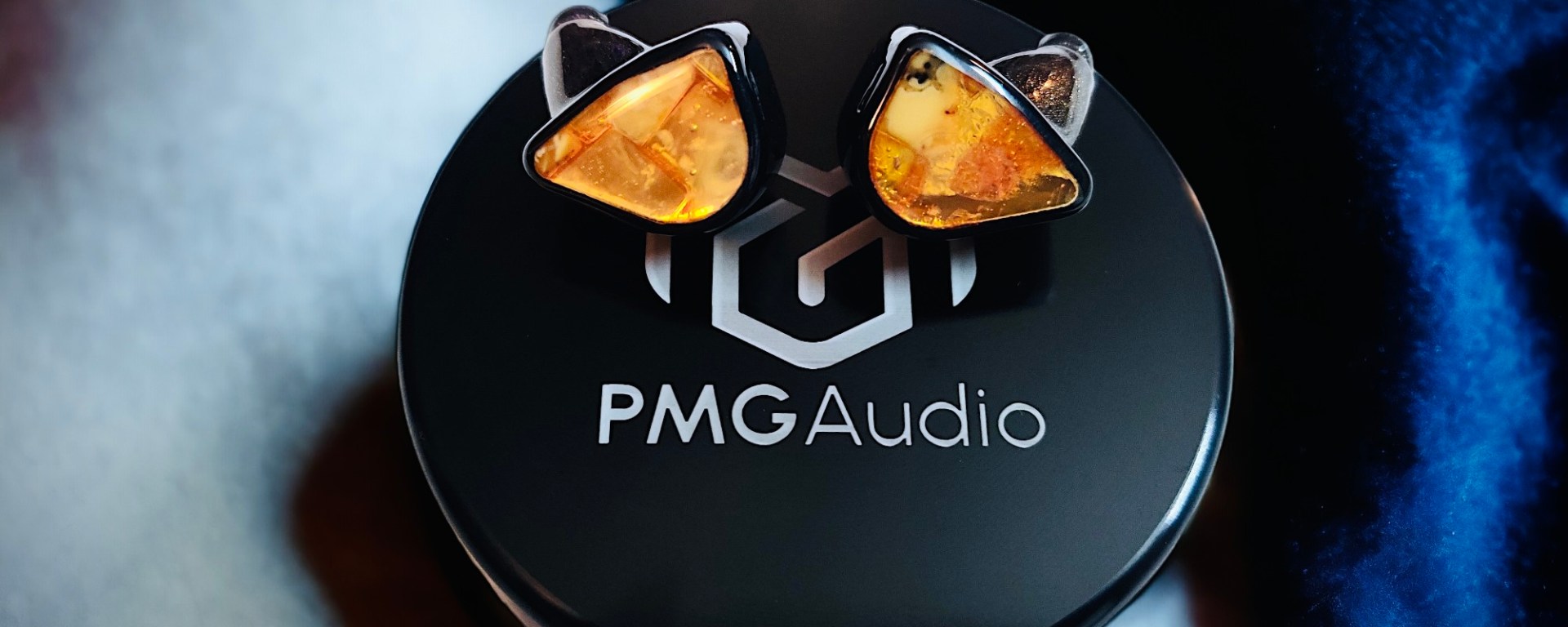
Is this the TOTL in IEM sound performance today?
PROS: Very tastefully tuned, very musical, vivid and exciting sound signature, exceptional TOTL technical performance (best I’ve tried in the IEM world), well built with rare Amber faceplates and very attractive golden galaxy shell design, very snug and comfortable fit for long listening sessions, modular cable, two well made carry cases.
CONS: Expensive, slightly on the brighter side and could irk the treble sensitive, stock cable and unboxing experience could’ve been better for the package’s asking price.
About PMG Audio.
PMG Audio (Piotr Marek Granicki Audio) is a brand under Custom Art’s umbrella focusing on premium high-end products. As per Piotr, their goal is to create audio products that are unique and exclusive, but at the same time a little bit more eccentric. With over a decade of hands-on experience in tuning and building IEMs under the Custom Art brand name, they’re now venturing out to deliver the best sound they can achieve with money no barrier.
Official Website – PMG Audio (€6000)

Tech in APX.
FIBAE – Flat Impedance Balanced Armature Earphone.
Flat Impedance Balanced Armature Earphone (FIBAE™) patented technology is a revolutionary In-Ear Monitor design providing flat impedance and phase. By changing the Balanced Armature driver’s character from inductive to resistive, guys at Custom Art solved one of the oldest problems in the industry – dependence on output impedance of sound source for correct earphone output. With FIBAE™ technology, their IEMs will always perform their true self plugged into any kind of source.
Geometrical Sound Outlet.
GSO is a calculated parallel wall structure inside an otherwise round nozzle.
Geometrical Sound Outlet serves multiple functions – firstly as a support structure to increase the rigidity of the nozzle, secondly optimizes the dimensions of the nozzle and reduces the cross section size, finally it works as a horn structure increasing high frequency extension.
Pressure Optimizing Design.
Pressure Optimizing Design is our in-house developed technology to reduce the pressure in front of the driver and influence its response by properly tuned acoustic filters.
Ultra Planar Speakers.
We equipped Apx with an Ultra Planar Subwoofer delivering range only up to around 80Hz and an Ultra Planar Tweeter for range above 10kHz. Planar technology offers near limitless response on both ends of audible frequency range. Planar subwoofer supports Dynamic Driver in order to create the most natural bass attack and decay without unnatural bass boost to compensate. This woofer is strong enough to create perceivable vibrations enhancing listing experience. Planar Tweeter supports Balanced Armatures by adding extra air and extension, the choice of speaker and its application allowed to retain correct high frequency tone and speed.
Precision 3D printed housing with calculated waveguides.
Each driver inside the shell is meticulously positioned in a 3D printed coupling structure, with calculated and proper distance to the sound outlet, accounting for frequency and time domain. By removing variable elements such as a typical soft tubing, we increased the repeatability of the response across the whole production run.
Technical Specifications.
- 11 drivers: 1x Rectangular Planar, 1x 10mm DD, 8xBA, 1x Round Planar (all drivers are custom-built to PMG Audio’s spec)
- True 7-way passive crossover
- Flat impedance technology
- GSO, UPS, POD, 3D in-house developed technologies
- Impedance: 5 Ohm ±1 Ohm
- SPL: 107dB @1kHz
- Frequency response: 3Hz-20kHz
- Silver-Copper Alloy with Graphene core cable, 2.5, 3.5, 4.4mm connectors, 0.1 Ohm resistance
- Wooden box
- Metal and EVA cases
- Certificate of authenticity
- 2-year warranty

What comes in the box?
- PMG Audio Wooden box
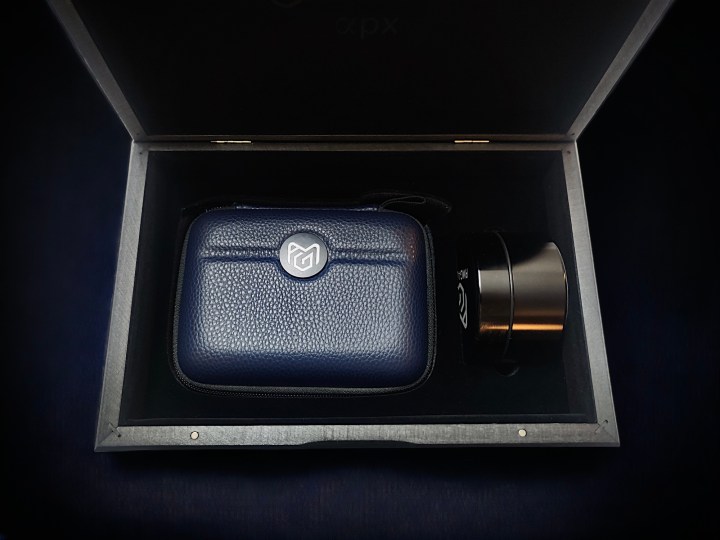
- Two Carry Cases – Leather and Hockey Puck case
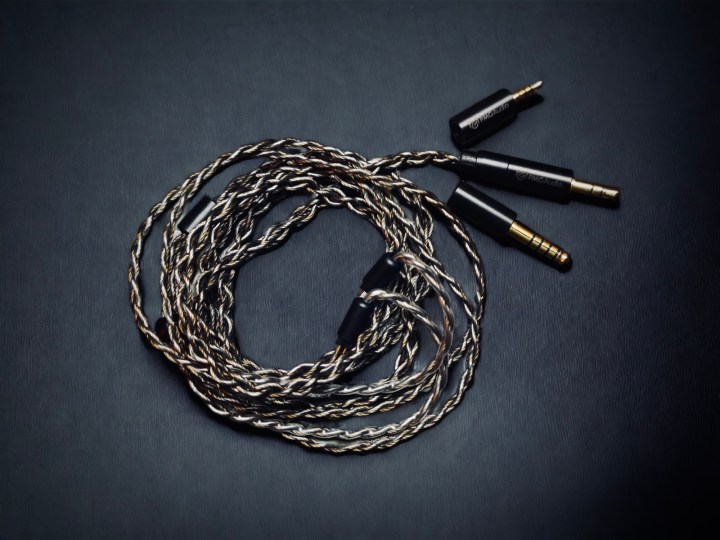
- PMG Audio Omega 2-pin Cable (Silver-Copper Alloy with Graphene core with 0.1 Ω resistance)
- Interchangeable 2.5, 3.5, and 4.4 mm connectors
- Ear tips – Silicon (SML) and Foam (SML)
- Leather strap

Build Quality, Fit and Comfort.
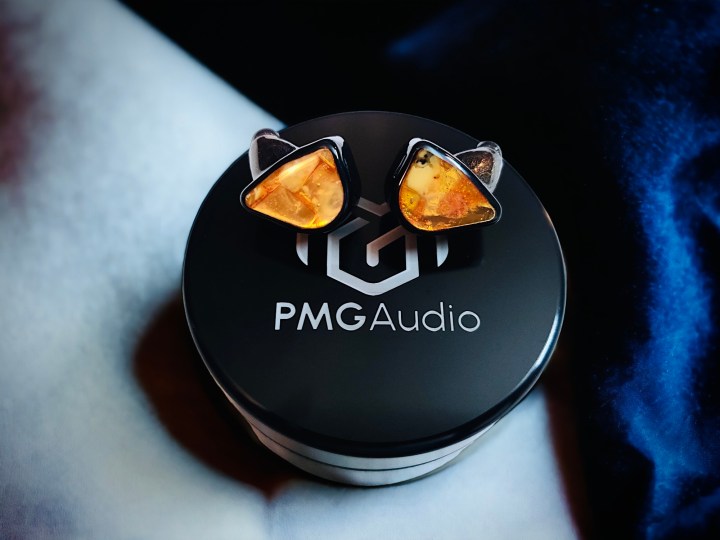
PMG Audio has gone a slightly different route with the faceplates and shell colouring in APX while keeping the shell shape similar to their Custom Art IEMs. APX’s shells are very slightly larger than FIBAE 5. They’re not chonky as such and are very ergonomically designed considering the kind and number of drivers they have in there. They’re still a resin build with hand painted shells that have a glittery, gold galaxy design with ‘PMG Audio’ and ‘APX’ lasered in there in gold colour and faceplate material that can be considered a collectible, something quite unexpected in an IEM – real Amber. The only thing missing in there is a mosquito with a dinosaur’s DNA. Jokes aside, I imagine liking for it would be split as most people won’t realise what the faceplate material is until they’re told about it. Some might not even think of Amber as luxury and a lot in general lean towards things like JH Audio’s complex CNC metal faceplate designs when spending the big money on just the design. Also, since APX isn’t customisable at the moment, one would really have to love the Amber and gold Galaxy shell colour way to be okay spending the big bucks. Regardless, it does look like a collectible and if one knows how rare real Amber is and how much time and expertise it takes to do the kind of gold galaxy design the shells have, they’d surely appreciate the APX much more. Coming to the nozzles, the’re the perfect size to fit most tips and the overall fit is very snug with the shells sitting ‘almost’ flush with my outer ear, protruding outside very slightly. Custom Art shells have always been some of the most comfortable shells for me, one’s I can even use to watch movies while laying down sideways, which isn’t something I can do with most IEMs. On top of that they isolate really well too.
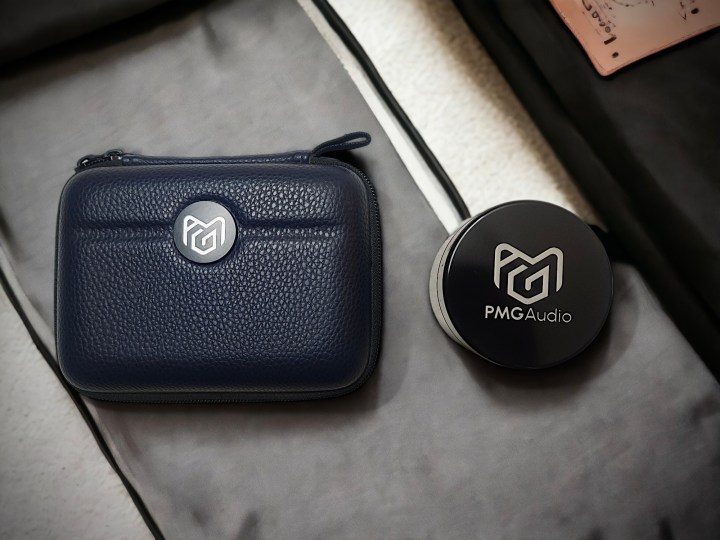
Cable – APX comes with PMG Audio’s $800 Omega cable. It has swappable jacks (2.5mm, 3.5mm and 4.4mm), is soft, supple, light and has absolutely no downward pull – which makes for a very comfortable wearing experience. It’s a pretty nice cable for live use too as it almost disappears while wearing it but feels a little too thin and cheap considering its €800 pricing ands APX’s asking price of €6000 – a price segment where brands not only offer flashy cables but sometimes even two different types of cables in the package.
Sound Analysis.
Drivability – APX has a very low 5Ω impedance, fairly high sensitivity of 107dB which make it very easy to drive.
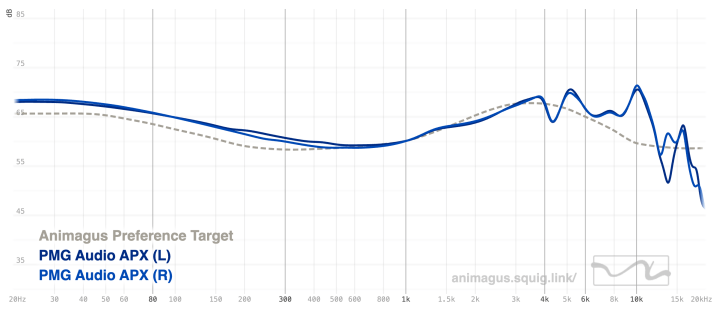
Graphs are measured using an IEC60318-4 (IEC711) setup. You can compare all the graphs on my IEM Graph Database here – Animagus Squiglink.
Summary – APX has a neutral-bright W-shaped signature that is not only a tasteful coloured take on a sub-bass boosted reference tuning but also one that has impeccable technical performance. It has a mesmerising tonality, one that leans slightly brighter than neutral but without compromising on the bass quantity or quality. This is neither a full sounding bass head IEM nor a dry, lifeless sounding technical IEM. APX goes for a very exciting, vivid presentation of music – one that is as much musical as it is technical and the technical performance, particular soundstage, instrument detail retrieval and stage LCR separation is one of the nicest I’ve heard in an IEM, which we shall discuss in detail in the technical performance section.
Let’s dig deeper in its tonal performance…
Bass – APX has what PMG Audio refer to as a rectangular Ultra Planar Subwoofer which executes the sub-bass region and a bit of mid-bass upto 80Hz in conjunction with the dynamic driver, creating a very tasteful 9dB bass shelf. The quality and combination of drivers chosen as well as the FR make up a bass presentation that has very good tonality, very precise and defined bass notes as well as very good separation of bass in the centre. It is very dynamic, one that is able to relay the intricate dynamism in bass playing very well. It has punch when the song requires it while keeping everything in control and in its dedicated space. It’s not an IEM with bass and boom everywhere but a very tasteful presentation that is always trying to give you good hi-fi speakers in a room kind of feeling.
Midrange – Midrange is one for the reference heads than the section of audiophiles that like fuller than neutral sounding lower-midrange presentations. It’s very neutral, very clean and has about 9dB of ear gain. This fairly accurate midrange helps keep the midrange tonality of instruments sounding correct and real, and as all know, most instruments rely on the midrange for tonal accuracy the most. So, this is one thing that definitely needs to be done well if tonal accuracy is the motive and I’m happy to see PMG Audio get this right.
Treble – It’s post 5kHz where APX starts boosting above neutral, creating not only a bright leaning presentation but one that greatly influences the rest of the signature to make APX a very vivid and exciting IEM with excellent detail retrieval. This is done using the round Planar tweeter in conjunction with the balanced armature tweeters. Now I’m not really a fan of over-boosting of treble to influence technical performance but APX does it so tastefully that it hardly sounds bright after a few minutes of listening to even a reference head like me. In fact, this did not come across as too bright to me in the first listen either, like Custom Art’s FIBAE 5, 64 Audio’s Tia Trio, TRI Starlight and Starshine or the Loki Emerald did in the first listen. APX is bright in a good way, with peaks that do not sound harsh or strident. Yet, I’d still warn the treble sensitive to be wary. Treble heads on the other hand will definitely enjoy this to the max. This is more an airy sounding IEM and never sibilant. Sibilance is one thing I have quite a problem with but APX just put across even the most sibilant songs I know very neutrally – which is why I’ll say that APX is a bright signature done tastefully right.
Technical performance – The tonality along with the technical performance, particular the soundstage, left to right separation, imaging, LCR + depth layering as well as the detail retrieval, all combined, help APX come the closest an IEM has every gotten to sounding like nice Hi-Fi speakers in a room. Of course, IEMs due to the nature of their design and insertion depth have a massive limitation when it comes to staging but I must commend PMG for coming closest to giving a sense of big space in an IEM in stock form. I an audio engineer otherwise have to bring out my engineering hat and use a combination of target calibration (calibrating IEMs and headphones to particular room based targets) and a room modelling plugin that models crosstalk and IRs (Impulse Response) of a studio room to give me that sense of perception and level of performance in an IEM or headphone. APX of course can’t do the crosstalk bit in stock form but it gets quite close in the other aspects. APX has exceptional side wall and depth layering, where it is able to bring out not only depth but also height layering in songs that are mixed that way. You can hear this most in songs that have several layers of guitars and keyboards playing, for example in songs of bands like Coldplay, Radiohead, MuteMath or rich film scores like that of Hans Zimmer. It’s the detail retrieval, layering, separation along with precise imaging that enable a spacious, heavily layered stage and it all combined makes for technical performance that’s one of the best I’ve experienced in an IEM. All in all, APX is exceptional in this aspect and if you know me and my reviews, I don’t say these things lightly.
Comparisons.
Oriolus Trailli.
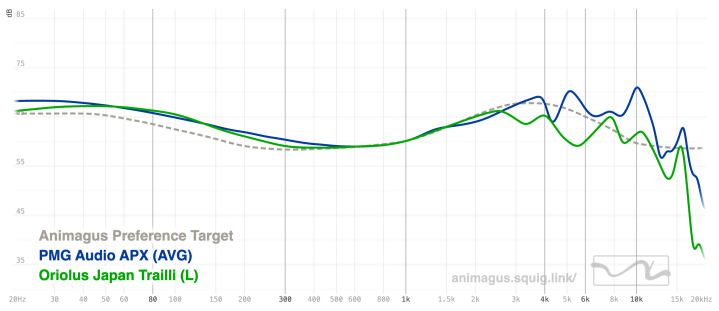
Oriolus Trailli was the TOTL IEM that first broke the barriers of the otherwise $4000 segment of TOTL pricing, coming in around $6600. It too has a W-shaped tuning but one that is a warmer version of APX. If you notice it compared to my Animagus Preference Target in the graph above, you can see that Trailli was in fact a little warm for me and its dip in the 2.5-6kHz section didn’t have it working for me that well. It did have a fairly easy going warm tonality and really good technical performance but I always wished for more of the 2.5-6kHz, which I always boosted in EQ. Anyway, APX and Trailli are very similar till about 1kHz and post that is what makes APX a brighter version of it, with significantly better technical performance – particularly soundstage, detail retrieval, left to right separation and layering. Trailli does have more bass punch due to its warmer signature than leans towards bass over treble but APX’s bass is more dynamic, better separated in the centre as well as brings out the tiny nuances to you better. The more ear gain makes instruments have better definition and forwardness in APX than they do in Trailli. On the other hand, APX’s more energetic treble makes it come across a more vivid and exciting IEM, while the Trailli sounds more laid back in comparison. APX is also airier and has better treble extension in comparison. Both being in the same price ballpark, I’d take APX over the Trailli for my preferences.
Elysian Annihilator.
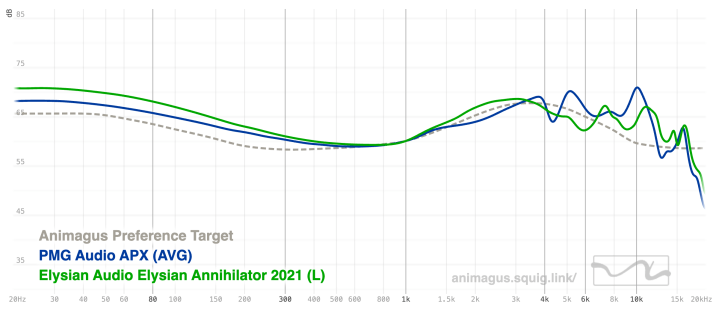
Elysian Annihilator is again a W-shaped, slightly coloured take on a sub-bass boosted reference signature. Annihilator is bassier and fuller sounding, with the APX being very slightly brighter. Annihilator presents instruments with not just more weight down low but also slightly fuller body than neutral. It’s the APX that comes across more neutral in the bass as well as lower-midrange out of the two. Annihilator has a more accurate upper-midrange curve than APX but that difference is hardly noticeable in most songs. APX is slightly sizzlier and airier in treble than Annihilator with both having similar treble extension. But when it comes to technical performance, APX is an outright winner with an airier, more open and spacious soundstage along with better LCR separation, imaging, detail retrieval as well as layering. Instruments are spaced out more in the stage along with them occupying less space and more confined to their designated space in the panning, a lot of it owed also to APX’s lower-midrange being cleaner and more neutral. Instruments in APX also have more space between them, they image stronger and there is a better representation of depth and height layering as per the mix. All in all, APX is much pricier, but definitely a better performer when it comes to technical performance. For tonal performance, it’ll totally depend on the lister’s preference.
Kinera Loki Emerald.
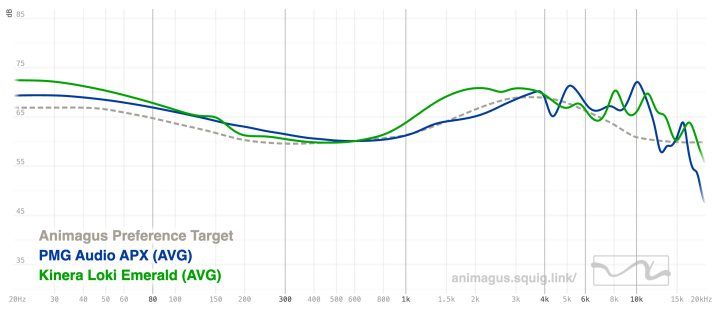
Like the APX, Trailli and Annihilator, Loki too has a W-shaped signature but quite a different one at that. Even though Loki has slightly more sub-bass down low, it has siginificantly more upper-midrange and comes across as a more forwards and energetic sounding IEM compared to APX. Even though APX leans bright, Loki is brighter, which makes it more into energetic category of IEMs. Loki does have nice bass impact and rumble but APX’s bass is quicker, more precise and has better dynamism in the notes. Loki has instruments presented more forwardly due to a more forward upper-midrange presentation while instruments in APX sound spaced out wider and deeper. Even though they both have fairly strong boosting in mid-treble, it’s actually the Loki that comes across sizzlier. Coming to technical performance, Loki is quite the performer but again it’s the APX that comes winning at the end with an airier, more spacious soundstage, better LCR separation, better depth and height layering, better detail retrieval as well as a more holographic listen.
Empire Ears Odin.
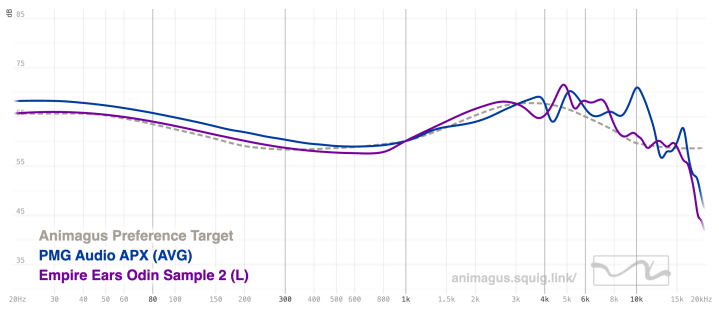
Again, Empire Odin too has a W-shaped signature that is a very slightly leaner take on a sub-bass boosted reference signature. Odin has a slightly lower bass shelf, is slightly leaner in lower-midrange, is equally bright in lower-treble while APX has a bigger bass shelf, is slightly fuller in lower-midrange and sizzlier plus airier up top. APX has stronger bass quantity but one which is also more dynamic with more precise bass note definition as well as better separation in the centre. When it comes to technical performance, while the Odin is a very capable IEM itself, APX has stronger capabilities. APX has a more open and much spacious sounding stage with wider left to right separation, more space between instruments, stronger imaging, better detail retrieval as well as better depth and height layering.
vs Custom Art Stalwarts – FIBAE 7 Unlimited and FIBAE 5.
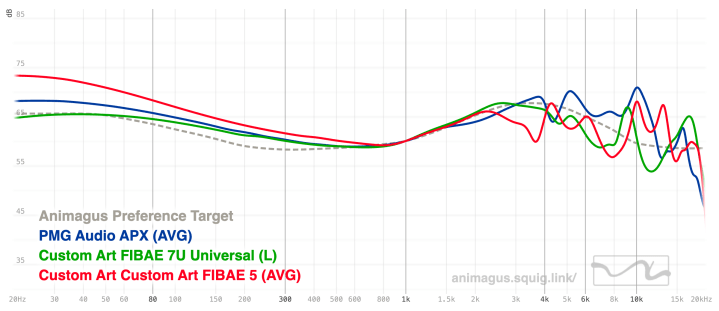
FIBAE 7U is Custom Art’s flagship IEM with 7 Balanced Armatures and FIBAE 5 their tri-brid with 1DD + 2BA + 2 Planar Drivers. You can hear the Custom Art flavour in all these IEMs but APX is like F7U and F5 combined and on very strong steroids. It is similarly tuned to the F7U till 1.5kHz but with about 3dB more sub-bass, brighter treble and much stronger technical performance, particularly bass dynamism, note definition and precision, separation in the centre and impact of the rumble. F5 has more bass quantity owing to a stronger bass shelf, so the bass is more upfront but APX again is more technically proficient with cleaner, more precise bass note definition and better soft to impactful dynamism. F5 bass, while extremely capable at its price point, sounds like it’s always there at all times and not as dynamic in comparison. APX has better ear gain than both F7U and F5 with a more forward and stronger definition of instruments. APX is also brighter than both in lower-treble while airier than both IEMs. F5 is sizzlier sounding than both IEMs and because there’s contrast created between the 8kHz dip and strong 10-14kHz mid-treble boosting, the F5 sounds significantly sizzlier and needs a slight adaptation period to sound best. That isn’t a thing with the APX as it has more linear boosting and just comes across a slightly bright leaning IEM. When it comes to technical performance, Custom Art, in particular F7U and F5 are quite popular for having very wide, spacious soundstages but APX takes not just the staging but the whole technicalities to a totally different, higher realm of performance. It not only has wider and deeper boundaries but also significantly better resolution, detail retrieval, left to right separation, imaging as well as depth and height layering.
Conclusion.
When the Trailli launched a few years back at $6600, it was the first IEM to break the $4000 flagship pricing barrier and introduce a new realm of TOTL pricing. Once that precedent was set, some brands tried to take it even further, with brands like Unique Melody going crazy pricing some of their IEMs upwards of $8000. When it came to audio performance, while I was fairly impressed with the Trailli, the same could not be said about the Mason IEMs or IEMs like the Aroma Jewel in the auditions I managed to get. In fact, I was so disappointed that I never bothered to borrow them for a longer listen. The thing is that when a brand sets that high a price point of entry, I an audio engineer as well as audiophile reviewer have very high expectations of it being a true epitome of audio perfection in totality or at least some segments. But when that IEM does not meet or come close to those expectations, it’s way more disappointing than what it’d would’ve been for a product 1/10th its price.
When Piotr contacted me to tell me about the new IEM he was developing and shared the graph as well as pricing with me to ask for my feedback and suggestions, I was happy about the first and and sceptical about the second, particularly knowing how Custom Art was known to be a brand that kept its pricing in check and provided some of the nicest value for money IEMs. While the graph looked very good, I suggested him to keep the pricing low several times. He let me know how this was the absolute best he’d created with all that he had learnt till now, with all the R&D he had done till that point in time, how this was one of the most complex circuits he had ever made with 3 different types of custom drivers, 7-way crossover, proprietary technologies and all the while making sure it had flat impedance. He was wanting to make it with no price or material restrictions, using some rare materials to manufacture it, keeping it as a limited edition and releasing it under a different banner name to keep the VFM image of Custom Art intact. But being wary of where the TOTL pricing has gotten to and how it limits access, I kept suggesting him to try and keep the price as low as possible so that more and more people can have access to it. But that supposedly wasn’t his motive. It was supposed to be the best of the best of his knowledge and calibre and he wanted it to be a very limited edition – a priced possession collectible for people who trusted his expertise.
Now having received and tried the APX for more than 2 months, I can safely say that I’m more than impressed, to the point that it has become one of my favourite IEMs, definitely first or second in the top 3. But the sadness about the pricing hasn’t gone away, now turning into frustration – because this really is a proper TOTL IEM, the epitome of technical performance I’ve heard in an IEM in my almost 2.5 decades of being an audiophile and having tried most of the popular IEMs in the market. With this being a very limited edition and at a price point that is inaccessible for 99.99% of the audiophile crowd, I’m saddened to think that most might never get to hear it. But well it is what it is.
Now if you ask me if I can recommend the APX based on its tonal and technical performance – absolutely! It’s one of the finest experiences I’ve had till now, even more when it comes to technical performance. The only thing I’d caution here is for the extra treble sensitive to be wary and maybe try and audition it first. But I’ll also put in a suggestion that those same treble boosts are actually quite tastefully done and would work really well for the majority, even more for reference and treble heads. Also, the other complaint I have is that the unboxing experience was a bit underwhelming for the asking price. It comes in a nice wooden box with two cases (hard and hockey puck style) as well as 2 sets of ear tips and a modular cable but the accessories aren’t up to the mark with what one expects of a €6000 IEM. But well, it might matter to some while not as much to others. Regardless, if €6000 is easy money for you, I highly recommend trying it out, possibly with an audition first – which is what I recommend for every product, even more for the expensive ones. In fact I highly recommend everyone to check it out if you ever come across it or get a chance to get on a tour because this is one of those IEMs that is going straight into the ‘must-listen to know what’s possible‘ category of recommendations.
I hope more and more people can get the opportunity to hear this IEM and in the meantime I’ll keep suggesting, in fact pestering Piotr to release a non-limited, non-rare material, basic accessories version of it under the Custom Art banner so that its audio performance, what truly matters, becomes accessible to a bigger chunk of the audience. Hopefully it’ll happen! 🤞
Gear used for testing and review.
- DAPs – HiBy R6 Pro II
- Dongle – Tanchjim Space | iBasso DC04 Pro
Artists I like and listen to.
- Rock – Foo Fighters, Linkin Park, Switchfoot, Imagine Dragons, Daughtry, Green Day, MuteMath, X Ambassadors, Dave Matthews Band, Vertical Horizon, Our Lady Peace, Lifehouse, Fall Out Boy, Breaking Benjamin, Muse, ACDC, Audioslave, Rage Against the Machine, Biffy Clyro, I Am Giant, Normandie, Paramore, Slash & Guns N Roses, 3 Doors Down.
- Pop Rock – John Mayer, Coldplay, Paul McCartney, James Bay, Hunter Hayes, Niall Horan, Keith Urban, The Bros Landreth, Bryan Adams.
- Progressive Rock/Metal – Porcupine Tree/Steven Wilson, Karnivool, Tool, Dead Letter Circus, Periphery, Lamb of God.
- Pop/Soft Rock – Ed Sheeran, Adele, Taylor Swift, OneRepublic, The Script, Gavin James, Magic Man, Maroon 5, Bruno Mars, Charlie Puth, Dua Lipa, The Weeknd, Oasis, Panic! At the Disco, TwentyOne Pilots.
- EDM – Chainsmokers, Zedd.

 Twister6 Reviews
Thank you for another stellar review Twister6!! Just wow, and thanks to you bought the Apx 🙂 It is very special indeed.
You mentioned you have list of your favorite IEMs…would you mind sharing #s 1-5 ?
Thank you again for all you do!
LikeLike
Hey Henry! Thank you! I generally try to avoid mentioning Top 5 kinda lists because most people read too much into them without realising that it’s an ever changing thing and never constant. I mostly use stuff based on mood, use case and the kind of music I’m listening rather than have a fixed list of best IEMs and use only those.
At the moment out of what I personally have I’d say I use and rotate PMG Audio APX, Softears RS10 (with calibration to my Animagus Preference Target), Kinera Loki Emerald, FIBAE 7U, FIBAE 5 and Yanyin Canon 2 the most. Besides these I like Elysian Annihilator, Oriolus Trailli and Empire Odin but don’t own a unit.
LikeLike
Do you still have the PMG Apx Amber with you or have you returned it to PMG.
If you still have it, can you please compare it with the PMG ME?
Thanks
LikeLike
Hey, the comparison is already in the APX ME review — that’s exactly where it makes sense to put it since ME is the newer IEM. If you go through that review, you’ll find the direct comparison with the original APX covered in detail there along with several other IEMs. 🙂
LikeLike
Thanks for the quick reply.
Do you still have the demo Apx Amber though?
I might have another comparison I would ask you to make in the future.
Thanks
LikeLike