
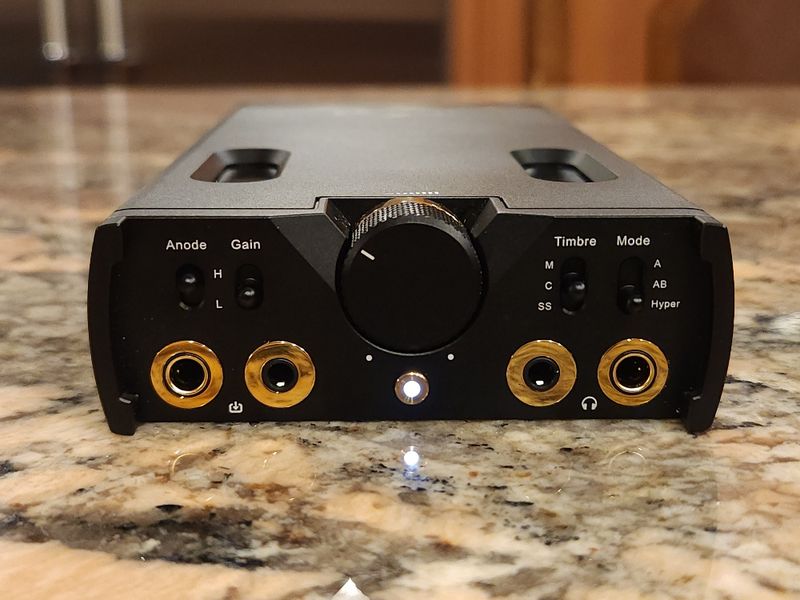
Under the hood.
You can already get a good idea of what to expect under the hood from the Design section of the review, realizing all the enhancements you will get moving from C9 to C9ii. Cayin has been in the business of audio electronics for over three decades, especially with a focus on personal audio products in the last 10+ years. C9ii amplifier is a combination of their best design elements combined in one package. And it looks like Cayin is continuing their focus on portable audio with DAPs and amps since they mentioned in the past that due to DAC and sw/fw dependency, DAC/amps get outdated faster than a pure amplifier that can stay relevant for a much longer time and be used with many different sources. And here is what you will find under the hood of C9ii.
First of all, you have a dual Input mode where you select Line Input with the incoming signal from the source being fixed as you vary the amplifier output using the C9ii volume wheel, a more traditional headphone amplifier operation. Or you switch to Pre-Amp Input where C9ii functions as a power amp with a fixed max gain level and you adjust its output by varying the input from the source. Some DAPs offer LO with an adjustable output controlled by a volume wheel, thus the name “Pre-Amp” since you are adjusting the amp volume in the pre-amplifier input stage. And because Pre-Amp output will set C9ii to max gain level, as a safety precaution you have to press and hold the pre-amp activation button on the side of C9ii.
After the initial input stage, the signal gets timbre treatment depending on a selection of either Solid State (2SK209 JFETs) or Vacuum Tube (Korg NuTube 6P1), their Gen5 NuTube audio circuit, which is based on and following their previous N8, C9, N8ii, and N30LE designs. C9ii is a Solid State/Tube amplifier, but that part of the circuit is responsible for the “coloring” of the sound before the actual headphone amplifier section. This sound “coloring” will be applied to either SE or BAL inputs, and as I already mentioned, you are not limited to using only SE or BAL input/output path but can mix it.
The amplifier gain control is done in two stages. Primary Gain control is between Low and High settings selectable from the front panel switch, boosting the signal by 6dB. Secondary Gain control uses an ALPs potentiometer (volume wheel) with a pair of MUSES Series low noise, low distortion resistance ladder electronic volume (MUSES72320). Especially when using sensitive IEMs while keeping the volume low, I never experienced L/R imbalance with C9ii volume control.
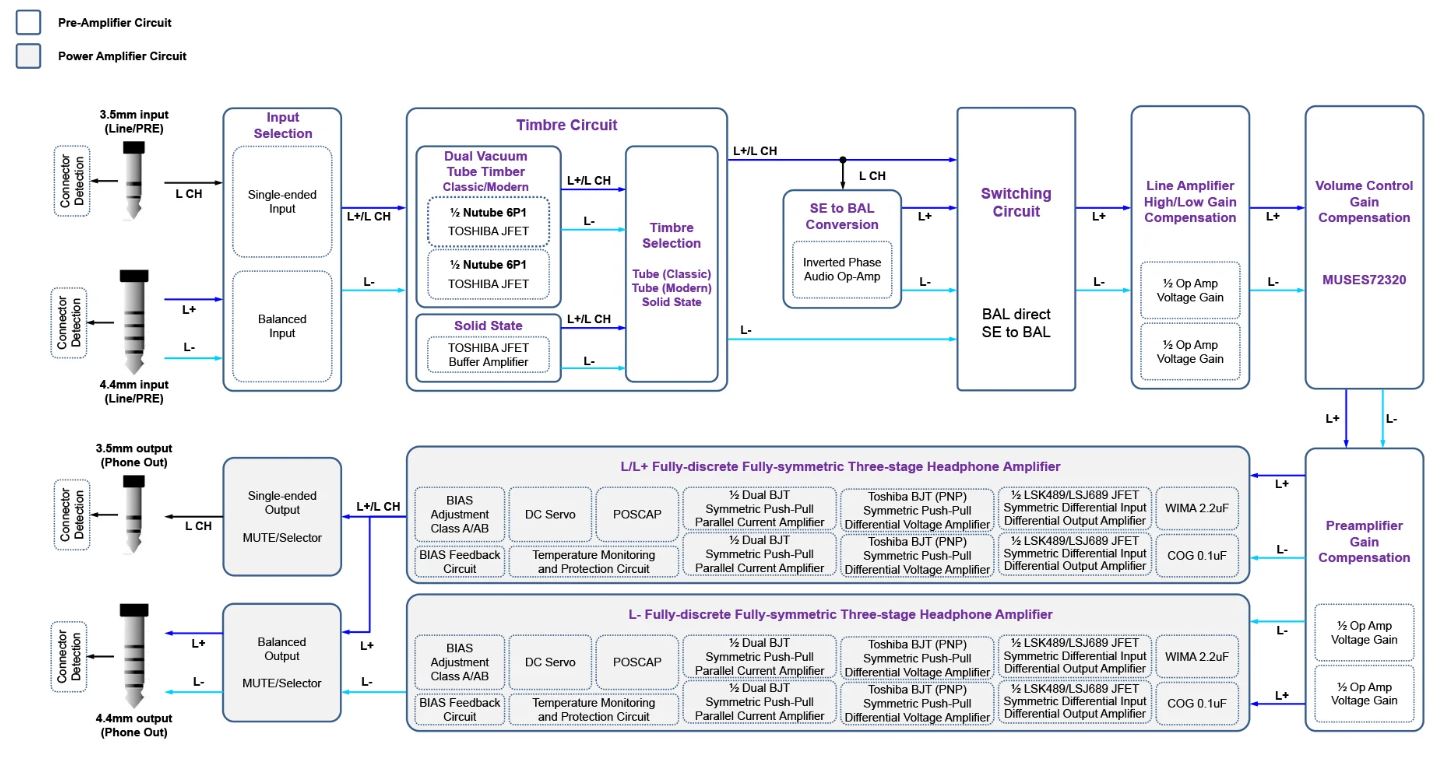
Last, but not least, the fully discrete, fully symmetric differential headphone amplifier, is significantly different from C9, with a selection between Class A or Class AB of dual amp operation (DAO) mode and Hyper mode setting that has a highly optimized Class A setting with the adjusted bias, the gain stage, and the headphone amp voltage. While both C9 and C9ii have a fully discrete, fully differential four-channel amp circuit, C9ii also adopts a fully symmetrical three-stage design architecture: 1) Symmetric JFET Common-source Differential input amplifier, 2) Symmetric BJT Common-emitter Push-Pull Differential Voltage Amplifier, and 3) Symmetric BJT Common-collector Push-Pull Parallel Current Amplifier (emitter follower).
Furthermore, C9ii introduced a new feature, the High/Low adjustable Anode (plate) voltage which enhances and refines the vacuum tube timbre by applying different operating voltage to the plate of the vacuum tube. And, we have Classic and Modern sound NuTube tuning where the Modern sound option utilizes a large-loop negative feedback system, similar to the original C9 where you only had one Tube timbre sound mode, while the Classic sound option doesn’t have this large-loop negative feedback, with each stage operating independently through local feedback, similar to the N8 DAP design. Also, C9ii adds an integrated precision control circuit to allow the amp to operate in Negative FeedBack (NFB) mode.
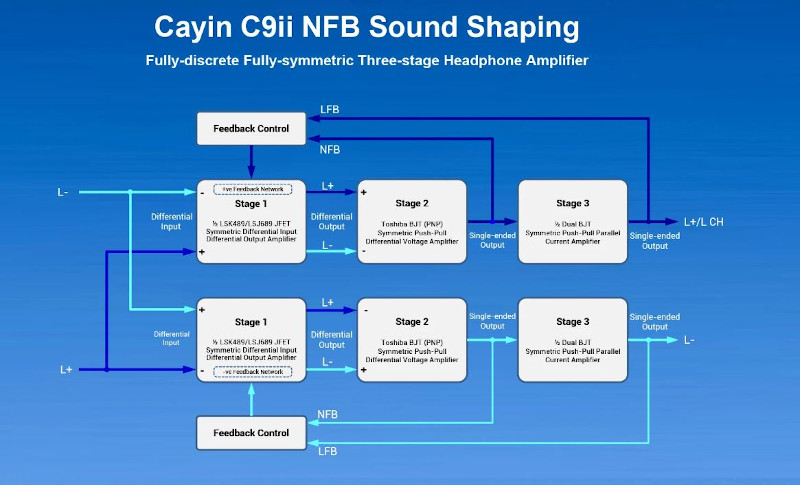
You don’t need to have an EE degree to understand all these terms. Just know that you will have at your fingertips full control of sound shaping with NFB/LFB, Class A, Class AB, and Hyper modes, Anode H/L voltage setting, Solid-State, and Tube (Classic and Modern) timbre, Gain H/L setting, and Line/PreAmp modes, all of which going to help you fine-tune the sound of your IEMs and headphones to a perfection of your exact liking.
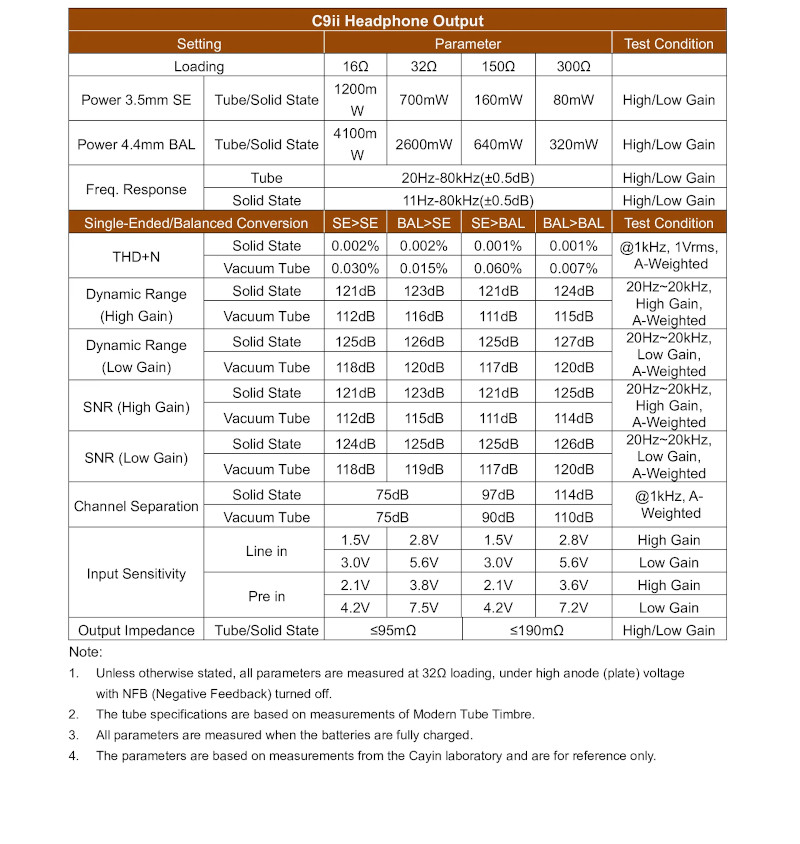
So, how does C9ii amplification translate into the actual output power? C9ii is rated at 700mW (@ 32ohm) from 3.5mm SE and 2,600mW (@ 32ohm) from 4.4mm BAL output jack. Of course, depending on headphones, with higher impedance the rated output power will scale down accordingly since it is inversely proportional. Considering this is a portable battery-operated amplifier, the power output parameters are quite impressive. And speaking of battery, the rating is from 8hrs (Tubes, Hyper mode) to 17.5hrs (Solid-State, Class AB mode), depending on the mode of operation. Vacuum Tubes consume more current and will drain the battery faster in comparison to Solid State. Also, you should expect to drain more battery in power-hungry Class A (or Hyper) or when using a balanced connection. Btw, I noticed that C9ii doesn’t have as much leakage current as the original C9 when on standby with power off, keeping the battery charge longer in comparison to C9.
I have talked about Korg NuTube 6P1 (https://korgnutube.com/en/ – a dual channel triode vacuum tube) back in my N8, C9, N8ii, and N30LE reviews. Just as a recap, while NuTube operates exactly like a triode vacuum tube, the tech behind it is based on a vacuum fluorescent display technology, like LED. These NuTube modules require less power than a traditional vacuum tube, are smaller in size, and have a much higher reliability with 30,000 hours of continuous life expectancy, all that while still providing the sound characteristics of vacuum tube sound. And just like with a vacuum tube, there is a warm-up period, thus when you switch to tubes there is a short delay. Similar to other Cayin products with NuTubes, to eliminate microphonics associated with these tube modules, Cayin designed a custom-built shock-absorption silicone housing and a spring-loaded suspension system.
Page 3 – Sound analysis and Comparison.
Page 4 – Pair up with IEMs, Headphones, DAPs, and Conclusion.

 Twister6 Reviews
I am using a Campfire Audio Stellar Horizon with C9II and I can’t underwrite your comments with Solaris. Also no hiss so probably very different of Solaris
LikeLike
Try to listen to first 30sec of something like Agnes Obel “the Curse”. In instrumental songs or with less busy arrangement you will hear a strong waterfall hissing. It’s typical of many Campfire iems, different versions of Andro or Solaris, or other sensitive iems like VE VE10. Of course, people have different ear sensitivity, some might hear it more or less pronounced. In ‘busy’ arrangement tracks with lots of instruments it could get lost as well in comparison to classical, instrumental, vocal tracks. Many of my readers who have tinnitus also can’t hear hissing due to their own hearing “noise floor”. But in general, many (but not all) Campfire iems do hiss with various sources. And if you don’t hear it, then nothing for you to worry about 😉
LikeLike
Also, I don’t have Stellar Horizon, it was reviewed by my other contributor, so maybe they did change something?
LikeLike
Hello,
Is Cayin 9ii comparable to Mass Kobo 475?
Thank you very much for your high quality reviews!
LikeLike
I only had 475 on a short loan over a year ago, so no way to do a/b comparison. But by memory, 475 was a lot more neutral with hardly any coloring. C9ii is all about lots of different sound shaping options to color your sound instead.
LikeLiked by 1 person
Does that mean that no setting in Cayin 9ii can give a neutral sound?
LikeLike
you can get closer using Solid State timbre instead of dual NuTubes, noticeably less coloring. But it will not be identical to 475.
C9ii has a lot of flexibility to adjust the output tonality.
LikeLike