
The complete package!
PROS: Triple timbre selection with Solid State and Classic/Modern dual NuTube tuning, fully symmetric differential discrete headphone amp with Class A, AB, and Hyper modes, Anode (plate) High/Low voltage, Negative FeedBack (NFB) integrated circuit, dual LINE and Pre-AMP input modes, 3.5mm SE and 4.4mm BAL for input/output, high power output, removable rechargeable 18650 batteries, included SE and BAL interconnect cables.
CONS: price, hissing with sensitive iems.
The product was provided to me free of charge for review purposes in exchange for my honest opinion.
Manufacturer website: Cayin. Available for sale from authorized sellers like Musicteck.
Intro.
Introduced over 3.5 years ago, the original C9 was one of the first dual NuTube portable amps with many sound-shaping options under its belt, later trickling down into the N8ii DAP design. After the feedback from the audiophile community that missed a warmer tonality of the original N8 DAP, Cayin updated the N8ii design, turning it into the limited-edition release of their 30th Anniversary N30LE DAP with new Tube timbre modes (Classic and Modern) and new Hyper amp mode. It even trickled down to their “entry” level N3Ultra DAP, utilizing its miniature tubes with Classic and Modern timbre options. That is very typical of Cayin, constantly evolving and refining their designs with updated tech shared in new releases.
Spending time with C9 wiped away my skepticism about using portable amps, especially since around that time we were still dealing with COVID-19 aftershock and a hybrid work environment, listening to music while spending more time at our home desks. Plus, many portable non-modular DAPs couldn’t offer the same flexibility of the internal headphone amp section like in N8ii or N30LE, if you were even lucky to get your hands on the latter one. Thus, I opened my mind to the use of portable external amps in conjunction with many fine DAPs and their different DAC implementations. I also realized that these portable amps would benefit not only the demanding headphones but also improve the pair-up synergy with many IEMs.
When the rumors about the C9 update started to circulate, I realized that expectations of something radically different would be unrealistic. But considering what C9 already had to offer, and all the new design ideas introduced in the follow-up N8ii and N30LE releases, I couldn’t wait to find out what Cayin has come up with. After spending the last month with this little beast, I would like to share with my readers what I have found.
Unboxing and Accessories.
The unboxing experience of C9ii is very similar to C9, still reminding me of the premium IEM packaging. The gift-box quality box has a magnetic top cover to reveal a non-removable foam insert with a secure cutout for C9ii and a sliding tray underneath with accessories. Maybe for some, the packaging is not a big deal, however, I found it to be very convenient to access the accessories without digging through and removing layers inside the storage box.


In addition to the main attraction, C9ii with its battery module already mounted inside, other accessories include an upgraded pure copper single-ended (3.5mm to 3.5mm, CS-35C35II) and balanced (4.4mm to 4.4mm, CS-44C44II) short interconnect cables, high-quality type-c charging/data cable, 4 small stick-on rubber feet you can attach to the amp, and a very comprehensive user manual. At first, I thought the included usb cable was for charging only since the connectors had red plastic inserts, but I did verify it could be used for data as well. Don’t rush to attach rubber feet/bumps because you might want to get an optional case for the amp. Also, the interconnect cable has been upgraded and each of its 8 pure copper conductors now has a shielding connected to the ground of a 4.4mm connector.


As an optional accessory, Cayin is also made available in either black or blue a rugged case that offers full drop and impact protection without adding a lot of bulk. The case is crafted from a high-strength flexible PC material and features a PU leather surface and multi-vent heat dissipation cutouts on the top and the bottom with fully open sides, including NuTube window cutouts. The case is not exactly cheap, but it is high quality and quite functional, and I highly recommend it. Here is a link on the MT page for this case.


Design.
The overall dimensions of C9ii did go up in size from C9’s 160x80x28mm with a weight of 550g to 165x88x30mm with a weight of 650g. The extra length here is due to new side guards, protecting toggle switches on C9ii (vs sliding C9 switches), and the additional width is contributed by the curved sides (vs flat C9 sides) with heat-sink ridges. It still has a rectangular shape, but the guards and curved heat-sink sides give it a more pro-amp look. I would still consider it to be borderline portable/transportable due to its weight/size and since it has to be stacked with a source if you choose to use it with a DAP on the go. A big contributing part of its weight and size is still due to the internal battery tray and the included 4x Samsung 35E (3400mAh) 18650 batteries which alone has a weight of 288g and extends 82mm in length. Thus, half of the length and the weight of C9ii is due to its 4x rechargeable premium batteries with a tray.


The back of C9ii has usb type-c connector for charging batteries, and it supports anything from a standard 5V/2A to a higher voltage fast PD2.0 or QC3.0 chargers which cut down the charging time by almost half from 6.5hrs to 3.8hrs. Also, next to usb connector you have 4 battery status LEDs to indicate the charging status and remaining battery capacity. The unit is fully charged when all 4 LEDs are solid and stop blinking. Both, usb connectors and LEDs, are part of the removable charging battery tray which you can use standalone, very convenient to charge 4 batteries at once.
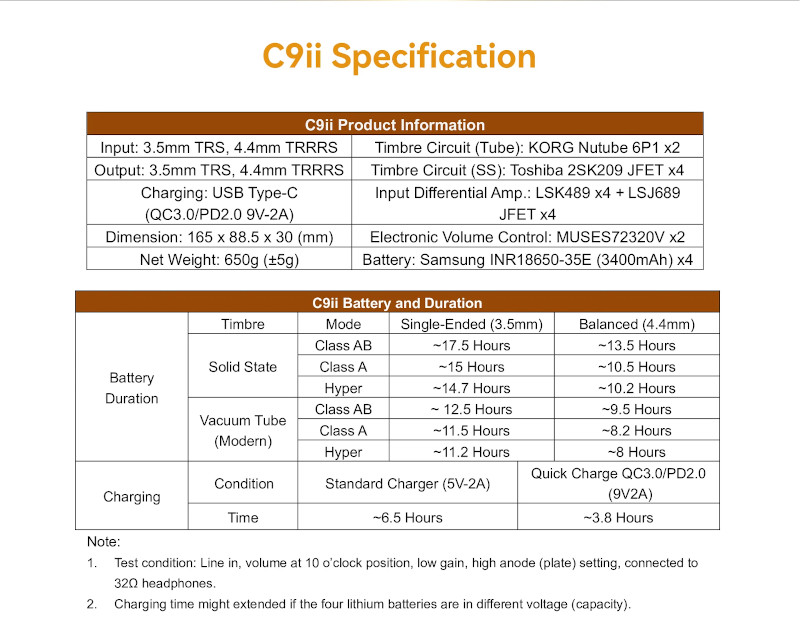
You can buy any standalone battery charger, but I assume similar to C9, Cayin will be offering a spare charging tray for sale in the future which should make it more convenient to be able to charge another set of batteries outside of C9ii and then just slide in and out a new tray. Keep in mind, that once you remove one of the batteries for replacement, you will need a charger to reset the overprotection mode the tray enters. But when you slide in and out the tray by itself, in my testing it worked without the need to reset it. And speaking of sliding, unlike C9 where you had to use a screwdriver to remove two side hex screws, Cayin implemented a handy latch mechanism on both sides where you just have to push the latch in to release the tray. Out of the box, the latches were a bit stiff and harder to press, but after a few removals, it loosened up and became more manageable, though I did “enhance” it by using a small piece of masking tape on each side of the tray to improve the grip.


The bottom of the original C9 has a glass surface, while the C9ii has an all-metal 6063-T6 aluminum alloy chassis. You can apply the included small stick-on rubber bump feet unless you are planning to use the protection case which I do highly recommend. The top of C9ii was crafted with two glass oval-shaped “eye” openings to reveal a pair of Korg NuTube directly heated triode vacuum tubes when in use. These openings were bigger than in the original C9. As already mentioned, both sides have heat-sink ridges. Other than that, the right side doesn’t have anything, and the left side has a Pre-Amp activation button which for a safety measure you have to press and hold for 3-4sec until the blue LED indicator next to it lit up. Keep in mind, that the Line setting (when Pre LED is off) controls output with a volume wheel and Pre-Amp sets the output to a fixed level and you control the input to C9ii from the source. A Negative FeedBack (NFB) button is next to it, and this one is just an on/off switch with a blue LED indicator next to it.


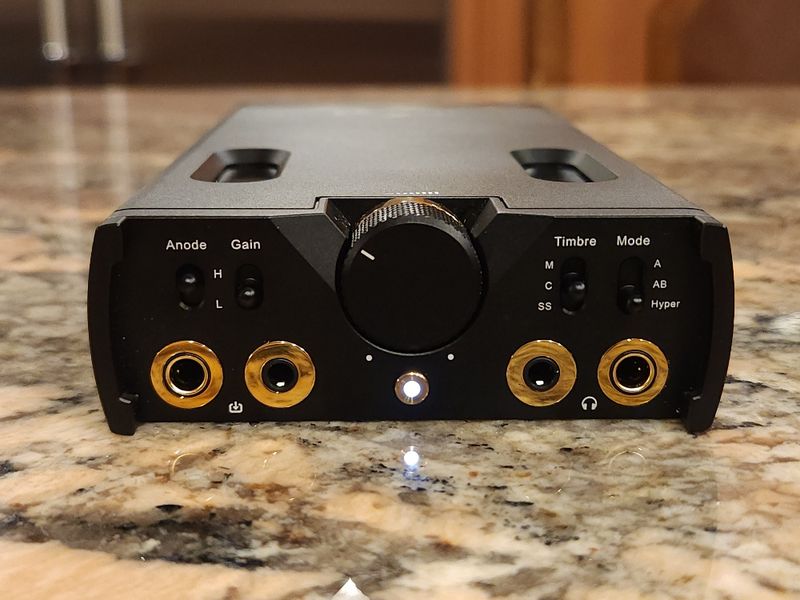
The front of the C9ii is where you will find all the ports and toggle switches placed around the volume wheel in the middle. The volume wheel, which controls the ALPS potentiometer, is 20mm in diameter (vs 15mm in C9) and rotates clockwise to raise the volume and counterclockwise to lower it. The knob of the wheel is nearly flush with the front of the C9ii to prevent accidental turning and is easily accessible from the top through a generous cutout to be able to turn its diamond-cut wheel knob. The rotation of the wheel has a fluid motion and a nice resistance, just enough so you don’t turn the wheel by accident, and still easy to operate with a thumb. As already mentioned, due to the implementation of toggle switches, the side guards are there to prevent accidental bumps as well. Worth noting, that if you are using L-shaped headphone plugs, you have to rotate them away from interfering with side guards.
Looking closer at the front of C9ii, you will find at the top left corner the Anode (plate) voltage High/Low switch and the Gain High/Low switch. To the right of the volume wheel, you will find a Timbre selection toggle with Solid State (quad set of Toshiba 2SK209 JFETs) or Tube (Korg NuTube 6P1 vacuum tubes) with either Modern or Classic modes, and Class A and AB (dual amplification operation – DAO) mode switch along with a bonus Hyper mode setting. In the lower-left corner, you have Input ports, 4.4mm BAL and 3.5mm SE, and in the right corner, you have Output ports, 4.4mm BAL and 3.5mm SE, designed to allow you to mix SE and BAL between the input and output. Unlike C9 where BAL ports were closer to the middle, here they were moved farther apart to reduce the cluttering around the volume wheel since 4.4mm is a more used port, at least for me. In the middle of the front under the volume wheel, you will find a power button with a white status LED that blinks for a few seconds when you turn C9ii on and the controller initializes the device, and also when you switch between Solid State and Tube timbre.

Page 2 – Under the hood.
Page 3 – Sound analysis and Comparison.
Page 4 – Pair up with IEMs, Headphones, DAPs, and Conclusion.

 Twister6 Reviews
I am using a Campfire Audio Stellar Horizon with C9II and I can’t underwrite your comments with Solaris. Also no hiss so probably very different of Solaris
LikeLike
Try to listen to first 30sec of something like Agnes Obel “the Curse”. In instrumental songs or with less busy arrangement you will hear a strong waterfall hissing. It’s typical of many Campfire iems, different versions of Andro or Solaris, or other sensitive iems like VE VE10. Of course, people have different ear sensitivity, some might hear it more or less pronounced. In ‘busy’ arrangement tracks with lots of instruments it could get lost as well in comparison to classical, instrumental, vocal tracks. Many of my readers who have tinnitus also can’t hear hissing due to their own hearing “noise floor”. But in general, many (but not all) Campfire iems do hiss with various sources. And if you don’t hear it, then nothing for you to worry about 😉
LikeLike
Also, I don’t have Stellar Horizon, it was reviewed by my other contributor, so maybe they did change something?
LikeLike
Hello,
Is Cayin 9ii comparable to Mass Kobo 475?
Thank you very much for your high quality reviews!
LikeLike
I only had 475 on a short loan over a year ago, so no way to do a/b comparison. But by memory, 475 was a lot more neutral with hardly any coloring. C9ii is all about lots of different sound shaping options to color your sound instead.
LikeLiked by 1 person
Does that mean that no setting in Cayin 9ii can give a neutral sound?
LikeLike
you can get closer using Solid State timbre instead of dual NuTubes, noticeably less coloring. But it will not be identical to 475.
C9ii has a lot of flexibility to adjust the output tonality.
LikeLike