

The APX for the west?
PROS: Very tastefully tuned, highly musical, immersive and exciting sound signature, exceptional TOTL technical performance, well built with rare faceplates and very attractive blue sparkle shell design, very snug and comfortable fit for long listening sessions, modular cable, two well made carry cases as well as a premium leather suitcase.
CONS: Very expensive, I would’ve liked a bit more ear gain, mid-treble sizzle and upper-treble air boosting needs a slight adaptation period, nothing else.
The product was provided to me free of charge for the review in exchange for my honest opinion.
About PMG Audio.
PMG Audio (Piotr Marek Granicki Audio) is a brand under Custom Art’s umbrella focusing on premium high-end products. As per Piotr, their goal is to create audio products that are unique and exclusive, but at the same time a little bit more eccentric. With over a decade of hands-on experience in tuning and building IEMs under the Custom Art brand name, they’re now venturing out to deliver the best sound they can achieve with money no barrier.
Links – Official Website (€5500) | Musicteck ($6000) | APX SE Cable @ Musicteck ($1619)

Tech in APX.
FIBAE – Flat Impedance Balanced Armature Earphone.
Flat Impedance Balanced Armature Earphone (FIBAE™) patented technology is a revolutionary In-Ear Monitor design providing flat impedance and phase. By changing the Balanced Armature driver’s character from inductive to resistive, guys at Custom Art solved one of the oldest problems in the industry – dependence on output impedance of sound source for correct earphone output. With FIBAE™ technology, their IEMs will always perform their true self plugged into any kind of source.
Geometrical Sound Outlet.
GSO is a calculated parallel wall structure inside an otherwise round nozzle.
Geometrical Sound Outlet serves multiple functions – firstly as a support structure to increase the rigidity of the nozzle, secondly optimizes the dimensions of the nozzle and reduces the cross section size, finally it works as a horn structure increasing high frequency extension.
Pressure Optimizing Design.
Pressure Optimizing Design is our in-house developed technology to reduce the pressure in front of the driver and influence its response by properly tuned acoustic filters.
Ultra Planar Speakers.
We equipped Apx with an Ultra Planar Subwoofer delivering range only up to around 80Hz and an Ultra Planar Tweeter for range above 10kHz. Planar technology offers near limitless response on both ends of audible frequency range. Planar subwoofer supports Dynamic Driver in order to create the most natural bass attack and decay without unnatural bass boost to compensate. This woofer is strong enough to create perceivable vibrations enhancing listing experience. Planar Tweeter supports Balanced Armatures by adding extra air and extension, the choice of speaker and its application allowed to retain correct high frequency tone and speed.
Precision 3D printed housing with calculated waveguides.
Each driver inside the shell is meticulously positioned in a 3D printed coupling structure, with calculated and proper distance to the sound outlet, accounting for frequency and time domain. By removing variable elements such as a typical soft tubing, we increased the repeatability of the response across the whole production run.

Technical Specifications.
- 11 drivers: 1x Rectangular Planar, 1x 10mm DD, 8xBA, 1x Round Planar (all drivers are custom-built to PMG Audio’s spec)
- True 7-way passive crossover
- Flat impedance technology
- GSO, UPS, POD, 3D in-house developed technologies
- Impedance: 5 Ohm ±1 Ohm
- SPL: 107dB @1kHz
- Frequency response: 3Hz-22kHz
- Gold Plated Silver+Silver+Silver Copper Alloy cable with Silver Alloy and Copper dual shielding; 2.5, 3.5, 4.4mm connectors, 0.1 Ohm resistance
- 2-year warranty

What comes in the box?
- Leather multi-function suitcase
- Metal and leather cases
- Certificate of Authenticity
- Interchangeable 2.5, 3.5, and 4.4 mm connectors
- Ear tips – Silicon (SML) and Foam (SML)
- Leather strap
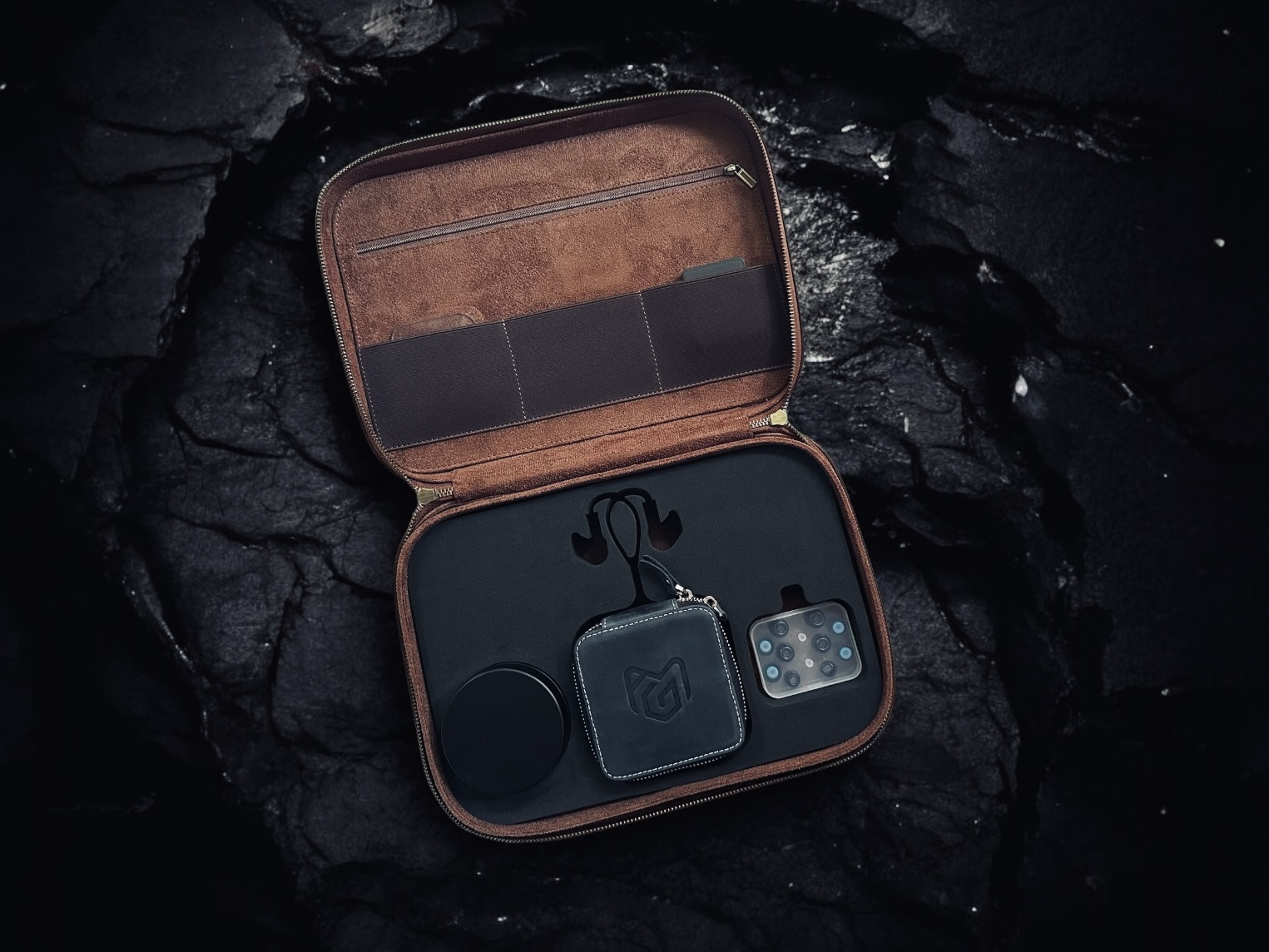
Build Quality, Fit and Comfort.
APX SE shells are significantly different from APX which had the Amber faceplate with gold sparkle shells. The shell shape is still similar to APX and their Custom Art IEMs but now has the For people who’ve used or tried Custom Art IEMs, APX SE’s shells are very slightly larger than FIBAE 5, not chonky, in fact very ergonomically designed considering the kind and number of drivers they have in there. They have ‘PMG Audio’ and ‘APX SE’ lazered in there in gold colour. Just like the APX, APX SE too looks like a collectible and I can only imagine how much time and expertise it takes them to do this design.
Nozzles are the perfect size to fit most tips and the overall fit is very snug with the shells sitting ‘almost’ flush with my outer ear, protruding outside very slightly. Custom Art shells have always been some of the most comfortable shells for me, one’s I can even use to watch movies while laying down sideways, which isn’t something I can do with most IEMs. On top of that they isolate really well too.
Premium Cable.
APX SE comes with a flashy Gold Plated Pure Silver + Pure Silver + Silver Copper Alloy cable that measures 0.1Ω (100mΩ), which is significant upgrade over APX’s underwhelming cable. It has a coaxial structure with first shielding as a Silver Copper Alloy and the second shielding being black Oxygen-Free Copper. It has a detachable jack with 2.5, 3.5 and 4.4mm connectors. This is a very nice cable that PMG Audio now sell for $1619 separately via few selected dealers (here). All in all, this is a very nice premium cable and there’s isn’t anything I can nitpick here besides its solo asking price, a complaint I always have with kilobuck cable prices.

Leather Suitcase.
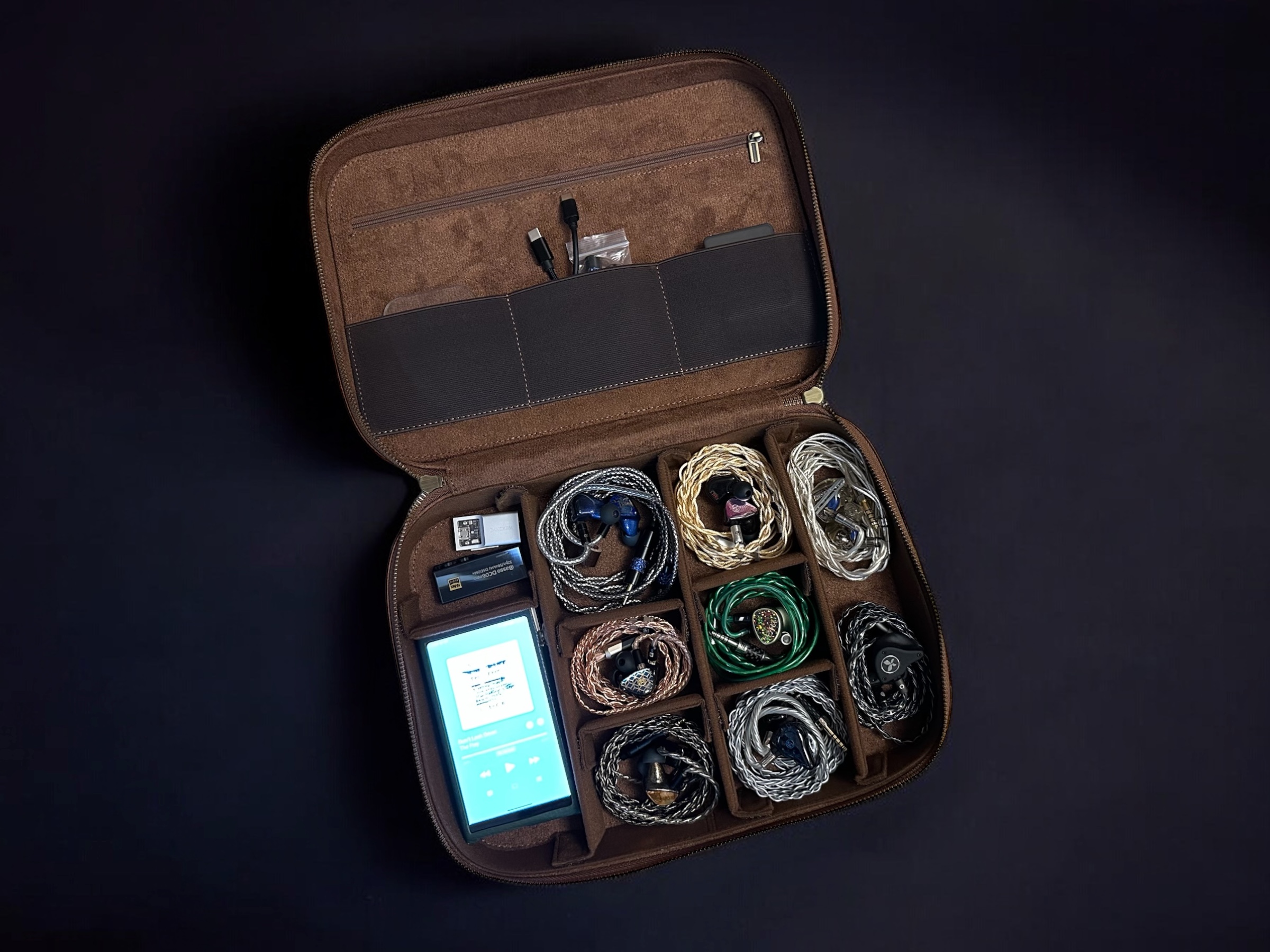
PMG Audio have included a wonderful premium leather suitcase with the APX SE as stock – which is such a wonderful addition over the previous wooden box of the original APX that wasn’t usable after unboxing. This is not only premium but also robustly built. As you lift the internal foam cast, there are several partition strips for you to customise the suitcase to your use case perfectly. I have it setup in a way so that I carry one DAP, a few dongles and some of my frequently used IEMs. Such a well thought out package this time.
Sound Analysis.
Drivability – APX has a very low 5Ω impedance, fairly high sensitivity of 107dB which make it very easy to drive.
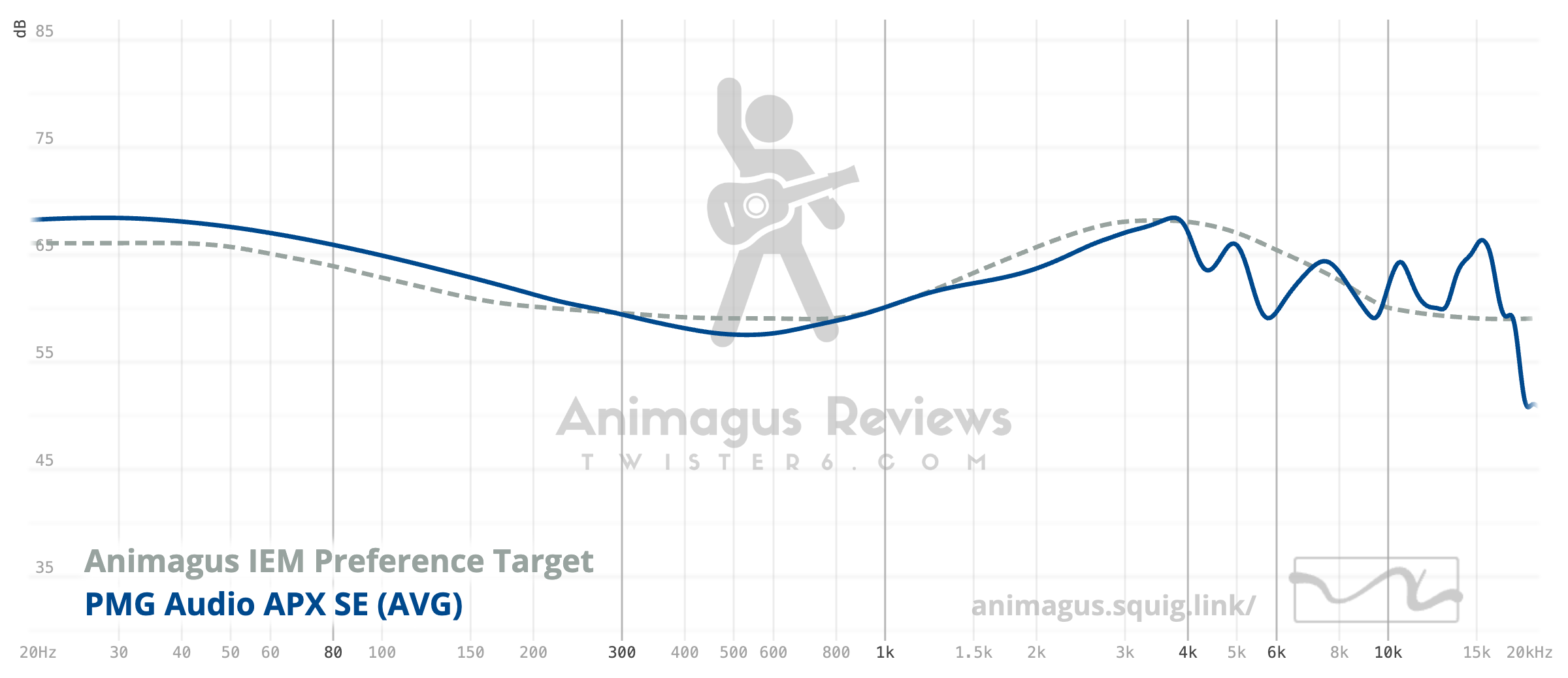
Graphs are measured using an IEC60318-4 (IEC711) setup. You can compare all the graphs on my IEM Graph Database here – Animagus Squiglink.
Summary – After APX’s success which was basically sold out in the Asian markets before any other, Piotr says APX SE was tuned more for the western market that tends to go for slightly warmer and bassier signatures. Even though I don’t believe in ethnicities deciding what kind of audio one likes and why there is some consistency in audio research of humans as a whole, sales figures do help tell a story of personal preferences, even though no significant scientific research has been done in this area to bring out the actual truth of region based preferences.
So now, APX SE has been tuned targeted towards the western market as a warmer take on APX’s neutral-bright W-shaped signature – still being a tasteful coloured take on a sub-bass boosted reference tuning in the larger picture and one that still has APX’s impeccable technical performance mostly. It has a wowing, mesmerising tonality, one that leans slightly warmer than neutral in upper-midrange and lower-treble but with exceptional treble extension and airy quality on top. APX SE goes for an immersive and exciting presentation of music – one that is easier at louder volumes and still has a particularly large soundstage, good instrument detail retrieval and wonderful stage LCR separation.
Let’s dig deeper in its tonal performance…
Bass – APX SE like the APX has what PMG Audio refer to as a rectangular Ultra Planar Subwoofer which executes the sub-bass region and a bit of mid-bass up to 80Hz in conjunction with the dynamic driver, creating a very tasteful 9dB bass shelf. APX SE’s bass shelf and drivers are the same as APX, so the FR makes up for a bass presentation that has very good tonality, very precise and defined bass notes as well as very good separation of bass in the centre but with one major difference influencing the perception of technical performance – the warmer lower-treble region that influences the perception of bass detail and transient response. APX’s bass was vibrantly dynamic, one that was able to relay the intricate details and dynamism in bass playing extremely well. In comparison, APX SE’s bass feels warmer, softer and more gooey. Where APX’s bass performance focussed on attack, speed and micro-detail retrieval, APX SE’s focuses more on punch and slam due to the less treble in APX SE influencing the perception of its bass quantity being more. Like the APX, it too has a very tasteful accurate presentation that is always trying to give you good speakers in a good room kind of feel, with the APX SE being more a cosy home with a fireplace to keep you warm and APX giving you a feel of a high end studio control room.
Midrange – There’s a slight dip around 500Hz which results in APX SE’s lower-midrange coming across slightly leaner but generally warm due to its lower-treble being warmer. The upper-midrange on the other hand is one for people who like slightly warmer ear gain than reference-neutral. It has about 6.6dB of ear gain at its highest peak at 3kHz and dips it from 3-8kHz by about 3-4 dB compared to my Animagus Preference and Neutral targets. This results in a warmer tinge to the tonality of most instruments and the midrange sounding softer and further away, not as strong or upfront as reference-neutral IEMs do. Luckily it’s quite well done and doesn’t take it away from accurate tonality of instruments but does makes it easier to listen to at louder volumes.
Treble – It’s post 5kHz where APX SE differs from APX significantly. Where APX boosted above neutral, creating not only a bright leaning presentation that greatly influenced the signature to make for a bright, vivid, detailed and energetic sounding IEM, APX SE does it differently by going for a warm down low and sizzly and airy up top sounding signature by dipping the lower-treble from 5-8kHz and instead boosting the mid and upper-treble for sizzle and airiness – making for an IEM that is easier to listen to at loud volume and yet vivid and exciting, just not bright as APX. The mid-treble sizzle and upper-treble air greatly enhances the feeling of an open, spacious and airy soundstage. They’re both different types of vivid and exciting signature but I can see APX SE being more versatile for the majority. Where I had to warn the treble sensitive to be wary of APX’s treble, the same is not required for the APX SE.
Technical performance – Just like the APX, APX SE’s tonality along with the technical performance – particular the soundstage, left to right separation, imaging, LCR + depth layering as well as the detail retrieval, all combined, help APX SE come the closest an IEM has ever gotten to sounding like nice Hi-Fi speakers in a room – just one with a warmer tonality than the APX. Of course, IEMs due to the nature of their design and insertion depth have a massive limitation when it comes to staging but I must commend PMG for coming closest to giving a sense of big space in an IEM in stock form. I an audio engineer otherwise generally have to bring out my engineering hat out and use a combination of target calibration (calibrating IEMs and headphones to particular room based targets) and room modelling plugins that model crosstalk and IRs (Impulse Response) of a studio room to give me that sense of perception and level of performance in an IEM or headphone. APX and APX SE of course can’t do the crosstalk and IR bit in stock form but it gets quite close in the other aspects. APX SE has exceptional depth layering, where it is able to bring out not only depth but also height layering in songs that are mixed that way. You can hear this most in songs that have several layers of guitars and keyboards playing, for example in songs of bands like Coldplay, Radiohead, MuteMath or rich film scores like that of Hans Zimmer. It’s the detail retrieval, layering, separation along with precise imaging that enable a spacious, heavily layered stage and it all combined makes for technical performance that’s one of the best I’ve experienced in an IEM along with the APX. All in all, APX SE just like the APX is exceptional in this aspect and if you know me and my reviews, I don’t say these things lightly.
Comparisons.
PMG Audio APX.
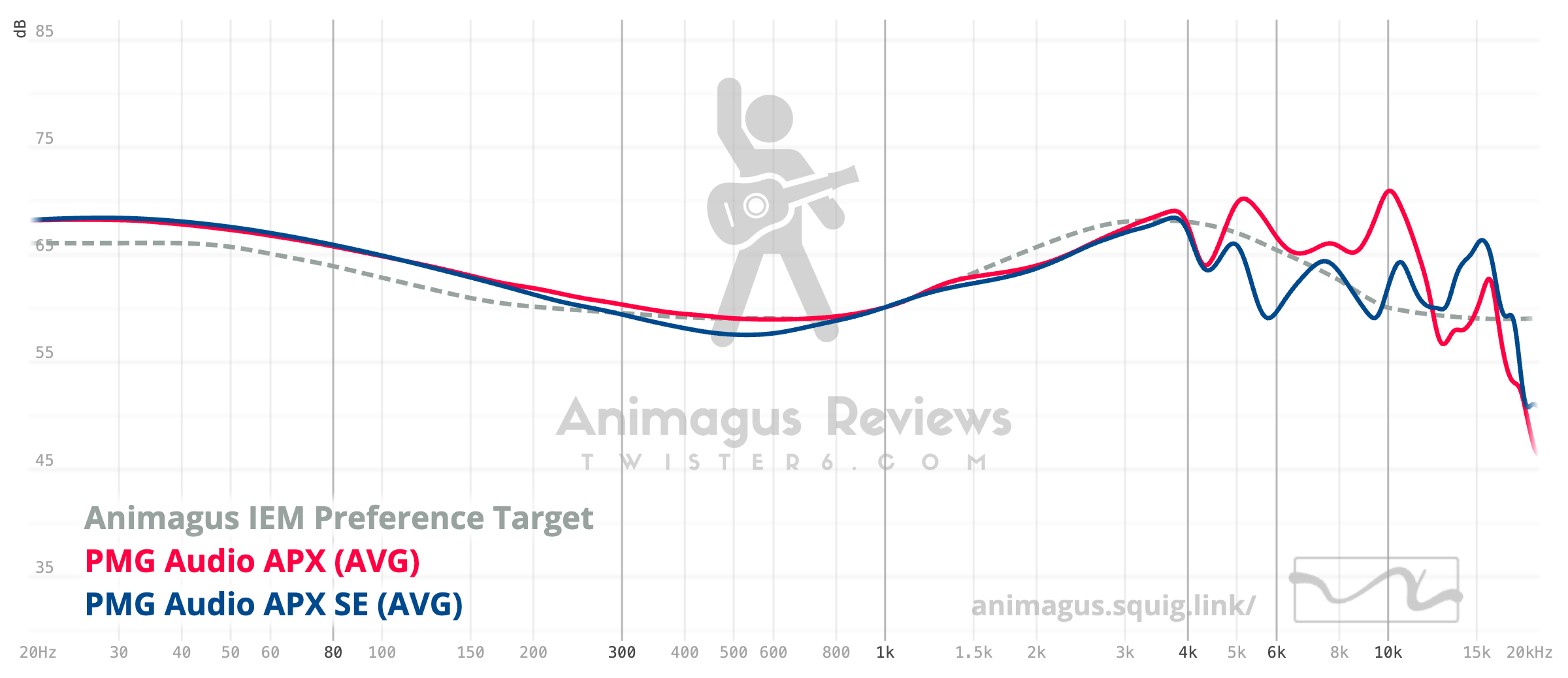
Sometimes just tweaking a certain frequency band can result in extremely different experiences as we humans hear the full frequency spectrum as a whole and not as isolated bands. On top of that some frequency bands have a more significant impact on the full FR than others. This is why APX and APX SE are quite different when you actually hear them back to back, so much that you might not realise they’re just twins with different personalities in a blind test.
APX’s bass presentation was full on transient response, macro + micro-detail pomp and show where it was so clean and precise with each detail that you could pick out the minutest of details in the performance easily. It had punch and slam when needed but they always played second fiddle to the hyper-realistic detail oriented vivid character. APX SE kinda does the opposite. It shines the spotlight on the bass punch, slam and rumble more without increasing the bass quantity, while the micro-details and transient response play the second fiddle instead. Which signature one would prefer completely depends on preferences. For me, it depends on my mood. I like both ‘almost’ equally with a slight tilt towards APX.
Even though APX SE looks to be very slightly leaner in the lower-midrange on graph, it actually sounds fuller due to it having lesser lower-treble quantity. When it comes to upper-midrange, it’s actually the APX that is more reference-like for the major part and sounds more forward and has more spank. APX SE has similar competence when it comes to the quality of the midrange but goes for a warm, comfortable blanket vibe to APX’s vivid and energetic character.
Lower-treble is where the major differences are, with APX being substantially brighter than APX SE which results in APX highlighting the sheen of stringed instruments and cymbal work while APX SE boosts mid-treble and upper-treble air instead adding sizzle and air to those same instruments but keeping the brightness in check. So, APX comes off bright while APX SE comes off sizzly and airy. APX SE also has very slightly better extension to give an open and airy sense of space making the staging equally competent as APX which had a more lighter and spacious character. All this also results in the major experiential difference where APX primarily went for a vivid and energetic signature making you feel like you’re standing in front of the band as they perform, be it a room, stage or stadium depending on the amount of ambience mixed in the song, while the APX SE goes for a more neutral-warm + airy immersive experience like listening to very nice HiFi speakers in a massive living room of a stone and wood cottage in the winters while you sit comfortably on the sofa in front of the fireplace. That’s the best visual representation I can think for their signature and how they make one feel.
Both are extremely technically competent with slightly different strengths. APX is more micro-detailed due to its brighter signature and can also give you a feeling of having better resolution but APX SE’s detail retrieval, layering and resolution are still top notch, just a slight bit below APX’s competence. APX had a lighter feeling stage whereas APX SE has a more wighted stage, with instruments having more weight and punch mainly due to the slightly warmer signature. Otherwise, all the other aspects of technical performance are equally good as they share 75-80% same FR and same exact tech, shell shape and fit.

Oriolus Trailli.

Oriolus Trailli was the TOTL IEM that first broke the barriers of the otherwise $4000 segment of TOTL pricing, coming in around $6600. It too has a W-shaped tuning but APX SE is a more W-shaped signature compared to Trailli with slightly more sub-bass, more ear gain as well as more mid-treble sizzle and upper-treble air and extension. This results is Trailli coming across warmer and slightly fuller sounding in comparison. APX SE is more vivid, energetic and exciting and makes for a signature that has a more immersive, engaging and attention grabbing quality. It also has a better micro-detail retrieval, a more open and airy sounding stage with slightly better imaging and depth layering.
Elysian Annihilator.
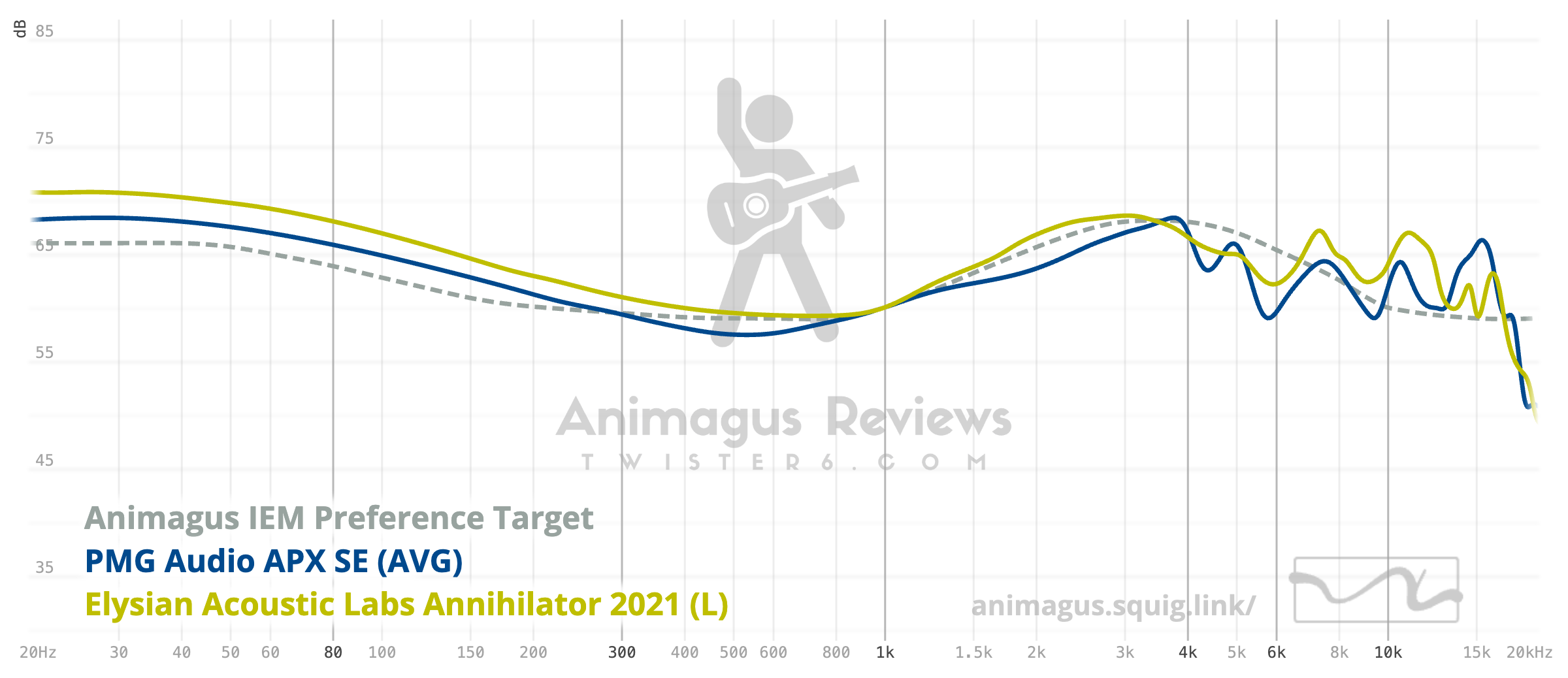
Elysian Annihilator is an even more W-shaped signature compared to APX SE resulting in it coming across bassier, slightly fuller, with slightly more forward presentation of instruments and a slightly brighter and sizzlier character on top. Annihilator has more bass boom quantity but its APX SE that has better bass tonality and technical performance with a better LCR separation, better isolation of bass in the centre, quicker speed and very precise dynamics. Annihilator has fuller lower-midrange because of which instruments sound slightly fatter than reference. Annihilator does have slightly more accurate ear gain and hence slightly more accurate forward definition of instruments but APX SE’s 2kHz dip takes some directivity out in result for deeper sounding vocals that aren’t as forward as in Annihilator. APX SE is airier up top while Annihilator is brighter in mid-treble resulting in different treble characters where one sounds more airy while the other sizzle. APX SE has a more holographic, open, airy and spacious stage with better LCR as well as depth layering and separation along with better imaging and detail retrieval.

Conclusion.
The original PMG Audio APX has been one of my favourite, most used IEMs from the time I got it – one I always look forward to using, especially to check out new releases from my favourite artists – something I have rarely felt for an audio product in a long time due to product overload and reviewer burn out caused by extensive testing of several new products and betas for product development all the time. So, when Piotr let me know that he was tuning an APX SE for the western audience based on the feedback he got from his west based dealers and customers (something I had recommended him to do for the original APX from the start when he first shared the beta graph with me), I wondered if it could beat what APX had created – a very engaging, vivid and exciting signature with top tier performance. Having taken APX SE through it paces and loved most of what I heard, I reckon it’s time to give it a spot in my top 5 IEMs too, just a rank below APX. APX SE does not make the APX obsolete for me but instead provides a different character with almost the same technical performance, both shining as very nice TOTL options of tuning and technical performance of today, with two different characters for different preferences. Where PMG really have done significantly better this time with APX SE is the more attractive design as well as a much better overall package and selection of accessories which now feel more in line with the asking price. They offer a premium leather suitcase that can fit in multiple IEM cases as well as a DAP or two, 2 different carry cases and a premium cable with swappable jacks that all make for a well rounded complete package. I’m still not happy about the $6000 asking price, as is always the case for me with top end pricing, as it makes it almost unobtanium for the majority. But looking at how quickly they sold all their limited 100 units, before I could even write a word of this article, seems like they have enough fans willing to pay top dollar for their product. For purely the audio performance, this gets two thumbs up from me. The rest is purely subjective as per the depth of one’s pocket. Regardless, I highly recommend getting your ears on both, the APX and APX SE, if you ever get the chance. With their peaking popularity for top tier performance and attractive designs, they sure look like they’re turning into collectibles and I only hope Piotr and team possibly put out more affordable versions so that more people can have access.
Gear used for testing and review.
- DAPs – HiBy R6 Pro II | iBasso DX260
- Dongle – Tanchjim Space | iBasso DC04 Pro
Artists I like and listen to.
- Rock – Foo Fighters, Linkin Park, Switchfoot, Imagine Dragons, Daughtry, Green Day, MuteMath, X Ambassadors, Dave Matthews Band, Vertical Horizon, Our Lady Peace, Lifehouse, Fall Out Boy, Breaking Benjamin, Muse, ACDC, Audioslave, Rage Against the Machine, Biffy Clyro, I Am Giant, Normandie, Paramore, Slash & Guns N Roses, 3 Doors Down.
- Pop Rock – John Mayer, Coldplay, Paul McCartney, James Bay, Hunter Hayes, Niall Horan, Keith Urban, The Bros Landreth, Bryan Adams.
- Progressive Rock/Metal – Porcupine Tree/Steven Wilson, Karnivool, Tool, Dead Letter Circus, Periphery, Lamb of God.
- Pop/Soft Rock – Ed Sheeran, Adele, Taylor Swift, OneRepublic, The Script, Gavin James, Magic Man, Maroon 5, Bruno Mars, Charlie Puth, Dua Lipa, The Weeknd, Oasis, Panic! At the Disco, TwentyOne Pilots.
- EDM – Chainsmokers, Zedd.

 Twister6 Reviews
Great review, couldn’t agree more that PMG Audio have delivered something quite special.
LikeLike
do you have a UM AP on hand? would love to see the two graph against each other.
LikeLike