
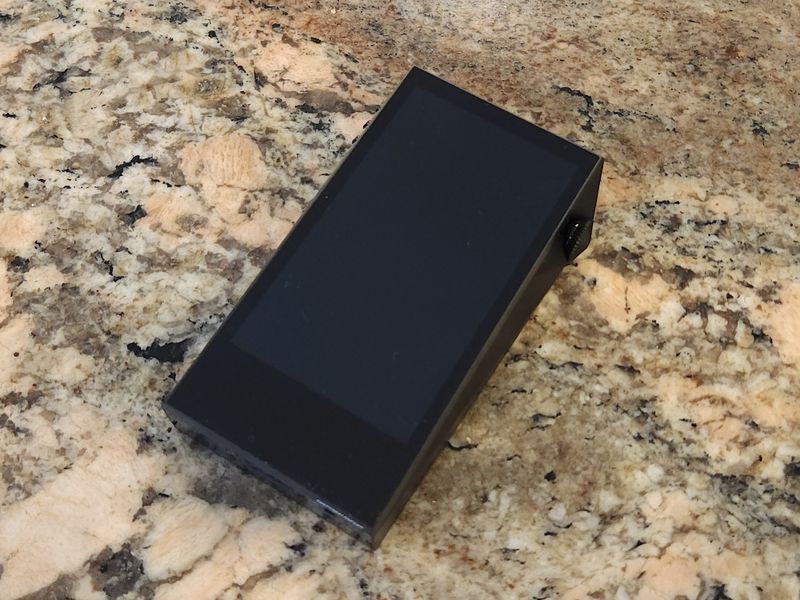
Sound Analysis.
The sound analysis of 3kM was done using Aroma Jewel and Audio-Technica ATH-R70x, playing a selection of test tracks, such as Agnes Obel’s “The Curse”, Sandro Cavazza’s “So much Better” (Avicii remix), C-Bool “Never go away”, Ed Sheeran “Shape of you”, Alan Walker “Darkside”, Galantis “Hunter”, Iggy Azalea “Black widow”, Indila “Boite en argent”, Dua Lipa “Love Again”, Counting Crows “Big yellow taxi”, David Elias “Vision of her”, and Michael Jackson “Dirty Diana”. I had over 120 hours of burn-in time when I started analyzing this DAP. I found SP3000M needed at least 120 hours because out of the box, the sound was warmer and more congested, opening up after 4+ days of continuous playback in the loop.
As my usual disclaimer, I prefer to describe the DAP sound based on the comparison to other DAPs and pair-ups with different IEMs/headphones since the DAP by itself doesn’t have a “sound”. What we hear is how it sounds through connected IEMs/headphones or the difference in sound relative to source comparison using the same pair of IEMs/headphones. This is my subjective opinion, describing how I hear it while analyzing the sound of 3kM in comparison to 3k and 3kT. The comparison was done using a RaoSound (by Oriolus) balanced switch with a pair of matching copper IC cables to minimize the time between unplugging and plugging back IEMs/headphones.


Please keep in mind, the same internal design doesn’t always guarantee identical sound performance as we have learned from SP1000 vs SP1000M days. Different factors contribute to the sound from the material used in the chassis to discrete head-amp filter components since a smaller footprint reduces the size of a circuit board and the real estate for miscellaneous components on it. Now, with all that said, after 120 hours of burn-in time and many hours of comparison listening between SP3000 and SP3000M, I did not find the sound changes to be that drastic. But there are some for sure.
As I compared both, with DAR off, 3kM has a decent soundstage expansion with a bit more center-focused intimate imaging, and also a touch more body in mids. 3k soundstage/imaging expands wider, being a bit more holographic, and its sound has a bit more transparency that results in a little less coloring in mids. As a result, with 3kM having a touch more body in the mids, it creates a perception of more treble contrast with a bit more crunch and a touch more air up top, while more transparency in 3k mids evens out the balance and gives the treble a bit smoother perception. Also, these changes create a perception of a slightly deeper and blacker background in 3k, however, it is quite subjective and you have to listen very closely using more resolving monitors.
If we add SP3000T into the mix, the 3kM and 3kT (OP mode) sound similar when DAR is off, perhaps, with the 3kM being just a bit more resolving and dynamic, including a slightly wider soundstage expansion. The sound difference between 3k and 3kM is not exactly night and day, but I do hear more transparency in 3k which could improve the resolution, while more body in 3kM mids could give it a bit smoother tonality. Of course, as expected, the 3kT (Hybrid and Tube modes) adds even more liquid musicality to its sound tonality, especially in mids.
There is a bigger gap in sound performance relative to soundstage expansion with the DAR filter being enabled, perhaps due to a different implementation since 3kM does it in software rather than hardware like in 3k. I found this difference to vary from IEM to IEM and also depending on using PCM vs DSD upsampling since 3k DAR DSD goes up to DSD256 while 3kM DAR DSD goes up to DSD64. In 3kM, some IEMs had the soundstage expansion narrower with DAR DSD, while others had it expanded and even more holographic with DAR PCM. Worth mentioning that in the middle of my 3kM testing, A&K pushed a new 1.05 fw update which I found to improve the imaging with DAR PCM enabled. But in general, I would suggest keeping DAR off when using 3kM to save the battery and for more consistent sound performance.
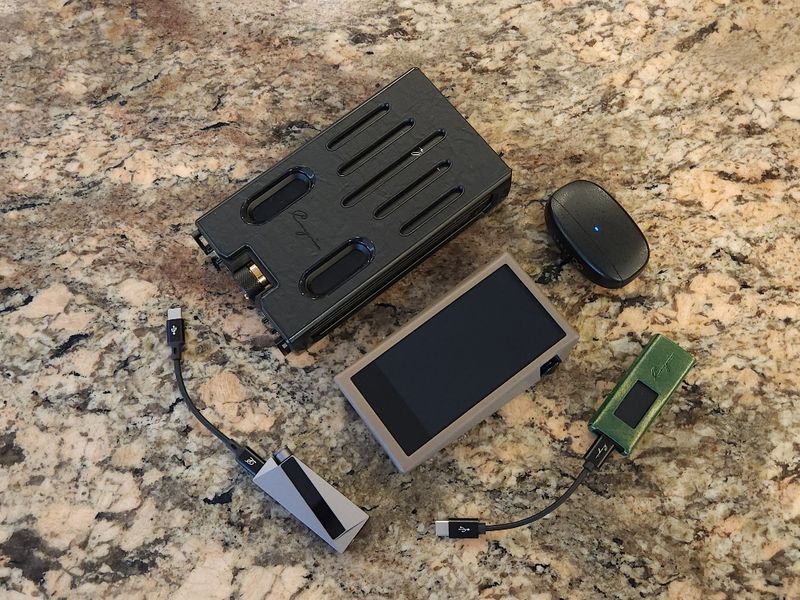
I also ran the same comparison using the C9ii amp, in SS and with NFB on (no tubes to reduce coloring and NFB on to cut the background noise level with sensitive IEMs). The test was done using 3k and 3kM LO, BAL output (at 4V), the same RaoSound switch, and the same matching IC cables. Under those test conditions, I only heard the difference related to soundstage width/imaging with 3k expanding wider while having minimal tonality changes which suggests that a bit of extra coloring in mids of 3kM comes from the internal head-amp difference.
Furthermore, I confirmed the power output to be nearly identical, and not just because it is listed such in a spec, but because I had the same volume setting on both DAPs while using different sensitivity IEMs and headphones, including open-back ATH-R70x (98dB sensitive, 470ohm impedance).


Wired and wireless connections.
Besides being a portable DAP, you can expand 3kM functionality as a transport to drive an external DAC/amp, use an external AMP, or turn the DAP into a wired/wireless usb DAC. And of course, you don’t have to be limited to wired headphones and can take advantage of a Wireless Bluetooth connection.
Wireless/Bluetooth.
I tested 3kM BT Tx with Final ZE3000 TWS, confirmed operation within 55ft in open space, and full remote control. The same TWS worked 45ft away from 3k. Not sure if anybody will be using TWS earphones that far away from the DAP, but it looks like some improvement here.
3kM also has Bluetooth Sink Mode (BT Receiver) when the BT DAC is enabled, and you set 3kM as a wireless DAC/amp. I tested this feature with my Galaxy S22 phone, streaming Amazon HD from my smartphone while using 3kM as a wireless DAC with LDAC protocol. It worked flawlessly 55ft away from my phone, displaying the name of the song I was streaming and letting me control the playback from 3kM.
USB Audio Out.
I tested and verified this feature with a few USB DAC dongles, such as RU7 and W4, and found it to work without a problem. Once connected, nothing is required to be selected, and the volume was fixed at max 150, thus it is helpful to use it with external dongles that have a volume control. The sound quality was no different when connected to my Galaxy S22 smartphone.
USB DAC.
I tested the USB DAC functionality of 3kM with my aging T480S Win10 laptop. Under the USB mode of the DAP, you need to switch from Media device (MTP) to DAC input which activates USB DAC mode and brings up a menu where you can enable/disable “Charge battery” and select a DAC filter. If you are connected to your smartphone to use 3kM as a wired USB DAC, there is no reason to drain the smartphone battery by charging the 3kM which uses the internal battery. Otherwise, keep charging the DAP when connected to the laptop. 3kM was recognized by my laptop as an AKAudio USB device without a problem and I was able to control the volume from both my laptop and 3kM.
One thing to note, once you unplug the USB cable, USB mode on 3kM goes back to MTP.
Line Out.
LO functionality was tested with the Cayin C9ii amp where you select it from the Notification bar (or settings), choose the voltage output level for unbalanced/balanced in Settings, and then activate it when adjusting the volume to enable a fixed LO output.
Conclusion.
Most of the latest flagship-level DAPs are getting bigger and heavier, often making them transportable rather than portable. In their latest release, A&K went in the opposite direction, miniaturizing their SP3000 and turning it into a 25% smaller and 50% lighter SP3000M which also cost 35% less. But you need to cut some corners when you shrink the footprint and reduce the price, such as using a smaller display (5.5”->4.1”), a smaller battery (5,050mAh->4,200mAh), a different chassis material (SS->AL), getting rid of a 2.5mm port, and simplifying the volume wheel (no LED). But despite a smaller pocket-friendly footprint, Astell & Kern still kept the same internal HEXA design with 2x AK4191EQ modulators and 4x AK4499EX DACs, the same Qualcomm 6125 (665) Octa-core processor, and the same PCM/DSD and WiFi/BT support, though DAR is now implemented in SW instead of HW.
But do these design changes translate into sound changes or not when on paper it looks the same? A similar internal design doesn’t always guarantee identical sound performance. Different factors contribute to the sound from the chassis material to the layout, partitioning, and discrete head-amp filter components since a smaller footprint reduces the size of a circuit board and the real estate for parts on it. To my ears and with the IEMs/headphones I tested, I didn’t find the sound difference between the 3k and 3kM to be night and day, but I do hear more transparency in 3k which could improve the perception of resolution, while more body in 3kM mids could give it a bit more musicality. There is also a difference in soundstage perception with 3kM still having a decent expansion and a bit more center-focused intimate imaging. The 3k soundstage and imaging expand wider and with more holographic presentation.
As I was finalizing my review, I came across comments with some people expecting the SP3000M to sound the same as the SP3000. In reality, there have to be some trade-offs because I don’t think it will be possible to have a carbon-copy sound performance when you go through all these changes to reduce the size of the DAP. I expect some people to hear a bigger difference, others more subtle, and some might not hear any at all. When the sound difference is not that drastic, our subjective hearing experience will vary, especially depending on what IEMs/headphones we use and the music we listen to. But at the same time, I found the smaller pocket-friendly footprint of the SP3000M to justify the trade-off changes I was hearing because it was a true pleasure handling such a small streaming DAP with such a big sound in the palm of my hand. I just wish for more manufacturers to follow this trend.

 Twister6 Reviews
Hi twister 6, I have Dita perpetua and L&P P6pro now. Do you suggest I should upgrade my earphone or dap? Should I buy A&K sp3000m or Empire Ears Novus? Thank you so much.
LikeLike
no need as tou have top music set
LikeLike