
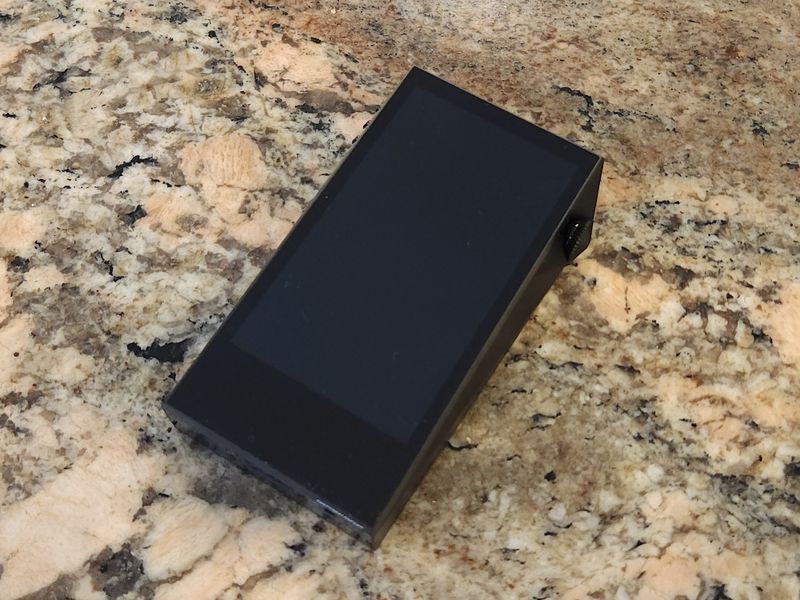
Mini-Me?
PROS: 2x AK4191EQ modulators and 4x AK4499EX DACs, lightweight solid-build aluminum chassis, hi-res 4.1” display, Snapdragon 665 SoC, latest gen user interface, 3.5mm/4.4mm PO/LO, MQA, DSD512, Roon-ready, LDAC Bluetooth (both Tx and Rx), 256GB internal storage, hi-res sound with black background, clear natural tonality, and expanded soundstage.
– in comparison to SP3000 – smaller size/display/weight, similar (but not exact) tonality, the same processor, DACs/chipset, and other critical components/specs, $1.4k cheaper.
CONS: price, removed optical out, additional battery drain due to SW implementation of DAR.
The product was loaned to me for review in exchange for my honest opinion.
Manufacturer website: Astell & Kern. Available for sale from authorized online retailers like Musicteck and Bloom Audio.
Intro.
While I still consider Astell&Kern to be full of surprises, especially when it comes to collabs, their DAP releases are more predictable in how their flagships often coincide with being one of the first in the implementation of the latest AKM DACs, just like with SP1000 and AK4497, SP2000 and AK4499, and SP3000 and AK4499EX/4191EQ. There is also a pattern of SS/Tube dual-tonality releases two years after the corresponding flagships, SP2000/T and SP3000/T. However, one thing nobody expected was that Astell & Kern would revisit SP1000 vs SP1000M from 6+ years ago by introducing a mini-version of their flagship SP3000 DAP, SP3000M.
Mini-version implies a smaller lightweight design where one would assume a cut-down performance. Instead, A&K found a way to keep the same internal HEXA design (4x AK4499EX DACs and 2x AK4191EQ modulators), the same Qualcomm 665 SoC, the same internal storage, the same BT/WiFi, and even the same output power spec. Of course, you do need to cut some corners to fit everything in a smaller chassis footprint with SP3000M being 25% smaller and 50% lighter. However, the majority of the design and overall functionality remains the same.
Due to the same GUI, comparisons to other DAPs, and pair-ups with IEMs and headphones already covered in my detailed SP3000 review, it makes no sense to repeat it. You are welcome to revisit that review as a refresher because the focus of today’s write-up will be on the comparison between SP3000M (3kM) and SP3000 (3k) which I would like to share with my readers after spending the last two months with it and already featuring it in several of my other reviews and reports.
Unboxing and Accessories Comparison.
With a noticeable price difference, one would assume that A&K had to cut “bigger” corners, perhaps, having more simplified packaging. To my surprise, that wasn’t the case. 3kM got the same flagship-level unboxing experience as their other SP-series DAPs. That includes a premium wooden storage box and other basic accessories like screen protectors, high-quality USB-C high-speed cable for charging, data transfer, and USB DAC functionality. I was also pleased to see a premium-quality leather case included.


The included Leather Case is crafted from soft cowhide by GRUPPO MASTROTTO. According to A&K, using chrome tanning and dyeing with high-quality pigments, the leather maintains a uniform surface quality to showcase its distinctive vibrant colors. The case doesn’t hide but rather highlights the details of the 3kM design. At the top, you will find a generous opening for 3.5mm/4.4mm ports and a power button. The right side has an easy-to-access with a thumb opening for the volume wheel. The bottom covers the microSD card port and gives you access to the USB-C port. You slide in the DAP from the left side, securing it with a flap that tucks in and covers all three playback control buttons with an easy-to-feel indentation.


Design Comparison.
Today, many flagship audio players are getting bigger and bulkier, but A&K went in the opposite direction, miniaturizing their 139.4×82.2×18.3mm, 493g stainless-steel SP3000 into 119.6×69.1×18.8mm, 237g aluminum SP3000M. The size of 3kM is about 25% smaller relative to SP3000, making it even smaller than SE300 and only a little bigger than SR35. The size is not the only noticeable difference here, but also the weight, cutting down in half the weight of SP3000 and SP3000T and being almost 100g lighter than SE300, though just a bit heavier than SR35.
SP3000T vs SP3000 vs SP3000M


The size reduction will contribute to the weight loss, however, the two of the biggest contributing factors here are a different body material, aluminum 316L (3kM) vs stainless steel 904L (3k) chassis, and a smaller 4,200mAh (3kM) battery vs 5,050mAh (3k). Along with that, the display size was reduced from 5.5” with a resolution of 1080×1920 (3k) to 4.1” with a resolution of 720×1280 (3kM).
The focus of the design is still around a 4.1″ HD touchscreen occupying the front view. The front view of the 3kM, the same as with 3k, is asymmetric due to uneven sculptured bevel sides, including a slightly bulging-out area around playback buttons on the left and a crown-patterned volume wheel on the right. But unlike the 3k volume wheel that doubles as a power button with a typical long press to turn the power on/off and a short press to turn the screen on/off, the 3kM uses a different volume wheel without LED and a separate power button at the top on the right. Since you no longer need to push the volume wheel, its shape is pointier and has a detailed unique crown pattern, typical of a wristwatch.
On the left side, you still have Play/Pause and Skip controls, three identical small rectangular buttons located in the upper part of the left side. They do have a nice tactile response and are spaced evenly with enough room in between to avoid pressing an adjacent button by mistake (at least for my fingers). The top of the DAP features a 3.5mm phone output port, also used for the Line Out function. The optical SPDIF output functionality has been removed here. Next to it, you have 4.4mm balanced phone ports that could also be configured for the Line Out.
The “legacy” 2.5mm balanced phone output is removed from 3kM, and in my personal opinion is not necessary. 2.5mm is an old standard and with 4.4mm implementing GND connection, unlike some other manufacturers, you no longer need ground adapters with bridging of 2.5mm/3.5mm ports. As already mentioned, to the right of the 4.4mm port, toward the right corner, you have a dedicated power button with a typical long press to turn the power on/off and a short press to turn the screen on/off. For me, I prefer to use double-tap to wake up the screen which is available with 3kM.
At the bottom, similar to the 3k, the 3kM has a USB-C port, used for charging (including Fast Charging), data transfer, USB DAC connection, and USB OTG external device connection for digital audio out. Also, to the right of the USB-C port, you will find a spring-loaded microSD card slot. The back of the DAP also has a typical A&K asymmetric design with an extra cutout around the volume wheel. Overall, the lines of the 3kM design are very similar to 3k, being less aggressive in comparison to previous A&K DAPs, giving it a classier look.


Under the hood Comparison.
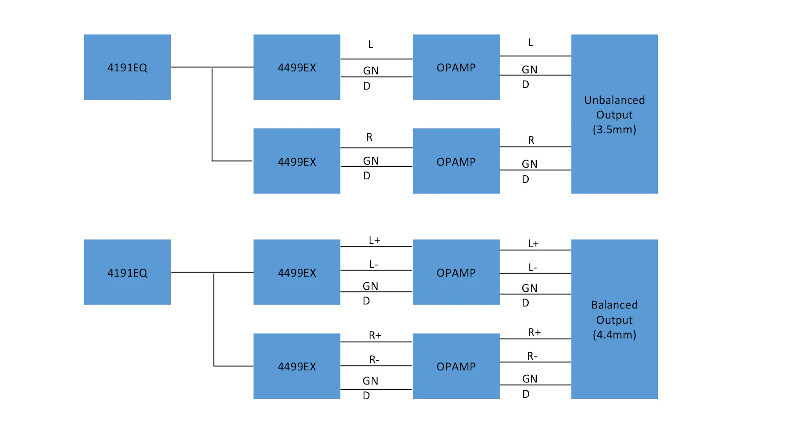
As I already mentioned in the Intro, despite a smaller chassis, A&K found a way to keep the same internal HEXA design with 6 AKM chips which include 4x AK4499EX DACs for analog conversion and processing, and 2x AK4191EQ modulators to process the digital signal of D/A conversion (digital filter with sigma-delta modulation and oversampling). As I mentioned in my 3k review, it is more common to see ckt boards with a partitioned layout of analog and digital circuits. Here, the DAC chip is partitioned into two separate chips to improve the purity of the analog signal, lower the noise and increase the SNR, and lower the clock jitter by separating the digital and analog portions of the clock. A&K implemented 2 separate AK4191EQ modulators, one for single-ended and one for balanced outputs. Then, each modulator is connected to a pair of AK4499EX DACs, for a total of 4 separate AK4499EX, with each one driving a separate signal.
The touch display went down from 5.46” (1920×1080) to 4.1” (720×1280). Similar to the 3k and 3kT, the 3kM interface is faster in comparison to previous A&K DAPs thanks to the implementation of the Snapdragon 665 SoC processor. The DAP has a typical optimized closed Android A&K interface making it harder to compare to other open Android DAPs since I can’t run 3D benchmark apps. There is plenty of processing power to do flawless audio decoding while supporting all the popular lossy and lossless formats, such as WAV, FLAC, WMA, MP3, OGG, APE, AAC, ALAC, AIFF, DFF, and DSF, with PCM rates up to 32bit/768kHz and DSD rates up to 22.58MHz (DSD512). Also, you have MQA playback support that covers Tidal Masters, Local files, External USB, and MQA-CD (ripped).
The output power also remained the same, where the single-ended 3.5mm PO has an output impedance of 0.8ohm and 3.3Vrms, while balanced 4.4mm has 1.8ohm output with a max of 6.3Vrms based on unloaded measurement. Each port can be switched to Line Out. The same with internal storage, remaining at 256GB considering more people are streaming rather than playing local files, which is also not a showstopper due to micro-SD card expansion. The dual-band WiFi (2.4/5GHz) and Bluetooth (BT5.0) with wireless support of not only aptX HD but also LDAC protocols for 24-bit playback over Bluetooth (Rx and Tx) remain the same too.
The battery capacity was slightly reduced, from 5,050mAh to 4,200mAh, but the max playback time remained nearly the same at close to 10 hours, though it will vary. In my best-case test scenario with WiFi/BT and DAR off, playing local hi-res files in a loop, I got about 9.5 hours of continuous payback time. When I enabled WiFi and DAR, streaming hi-res audio from Amazon HD, the total playback went down to 6.5 hours. Then, running the same streaming test with DAR turned off, I got 8 hours and 50 minutes of playback time. This suggests that the toll of an extra 2+ hours of battery time was due to the sw-implemented DAR filter. My suggestion is to keep the DAR filter off with 3kM for the best battery performance.
GUI.
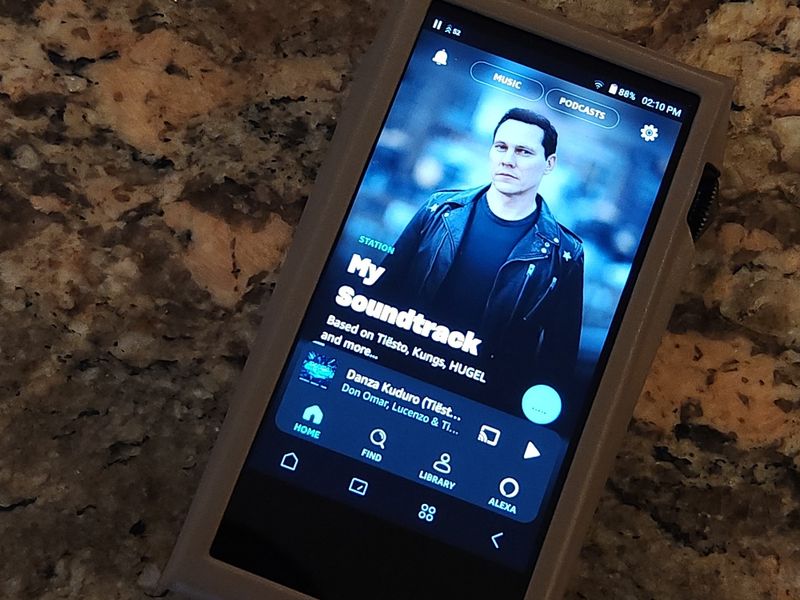
When it comes to A&K DAPs GUI, once you are familiar with one, you will feel at home using the rest because they share a similar interface, down to their smaller display SR35 model. Despite a smaller display, 3kM features the same (as in 3k/3kT) newly updated 4th-generation interface that greets you with a scrolling carousel and has improved ergonomics. As one would expect, a bigger display of 3k is more convenient for navigation, but to me, a smaller 3kM display was as “roomy”.


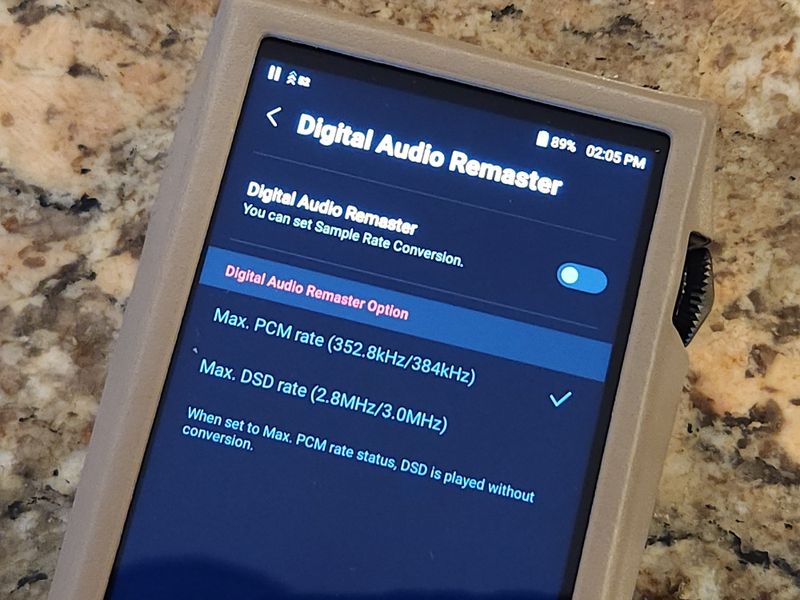
There is no need for me to go over all the GUI details, but I do want to mention one change. The Digital Audio Remaster (DAR) upsampling function to PCM and DSD was moved from hardware (in 3k) to software implementation in 3kM. Functionally, the DAR (PCM) remains the same with 44.1kHz PCM files converted to 352.8kHz, and 48kHz converted to 384kHz. But the DAR (DSD) option changed from DSD256 conversion (in 3k) to DSD64 conversion (in 3kM). As I already mentioned, DAR implementation in software did affect the battery life and even had some effect on the sound which I’m going to discuss further in the review.
Overall, the new updated GUI is a step forward in being more intuitive and faster. We are still dealing with a closed Android interface, but the changes bring it closer to the Android experience with an always visible navigation bar at the bottom where you have access to Streaming services, Home Screen (which you can set to a default view), and Back button for easier app navigation. Double-Tap screen to wake is useful so you don’t have to abuse the power button to turn the display on. I still found a smaller display of 3kM to have plenty of room for comfortable navigation and other eye-candy features like the new VU meters.


Open APP Service.
Open APP Service is implemented in all A&K Android-based DAPs. Additional info can be found here where Astell & Kern goes into more detail about it.
While Astell & Kern offers a built-in Tidal service (without off-line storage support), for a long time their customers have been asking to add other popular streaming services, especially since their DAPs run on Android though heavily modified closed OS without access to Google Play. Now, all their latest DAPs have access to many whitelisted apps they can run, such as Tidal, Amazon Music HD, Apple Music, Qobuz, Spotify, and others. For convenience, when you go to Services, you have an Open Service tab with installed apps and a Download tab with a list of available apps you can download and install. While you can’t install every app you desire, in a way it’s a blessing for a manufacturer to keep DAP performance optimized since you don’t have to worry about customers installing and running other unstable apps, and it also guarantees compatibility of the DAP with these apps.


Page 2 – Sound Analysis, Wired/wireless connections, and Conclusion.

 Twister6 Reviews
Hi twister 6, I have Dita perpetua and L&P P6pro now. Do you suggest I should upgrade my earphone or dap? Should I buy A&K sp3000m or Empire Ears Novus? Thank you so much.
LikeLike
no need as tou have top music set
LikeLike