
Play more!
PROS: A dual amp design (Transistor/Tube) with triple output modes (Transistor/Tube-Triode/Tube-Ultra-linear) providing very distinct sound tuning variations, 2x AK4191EQ/AK4499EX pairs, 2x Raytheon JAN6418 vacuum tubes, a solid build chassis, a high-resolution 6” display, Snapdragon 665 SoC, 6GB RAM/128GB ROM, 3.5mm/4.4mm outputs, DSD1024/PCM768Hz, and LDAC Bluetooth (Tx and Rx).
CONS: It’s challenging to find any at this price point.
The product was provided to me free of charge for review purposes in exchange for my honest opinion.
The manufacturer’s website: Shanling. It can be purchased from authorized retailers, such as Musicteck.
Intro.
When you power up the Shanling DAP, you are greeted with the phrase: “Life is short, play more.” However, as I press the play button on the M8T and switch between its solid-state and tube modes, I can’t help but wonder if it should be the other way around: “Play more to live longer.” There’s no denying that music brings pleasure and evokes deep emotions. I’m not sure if it’s a placebo effect or if I’m simply growing older and becoming more sentimental. Still, lately, I’ve found that any source with tubes enhances the sound and helps me connect better with the music, even EDM tracks, where it can soften the edge of the synthesized instruments.
I also recalled the same feeling when I first heard the original solid-state M8 DAP, which has been highly regarded as one of the smoother and warmer-tuned sources since its release years ago. Now that Shanling has introduced tubes in their new portable DAP release, they have honored the original M8 by naming their next audio player M8T instead of M9T. Since I can’t cover all the DAP models from every manufacturer and often focus on flagship devices, it has been a while since my last Shanling review, which discussed the M9 and overlooked the M9 Plus. Therefore, I was excited about the opportunity to spend time with the M8T.
I covered the M8T in my recent CanJam NYC report in a brief, detailed overview and received questions from readers asking whether I still plan to provide a full review. I took a bit more time with this one because every time I sat down to analyze its sound and play with its functionality, I forgot about testing and ended up spending hours simply listening and enjoying the music. It may sound cliché, but it’s true. Now that the review is complete, I’m ready to share my findings.
Unboxing and Accessories.
M8T arrived in a relatively compact box, and I mean compact by the standards of flagship releases. Perhaps Shanling is trying very hard to make us believe this is not their flagship release, though I feel differently. The external cardboard sleeve featured clever artwork, with two Raytheon tubes forming a “T.” Inside, the box had the usual setup, with an upper tray and a foam cutout to keep the DAP secure.

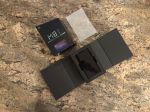
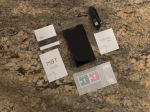
Beneath that tray, included accessories consist of a decent quality USB-A to USB-C cable, a screen protector, a warranty card, a quick start guide, and a brochure showcasing a catalog of all their products. The leather case is optional; the one I received is red, which makes it stand out among my other black and green cases from various DAPs. The M8T slides in from the top and is secured with a magnetic flap, perforated to display the lights of the tubes, allowing ample room to access the 4.4mm and 3.5mm ports. The case features generous cutouts on the left side for playback controls, on the right side for volume, and an extra cutout to highlight the curves of the chassis. Additionally, the bottom has a generous cutout for accessing the microSD card and the USB-C port.







Design.
With dimensions of 147mm x 82mm x 22mm and a weight of 383g, the M8T’s size and weight closely match those of the M9 Plus, which is also shorter and lighter than the original M9, making it quite impressive overall, especially since this new design features 2 tubes at the top. The sleek design and manageable thickness of the chassis ensure that this DAP remains portable in my hand, though I would still recommend a protective leather case to enhance the grip. Personally, if I can easily wrap my hand around the DAP, I consider it portable rather than transportable; even the M8T’s length makes it pocket-friendly.
M8T vs M9




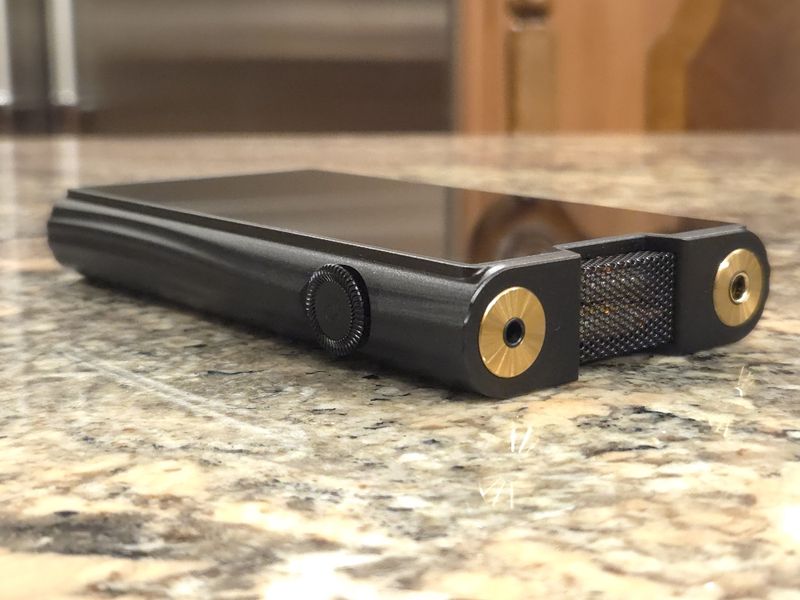
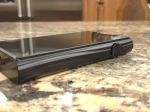
Surrounded by an aviation-grade aluminum body frame in deep black finish, the front of the DAP has an edge-to-edge glass screen with a beautiful 6” high resolution (2160 x 1080) display. With such a large display, it is always a challenge to come up with a more original design without looking like another phablet. I think Shanling has done a great job to overcome this challenge, introducing rounded sides with a sculptured wave pattern exterior. At the same time, they kept a traditional 3-button transport control (play/pause and skip) on the left side and a multi-function volume/power wheel on the right side.




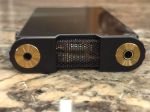
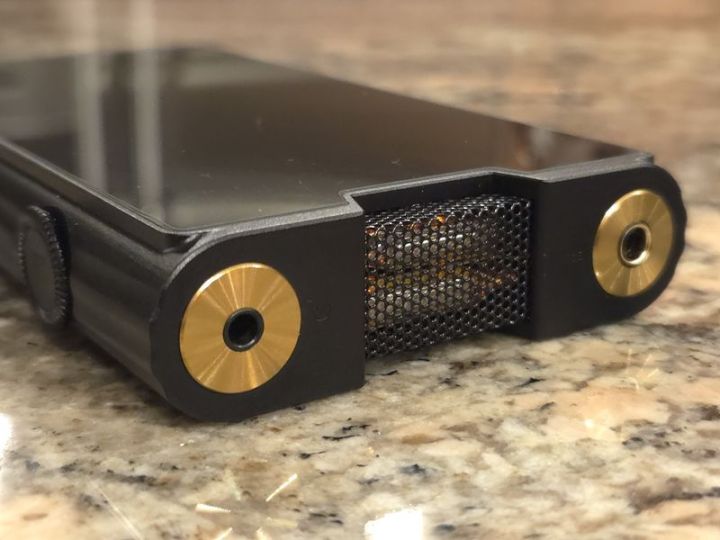
The volume wheel is a low-profile and, in addition to controlling the volume with a soft click action as you turn in, also functions as a push-button to control the power with a long press or turn the display on/off with a short press. Behind the wheel, you have a multi-function/color LED to indicate charging status (red) or different bit rate formats (multi-color), including a combination of red and other colors during simultaneous charging and playback. At the bottom, you have a USB-C port in the middle and a spring-loaded micro-SD card opening to the left. The top features a pair of “glowing” Raytheon JAN6418 vacuum tubes under a mesh cover in the middle, and separate 4.4mm BAL and 3.5mm SE ports on opposite sides. Starting with M9 Plus, unlike the original M8 and M9, you no longer need to deal with a modular interchangeable headphone jack.


Under the hood.
M8T operates on a Qualcomm Snapdragon 665 CPU with optimized Android 13. It includes 6GB of RAM, 128GB of internal storage, and a microSD card that can expand internal storage up to 2TB. Perhaps Shanling aimed to make a statement by reducing the specs, as the pricier M9/M9Plus features 8GB of RAM and 256GB of internal storage. The M8T interface performs just as quickly as the other 660/665-based DAPs I tested. As expected, it supports all popular audio formats, including PCM up to 32-bit, 768kHz, and DSD1024 for local playback, as well as 32-bit/768kHz/DSD512 for USB input (according to XMOS XU316 implementation).
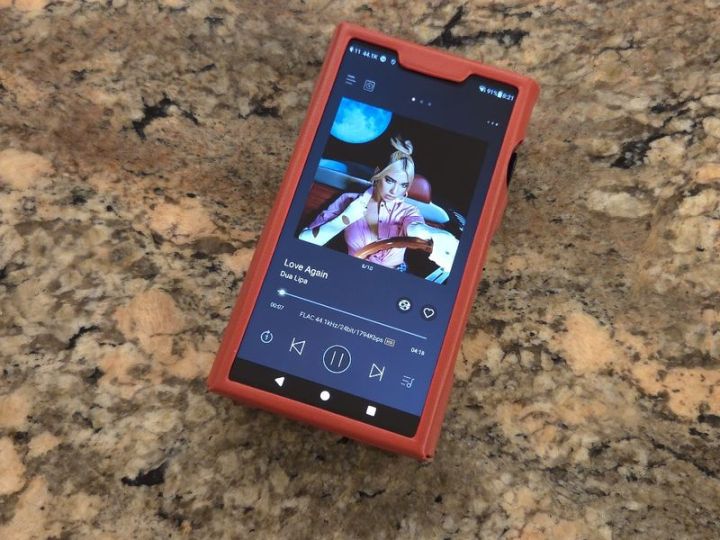
As already mentioned, M8T features a 6” HD touchscreen by Sharp. This is a hi-res 1080p display with 1080×2160 pixels resolution. Plus, it features a detection of double-tapping to wake up the screen. This is a great feature since you can turn the display on by double-tapping it, giving your power button a break. Other standard features are dual-band WiFi with support for 2.4GHz and 5GHz using Qualcomm WCN3980. Bluetooth 5.0 with two-way (Tx/Rx) support of all popular hi-res codecs, including LDAC, SBC, and AAC. Also, the USB-C port is multi-functional for charging, data copying, USB DAC functionality, and Digital out to connect external USB DACs.
M8T features a larger capacity 8350 mAh battery, and supports both PD2.0 and QC3.0 fast charging. The battery run time will depend on the playback file format, streaming vs local, solid state vs tubes, gain, volume level, etc. Under optimal operation, according to Shanling, you can get up to 15.5 hours from single-ended output, 13 hours from balanced output, and 96 hours when using wireless headphones. I was able to get a solid 12 hours of playback time from balanced output, in high gain, Tube Ultra-linear mode, at a regular listening volume, with wireless off, and the display mostly off.
When it comes to a DAC setup, the M8T utilizes a flagship AKM chipset with 2x AK4499EX DACs and 2x AK4191EQ modulators. The AMP setup begins with ADI ADA45253 low-noise op-amps for the I/V (current to voltage) conversion stage, followed by TI OPA1612 SoundPlus op-amps used for low-pass filtering, and classic ADI AD8397 high-speed headphone op-amps for high current output. As previously mentioned, the tube setup incorporates two Raytheon JAN6418 miniature tubes, each with an expected lifespan of 5000 hours. Due to the optimization of the AMP circuit, the output specifications between Transistor (solid-state) and Tubes do vary. For Transistors: BAL 1,125mW (6V) @32ohm (<1ohm output impedance), SE 500mW (4V) @32ohm (<1ohm output impedance). For Tubes: BAL 950mW (5.5V) @32ohm, SE 420mW (3.7V) @32ohm, also with low output impedance.
The Android 13 OS is optimized with custom shortcuts in the notification bar for quicker access to common settings, which can also be found under Android Audio Settings. In the notification bar, you will also see the Work Mode shortcut, allowing you to select USB DAC, Bluetooth AMP (wireless Rx), and AirPlay (for MAC users). Here, you can switch between regular Android mode, which provides access to all apps and streaming, and Prime Mode, which restricts access to the Shanling Audio app as the main interface, reducing other Android processes running in the background. I also appreciate the Support page link that includes shortcuts to firmware updates, a built-in user guide, and FAQs.

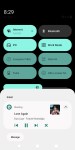
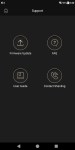
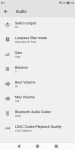
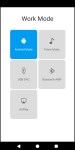
Speaking of the Shanling Audio app, I found it quite polished, featuring a clean and easy-to-navigate main interface with playback controls and settings. It also offers the ability to switch between album art, VU meter, and EQ bar meter views. Additionally, you have access to various sorting options and other audio settings.






Page 2 – Sound Analysis, Comparison.
Page 3 – Pair up, Wired/wireless connections, and Conclusion.

 Twister6 Reviews
In the end, which do you think is more complete, Dx340 or M8T? Since you two are in the same price range?
LikeLike
Well, they are not exactly in the same price range. To match their sound performance, you need to purchase DX340 with default amp15 and then buy a separate amp16, so it will be closer to $2k. While M8T is under $1.5k. Regarding being complete, this is also subjective. If you don’t care about modular design and want the dap as it, M8T is a better value. But if you want to invest into more amp modules or use external power supply to boost the amp output, DX340 has more flexibility due to its modular design. You just have to figure out your budget and what features you do or don’t need to decide which DAP will suit you better.
LikeLike
The DX340 def seems to be more scalable whist the M8T seems to be WYSIWYG (or more precisely WYHIWYG). But the M8T’s weight is def more pocket friendly than the DX340.
LikeLike
Very true, Sean. If you want a modular design to scale up the sound of your DAP, DX340 is the way to go. Just like if you want a solid ROON connection, people choose A&K DAPs 😉
LikeLike
Does it also play MP4 videos?
LikeLike
it’s an Android DAP, just like your phone without a “phone” part. You can access the Google Play store and download whatever app you need to play any format of files you want.
LikeLike