

Beyond the Chi-Fi Churn: Why the Yu9 Que Sets a New Mid-Tier Benchmark.
PROS: Exceptionally organic, vivid, and textured midrange presentation | Tight, fast and un-bloated low-end control | Extended, airy treble without sharp sibilant peaks | Outstanding 3D soundstage, left to right separation, imaging and driver coherence | Very clear centre image | Highly vented shell design eliminates in-ear pressure build-up | Excellent price-to-performance technical value.
CONS: Short nozzle geometry makes fit heavily tip-dependent | Lower passive noise isolation due to generous acoustic venting | Ultra low 9-ohm impedance requires a low-output-impedance source.
Thanks to Ahmed at Elise Audio for making this Yu9 Que review possible.
Introduction & Architecture.
In an IEM market increasingly dominated by endless Chi-Fi factory churn and minor frequency-response tweaks, Yu9 Audio occupies a fascinating position. Founded by an independent Chinese DIYer turned boutique developer, the brand has built a cult-like reputation among technical enthusiasts for prioritising acoustic driver alignment over marketing hype. With the Yu9 Audio Que ($400), they are entering one of the most fiercely contested price brackets in portable audio.
Rather than stuffing a dozen mismatched off-the-shelf armatures into a shell, Yu9 has deployed a carefully tuned 1DD + 3BA hybrid topology. Low frequencies are handled by a dedicated dynamic driver engineered for rapid transient recovery. The midrange utilizes a dual balanced-armature array positioned to execute an early pinna rise without harshness, while high-frequency duties are handed off to a single custom Knowles wideband tweeter designed for broad, linear treble extension beyond the limits of human hearing.
With an ultra low impedance of 9 ohms and a sensitive rating of 126dB/Vrms, the Que is exceptionally efficient – demanding a low output impedance source with a pitch-black noise floor to perform at its peak.
Elise Audio – Yu9 Que ($399/£329)

Technical Specifications.
- Driver Configuration: 4-Driver Hybrid Architecture (1 Dynamic Driver + 3 Balanced Armatures)
- Low Frequencies: 1× Custom Dynamic Driver
- Mid Frequencies: 2× Custom Balanced Armatures
- High Frequencies: 1× Custom Knowles Wideband Tweeter
- Frequency Response: 20 Hz – 20 kHz
- Impedance: 9 Ω @ 1 kHz
- Sensitivity: 126 dB/Vrms (@ 1 kHz)
- Shell Material: CNC-machined metal alloy
- Connector Type: 0.78mm 2-pin
- Nozzle Dimensions: 5.8 mm diameter | ~4.0 mm length
- Cable: Stock black 2-pin copper cable with 3.5mm / 4.4mm termination options
- Weight: ~6.5 grams per shell
Build, Ergonomics & Accessories.
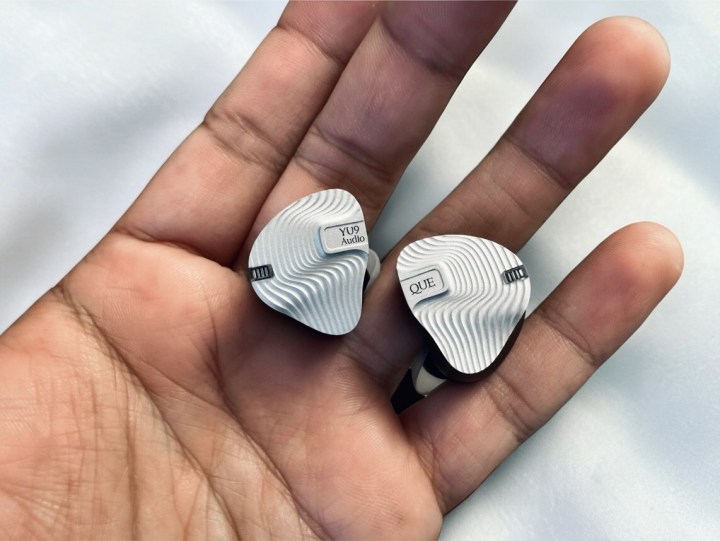
Visually and physically, the Que takes a minimalist, industrial approach. The dark grey, CNC-machined metal alloy shells feature a textured, concrete-like faceplate aesthetic that feels reassuringly robust without being overly heavy in the hand.
Shell & Fit Specs –
- Shell Material: CNC Metal Alloy (Dark Grey / Silver)
- Nozzle Diameter: 5.8 mm
- Nozzle Length: ~4.0 mm
- Connector: 0.78mm 2-Pin
- Venting: High-flow acoustic pressure-relief
Shell and nozzle Geometry: The nozzle measures 5.8 mm in diameter with a relatively compact 4 mm length. Because the nozzle is on the shorter side, achieving an optimal acoustic seal relies heavily on selecting the correct ear tips rather than relying on a deep insertion depth. Once I had that set, it remained a very comfortable IEM for the long sessions because of the semi-custom contours – just not one that I can use while lying down sideways as the shells protrude out quite a bit for me.
Pressure Relief & Isolation: Yu9 has implemented an exceptionally generous internal acoustic venting system. Upon insertion, there is virtually zero vacuum pressure build-up or driver flex – a rare and welcome trait for a hybrid design. The tradeoff is that passive isolation, while perfectly adequate for studio desks and standard commutes, is slightly lower than fully sealed, non-vented custom-style shells.
The included accessory package is functional and well-curated. You receive a structured, padded cube carrying case with ample room for the IEMs, spare tips, and a compact dongle DAC, alongside a micro-fiber cleaning cloth and a 0.78mm 2-pin cable. The stock black cable features a stiffer plastic sheathing that resists tangling well, though its ergonomic memory means some users may eventually want to swap it for a more supple aftermarket wire.
Cable – Constructed with a multi-strand twisted copper core wrapped in a durable dark PVC jacket, the bundled stock cable features standard flush 0.78mm 2-pin connectors, clear pre-formed ear hooks, and lightweight dark anodized metal hardware with protective rubberised strain reliefs. On the ergonomic front, the outer sheathing is slightly firmer than ultra-supple braided custom wires, giving it a sturdy, tangle-resistant nature that holds up well when tossed into the case. While this slightly stiffer jacket retains a subtle memory effect straight out of the pouch, it settles down quickly once worn. More importantly, microphonics (cable rustle noise) are kept exceptionally low—whether you’re moving around at a studio desk or listening on the go, mechanical noise transfer through the jacket is virtually non-existent.

Carry Case – The included carrying case is an exceptionally well-thought-out piece of kit that completely avoids the cramped, shallow “puck” layout typical of mid-tier IEMs. Wrapped in a sturdy black fabric zipper shell, the internal chamber is lined with a soft, light-grey micro-fleece featuring an unusually deep main cavity that lets the coiled IEMs and stock cable sit naturally without forced winding or strain. The real highlight is the inner top lid, which is fitted with a grid of plush, quilted impact-absorbing blocks designed to cushion the earpieces gently from above when zipped closed. Thanks to its roomy cubic proportions, you get plenty of excess headroom to toss in a portable dongle DAC, spare ear tips, and a 1/4-inch adapter alongside the monitor shells without risking faceplate scratches or lid compression.

Included Ear Tip Selection –
- AET07-Style Wide-Bore Silicone Tips (S / M / L)
- High-Tack Sticky Silicone Tips (S / MS / M / L)
Critical Fitting Note: The Que is noticeably tip-sensitive. The wide-bore AET07-style tips maintain the intended treble brilliance and spatial openness, whereas narrower or overly dampening tips (like Final Type E) can artificially attenuate the upper treble and obscure its holographic staging.

Sound Analysis.

Graphs are measured using an IEC60318-4 (IEC711) setup. You can compare all the graphs on my IEM Graph Database here – Animagus Squiglink.
The overall acoustic signature of the Yu9 Audio Que can be best described as a meticulously balanced, mid-forward W-shaped presentation that leans gracefully into musical realism rather than clinical, sterile monitoring. Instead of relying on bloated mid-bass shelves or forced lower-treble peakiness to fake high resolution, the Que presents a highly coherent, liquid soundscape anchored by an effortless, speaker-like soundstage and exceptional vocal intimacy. It manages to balance the technical speed and precision expected from a multi-driver hybrid with an organic, cohesive warmth that renders acoustic instruments and vocal tracks with striking believability. From top to bottom, the tuning exhibits a level of acoustic discipline that completely avoids sibilance, mid-bass bleed, or harsh glare, establishing a signature that is as engaging for casual listening as it is revealing for critical monitoring.
Bass – The low end of the Que is tuned with strict discipline: it prioritizes transient speed, texture, and control while delivering an authoritative sub-bass foundation. The dynamic driver maintains an elevated sub-bass shelf sitting roughly 2–3dB above my preference target down to 20Hz, providing satisfying rumble and physical weight without ever turning boomy or loose. From ~60Hz upward, the response glides down in a smooth, linear slope toward 300Hz, ensuring kick drums land with authentic impact while bass guitar lines maintain distinct pitch definition. Most importantly for studio translation, the transition into the lower midrange is executed cleanly with zero mid-bass bleed or masking, leaving lower fundamentals pristine and uncolored.
Midrange – The midrange performance is the absolute crown jewel of the Que’s tuning philosophy. It adopts a refined, mid-forward W-shaped trajectory characterized by an early pinna rise between 1kHz and 2kHz, followed by a relaxed, smooth plateau through 3kHz to 4kHz. This specific acoustic shaping gives vocals and lead instruments a remarkably vivid, creamy, and organic presence. Female vocals project with realistic breath work and upper-register air without ever crossing the line into sibilance or shouty, glass-like resonance. Male vocals retain proper chest resonance and foundational body, avoiding the thin, translucent character that often plagues mid-centric hybrid IEMs. The midrange timbre is wonderfully coherent, striking an ideal balance between analytical instrument separation and natural, musical warmth.
Evaluating it strictly against my Animagus Preference Target, the minor energy dip between 3kHz and 5kHz means it trades a touch of upper-midrange bite and transient attack for a smoother, more forgiving delivery. A couple more decibels in that region to match my target would have pushed this into absolute midrange perfection for my personal taste, but given the sheer technical capability, spatial depth, and tonal refinement Yu9 has achieved at this price point, that remains a minor nitpick.
Treble – High-frequency delivery is handled by the custom Knowles wideband tweeter, and the execution here is impressive. Instead of relying on a sharp 6kHz spike to force artificial clarity, the Que features a deliberate dip around 5.5kHz that effectively neutralizes sibilance and harsh vocal bite. Moving further up, the response rises into a well-defined peak at 10kHz that sits noticeably above my preference target, injecting natural air, brilliance, and micro-detail sparkle into the upper octaves. Cymbals, acoustic guitar strums, and trailing room reverbs decay with a sparkling, un-damped realism. While the relaxed lower treble keeps listening non-fatiguing, the boosted 10kHz air region ensures that poorly mastered or hot tracks reveal their top-end flaws unvarnished.
Technical Performance.
Where the Yu9 Que genuinely disrupts its price point is in its spatial reconstruction and driver coherence.
Soundstage & Layering: The Que projects a wide, three-dimensional, “speaker-like” soundstage that extends well outside the physical boundary of your ears. Depth and height are rendered with realistic proportions, preventing busy mixes from sounding cramped or center-focused.
Imaging: Imaging precision is pinpoint accurate. On live acoustic recordings or complex orchestral passages, individual instrumental cues are placed with distinct spatial separation across the horizontal and vertical planes, allowing you to easily track subtle micro-details and room reflections.
Coherence: Despite mixing dynamic and armature technologies, the integration between the DD low end and BA top end feels seamless. There is no noticeable disparity in transient speed or timbral texture between the bass and treble drivers.

Comparisons.
Yu9 Que vs Softears Volume S.

The Softears Volume S ($320) takes a drastically different architectural approach with its quad-driver setup (10mm active DD + 6mm passive wool-paper DD + 2 BAs) and dual hardware tuning switch. In Classical Mode, the Volume S and Que share a remarkably similar sub-bass baseline, though the Volume S carries slightly more mid-bass fullness between 80Hz and 200Hz. Moving into the upper midrange, the Volume S rises higher to a distinct 3kHz peak, offering stronger initial vocal presence than the smoother, more relaxed Que. However, the Que reclaims a clear technical victory in top-end extension: while the Volume S rolls off sharply past 10kHz, the Que’s custom Knowles tweeter maintains superior upper-treble air, sparkle, and spatial openness.
Yu9 Que vs BGVP DMA.

Comparing the Que against the BGVP DMA ($300) showcases a clash of acoustic philosophies: pure horn/tube acoustic loading on the Que versus bone conduction driver (BCD) tactile reinforcement on the DMA. The DMA delivers a noticeably heavier, punchier low-end shelf (+3dB over the Que) that glides into a deeper lower-midrange scoop around 500Hz. While the DMA’s tactile bass is undeniably fun for modern genres, its upper midrange and treble exhibit uneven peaks at 3kHz, 5kHz, 7kHz, and 9kHz before plummeting past 15kHz. In contrast, the Que offers vastly superior vocal coherence, linear lower-mid clarity, and extended upper-treble air, making it the significantly more refined and technically disciplined monitor for critical listening.
Yu9 Que vs Symphonium Meteor.

When pitted against the $599 all-BA Symphonium Meteor, the structural differences in their tuning philosophies are stark. The Meteor relies on a massive sub-bass and mid-bass shelf – sitting roughly 3–4dB above the Que across the entire low end – which provides visceral slam and heavy warmth at the expense of lower-mid transparency. Moving up the spectrum, the Meteor presents a noticeably darker, more recessed upper midrange (1.5kHz–4kHz) with a deep dip at 10kHz. The Que counters with far superior vocal intimacy, clearer pinna structure, and a more coherent, linear treble extension that creates a significantly more open and three-dimensional soundstage.
Yu9 Que vs BGVP Astrum.

Comparing the Que to the $699 BGVP Astrum highlights two distinct approaches to high-resolution tuning. Astrum with its 6-driver tri-brid architecture (2DD + 2BA + 2EST) features a deeper lower-midrange scoop between 300Hz and 800Hz compared to the Que. This gives the Astrum a leaner, slightly drier fundamental weight on male vocals, whereas the Que offers a fuller, more linear lower-mid transition that preserves natural vocal body. Moving into the upper midrange, the Astrum rises higher between 2kHz and 4kHz—tracking almost dead-on with my preference target for greater vocal bite and transient attack – while the Que presents a smoother, more forgiving delivery. However, the Que decisively reclaims technical dominance in upper-range air: where the Astrum’s treble plummets sharply past 12kHz, the Que maintains superior extension into the highest octaves, yielding a noticeably more open, holographic soundstage and realistic cymbal decay.
Yu9 Que vs Softears RSV MK2.

Pitting the Que against the benchmark Softears RSV MK2 ($650) highlights the contrast between a top-tier all-BA ‘not-so referenc-y anymore’ monitor (RSV MK2 isn’t really) and a mid-forward dynamic hybrid. The RSV MK2 carries about 2–3dB more bass elevation across the board and features a pronounced 3.2kHz pinna peak, giving it greater vocal bite, clarity, and transient attack than the smoother, more forgiving Que. However, the Que counters with its dedicated dynamic driver low end—delivering an organic physical elasticity and natural decay that balanced armatures struggle to mimic – alongside greater 10kHz air extension and a wider horizontal soundstage at a much lower price point.
Conclusion.
The Yu9 Audio Que is a masterclass in acoustic discipline. In a market segment littered with flashy multi-driver setups that sacrifice tonal coherence for artificial detail, Yu9 has delivered a deeply musical, mid-forward, and technically elite hybrid IEM that punches well above its $400 asking price. By pairing an authoritative low end with an organic midrange and extended 10kHz air, the Que effortlessly bridges the gap between analytical studio spot-checking and emotionally engaging casual listening. It isn’t without its quirks, however: the short nozzle geometry makes fit heavily tip-dependent and the relaxed 3kHz–5kHz region trades referenc-y upper-mid bite for smoothness. Yet, these operational nuances do little to dim its achievement. If you are a vocal purist, acoustic enthusiast, or critical listener hunting for a mid-centric, highly holographic reference monitor under $500, the Yu9 Que earns my highest recommendation!
